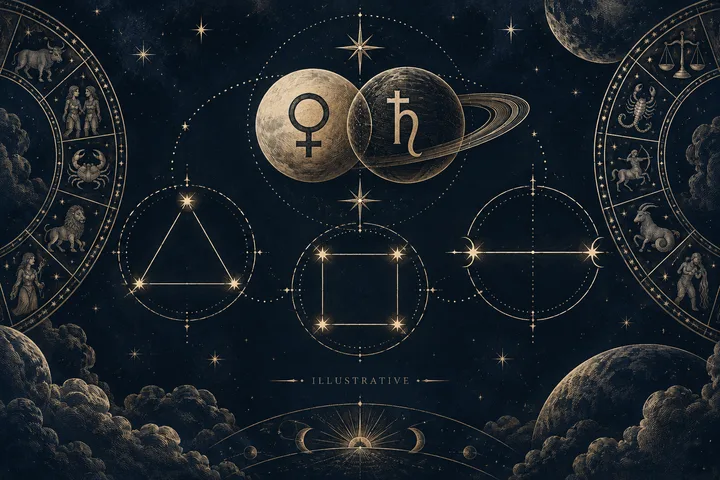
The comforting assumption Venus-Saturn asks you to test
You see Venus trine Saturn, square Saturn, or opposite Saturn in a synastry list. Then someone tells you what it means. The trine is good. The square is bad. The opposition means one person will pull away. It sounds tidy. It is also too blunt to help you read two actual people.
The stronger view is this: Venus-Saturn synastry describes a serious bond around affection and commitment, but the aspect does not hand down a verdict. It shows the style of contact. Trine, square, and opposition each give Saturn a different doorway into Venus. The trine tends to make steadiness feel natural. The square makes it a task. The opposition makes it a negotiation between two poles.
That difference matters on an ordinary Tuesday. In a trine, one person may show love by keeping a promise, planning ahead, or staying calm when life gets expensive. The other may receive that care without needing to translate it. In a square, the same act can feel like supervision or a test. In an opposition, one person may ask for warmth while the other asks for proof that warmth has a future.
Astrology gives you a language for the pattern. Your behavior gives the pattern a life. So read this contact as a question about how love becomes reliable without becoming narrow. The most useful interpretation is the one that helps you recognize the exchange, find its pressure point, and choose a better response.
Venus-Saturn synastry always brings Venus themes of affection, pleasure, values, and relating into Saturn themes of time, duty, limits, and commitment. The aspect changes the route. A trine usually lets loyalty and practical care flow with less resistance. A square makes affection meet friction, so the couple must name fears, standards, money, timing, or unequal effort instead of guessing. An opposition creates a live pull between closeness and caution, often making each person aware of what the other lacks or carries. I’d rank them this way for ease of use, not relationship worth: trine is the easiest to enact, opposition is the clearest to see, and square asks the most deliberate repair. Check the exact degree and which person owns Venus or Saturn, then compare the contact with Moon, Mars, signs, and the wider chart. No single aspect decides a relationship.
Sources: Venus-Saturn Aspects: Conjunct Sextile Trine Square Opposition; Aspect - Astrodienst Astrowiki
What Venus and Saturn each bring to the contact
Start with the planets before you judge the aspect. Venus describes attraction, affection, taste, pleasure, values, and the way a person gives and receives relational warmth. Saturn describes time, responsibility, structure, boundaries, fear, endurance, and the lessons that come through patience. Put them together and you get a bond that asks, What do we value enough to maintain?
In synastry, the Venus person often feels the contact through liking, desire for harmony, and the wish to be appreciated. The Saturn person often feels responsible for the shape or future of the connection. But do not turn those roles into permanent personalities. The Venus person can set the emotional tone. The Saturn person can soften, encourage, or become vulnerable. Both people can carry both functions elsewhere in the chart.
Saturn is not simply the cold planet in this story. It can give form to what Venus enjoys. A promise becomes a habit. A preference becomes a shared value. A passing attraction gets time to reveal its strength. Astrodienst’s aspect guide also stresses that the energy can move both ways: Venus can soften Saturn, while Saturn can contain and steady Venus. That exchange is the heart of the contact.
The shadow is just as clear. Saturn can make Venus feel judged, delayed, or never quite good enough. Venus can make Saturn feel exposed, indulgent, or responsible for pleasure that should be shared. Before moving to the aspect type, ask two plain questions: Who seems to set the terms of closeness? And does that person use the role to protect the bond or control it?
Those questions keep the reading concrete. They also prevent a common mistake. A Saturn person who pays the bills, keeps plans, or asks for a clear commitment may be expressing care. But if those acts come with contempt, surveillance, or a moving standard, the same Saturn symbolism has hardened. Astrology can describe the pressure. It cannot make an unkind act kind.
Sources: Aspect - Astrodienst Astrowiki; An Introduction to Aspects and Chart Shaping in Natal Astrology; Aspect Meanings in Birth Charts: Aspects involving Saturn
Venus trine Saturn: when commitment has a natural rhythm
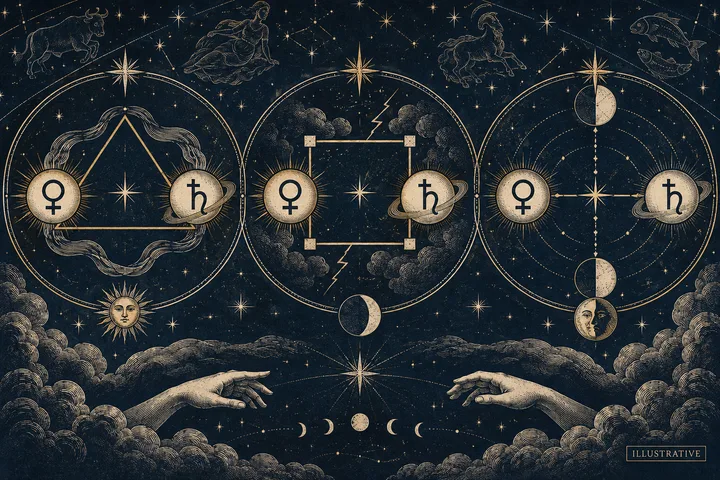
A trine connects planets 120 degrees apart, usually through the same element. Its basic movement is easy. In Venus-Saturn synastry, affection and responsibility can support each other without constant translation. The couple may not be dramatic about love, but they can be consistent. They show up. They remember. They make room.
This is the contact most likely to make commitment feel like a natural extension of liking. The Venus person may enjoy the Saturn person’s reliability rather than experience it as a demand. The Saturn person may feel respected by Venus’s warmth and values. Neither has to force the other into the role. The bond can grow through small repetitions: a call when promised, a budget discussed before a purchase, a quiet hand on the shoulder after a hard day.
Cafe Astrology describes harmonious Venus-Saturn contacts as cautious, loyal, and drawn toward lasting partnerships. It distinguishes the trine from the sextile by treating the trine’s qualities as more readily integrated. That is useful in synastry. A trine often tells you what the pair can do without much coaching. The couple already understands, at least instinctively, that pleasure lasts longer when trust can carry it.
But ease has a blind spot. A trine can make a pattern so comfortable that nobody examines it. The couple may stay together because staying is familiar, even after affection has gone quiet. They may praise reliability while avoiding play. One person may quietly take on the practical burden because it seems efficient, then feel unseen months later. Easy does not mean complete.
Imagine Maria has Venus in Taurus and her partner’s Saturn in Virgo, close to a trine by degree. She loves tangible affection and a calm domestic life. He shows care by fixing problems and planning for the next season. Their shared earth tone helps, but it does not speak every language. If she wants admiration and he offers logistics, the relationship still needs a sentence such as, I appreciate what you handle, and I also need you to tell me what you enjoy about me.
Read the trine at its best as dependable warmth. Then test whether warmth is actually being expressed. Ask what the couple repeats, what those repetitions protect, and where routine has replaced delight. The trine’s task is not to create stability from nothing. It is to keep stability alive.
Sources: Venus-Saturn Aspects: Conjunct Sextile Trine Square Opposition; An Introduction to Aspects and Chart Shaping in Natal Astrology; Saturn Trine Venus
Venus square Saturn: when love meets a wall it must name
A square connects planets 90 degrees apart. It creates friction because the planets push in different directions. Venus wants contact, enjoyment, and a felt sense of value. Saturn asks whether the bond can carry weight, respect limits, and survive time. In synastry, that can feel like one person reaches for closeness while the other checks the cost.
The square is not a sentence of rejection. It is a repeated problem with energy behind it. Astrology.com describes Venus-Saturn opposition themes through questions of worth, standards, vulnerability, and responsibility. Skyscript’s Saturn material links the Venus square with reserve, fear of rejection, and difficulty relaxing into relationships. Taken together, these sources point to a specific reading: the square often turns love into an evaluation before it turns love into an exchange.
The Venus person may ask, Do you want me? The Saturn person may answer, Can this work? Both questions matter, but they do not land at the same time. If the Saturn person keeps requesting evidence before offering tenderness, Venus can feel starved. If Venus treats every limit as proof of indifference, Saturn can retreat behind rules. The square tightens when each person uses the other’s fear as evidence against them.
Watch for the everyday forms of the aspect. One person criticizes the other’s spending, clothes, friends, or timing. A couple keeps postponing pleasure until work, family, or money is sorted. Affection appears only after performance. A promise becomes a ledger. The hard expression is not simply that love feels difficult. It is that one person has to earn what the other person gives freely.
Consider an example. Maria has Venus in Libra, and her partner’s Saturn in Cancer squares it closely. She wants graceful conversation and visible partnership. He wants security and proof that private life comes first. When she suggests a social evening, he hears risk to the home. When he asks for more time alone together, she hears disapproval of her friendships. The sign meanings color the square, but the repair begins with behavior: agree on one protected evening at home and one protected evening with friends.
The square improves when the couple replaces judgment with a defined agreement. Name the value Venus is protecting. Name the fear Saturn is protecting. Then set a limit that serves the bond instead of one person’s authority. Say, We need a spending rule we both approve, not, You need to stop being careless. Say, I want reassurance before we decide, not, You never make me feel secure.
This is why the square can become strong. It brings the hidden contract into the room. If both people can revise that contract, Saturn gives durability to Venus. If only one person gets to define the rules, the aspect does not become mature through patience alone. It becomes a pattern of accommodation.
Sources: Venus-Saturn Aspects: Conjunct Sextile Trine Square Opposition; Aspect Meanings in Birth Charts: Aspects involving Saturn; Venus Opposite Saturn
Venus opposite Saturn: when closeness and distance face each other
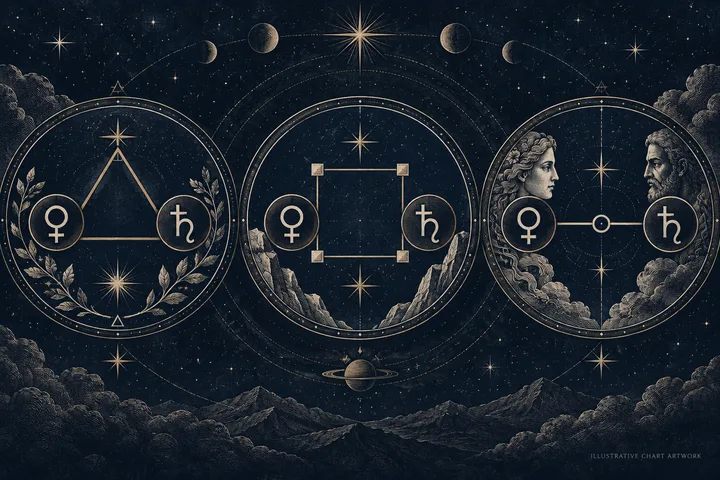
An opposition places planets 180 degrees apart. The planets see each other across a line, so the contact often becomes vivid through contrast. In Venus-Saturn synastry, one person may carry the invitation to enjoy, connect, and value the present while the other carries the demand to define, protect, and prepare for the future. The roles can reverse. The tension remains.
Unlike the square, which often feels like a blockage inside the exchange, the opposition can feel like a pendulum. You are close, then cautious. One person asks for affection, and the other asks for a plan. You settle the plan, and the first person asks whether there is any joy left in it. The contact makes the difference visible. That can be painful, but it gives the couple something clear to work with.
Astrodienst describes opposition as dynamic and motivating, with tension that can produce useful results. Its aspect guide also warns against treating difficult aspects as simply bad. The opposition expands the range of choices because both sides stay present. Cafe Astrology’s Venus-Saturn interpretations add themes of loyalty, fear of rejection, reserve, and the desire for security. Together, they suggest a reading of attraction that must learn to hold two truths: love needs warmth, and love needs a container.
The opposition can create a strong projection effect. The Venus person may see Saturn as the keeper of the commitment they crave. Saturn may see Venus as the keeper of pleasure they have denied themselves. Each person wants the other to carry a quality they have not fully claimed. This can feel magnetic. It can also create disappointment when the partner turns out to be a person rather than a missing half.
Imagine Maria’s Venus is in Leo and her partner’s Saturn in Aquarius, close to an opposition. She wants generous affection and visible pride in the relationship. He values independence, friendship, and a future that leaves room to breathe. If she reads his space as rejection, she may perform louder. If he reads her need for warmth as control, he may disappear into distance. Their work is not to choose Leo or Aquarius. It is to make admiration and autonomy concrete enough to coexist.
Try a two-part agreement. First, define the Venus need in a behavior: a warm greeting, direct praise, or one planned date. Then define the Saturn need in a behavior: protected solitude, advance notice, or a shared long-term plan. The opposition becomes workable when neither side must beg the other to become different. Each person practices the missing half without abandoning the native one.
At its best, Venus opposite Saturn creates mature reciprocity. Venus teaches Saturn that pleasure is not waste. Saturn teaches Venus that devotion needs time and boundaries. At its hardest, it keeps the couple alternating between hunger and withholding. The deciding factor is whether the pair can negotiate the distance instead of turning distance into proof.
Sources: Aspect - Astrodienst Astrowiki; An Introduction to Aspects and Chart Shaping in Natal Astrology; Aspect Meanings in Birth Charts: Aspects involving Saturn; Venus Opposite Saturn
The degree, sign, and planet owner change the reading
Aspect type comes first, not last. But it is not enough. A Venus-Saturn trine at one degree and a trine at six degrees may share a geometry while speaking with different force. The closer the aspect is to exact, the more insistently the contact tends to show. Skyscript’s aspect guide states the basic rule plainly: a tighter aspect is stronger, while a looser one is weaker.
For this report’s comparison, use a six-degree orb for a selected major aspect. An orb is the distance between the actual planetary positions and the exact aspect. If Venus is at 14 degrees Gemini and Saturn is at 18 degrees Libra, the four-degree distance from a perfect trine is within that scope. If the positions are much farther apart, do not write as though the same contact dominates the relationship. Record the degrees you actually have.
The sign pair tells you what kind of Venus and Saturn are meeting. Venus in Taurus may seek touch, loyalty, and material ease. Venus in Gemini may need conversation and variety. Saturn in Capricorn may protect through structure and achievement. Saturn in Pisces may protect through compassion, retreat, or porous boundaries. The aspect says how the planets meet. The signs say what they are trying to do.
Also check which person owns which planet. Venus person and Saturn person are useful shorthand, but they are not interchangeable. If your Venus contacts your partner’s Saturn, you may feel your affection is being assessed. If your Saturn contacts your partner’s Venus, you may feel the weight of being the one who must define the bond. Then reverse the reading. A person can own Venus in one contact and Saturn in another.
A dissociate aspect deserves care. The planets may be close enough by degree to form a geometric aspect while sitting in signs that do not match the usual sign relationship. Astrodienst calls this a dissociate aspect and notes that it can carry more varied or complicated themes. Do not erase it. Do not force it into a clean textbook version. Keep the aspect geometry and add the sign mismatch to the interpretation.
The practical order is simple. Write down Venus’s sign and degree. Write down Saturn’s sign and degree. Measure the shortest zodiac distance. Name the aspect and orb. Note whether the signs support the usual aspect relationship. Then ask which planet belongs to which person. This sequence keeps you from letting a dramatic keyword outrun the chart input.
Remember that this article works from supplied placements and optional degrees. It does not calculate a natal chart, houses, or a full synastry chart from birth details. If a degree is unknown, treat closeness as unknown. You can still discuss the broad planet and aspect pattern, but you should not pretend to know whether the contact is exact. Precision makes the interpretation more useful.
If you have only signs and no degrees, keep the language broad. You can say that Venus and Saturn are in a trine by sign if the signs support that relationship, but you cannot rank the contact against another aspect by exactness. Missing degrees do not make the comparison useless. They change the strength of the claim. Say, This may describe an easy earth-sign exchange, rather than, This is the dominant bond in your chart.
Applying and separating motion can add another layer when a complete chart report supplies it. An applying aspect moves toward exactness, while a separating aspect has already passed it. Some astrologers give an applying aspect more psychological force. In a supplied-placement report, use that distinction only when the motion is known. Do not infer it from the sign pair or from the relationship story.
The six-degree scope also protects the reader from aspect inflation. A report can list many contacts if it accepts wide orbs, but a long list is not the same as a crowded relationship. Keep the closest relevant Venus-Saturn contact in view, then ask whether the same theme repeats through another personal planet. Repetition matters because it shows a shared field of experience, not because it creates a numerical score.
Sign-based aspect language needs one more check. A trine between water signs may express care through emotional attunement, while a trine between fire signs may express it through encouragement and shared momentum. A square between fixed signs may hold a disagreement in place. A square between mutable signs may keep changing the terms. These are tendencies, not scripts. The people still choose the response.
When Saturn is retrograde or Venus is retrograde, read the contact with care if the report includes that fact. A retrograde planet may turn its work inward or make its expression less direct, but the aspect geometry does not disappear. The useful question is still what the planet is trying to protect, offer, or revise. Retrograde status modifies the delivery; it does not replace the planet’s basic meaning.
Do not mix synastry with the composite chart in the same sentence. Synastry compares one person’s planets with another person’s planets. A composite chart describes a relationship chart calculated from the pair. Venus-Saturn in those two methods can echo a theme, but it answers a different question. This article stays with synastry and the supplied placements, so its conclusions belong to the exchange between two charts.
Sources: Aspect - Astrodienst Astrowiki; An Introduction to Aspects and Chart Shaping in Natal Astrology
How to rank Venus-Saturn beside the rest of synastry
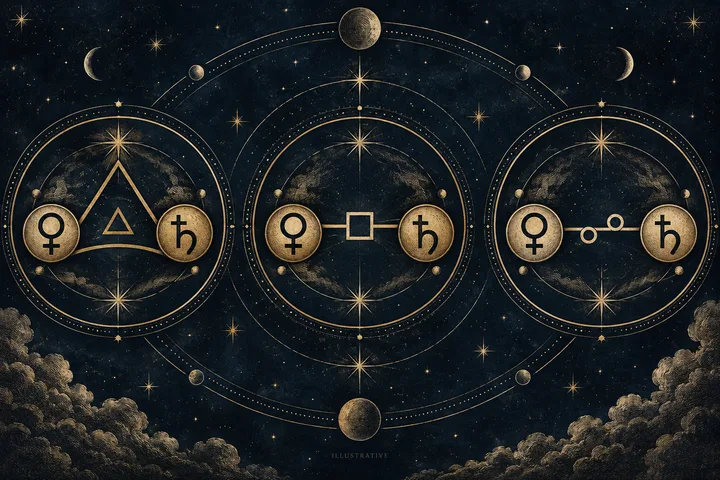
A single Venus-Saturn contact can explain a serious tone. It cannot explain the whole relationship. The next step is to see whether other contacts describe the same exchange, soften it, or tell a different story. This is where many readings go wrong. They find Saturn and stop. Then every delay becomes destiny and every boundary becomes a character judgment.
Begin with the Moon. The Moon shows emotional habit, comfort, and what helps a person feel held. A Venus-Saturn trine with tense Moon contacts may create loyalty without easy emotional soothing. A Venus-Saturn square with a supportive Moon contact may still contain friction, but the couple has a way back after the difficult moment. Ask whether affection has somewhere safe to land.
Next, check Mars. Mars shows desire, pursuit, anger, initiative, and the way a person acts under pressure. Venus-Saturn can slow or structure the bond, while Mars contacts show how quickly the pair moves toward or away from conflict. A square may feel less heavy when Mars has a constructive outlet. A trine may become too settled if no contact keeps desire awake. Stability and spark do not cancel each other. They need coordination.
Then examine the signs and houses only if they are actually available in the report’s scope. A house placement can show where the contact concentrates, but this comparison does not calculate houses. Stay with the information you have. Compare the major aspects by closeness, planet importance, repetition of themes, and lived behavior. A close Venus-Saturn square may matter more than a wide trine elsewhere, but a close square does not automatically outrank every Moon or Mars contact.
Use a three-column note while you read. In the first column, write the astrological promise: Venus seeks appreciation, Saturn seeks durability. In the second, write the observed behavior: who plans, who reassures, who delays, who pays, who apologizes. In the third, write the experiment: one change the couple can try for a month. This turns a symbolic reading into a relationship practice without reducing astrology to a score.
Suppose a couple has Venus trine Saturn, Moon square Moon, and Mars opposition Mars. The Saturn contact may help them keep promises, but it will not dissolve emotional mismatch or power struggles. Suppose another couple has Venus square Saturn, Moon trine Moon, and Mars sextile Venus. The square may be real, yet the pair may have both emotional access and desire available for repair. Rank the patterns. Do not let the scariest word win.
The best synthesis names one main strength, one live pressure, and one supporting resource. For a trine, the strength may be follow-through, the pressure may be emotional flatness, and the resource may be a playful Mars contact. For a square, the strength may be seriousness, the pressure may be judgment, and the resource may be a Moon contact that restores trust. For an opposition, the strength may be awareness, the pressure may be pursuit and retreat, and the resource may be a shared sign language around space.
You can also rank by the question the couple is asking. If the question is, Can we make this last? Venus-Saturn deserves close attention. If the question is, Do we feel emotionally safe? Start with the Moon and return to Saturn. If the question is, Why is the attraction so active but the timing so slow? Compare Venus-Saturn with Mars and any relevant retrograde information. The same aspect changes importance when the reader changes the question.
Keep interpretation and observation in separate sentences. The chart may suggest restraint. The observed fact may be that one partner takes three days to answer a vulnerable message. The first is symbolic language. The second is relationship evidence. A good reading brings them together without pretending the chart supplied the fact. This separation gives the couple something they can check and discuss.
A useful ranking is not a list of every contact. It is a short argument. This contact describes the bond’s commitment style. That Moon contact describes how the couple recovers emotionally. This Mars contact describes what happens when desire or anger rises. The conclusion follows from the pattern. You know where the relationship has support, where it has work, and which experiment deserves attention first.
If several Venus-Saturn contacts exist, note their direction and repetition. Your Venus may contact your partner’s Saturn while your Saturn also contacts their Venus through another close aspect. One person can then feel evaluated while also evaluating. The exchange becomes more mutual, but it may also become heavier. Look for whether both people can offer reassurance and structure, or whether both wait for the other to prove safety first.
Money is a classic Venus-Saturn meeting point, but it is only one. Time, age difference, family duty, social approval, physical affection, art, pleasure, and shared possessions can all carry the symbolism. Do not force a money reading when the real issue is public affection or unequal free time. Let the planet topics stay wide enough to fit the actual story, then make the chosen topic specific.
Sources: Venus-Saturn Aspects: Conjunct Sextile Trine Square Opposition; Aspect - Astrodienst Astrowiki; An Introduction to Aspects and Chart Shaping in Natal Astrology
The strongest exception, then one clear conversation
The common assumption says the trine is the relationship winner. It is easy, loyal, and less demanding. That makes it attractive. But a hard Venus-Saturn aspect may be more honest about the work a couple must do. The square can reveal a buried standard. The opposition can show the exact distance between what one person calls love and what the other calls safety.
This does not make the square or opposition superior. Friction is not proof of depth. Pain is not a measure of devotion. A couple should not stay in a humiliating pattern because Saturn is present, and nobody has to call emotional withholding commitment. The exception is narrower: when both people have agency, the hard aspect can produce a clearer conversation than an easy aspect that lets important differences remain unnamed.
The same caution applies to the trine. A trine can support long-term love beautifully. It can also make the couple efficient at avoiding the subject that would change them. They may be kind, faithful, and quietly lonely. They may have mistaken the absence of conflict for the presence of intimacy. The trine needs a deliberate invitation to play, risk, and tell the truth before resentment takes a polite form.
The deciding evidence is not the label. Look for mutuality. Does each person get to have needs? Can either person say no without punishment? Do promises become shared habits, or do they become debt? When a mistake happens, does Saturn protect repair or protect authority? When Venus asks for pleasure, does the relationship make room, or does it treat pleasure as a reward for good behavior? These questions reveal the mature or immature expression of any aspect.
Return to the chart after you answer them. A Venus-Saturn contact is strongest when the lived pattern matches the symbolism with some consistency. If the chart suggests restraint but the couple is openly affectionate, the contact may be operating through money, timing, family duty, or another Venus-Saturn topic. If the chart suggests ease but the couple feels blocked, another close aspect may carry the pressure. Let the whole chart correct your first impression.
My ranking stays clear. For natural cooperation, the trine comes first. For a visible and negotiable polarity, the opposition comes second. For concentrated work around fear, judgment, and unequal standards, the square comes third in ease, but not in value. That distinction matters. The aspect that feels hardest may identify the conversation that matters most.
You do not need to decide whether Venus-Saturn synastry is good before you can use it. You need to find the behavior it describes. Is the bond steady because both people choose steadiness, or because one person is afraid to ask for more? Does a delay protect the relationship’s timing, or does it keep one person waiting without a plan? Is a boundary mutual, or does only one person benefit from it?
Choose one example from the last month. Keep it small. A missed call, a money decision, a postponed date, a criticism, a request for more space. Name what happened without chart language. Then name the Venus need underneath it and the Saturn need underneath it. This is the point where symbolism earns its place. It helps you see the second need instead of arguing only for the first.
If you have the trine, ask, How can we keep our reliability from becoming routine? If you have the square, ask, Which rule or fear is making affection feel earned? If you have the opposition, ask, What amount of closeness and space lets both of us stay present? The questions differ because the aspects differ. Do not use a trine question to solve a square problem.
Make the agreement observable. We will plan one pleasure before the week fills up. We will discuss purchases above an amount we choose together. We will say when we need solitude and when we will reconnect. We will offer one direct expression of appreciation without attaching it to performance. Small agreements give Saturn something real to hold, and they give Venus a way to feel the love in the present.
If you want to compare your placements, bring the known Venus and Saturn signs and, when available, their degrees. A Synastry Comparison Report can work from those supplied placements and use a stated six-degree orb for selected major aspects. It does not calculate a natal chart from birth details or decide the future of a relationship. The point is to make the comparison clearer, then take the useful question back to the two people living it.
Before you start, agree on the purpose of the reading. Are you trying to understand a recurring disagreement, choose a kinder way to ask for commitment, or learn why the connection feels serious? A chart comparison works best when the question is narrow enough to answer. If one person wants reassurance and the other wants a final verdict, no aspect can solve that mismatch. Say what you hope to understand before you open the placement list.
Give each person equal authority over the lived meaning. The Venus person can say how affection lands. The Saturn person can say what responsibility feels like. Neither person gets to announce that the chart proves the other is withholding, needy, controlling, or destined to stay. Use the language as an invitation. Then let the person who lives the pattern confirm, correct, or refine it.
After the conversation, choose a time to review the agreement. A Saturn contact benefits from a date and a promise that can be checked. Venus benefits from feeling that the effort has not become another obligation without tenderness. A month is long enough to see whether a small change repeats and short enough to revise the plan. If the agreement helps, keep it. If it fails, ask which need was missing rather than blaming the aspect.
That is the balance this comparison is meant to protect. Venus should not have to beg for warmth. Saturn should not have to carry the entire future. The trine, square, and opposition name different routes between those needs, but every route asks for consent, clarity, and shared effort. Read the contact closely. Live the answer together.
So begin the conversation this way: I think our Venus-Saturn contact may show how we turn affection into security. Where does that feel easy between us, and where does it feel like one of us has to earn the other? Then stop talking about the aspect long enough to hear the answer. That answer is the reading’s next layer.
Sources: Aspect - Astrodienst Astrowiki; An Introduction to Aspects and Chart Shaping in Natal Astrology; Aspect Meanings in Birth Charts: Aspects involving Saturn; Saturn Trine Venus; Venus-Saturn Aspects: Conjunct Sextile Trine Square Opposition; Venus Opposite Saturn
A little more clarity
Is Venus-Saturn synastry better as a trine than a square or opposition?
The trine is usually easier because affection and responsibility cooperate with less friction. A square or opposition is not automatically worse. It can show where the couple must work with fear, timing, standards, or different needs for closeness and space. Judge the aspect by its degree closeness, sign condition, other synastry contacts, and the behavior it describes. A trine still needs warmth and honesty, while a hard aspect needs mutual repair rather than one person carrying the whole relationship.
Sources & further reading
- Venus-Saturn Aspects: Conjunct Sextile Trine Square Opposition
Supports the distinction between harmonious and hard Venus-Saturn expressions, including loyalty, reserve, responsibility, and relationship pressure.
- Aspect - Astrodienst Astrowiki
Supports the two-way exchange of planetary symbolism, the meaning of major aspect types, and the care needed with dissociate aspects.
- An Introduction to Aspects and Chart Shaping in Natal Astrology
Supports the degrees, relative strength, orb, and interpretive qualities of trines, squares, and oppositions.
- Aspect Meanings in Birth Charts: Aspects involving Saturn
Supports Saturn trine and square themes involving caution, responsibility, reserve, fear of rejection, and relationship judgment.
- Saturn Trine Venus
Supports trine themes of loyalty, measured commitment, practical care, and the need to keep commitment connected to genuine feeling.
- Venus Opposite Saturn
Supports opposition themes of worth, external standards, vulnerability, self-acceptance, and balancing pleasure with responsibility.
Synastry Comparison Report
Enter known placements for two people. Get an input-by-input comparison, selected aspect calculations and a clear record of what remains uncertain.
Compare our placements