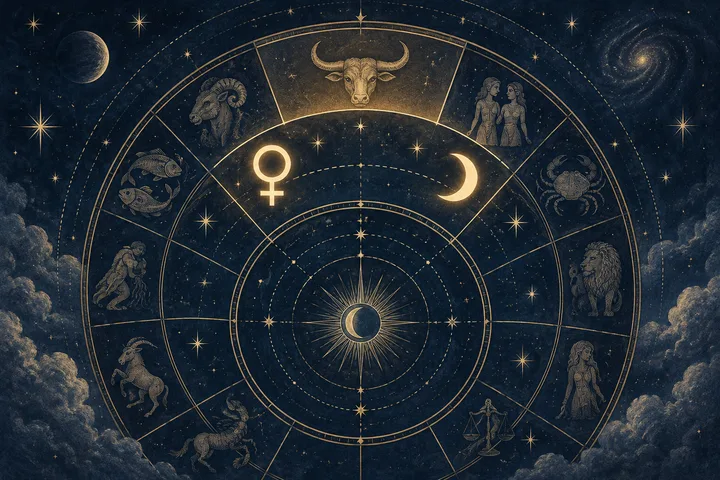
The short answer: same sign is a shared language, not automatically a conjunction
The pattern can feel familiar. One person carries Venus in a sign, and the other carries the Moon in that same sign. You may notice similar tastes, a shared rhythm around comfort, or an easy sense of what counts as pleasant and reassuring. The connection is real at the sign level. It just isn't the same thing as a close Moon-Venus aspect.
That distinction matters because a conjunction describes a measured relationship between two planets. In a synastry comparison, you compare the actual zodiac degrees, not only the labels printed beside them. If one Venus is at 4 degrees Libra and the other Moon is at 26 degrees Libra, both placements are in Libra, but they sit 22 degrees apart. Under a six-degree orb, there is no conjunction.
So the best reading has two parts. First, describe the common sign ground. Then state the limit clearly: the planets share a sign, but they do not blend closely by degree. This gives you a useful interpretation without inflating a soft resemblance into the strongest version of Moon-Venus synastry.
The practical question is not whether the pattern counts as magical or meaningless. Ask what it can actually describe. It can show that Venus's way of offering pleasure, affection, or value speaks a dialect the Moon already understands. It cannot, by itself, show that the pair will always comfort each other, stay together, or resolve conflict easily. Rank it as a supporting theme, then let tighter contacts lead the reading.
There is another reason to make this distinction early. Readers often find a shared sign before they find the degrees, and the first story can become emotionally persuasive. A careful reading begins with the data, names the sign connection, measures the relationship, and only then chooses the strength of the language. That order protects the useful meaning without making the symbol carry a promise it never made.
Think of the shared sign as an invitation to compare habits. Notice how each person asks for attention, offers reassurance, spends time, and handles beauty or pleasure. If the habits meet, the sign repetition has practical weight. If they only look similar in theory, the lack of a close aspect helps explain why the connection may feel familiar in one setting and distant in another.
Sources: Synastry: Moon-Venus Aspects Between Two Charts; Free Synastry Chart Calculator - Compare Two Birth Charts; What's Your Sign? An Intro to Synastry Charts and Astrological Compatibility
What information do you need before you interpret the pattern?
You need four pieces of information: each person's planet, sign, and degree, plus the zodiac system used. If the chart gives minutes, keep them. A placement written as Venus 4 degrees 12 minutes Libra is more useful than Venus in Libra alone. The same is true for the Moon, whose position can change quickly enough that a rough entry may hide an important degree shift.
You also need the aspect policy. This article uses a six-degree orb for the selected Moon-Venus comparison. That means you treat the planets as conjunct when their shortest zodiacal distance is 6 degrees or less from 0 degrees. A pair at 2 degrees and 7 degrees of the same sign is 5 degrees apart and qualifies. A pair at 4 degrees and 26 degrees is 22 degrees apart and does not.
A synastry report can compare supplied placements and optional degrees. It does not need to pretend that a sign-only input contains a hidden exact aspect. If one degree is missing, say that the aspect strength cannot be ranked precisely. You can still discuss the sign meanings, but you should not label the pair close, exact, or out of orb without the numbers.
Finally, keep the chart order visible. If the report says Person A's Venus repeats Person B's Moon sign, Venus remains the Venus person and Moon remains the Moon person. The symbolism is shared, but the roles differ. Venus describes the way affection, taste, pleasure, and values are offered. The Moon describes instinctive feeling, comfort, memory, and the conditions that help someone settle.
Write down the placements before you interpret them. Record, for example, 'A Venus 4 Libra, B Moon 26 Libra, tropical zodiac, six-degree orb.' That sentence prevents several common errors. It stops you from switching whose planet is whose, silently changing the zodiac system, or treating a sign match as a measured aspect. If all you know is the two signs, keep the reading at the sign layer.
Birth time matters more for houses and angles than for this focused sign comparison, but it still matters to know what your report includes. A placement list can support a Moon, Venus, and Mars comparison when the signs and degrees are supplied. It cannot support a house overlay or a reliable Ascendant contact when the time is unknown. Keep those tasks separate. A precise limit helps the reader understand what the report can answer now and what information another layer would need.
Do not let a chart graphic settle the question by appearance. Two symbols can look close on a wheel while their degree distance is wider than the chosen orb. Read the positions as numbers first. The picture helps you see the whole chart, but the degrees decide whether the specific aspect is present under the stated method.
There is a useful distinction between missing data and quiet data. If you know both signs but not the degrees, the aspect question is unresolved. If you know the degrees and they are 22 degrees apart, the question is settled: the pair is not a close conjunction under the six-degree policy. A quiet result can still carry meaning. An unresolved result needs restraint until the missing number is supplied.
Keep the zodiac circle in mind when you measure. Convert each placement to a position from 0 to 360 degrees, subtract one from the other, and use the smaller distance between that difference and 360. For two placements in one sign, the arithmetic is usually simple. Near a sign boundary, the circular calculation matters. Twenty-nine degrees Pisces and 2 degrees Aries are not 27 degrees apart in the chart; they are 3 degrees apart across 0 Aries. The sign labels and the geometry are answering different questions.
Minutes can matter at the edge of an orb. Venus at 4 degrees 55 minutes and Moon at 10 degrees 10 minutes are 5 degrees 15 minutes apart, while rounded whole-degree labels might make the pair look like 6 degrees. Record the raw positions when the source provides them. Then state whether your conclusion is exact, comfortably within the orb, near the boundary, or dependent on rounding. That small habit makes the reading easier to trust and easier to revise.
Sources: Synastry: Moon-Venus Aspects Between Two Charts; What's Your Sign? An Intro to Synastry Charts and Astrological Compatibility; Venus in the Signs
How the sign repetition works when the degrees are far apart
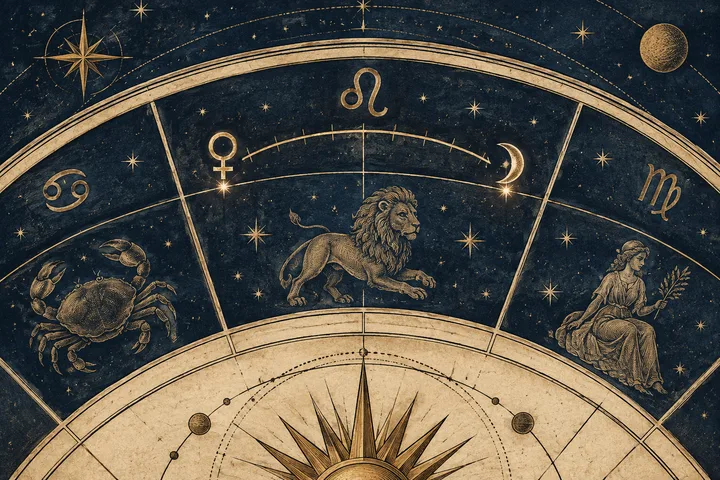
A sign is a field of expression. It gives both planets a common vocabulary. Libra may bring attention to fairness, grace, cooperation, and the way a relationship feels in social space. Cancer may draw both people toward care, privacy, protection, and the emotional meaning of home. Aquarius may value room to breathe, friendship, originality, and a relationship built on chosen principles. The sign tells you what kind of atmosphere the two planets recognize.
But each planet still has a different job. Venus moves toward what it enjoys and values. It shows how a person gives affection, what they find attractive, and what kind of exchange feels good. The Moon receives experience through feeling. It shows what settles the nervous system, what becomes familiar, and what someone needs when they are tired or exposed. Same sign does not erase that difference.
This is why the pattern can be pleasant without feeling fused. The Venus person may offer affection in a way that matches the Moon person's instincts. Yet the Moon person may not automatically feel that Venus is speaking directly to them. A Libra Venus may choose tact, beauty, and compromise, while a Libra Moon may need emotional balance and a calm room before they can open. The shared sign helps. It doesn't complete the conversation.
Read the repeated sign as a common climate. Then ask whether the two planets are actually close enough to share a room. A wide same-sign pair may resemble two people who like the same kind of music but don't always hear the same lyric. That is useful information. It is not a substitute for contact.
The distinction is helpful when a relationship feels pleasant but not deeply binding. A shared sign can explain the easy parts: the same room feels attractive, the same social code feels natural, or one person's preferences seem familiar to the other. The missing close aspect can explain why the connection does not automatically reach private feeling, desire, commitment, or repair. Those layers need their own contacts.
Some readers hear 'no aspect' and throw away the sign connection entirely. That is too severe. Astrology works through layers. Sign resonance is one layer. Degree-based aspect is another. House placement, reception, planetary condition, and repetition add more. The right reading keeps the layer and gives it the right volume.
Element and modality can refine the common sign story, but they should not replace degree measurement. Two earth placements may both want something tangible. Two mutable placements may both adapt quickly. Two fixed placements may both protect a preferred rhythm. Those observations explain the tone around the planets. They do not turn a wide pair into an aspect. Use them after the basic geometry, never as a shortcut around it.
Sources: Venus in the Signs; What's Your Sign? An Intro to Synastry Charts and Astrological Compatibility
What does no close aspect change in the interpretation?
It lowers the volume of the Moon-Venus story. A close conjunction is a direct cross-chart contact. The planets occupy nearly the same degree, so their functions are repeatedly activated together in the comparison. A same-sign pair outside the chosen orb still shares a sign, but it lacks that tight geometric link. The theme may be present as background agreement rather than a central relationship engine.
That changes the language you should use. Say there may be recognition, shared taste, or compatible ways of creating comfort. Don't say the Moon person feels emotionally held by the Venus person as a settled fact. Don't call the pair an exact conjunction. Don't use the same paragraph you would use for Venus at 12 degrees and Moon at 14 degrees, because the chart inputs are different.
It also changes how you rank the pattern against other contacts. A 1-degree Venus-Saturn square, a 3-degree Moon-Mars trine, or a close Venus contact to the other person's Ascendant deserves more attention than a 20-degree same-sign overlap. The exact comparison depends on the planets and aspect, but tightness is a real part of the reading. A broad idea should not outrank a clear contact simply because the sign sounds romantic.
There is a softer possibility. If the planets sit near the edge of the sign, an out-of-sign conjunction may exist. Venus at 29 degrees Pisces and Moon at 2 degrees Aries are only 3 degrees apart, even though the signs differ. A sign-only reading could miss this. That is why degrees come before interpretation.
When one person's Venus repeats the sign of the other's Moon but the degrees are too far apart for a close aspect, read it as shared sign language, not as a Moon-Venus conjunction. The Venus person may express affection in a style the Moon person recognizes, and the Moon person may respond warmly to that style. But the planets aren't operating as one tight channel. The strength of the pattern depends on the exact degrees, the orb used, and what else connects the two charts. Check the distance first. Then look for another Moon-Venus aspect, contacts to the Ascendant or Descendant, and supportive links from Saturn, Jupiter, Mars, or the personal planets. A useful report should name the sign resonance and keep it in its proper rank. It shouldn't turn one repeated sign into a verdict about the relationship.
Sources: Synastry: Moon-Venus Aspects Between Two Charts; Free Synastry Chart Calculator - Compare Two Birth Charts; What's Your Sign? An Intro to Synastry Charts and Astrological Compatibility
A worked example: Venus at 4 Libra and Moon at 26 Libra
Imagine Maria has Venus at 4 degrees Libra. Luis has the Moon at 26 degrees Libra. These are illustrative placements, not a calculated personal chart. They share Libra, so both charts bring Libra themes to the Venus-Moon question. Maria may offer affection through courtesy, aesthetic care, listening, and a wish to keep the exchange balanced. Luis may seek emotional peace, respectful treatment, and a home atmosphere where conflict doesn't swallow the bond.
Now measure the distance. From 4 degrees Libra to 26 degrees Libra is 22 degrees. With a six-degree conjunction orb, the pair is not conjunct. The sign repetition can support a sense that Maria's manners or tastes make sense to Luis, but it doesn't prove that her affection reaches his emotional core with the immediacy of a close Moon-Venus contact.
What might you observe? They could enjoy the same restaurants, music, colors, or social settings. They might both dislike crude pressure and prefer a conversation that leaves room for both people. Yet when Luis is hurt, Maria's Libra instinct to smooth the mood may feel like avoidance if he needs a direct emotional response. The shared sign offers a common ideal of harmony. It does not guarantee the same method for repairing a breach.
A ranked reading would call this a moderate supporting theme. It sits below any close cross-chart contact involving the Moon or Venus. It may become more visible if other planets reinforce Libra, if one person's planet falls in the other's relationship houses, or if a tight aspect activates the same need for fairness and care. The sign repetition is worth mentioning. It is not the headline by itself.
Now imagine the same example with Maria's Venus at 4 degrees Libra and Luis's Moon at 8 degrees Libra. The sign story has not changed, but the degree story has. The pair is now 4 degrees apart and qualifies as a conjunction under the stated six-degree policy. A four-degree change in one placement changes the rank of the interpretation.
Write the two versions side by side. Version one says, 'The same sign suggests shared Libra values, but the 22-degree distance keeps this from being a conjunction.' Version two says, 'The same sign and 4-degree distance join Venus and Moon, so affection and emotional receptivity meet directly through Libra.' The difference is the interpretive decision.
The example also shows why 'no close aspect' does not mean 'no effect in the relationship.' Maria's Libra Venus can still be part of the atmosphere Luis recognizes. He may appreciate her social grace, feel at ease in places she chooses, or share her wish to make decisions fairly. But a chart reader should not assign the stronger conjunction meaning until the degrees justify it. The reader's confidence should rise and fall with the precision of the input.
If one person knows only a rounded degree, use the range it creates. Venus at approximately 4 degrees and Moon at 8 degrees might be close enough, but an unknown minute does not turn an uncertain pair into an exact one. Name the confidence level. A report can say 'likely within the selected orb' when the inputs support that wording, or it can stay with the sign layer when they do not.
Read the Moon person's experience before you describe romance
The Moon person is not simply the sensitive one, and the Venus person is not simply the charming one. Those shortcuts flatten the reading. Start with the Moon's sign and ask what kind of safety it seeks. A fire Moon may need warmth, honesty, movement, and room to respond spontaneously. An earth Moon may settle through reliability, tangible care, and a dependable rhythm. An air Moon may need conversation, perspective, and emotional breathing space. A water Moon may need tenderness, privacy, and permission to feel deeply.
Then bring in the shared sign. Does the Venus person's way of showing love meet that need, or only resemble it from the outside? A Venus in Virgo may show care through useful details and practical help. That can fit a Virgo Moon's need for order and thoughtful attention. But if the Moon needs praise and the Venus person keeps correcting small problems, the same sign can turn into a shared habit that misses the heart of the matter.
This is the strongest reason to avoid calling a wide same-sign pair a conjunction. The Moon can recognize the sign's language while still asking for a different sentence. Familiarity is not the same as emotional contact. A person may like the way you decorate a room and still not know how to meet you when grief enters it.
Use observable questions to test the symbolism. When the Moon person is overwhelmed, does the Venus person offer the kind of care that actually helps? When the Moon person says what they need, does the Venus person listen or substitute charm for repair? The chart layer suggests the question. The lived exchange supplies the answer.
The Moon person's response can change with context. Someone may receive Venus warmly during ordinary routines but feel unseen during conflict. That does not cancel the shared sign. It tells you to separate ease from capacity. A sign repetition may describe what feels familiar when both people are calm. A closer aspect, a natal condition, or a practiced relationship skill may describe what happens when the emotional weather turns.
Ask the Moon person to name the difference between being understood and being soothed. Being understood may mean that the other person recognizes a preference or emotional value. Being soothed may require timing, physical presence, silence, words, or a concrete act. Venus can create beauty and goodwill. The Moon may still need Venus to stay present after the first pleasant gesture has passed.
Sources: What's Your Sign? An Intro to Synastry Charts and Astrological Compatibility; Venus in the Signs
Read Venus as a style of love, not a promise of comfort
Venus tells you what feels worth choosing. It can describe affection, attraction, taste, pleasure, fairness, and the values a person brings into a bond. In synastry, Venus also shows how one person may be received by the other's planets. When Venus closely contacts the other person's Moon, astrologers often give the connection a strong tenderness because affection and emotional receptivity meet directly.
When the degrees are far apart, keep the Venus layer more specific. What does this Venus value in the shared sign? Venus in Taurus may offer steadiness, touch, food, and comfort. Venus in Gemini may offer words, wit, variety, and mental play. Venus in Scorpio may offer focus, intensity, privacy, and total attention. The Moon person's same-sign placement may understand that style, but it may not be able to receive it at every moment.
This can produce a subtle mismatch. The Venus person thinks, 'I am showing love in the language you should want.' The Moon person thinks, 'You understand the kind of atmosphere I like, but you still don't meet me when I am vulnerable.' Neither person has to be wrong. The shared sign creates a plausible bridge. The absence of a close aspect means you should inspect whether the bridge carries weight.
A good reading keeps affection concrete. Look at how gifts, time, touch, praise, privacy, and practical help move between the two people. Then compare those habits with the sign's values. If the behavior fits, the same-sign theme has something to work with. If it doesn't, the sign is describing an available style, not a completed relationship.
Look for the Venus person's response when the Moon person's need is inconvenient. Anyone can enjoy affection when the mood is easy. The sharper question is whether Venus can keep valuing the Moon's inner life when it asks for time, patience, or a change in plans. A shared sign may make the request legible. It does not guarantee generosity. That is where the rest of the synastry and the actual relationship behavior become decisive.
You can also reverse the lens. What does the Moon person do with Venus's offerings? Do they receive them, distrust them, ask for more, or feel crowded by them? The Moon is not passive. It gives the emotional setting in which Venus is interpreted. When the planets are not close, that interpretation may depend more heavily on the Moon person's natal pattern and on other contacts in the chart.
Sources: What's Your Sign? An Intro to Synastry Charts and Astrological Compatibility; Venus in the Signs
Rank the rest of the synastry before you decide what this means
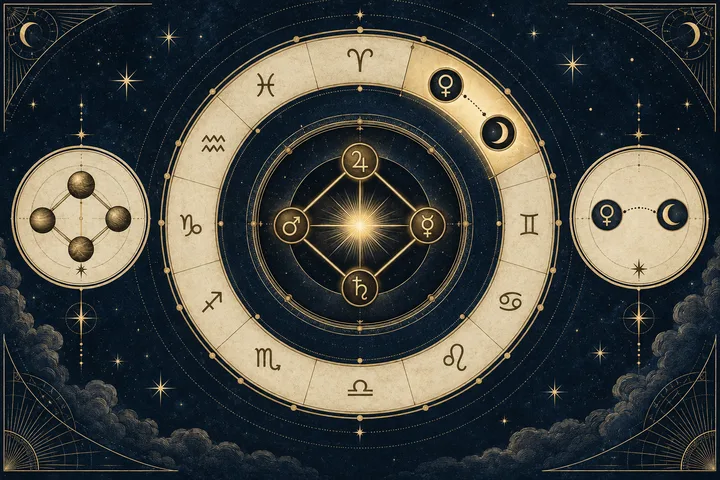
The first ranking question is simple: are there closer contacts involving the Moon or Venus? A tight Moon-Venus aspect elsewhere, a Venus-Mars contact, or a Moon-Saturn connection may describe the relationship more forcefully than a wide same-sign overlap. Do not let the repeated sign distract you from the actual geometry.
Next, look for contacts to the angles if the birth-time information supports them. A close Venus-Ascendant or Moon-Descendant contact can make attraction, recognition, or partnership themes visible in a way that a broad sign repetition may not. Houses add context too, but they require reliable birth times. If the time is unknown, leave houses out rather than turning a guess into a layer of meaning.
Then inspect the condition of each planet in its own chart. A Venus that is closely tied to Saturn, Neptune, Mars, or Pluto may express the shared sign through a more complicated personal pattern. A Moon under pressure may need something different from what its sign alone suggests. Synastry does not replace the natal chart. It shows how one person's pattern touches the other's pattern.
Finally, look for repetition. If the same need for fairness, safety, freedom, or intensity appears through the Moon's sign, Venus's sign, a close aspect, and the house overlays, the theme earns a higher rank. If the same-sign Venus-Moon pair is the only evidence, keep it modest. A repeated pattern is stronger than a single attractive label.
Sources: Free Synastry Chart Calculator - Compare Two Birth Charts; What's Your Sign? An Intro to Synastry Charts and Astrological Compatibility
The strongest exception: a wide sign pair can still sit inside a larger pattern
The absence of a close Venus-Moon aspect does not erase the sign resonance. It tells you where to place it. A wide same-sign pair can become meaningful when another contact repeats the same story. Suppose the shared sign is Capricorn, the Venus person also has a close Saturn contact to the Moon, and both people have personal planets emphasizing earth signs. The Venus-Moon sign repetition then supports a larger picture of loyalty, structure, and practical care. It still isn't a conjunction, but it is no longer standing alone.
An out-of-sign conjunction is another important exception. Suppose Venus is at 28 degrees Cancer and Moon is at 2 degrees Leo. The signs differ, yet the planets are only 4 degrees apart. With a six-degree orb, that is a close conjunction. The reader may feel the contact through the blend of Cancer and Leo, perhaps care meeting pride or protection meeting the need to be celebrated. Degree distance outranks the same-sign shortcut.
A second exception comes from the chosen tradition. Some astrologers use sign-based aspects or wider orbs, while others insist on tighter degree contact for personal-planet synastry. A report must state its policy and stay consistent. You can acknowledge that another school would read the relationship differently, but don't mix methods halfway through the page to rescue a preferred interpretation.
An orb is a measurement rule, not a rating of how much two people care. A six-degree policy can place a 5-degree pair inside the conjunction category and a 7-degree pair outside it, even when both couples describe warmth. The category changes because the geometry changes. If you compare reports, ask whether they use the same zodiac, aspect list, and orb before treating their labels as contradictory. Two readers may be describing the same placements with different thresholds. Keep the method visible, then decide which interpretation fits the chosen tradition and the rest of the chart.
The final exception is lived repetition. If the couple repeatedly creates the same pattern of comfort, taste, and emotional recognition, the sign layer may be describing something visible even without a close aspect. Astrology gives the pattern a name. It doesn't require you to ignore what the people actually do. It does require you to say which chart factor is carrying which part of the meaning.
Consider how the exception changes the writing. You might say, 'The shared Capricorn sign gives both planets a practical language, while the close Venus-Saturn contact supplies the endurance and duty themes.' That sentence gives each factor a job. A weaker version would call the wide Moon-Venus pair an exact conjunction and make it carry loyalty, commitment, comfort, and permanence all at once.
A good astrologer can use a different orb or sign-based technique and still be precise. The reader deserves to know which method produced the conclusion, where the strongest evidence lies, and what would change under another method. Consistency matters more than pretending that every school weighs a wide same-sign pair in exactly the same way.
You can make the larger pattern easier to see by separating three kinds of evidence. First comes geometry: the actual angular distance between Venus and Moon. Second comes symbolism: the sign, element, modality, and planetary roles. Third comes repetition: another aspect, house overlay, or natal condition that echoes the same theme. These are not interchangeable. Geometry tells you whether a conjunction exists. Symbolism tells you the language of the placements. Repetition tells you whether that language has support elsewhere.
Suppose A's Venus is 4 Libra and B's Moon is 26 Libra, but A's Mercury is 5 Libra and B's Moon is 6 Libra. The Venus-Moon pair remains wide. The Mercury-Moon conjunction may explain why conversation, naming feelings, or finding the right words becomes the more immediate bridge between them. If B's Saturn also contacts A's Venus closely, affection may gain steadiness through Saturn rather than through the wide Moon-Venus match. The chart becomes clearer when each contact keeps its own job.
This ranking also prevents a common reading error: using a broad sign match to explain every pleasant moment. A shared Libra sign may describe agreement about tone and fairness. It cannot automatically explain why the couple talks easily, feels sexual chemistry, or stays committed. Mercury, Mars, Saturn, the angles, and the houses may carry those subjects. Let the planet that actually touches the relevant point speak for that part of the story.
The reverse error is just as limiting. A reader may see no conjunction and announce that the placements do nothing. That throws away the symbolic layer. If Venus and Moon share Virgo, for example, both people may notice the value of care expressed through useful details, clean routines, and attention to what needs fixing. The question is whether those details feel loving or critical in practice. The sign gives you the question; the degree and the surrounding chart tell you how much weight to give the answer.
Sources: Synastry: Moon-Venus Aspects Between Two Charts; Free Synastry Chart Calculator - Compare Two Birth Charts; What's Your Sign? An Intro to Synastry Charts and Astrological Compatibility
Your final reading: name the warmth, keep the rank, choose the next check
The finished reading should be simple. A same-sign Venus-Moon pair can describe a familiar style of affection and comfort, but a wide degree gap keeps it from leading the synastry. Measure first. Interpret second.
Record both placements, the zodiac system, and the orb. Calculate the shortest distance. If the pair is wide, name same-sign resonance. If it falls within six degrees, call it a conjunction under this report's policy. If the signs differ but the degrees are close, check for an out-of-sign conjunction. If a degree is missing, stay with the sign layer and name the limit.
Next, give each planet its own job. Ask what Venus offers in that sign and what the Moon needs in it. Then check the tighter contacts involving the Moon, Venus, Mars, Saturn, Jupiter, or the angles. Use houses only when reliable birth times support them. The strongest repeated pattern deserves the most attention.
Now bring the symbolism back to ordinary life. You might say, 'Our Libra placements suggest that fairness and tone matter to both of us. What makes you feel respected when we're upset?' Listen for an answer you can observe. A text before a difficult meeting, a quiet evening, practical help, physical closeness, or a clear apology tells you more than a beautiful label by itself.
Ask what happens when the shared sign's ideal breaks. If both people value peace, who speaks first after an argument? If both value freedom, how do they reassure each other without creating a cage? If a close Saturn contact supports follow-through, make a plan. If Mars carries the stronger link, talk about timing, anger, and desire. The sign resonance tells you where to begin; the rest of the chart and the lived exchange tell you what can hold.
Check the pattern in both directions, too. If A's Venus repeats B's Moon sign, compare B's Venus with A's Moon. The two matches may not have the same width or meaning. That asymmetry can explain why one person feels more fluent in the other's comfort style. It belongs in the reading, not in a verdict.
If you want the comparison organized, bring the supplied Moon, Venus, and Mars signs to a Synastry Comparison Report, adding degrees where you have them. It can compare those inputs, selected major aspects, and the missing-data limits. It doesn't turn a sign match into a calculated promise. Use it to choose the next chart check and the next honest conversation.
Write the conclusion in one line: 'Shared sign, no close aspect. This may describe common ground around affection and comfort, while tighter contacts show how that common ground becomes action.' Then make one decision. Will you examine the strongest exact contact, ask for a specific form of care, or leave the pattern as useful background? Stop there. The reading has done its work when it sharpens your attention and gives the relationship a better question.
A compact worksheet can keep the interpretation honest. Write the two placements in full, including minutes if available. Mark the shortest distance and the orb policy. Label the pair as same-sign wide, same-sign close, or out-of-sign close. Next, write one sentence for Venus's offering and one for the Moon's need. Finally, list the two or three tighter contacts that outrank this pair, if they exist. You now have a reading that can be checked instead of a mood attached to two sign names.
Use the worksheet with a real exchange in mind. If Venus is in Taurus and the Moon is in Taurus, ask whether comfort arrives through touch, food, money, reliability, or a quiet physical setting. If Venus is in Gemini and the Moon is in Gemini, ask whether words, humor, and variety help the Moon feel met, or whether too much talk makes the feeling harder to hold. These examples are interpretive prompts, not promises. They turn a sign into a question you can answer from experience.
When you compare the two directions, preserve the asymmetry. A may offer affection in a style B recognizes, while B's Venus may meet A's Moon through a different sign or a different degree distance. That does not make one person more loving. It shows that reception and offering are not mirror images. A careful report can name who carries Venus, who carries the Moon, how close the contact is, and which person is more likely to notice the shared language first.
The best next step is usually small. Verify one degree, inspect one tighter aspect, or ask one direct question about care. Don't ask the same-sign pattern to answer the whole relationship. Let it do what it does well: point to a shared aesthetic or emotional vocabulary, then help you notice whether the two of you use that vocabulary kindly when the room gets difficult.
Sources: Synastry: Moon-Venus Aspects Between Two Charts; Free Synastry Chart Calculator - Compare Two Birth Charts; What's Your Sign? An Intro to Synastry Charts and Astrological Compatibility; Venus in the Signs
A little more clarity
Is Venus in the same sign as someone's Moon still meaningful if there is no conjunction?
Yes, but read it as a shared sign language rather than a close Moon-Venus conjunction. The two placements may recognize similar values around comfort, affection, or emotional atmosphere. Check the exact degrees, apply a consistent orb, and compare the theme with tighter contacts elsewhere in the synastry.
Sources & further reading
- Synastry: Moon-Venus Aspects Between Two Charts
Supports the traditional interpretation of Moon-Venus contacts as tenderness, affection, familiarity, and emotional balance, while noting that difficult contacts require cooperation.
- Free Synastry Chart Calculator - Compare Two Birth Charts
Explains synastry as a two-chart comparison using inter-chart aspects and house overlays, and recommends reviewing the strongest contacts first.
- What's Your Sign? An Intro to Synastry Charts and Astrological Compatibility
Explains that aspect strength depends on degree distance and that a smaller orb produces a stronger conjunction-style connection.
- Venus in the Signs
Provides sign-based Venus meanings used here to distinguish a Venus person's style of affection, taste, pleasure, and values from the Moon's needs.
Synastry Comparison Report
Enter known placements for two people. Get an input-by-input comparison, selected aspect calculations and a clear record of what remains uncertain.
Compare our placements