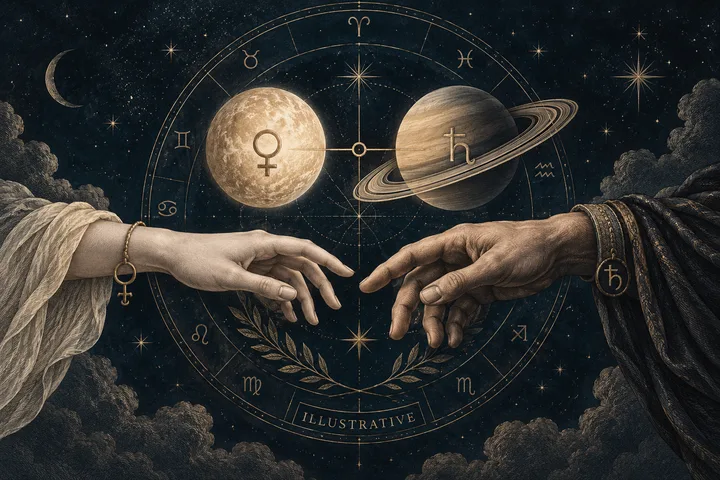
The conjunction gives the bond gravity, not one fixed outcome
What does Venus conjunct Saturn mean when affection feels serious but constrained? In synastry, it means one person’s Venus is joined by zodiacal degree to the other person’s Saturn. Venus describes affection, pleasure, appreciation, and what someone values; Saturn describes limits, responsibility, commitment, and the work of giving something form. A conjunction brings those functions into close contact. The result often feels weighty. It can steady affection through dependable care, or make warmth feel restrained, judged, or earned. The aspect names a serious bond between these themes. It does not promise that the relationship will last, or tell you whether the seriousness feels good to both people.
That distinction matters because commitment and tenderness are related, but they are not the same thing. Cafe Astrology’s guide to Venus-Saturn synastry holds both possibilities in view: its conjunction reading includes loyalty and stability, while also describing restriction, coolness, and friction. The guide points readers toward the wider compatibility picture instead of treating one contact as a complete verdict. Kerykeion’s Venus-Saturn interpretation likewise connects the conjunction with commitment and practical support, while allowing for emotional reserve or a gap between care offered and care recognized. These are astrological interpretations, not measured forecasts of a couple’s future. Together, they support a useful starting point: seriousness is the shared symbol; the lived expression still has to be read.
So begin with what the aspect actually joins. The Venus person’s style of affection meets the Saturn person’s approach to duty, pacing, and boundaries. That language describes a symbolic exchange, not either person’s fixed character or private motive. Reliability may become a language of love. A limit may help protect shared time. Yet the same concentration can feel heavy if affection seems to depend on meeting a standard. The chart alone cannot settle which experience is present.
The rest of the reading turns on that difference. First, confirm whose Venus meets whose Saturn and whether the supplied degrees support a conjunction under the stated orb. Then consider how each planet is placed in its own chart, compare the conjunction with other Venus-Saturn contacts, and bring the symbolism back to observable reciprocity: can both people ask for warmth, negotiate limits, and adjust? A serious tone can hold care and constraint at once. The practical question is whether the structure makes affection easier for both people to give and receive.
In synastry, Venus conjunct Saturn joins one person’s affection and values with the other person’s commitment and limits. The contact can give care a steady shape, or make warmth feel restrained or earned. Check whose Venus meets whose Saturn and whether the degrees support a conjunction under the stated orb. Then ask whether both people can negotiate the structure and still offer and receive warmth.
Sources: Synastry: Venus-Saturn Aspects Between Two Charts; Synastry Venus-Saturn Aspects
First verify whose Venus meets whose Saturn
Before interpreting the feeling, check what the chart actually connects. In synastry, Venus in one person’s natal chart makes an aspect to Saturn in the other person’s chart. Keep those roles clear: this is an interchart contact, not a Venus-Saturn conjunction within one person’s birth chart. Cafe Astrology’s guide names the contact as “Venus conjunct other person’s Saturn,” then describes possible experiences for each side. That distinction matters. A symbolic description of the Venus person or Saturn person doesn’t establish either person’s motives or tell you what they feel. It gives you a way to frame what each may experience and then compare that reading with the relationship as it is.
A conjunction has its exact center at zero degrees of zodiacal separation. The orb is the distance between the planets and that exact point. To check the contact, note the Venus sign and degree in one chart and the Saturn sign and degree in the other; compare their positions around the zodiac, accounting for the sign boundary if the placements sit at opposite ends of neighboring signs. Then state the orb convention you’re using. The Synastry Comparison Report uses a six-degree orb for selected major aspects when degrees are supplied. That is the report’s consistent working rule, not a rule every astrologer shares. In its Venus-Saturn discussion, WowAstro lists an eight-degree general span, then describes tighter choices for natal charts and synastry. The difference shows why a reader should ask which convention labels an aspect instead of treating “conjunct” as self-explanatory.
Sign-only placements don’t give the separation in degrees. If both planets share a sign, they may be close together or far apart within it; if they fall in neighboring signs, a close conjunction may also cross the sign boundary. So signs can suggest a possible connection, but they cannot confirm how close it is. Don’t fill the gap by guessing. Ask for both degrees, or keep the interpretation at the sign level and say that exact conjunction status remains unconfirmed.
A practical check takes three notes: whose Venus, whose Saturn, and how many degrees separate them under the chosen orb rule. If the degrees are available, calculate the shortest angular distance around the zodiac and compare it with the stated six-degree threshold. If only signs are available, record the shared or neighboring signs without claiming a verified close aspect. The report works from placements and optional degrees you supply; it doesn’t calculate natal positions from birth details. Once the contact is identified, interpretation can begin. The geometry tells you what is connected. It doesn’t decide whether the seriousness feels supportive or constraining.
Sources: Venus-Saturn; Synastry: Venus-Saturn Aspects Between Two Charts
The conjunction joins affection to responsibility
The conjunction joins affection to responsibility. Venus describes what a person values, enjoys, and offers in the exchange of affection. Saturn gives weight to time, commitment, limits, and accountability. When one person’s Venus meets the other’s Saturn, those functions work together in the symbolism: affection may feel serious because it carries an expectation of care that can be counted on. The conjunction does not promise that the relationship will last, or that both people will enjoy the same expression of love. It describes a concentrated meeting of pleasure and responsibility. That meeting can give ordinary choices emotional weight. A kept promise, a reliable plan, or practical help may feel loving because it gives affection a steady form. The Kerykeion guide to Synastry Venus-Saturn Aspects describes care expressed through consistency and follow-through, and notes that a gap can open when one person offers practical support while the other is looking for overt tenderness. Cafe Astrology’s Synastry: Venus-Saturn Aspects Between Two Charts likewise pairs commitment and loyalty with the possibility of restriction or a cool response. These are interpretive possibilities, not guaranteed events in every couple’s life. The same structure can support pleasure, but it can also seem to put pleasure under review. Spontaneity may feel harder when plans, standards, or obligations take up the space where ease could grow. A limit can protect time, money, or trust; a correction can also make affection feel like something to earn. The chart symbolism alone cannot tell you which is happening. Look at whether the structure leaves room for both people to enjoy what they are building. Consider an example: one person prefers to plan shared time in advance, while the other values unplanned gestures. A plan kept with care could help the couple feel secure, especially if they also leave room for surprise. But if every invitation must meet one person’s rules, or the other person’s wish for spontaneity is repeatedly dismissed, the same seriousness may feel constraining. This example illustrates the symbolism; it is not a report of a particular couple. Astrologers do not all emphasize the contact in the same way. Cafe Astrology highlights responsibility and commitment, while the Kerykeion guide describes structure as something that can carry love. In “Venus in Aspect to Saturn in Synastry,” Look Up The Stars gives more weight to restraint and the risk that duty can crowd warmth. Read together, these sources support a balanced interpretation: seriousness is the common thread, but it is not proof of tenderness. Ask what responsibility makes possible, and whether affection remains freely expressed within it. That distinction lets you name the gravity without mistaking obligation or formality for love.
Sources: Synastry Venus-Saturn Aspects; Synastry: Venus-Saturn Aspects Between Two Charts; Venus in Aspect to Saturn in Synastry
When does responsibility make affection safer to express?
In its supportive expression, Venus conjunct Saturn gives affection a dependable shape. The bond may feel serious because care is treated as something to tend over time, not only a feeling to enjoy in the moment. Synastry Venus-Saturn Aspects describes the conjunction as joining warmth and appreciation with commitment and structure. It also points to consistency, practical support, and shared routines as ways this symbolism can show up. Read those as possible expressions, not a script every couple must follow. Reliability matters most when it makes pleasure easier to share. A kept promise can let the Venus person relax into affection; a fair boundary can protect time or resources both people value. Planning need not drain romance from the bond. It can make room for it. The key is whether structure serves a mutual purpose and leaves space for delight, spontaneity, and each person's separate interests. Cafe Astrology's account places commitment and loyalty beside a caution about restricting one another's freedom. That pairing is useful: responsibility supports affection when it steadies the connection without making closeness feel like a duty owed under pressure. Imagine one person prefers to plan time together well ahead, while the other enjoys deciding spontaneously. They agree to protect one evening each week, but leave the activity open until the day arrives. The plan gives the first person something dependable to count on; the open choice lets the second bring freshness and pleasure. This imagined scene is not evidence about how a particular chart will behave. It shows one way to test the symbolism: can the couple shape a commitment that answers both needs, rather than asking one person to surrender theirs? Then notice what happens when the arrangement misses the mark. If one person feels overlooked, can they say so without being treated as ungrateful? Can the other listen, explain what the plan meant, and make a workable adjustment? Repair matters because even a thoughtful structure can become rigid if nobody may revise it. In everyday terms, the couple's actual exchange supplies context the conjunction alone cannot provide. Reserve need not mean rejection. A measured pace may feel caring when practical support is visible, appreciation is spoken, and both people can ask for more warmth without penalty. Kerykeion's guide notes that different expressions of care can leave a gap between what one person offers and what the other recognizes. Naming the gesture can help close that gap: “I see how you made time for this,” alongside “I feel closest when you tell me what you enjoy about being with me.” The useful sign is not perfect agreement. It is willingness to understand and respond. When responsibility protects shared pleasure and both people retain room to choose, Saturn's structure can help affection feel safer to express.
Sources: Synastry Venus-Saturn Aspects; Synastry: Venus-Saturn Aspects Between Two Charts; Love & Relationship Astrology: A Cosmic Guide to Compatibility
When does seriousness turn into conditional warmth?
A Venus-Saturn conjunction deserves the restrictive reading when affection feels like a reward for meeting one person's standards. The pattern isn't simply reserve or duties taking time. Look for a repeated exchange: one person asks for warmth or time together, and the answer is criticism, another test, or a reminder of what they owe. If closeness returns only after compliance, affection can feel conditional. Cafe Astrology's “Synastry: Venus-Saturn Aspects Between Two Charts” names restriction, cool responses to loving gestures, and a Saturn role that can become too parental. It warns against criticizing the Venus person's growth. These are interpretive possibilities, not proof of motive. Ask whether a limit protects something both value, or whether one person's preferences set the terms. A shared boundary has room for two voices. Imagine one person needs advance plans while the other wants spontaneous time. They agree on planned evenings and leave other time open; each can ask for a change without losing affection or being called careless. Both help shape the structure. A unilateral rule works differently: one person's schedule, tastes, or friendships become the standard, and the other must adapt. The distinction lies in negotiation and freedom. Notice what happens after a request. Does asking for tenderness lead to a conversation about what each can offer, or become evidence that the asker is needy? Does a missed expectation invite repair, or does duty end the discussion? If outside interests shrink because they trigger criticism, pay attention. Cafe Astrology raises the risk of restricting freedom and cutting off hobbies or social pleasures. Treat that as a question, not a prediction that every conjunction isolates a couple. “Venus in aspect to Saturn in synastry,” from Look Up The Stars, gives the cautionary view more force. It describes love that can feel earned, emotional restraint, and commitment that may persist without fulfillment. The author recounts a personal relationship and notes that broader chart context matters. Treat the page as one astrologer's account, not evidence that these outcomes are typical. Its challenge to a stabilizing reading is worth testing: loyalty and duration don't tell you whether affection feels mutual. A demanding season or cautious pace can reduce spontaneity without making warmth conditional. The difference is whether both can name what's hard, keep freedom, and revise an agreement as circumstances change. Reserve may be thoughtful pacing when care stays visible and requests can be heard. It becomes concerning when one person must keep proving worth while the other sets an unchanging standard. Don't label a person “cold” from Saturn, or “too demanding” from Venus. Name the pattern: whose needs shape the agreement, whether appreciation accompanies correction, and whether both can say no or ask for more without punishment.
Sources: Synastry: Venus-Saturn Aspects Between Two Charts; Venus in Aspect to Saturn in Synastry; Venus-Saturn
Read the Venus and Saturn roles without assigning motives
In synastry, the Venus person may feel the conjunction through how freely affection, pleasure, and appreciation move between you. The Saturn person may feel it through responsibility, pacing, and the terms that make the bond feel secure. Those are useful viewpoints, not fixed personalities. Neither placement tells you what someone intends, and either person can offer care or feel constrained.
Cafe Astrology describes the Saturn person as potentially stabilizing the Venus person, while also warning that the Venus person may feel restricted and that Saturn's manner can grow too cool. That account gives the roles different angles on one contact; it doesn't make one person the giver and the other the receiver in every moment. Kerykeion's “Synastry Venus-Saturn Aspects” similarly contrasts practical follow-through with a desire for more overt warmth, then points to the gap between what is offered and what is recognized. Read both as interpretive possibilities. Your lived exchange tells you which one deserves attention.
For the Venus person, reliability may feel loving, while reserve may feel like evaluation or a wish for more warmth. For the Saturn person, structure may feel protective, while responsibility may become duty, caution, or overcorrection.
This comparison isn't a personality test. It gives you two questions to carry into the chart reading: what kind of care might each person be trying to express, and what does the other actually recognize as care? The Venus person might value spoken appreciation while the Saturn person puts more weight on keeping plans or offering practical help. Or the roles may feel reversed in a particular situation. The point is to ask, not assume.
The sources also differ in emphasis. Kerykeion presents reliability and practical support as possible expressions of affection, while Cafe Astrology gives more space to restriction, coolness, and the risk of a parental tone. “Venus in Aspect to Saturn in Synastry” on Look Up The Stars leans further toward the possibility that duty can persist alongside emotional restraint. These are astrologers' readings, not evidence that a particular couple will follow one script. Together they show why the same symbolism can feel supportive to one person and heavy to the other.
That difference needn't mean either person is wrong. One may experience a promise kept as devotion; the other may still need warmth that arrives without first meeting a standard. Ask each person to name one gesture that registers as affection, then compare answers. If you can hear the difference and respond without ridicule or scorekeeping, the contact can become a language to learn together. If one person's needs repeatedly disappear beneath the other's rules, don't let a planet label explain that away. The chart offers a way to frame the conversation; it cannot settle what either person feels.
Sources: Synastry: Venus-Saturn Aspects Between Two Charts; Synastry Venus-Saturn Aspects; Venus in Aspect to Saturn in Synastry
Why the Venus and Saturn person's own charts change the emphasis
A synastry contact is one thread between two charts. The Venus-Saturn conjunction matters, but it cannot explain either person by itself. First ask what Venus and Saturn are doing in each person's own chart, then return to the contact. Their signs and known aspects can change its tone. The conjunction may echo an existing way of expressing affection or responsibility, or make those themes more noticeable. This is interpretation, not a claim that one placement determines behavior.
The excerpt from Aspects in Astrology describes interpretation as bringing planetary, sign, house, and aspect meanings together. It warns that a single-factor reading has limits outside the wider chart. Apply that principle in sequence: begin with each natal Venus and Saturn as separate symbols; note their signs and known aspects; then read the interchart conjunction, one person's Venus meeting the other's Saturn. Last, compare it with other supplied placements that may reinforce or soften the same theme. This keeps one contact in view without asking it to carry the whole reading.
Context can change emphasis without erasing the conjunction. Other known contacts to Venus may add nuance to how affection is expressed; other contacts to Saturn may give responsibility or restraint a broader place in that person's chart. These are interpretive questions, not conclusions about how either person must act. Don't infer that a difficult Venus aspect means someone cannot love, or that a supportive Saturn pattern guarantees reliability. Read only supplied placements.
Love & Relationship Astrology: A Cosmic Guide to Compatibility describes comparing planets across both natal charts and, in broader chart reading, considering house placements. A relationship reading considers a blend rather than one isolated contact, but not every comparison includes houses. If birth time or house placements are absent, leave houses unread. With only Venus and Saturn signs, discuss their sign-based symbolism without claiming to have surveyed every aspect.
The Synastry Comparison Report uses supplied placements, with optional degrees for selected major aspects. It doesn't calculate natal positions from birth details or provide houses. Use a confirmed Venus-Saturn contact as a focused lens, then bring in other known placements carefully. If details aren't available, keep the reading narrower. A conjunction deserves attention, but remains one thread.
Cafe Astrology's Venus-Saturn synastry guide places its interpretation alongside the wider compatibility picture. Together, these sources support a practical sequence: read the natal context of Venus and Saturn, place the interchart contact beside it, then look for other known placements that repeat or temper the theme. This isn't a verdict about duration or motives. Ask whether the serious tone shows up as care both people recognize, or as a structure that leaves affection constrained.
Sources: Aspects in Astrology; Love & Relationship Astrology: A Cosmic Guide to Compatibility; Synastry: Venus-Saturn Aspects Between Two Charts
Compare the conjunction with neighboring Venus-Saturn aspects
The conjunction blends Venus and Saturn into one concentrated contact; a sextile or trine is commonly read as easier cooperation, while a square or opposition foregrounds friction or polarity. These are different geometries between the same planet pair, not interchangeable labels. Comparison clarifies why the question feels fused and weighty, but it cannot prove which couple will last. In Synastry Venus-Saturn Aspects, Kerykeion describes the conjunction as affection joined to responsibility, the sextile as cooperation, the trine as harmony, the square as tension, and the opposition as polarity. The map distinguishes how the symbols meet, not a scale from bad to good or a forecast of duration. The geometry changes the interpretive question. With a conjunction, ask how affection and responsibility have become bound: does a promise kept help both people feel cared for, or does every expression of warmth seem to carry a condition? A flowing sextile or trine is read as structure supporting pleasure, though ease can still leave affection unspoken or taken for granted. A square brings the friction into clearer view: expectations about attention, standards, or boundaries may press against what feels pleasurable. An opposition emphasizes the pull between those needs, inviting a balance rather than a verdict that one person is right. Cafe Astrology makes a similar distinction between flowing aspects, which it associates with reliance and commitment, and hard aspects, which it connects with friction and restriction. There is a counterpoint. Both Cafe Astrology and Kerykeion give Venus-Saturn contacts a language of loyalty, steadiness, and building over time. Yet Venus in aspect to Saturn in synastry, from Look Up The Stars, warns that duty can coexist with muted joy or conditional warmth. Neither emphasis settles what a particular couple experiences. Read the contact in chart context, then look at the exchange: can each person ask for affection, negotiate a limit,? Reciprocity is the better guide to whether structure supports love. The conjunction describes gravity; it does not promise permanence, marriage, or emotional fulfillment.
Sources: Synastry Venus-Saturn Aspects; Synastry: Venus-Saturn Aspects Between Two Charts; Venus in Aspect to Saturn in Synastry
Use the contact to name one negotiable limit
Start with one commitment or limit that shapes affection now. It might be a boundary around time, a shared responsibility, or a pace one person prefers. Name what happens, without turning the chart into an explanation of anyone’s motive. Then ask: what does each of us experience as care here, and what could change so both of us still feel wanted? The answer matters more than the appearance of seriousness. Kerykeion’s “Synastry Venus-Saturn Aspects” describes reliability and practical support as possible expressions of the conjunction; Cafe Astrology’s “Synastry: Venus-Saturn Aspects Between Two Charts” also holds commitment beside restriction. Read those meanings together. A thoughtful pace or demanding season can constrain spontaneity while care remains visible, negotiable, and freely offered. But if warmth stays conditional, or only one person keeps adjusting, duty alone does not settle the question. Notice how the conversation goes. Can each person name a need? Does the other listen, discuss an adjustment, and follow through? Those responses help you decide whether the structure supports affection or leaves it feeling earned. The aspect can frame that discussion; it cannot decide the relationship’s future. If comparing placements would help, the Synastry Comparison Report uses supplied Moon, Venus, and Mars signs and optional degrees. It does not calculate natal positions from birth details or determine relationship success.
Sources: Synastry Venus-Saturn Aspects; Synastry: Venus-Saturn Aspects Between Two Charts
A little more clarity
Can sign-only placements confirm a Venus-Saturn conjunction?
No. Signs can suggest a possible conjunction, but degrees are needed to confirm the separation under a stated orb convention.
Sources & further reading
- Synastry: Venus-Saturn Aspects Between Two Charts
Supports the two-sided interpretation of commitment and loyalty alongside restriction, coolness, and the need to consider wider chart context.
- Venus-Saturn
Shows that conjunction orb practices vary and supports distinguishing exact angular separation from a same-sign possibility.
- Synastry Venus-Saturn Aspects
Supports interpretations of commitment, practical care, different expressions of affection, and distinctions among Venus-Saturn aspect geometries.
- Venus in Aspect to Saturn in Synastry
Offers a contrasting astrological interpretation emphasizing restraint and the possibility that duty can coexist with muted warmth.
- Aspects in Astrology
The accessible publisher excerpt supports reading aspect meanings in whole-chart context rather than treating one contact as a complete reading.
- Love & Relationship Astrology: A Cosmic Guide to Compatibility
Supports the broad description of synastry as comparing placements across two natal charts and interpreting their overall blend.
Synastry Comparison Report
Enter known placements for two people. Get an input-by-input comparison, selected aspect calculations and a clear record of what remains uncertain.
Compare our placements