The real question is not whether the chart is good
You have two synastry lists open. One contains a soft Venus-Moon contact. The other contains a tense Venus-Mars square. You feel the tenderness and the irritation in ordinary life, sometimes in the same evening. Now you want to write a summary that says something more useful than compatible or incompatible. What belongs in the first sentence?
Begin with the relationship question underneath the chart question. Are you trying to understand why affection feels easy but desire becomes argumentative? Are you deciding what to discuss before moving in together? Are you comparing known Moon, Venus, and Mars placements because the connection feels strong but its rhythm keeps changing? The answer determines which chart layer deserves attention first today.
The governing rule is simple. A synastry summary should describe a pattern of exchange and then show how the pair can work with it. Ease tells you where energy may move naturally. Friction tells you where the two people must choose a response. Neither is a final judgment. An easy contact can be taken for granted. A difficult contact can become a source of skill when both people meet it consciously.
That is why a balanced reading needs a rank order. Put the tightest relevant aspect before a loose one. Put the planet pair before a vague label such as chemistry. Put repeated themes before a single dramatic symbol. Then bring the interpretation back to behavior. If Venus-Mars tension keeps appearing as one person feeling rushed and the other feeling refused, that detail matters more than the attractive phrase magnetic connection.
A good summary also makes its limits visible without making them the subject. If you only have sign placements, say that you are comparing signs. If you have degrees, state the aspects you checked and the orb you used. If birth times are absent, do not claim house overlays or a reliable Ascendant. Precision gives the reading its dignity. It lets the reader see what the chart can actually speak to.
The best opening holds two truths at once: there is a real point of ease, and there is a real point of work. Make it serve one decision. If the reader wants to understand defensiveness during conflict, lead with the Moon and Mars pattern. If she wants to discuss affection, lead with Venus. If the data itself is uncertain, lead with the degrees, zodiac system, and birth-time limits. Give the conclusion first, then show the path that supports it.
Sources: Synastry: Love and Relationship Astrology; Aspects Between Charts
Start with the inputs before you interpret the story
Synastry compares two charts. That sounds obvious until a summary quietly changes the inputs halfway through. One line treats a whole-sign placement as though it were an exact aspect. Another uses a tropical sign for one person and a sidereal sign for the other. A third calls a contact close without showing the degrees. The prose may sound confident, but the reading has lost its footing.
Record each person in the same order. Person A: Moon sign and degree if supplied, Venus sign and degree, Mars sign and degree. Person B: the same three placements. Add the zodiac system, the aspect list, and the orb policy. If the report compares only personal-planet placements, say so. This is not clerical fussiness. The order of the inputs keeps the planet person and the receiving person clear when you explain the contact.
A sign comparison answers one question: how do these planets express themselves by element, modality, and style? An aspect calculation answers another: what angular relationship do the two placements form? Two Venuses can be in compatible elements without forming a close major aspect. Two placements can form a square even when a reader finds the signs attractive in isolation. The summary should not blur those layers.
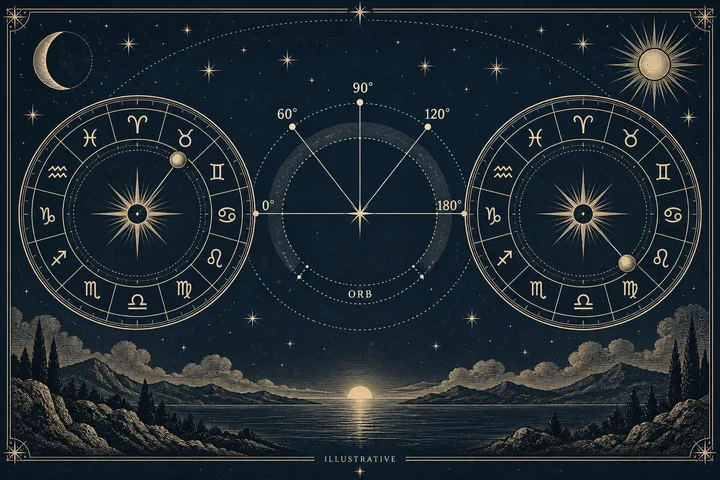
For a report with optional degrees, use a stated six-degree orb for the selected major aspects. A conjunction is based on 0 degrees, a sextile on 60, a square on 90, a trine on 120, and an opposition on 180. The orb is the distance from the exact angle that you allow. At 2 degrees, a contact deserves more weight than the same aspect at 5 degrees. At 8 degrees, it falls outside this report's chosen policy and should not be promoted as a close aspect.
The six-degree rule is an editorial scope for this comparison, not a universal law of astrology. Astrologers use different orb traditions, and synastry often benefits from a clear rule because two charts create many possible cross-connections. The practical lesson is agreement: choose the rule before ranking the contacts, then apply it to both charts. A reader should be able to see why one contact leads and another stays in the background.
Missing information changes the kind of sentence you can write. Without degrees, write Venus in an air sign may harmonize with Venus in a fire sign through shared movement and curiosity, not Venus trines Venus. Without birth times, leave houses and angles aside. Without a complete aspect list, do not call one contact the strongest in the chart. A clean limitation is more helpful than a polished invention.
Imagine Maria and Daniel comparing placements from a form. Maria has Moon in Taurus, Venus in Gemini, and Mars in Cancer. Daniel has Moon in Libra, Venus in Aries, and Mars in Capricorn. No degrees are supplied. We can discuss sign styles and likely points of contrast. We cannot claim that their Moons trine, that Venus squares Mars, or that either person activates a partner's seventh house. The example stays useful because it stays honest about what is known.
The same discipline prevents a common confusion: mistaking an attractive sign pair for a complete chart judgment. A sign gives a field of expression. An aspect gives a relationship between two placements. A house gives a place of life, but it requires dependable angles and birth times. Label each sentence privately as sign, aspect, or house. If it cannot pass that test, soften it or remove it. The reader should be able to follow every interpretive move.
When you need to mention uncertainty, make it active. Write, Degrees were not supplied, so this section reads sign style rather than aspect strength. That sentence tells the reader what to trust and what to revisit. Then move on. Good chart reading does not stall at the edge of the data. It uses the evidence that is present and labels the layer it belongs to.
Source quality matters before interpretation begins. If two chart tables disagree, don't average them and move on. Check whether they use the same zodiac system, whether one rounds positions, and whether the birth time is exact, estimated, or unknown. Record the version you chose in the report. A difference of one degree can change the order of close contacts, while a difference of several degrees can change whether a selected aspect belongs in the reading at all. The cleanest sentence is often the most useful one: this comparison follows the supplied table, uses the stated zodiac system, and treats unconfirmed degrees as unavailable.
You can also separate three levels of confidence in your notes. A sign placement is usable for a sign-style comparison when the placement is settled. A degree-based aspect is usable when both degrees are supplied and the angle falls within the chosen orb. A house or angle interpretation needs dependable birth times and a declared house method. These levels prevent a beautiful but uncertain detail from taking over the summary. They also make revision easy when a reader later supplies better data.
Sources: Synastry: Love and Relationship Astrology; Summary of Techniques in Synastry, Relationship Astrology
Read the Moon first when the question is emotional ease
The Moon is the first layer when the reader asks, Do we feel safe together? In synastry, it speaks to emotional habits, comfort, memory, and the private pace of connection. It does not describe every feeling in the relationship. It gives you a place to look for the way closeness is received and sustained.
Compare the Moon signs before looking for a spectacular aspect. Earth and water combinations may understand the need for steadiness, care, and a protected private life. Air and fire combinations may find ease through talk, play, movement, and room to breathe. These are tendencies, not personality verdicts. The whole natal chart would refine them, but a placement comparison can still give a couple a clear vocabulary.
Then inspect Moon contacts if degrees are available. A Moon-Venus contact often brings tenderness, liking, and an instinct to make daily life pleasant. It can help a couple soften after a hard exchange. Yet the same warmth can hide a problem when Venus charms the Moon instead of addressing what hurt. Ease is not proof that repair has happened. It is a resource that can make repair gentler.
A Moon-Mars contact changes the temperature. It can bring bodily pull, quick reactions, and an active emotional exchange. In a flowing form, it may help people act on care. In a tense form, one person's initiative can land as pressure while the other person's mood feels like resistance. The summary should name the loop, not label either person as difficult. Who moves first? Who needs time? What happens after the first reaction?
Consider an example with Moon in Taurus meeting Moon in Libra. Both may value peace and a pleasant environment, but they can define peace differently. Taurus may want consistency, physical reassurance, and a decision that holds. Libra may want dialogue, balance, and a choice that keeps the atmosphere kind. The shared preference for harmony is real. The friction appears when one person experiences deliberation as delay and the other experiences firmness as refusal to negotiate.
Put the shared value first, then name the exception, then give the pair a rule they can test. In this example, choices about home, money, or plans can get two tracks: a short period for Libra-style discussion, followed by a Taurus-style deadline. That keeps harmony from becoming endless delay and steadiness from becoming a refusal to revisit the choice. Astrology has translated an emotional pattern into a small act of care.
If the Moon is uncertain because the birth data is approximate, lower the claim. The Moon can move quickly, so a date near a sign change needs special care. Use the supplied Moon sign only when the source gives it with confidence. If the placement is not settled, say the emotional layer needs corrected data before you build a strong conclusion on it.
A useful Moon paragraph also distinguishes comfort from agreement. Two people may soothe one another and still want different answers about money, family, privacy, or time alone. Emotional ease tells you that the nervous system of the bond may settle together. It does not mean every practical need matches. That distinction keeps the reading kind and precise.
When you rank Moon evidence, give special attention to contacts that describe the same emotional task from different angles. A Moon-Venus contact may make affection easy, while a Moon-Mars contact may make the timing of that affection urgent. The first says, We can care for each other. The second asks, Can we approach that care without flooding or retreating? Together they form a readable pattern. Separately, they can sound like unrelated traits.
When a reader says, We understand each other without speaking, do not rush to call it a mystical signature. Ask what happens when the two people do speak. A strong Moon reading includes both the felt familiarity and the words that keep familiarity from becoming assumption.
Sources: Synastry: Love and Relationship Astrology; Synastry: Moon-Venus Aspects Between Charts
Use Venus to describe affection, taste, and what feels loving
After the Moon, read Venus. Venus shows how each person gives and receives pleasure, affection, beauty, and relationship attention. It can describe the gestures that feel romantic, the values that guide attraction, and the style each person uses when they want to draw close. Venus is not a promise of permanence. It is the language of liking and attachment.
Compare the Venus signs in plain terms. Venus in an earth sign may show love through reliability, touch, useful help, and quality. Venus in an air sign may need conversation, wit, and mental freshness. Venus in fire may respond to warmth, direct desire, and shared adventure. Venus in water may seek emotional depth, protection, and a felt sense of belonging. These sign themes become useful only when you connect them to an actual question: What gesture makes each person feel chosen?
Venus-Venus aspects refine the comparison. A conjunction can feel familiar because the two styles meet in the same place. A trine or sextile can make affection easier to exchange, even when the styles are not identical. A square or opposition can create attraction alongside a sense of being misunderstood. The friction is not simply bad taste. It can come from different expectations about pace, privacy, spending, touch, or public affection.
A Venus-Sun contact can show admiration and shared pleasure. A Venus-Moon contact can make care feel natural. Venus-Jupiter can widen generosity and forgiveness, though it can also encourage indulgence. These are interpretive patterns, not items to total. A summary becomes thin when it names ten contacts but never says which one changes Tuesday night, a difficult conversation, or the way a couple plans a weekend.
Imagine Maria's Venus in Gemini and Daniel's Venus in Aries. Maria may feel loved when the relationship stays curious, responsive, and verbally alive. Daniel may feel loved when affection is direct, immediate, and willing to act. Neither person is less romantic. But Maria might experience Daniel's speed as a lack of conversation, while Daniel might experience Maria's questions as hesitation. The useful translation is a two-part request: keep the dialogue alive, and make room for clear invitations that do not require a long preface.
This is where a writer must resist the easy contact trap. Suppose the Venus signs look naturally compatible. That does not erase a tense aspect to Mars or Saturn. It tells you what can restore goodwill after the harder pattern appears. Venus is often the balm, but balm is not the same as treatment. The summary should say how the pair can use their shared pleasure to return to the issue rather than escape it.
A strong Venus section ends with a ranked sentence. The affection style is the first resource. The difference in pace is the main adjustment. The next step is to ask each person for one specific gesture that feels loving and one gesture that feels intrusive. That question turns a sign description into a shared vocabulary.
This contrast appears in ordinary choices. One partner brings flowers; the other fixes the loose cabinet hinge. One wants a public declaration; the other prefers a private promise. Venus does not tell you which gesture is superior. It asks whether the offering reached the other person's language. Do not make Venus carry trust or responsibility on its own. Let Venus name what draws the couple together, then let the Moon show how closeness is received and Mars show what happens when desire or conflict asks for action. Keep an easy Venus pattern alive with a gesture that is specific, mutual, and repeatable.
A useful synastry summary does not choose between the easy parts and the difficult parts. It shows how they work together. Start with the supplied placements, confirm the zodiac system, and separate sign comparisons from calculated aspects. Then rank the reading by exactness, planet role, and repetition. A close Moon-Venus contact may describe emotional warmth, while a close Venus-Mars square may describe attraction that needs better timing and clearer consent. Neither statement cancels the other. Your summary should name the gift, name the point of work, and connect both to an observable choice. Use a six-degree orb for selected major aspects, say when degrees are missing, and never turn the result into a percentage or a dating verdict. The strongest conclusion is usually practical: this pair has a natural way to create closeness, a predictable place where they can rub each other raw, and one conversation that can help both patterns serve the relationship.
Sources: Synastry: Love and Relationship Astrology; Synastry: Venus-Mars Aspects Between Charts
Read Mars as heat and action, then name the friction
Mars is where a synastry summary often becomes dramatic too quickly. It can describe desire, pursuit, initiative, sexual expression, anger, competition, and the way a person moves from feeling to action. Mars brings heat. It does not decide what the heat will build.
Compare Mars signs for pace and method. Cardinal Mars may act first and adjust later. Fixed Mars may hold a line and resist being rushed. Mutable Mars may change tactics, follow the moment, or need variety. Fire can be frank and fast. Earth can be deliberate and practical. Air can act through words and ideas. Water can act through instinct, protection, and emotional timing. Keep the language flexible. A Mars sign is a style, not a sentence about character.
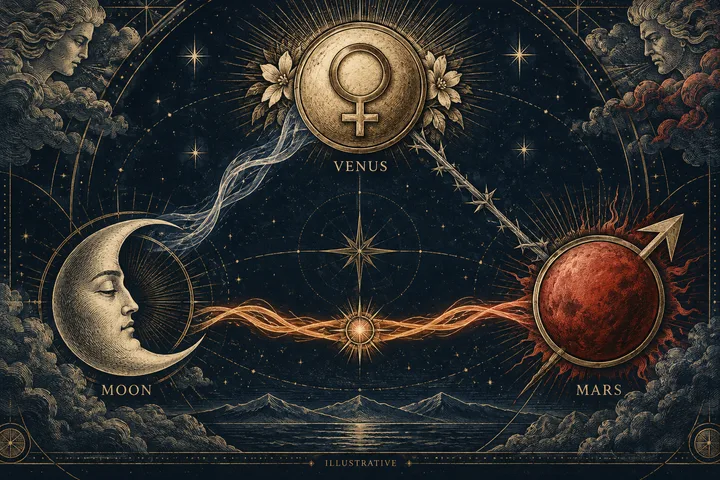
Then check Venus-Mars contacts. These are classic attraction signatures because Venus draws toward pleasure and Mars moves toward desire. A flowing aspect may make pursuit and receptivity cooperate. A square or opposition can create strong attraction with mismatched timing. One person reaches, the other braces. Then the roles reverse. That push-pull can feel thrilling at first and exhausting when neither person learns the rhythm.
The report should never turn this into a bedroom verdict. It can ask better questions. Does directness feel exciting or invasive? Does waiting feel respectful or withholding? Can either person say not yet without making the whole bond feel rejected? Can desire return after a disagreement, or does conflict become the only route to intensity? Those questions honor Mars because they give its force somewhere clean to go. They also keep attraction connected to trust, choice, and the ordinary care that lets desire remain welcome over time.
Consider this example: Maria's Mars in Cancer meets Daniel's Mars in Capricorn by sign opposition, but no degrees are supplied. We can describe a polarity between protective, mood-led action and goal-led, controlled action. We cannot claim an exact Mars opposition. In daily life, Maria may want emotional acknowledgment before solving the problem. Daniel may reach for a plan before discussing the feeling. The repair is not to choose one style. It is to make the order explicit: first name what happened, then decide what to do.
If degrees later confirm a close Mars-Saturn hard aspect, the ranking changes. The issue may move from simple difference to blocked action, frustration, or a sense that one person's effort meets a wall. If a close Jupiter contact also appears, goodwill may help the pair recover. If the only Mars contact is a loose sign-based contrast, keep the language lighter. This is why aspect strength matters. The same planet pair can carry different weight at different distances.
Friction earns its place in the summary when you describe its constructive use. A square asks for a method. An opposition asks for balance. A conjunction asks for conscious separation when both people amplify the same impulse. Mars becomes useful when the couple can disagree without using desire, silence, or urgency as a weapon. The chart points to the training ground. The couple chooses the practice.
A writer can make Mars concrete by tracing a small sequence. One person asks for closeness. The other is tired and delays. The first person pushes harder because delay feels like disinterest. The second person withdraws because pressure feels unsafe. That is the loop. The astrological interpretation becomes useful when it tells the couple where to interrupt it, perhaps with a clear answer, a defined pause, and a promised return.
Strong attraction deserves careful language because it can be both joyful and destabilizing. Say that a contact may intensify pursuit, desire, or reaction. Do not say it guarantees sexual fulfillment or proves that two people belong together. Mars shows force. The relationship decides how that force is handled.
Sources: Synastry: Love and Relationship Astrology; Synastry: Venus-Mars Aspects Between Charts
Integrate the chart instead of adding up good and bad
This is the turn that separates a reading from a list. You have Moon information, Venus information, Mars information, and perhaps several aspects. Now you need to decide what the chart is mostly saying. Do not add soft aspects and subtract hard ones. A relationship is not a scorecard, and a pile of contacts is not yet a pattern.
Look for reinforcement. If the Moon and Venus both suggest a need for reassurance, that theme outranks one isolated Mars difference. If Venus and Mars both repeat a direct, fast style, attraction may be easy while patience becomes the work. If the Moon wants quiet and Mars keeps pushing for action, the report should connect the emotional and physical layers instead of describing each planet in a separate silo.
Look for compensation, too. A difficult Venus-Mars aspect may be easier to handle when Moon-Venus offers tenderness and Mercury contacts support honest talk. A strong Saturn contact may feel demanding, yet it can give the pair structure if both people experience responsibility as shared rather than imposed. A flowing aspect can support a hard one, but it does not erase it. The support tells you where to begin the repair.
Now rank exactness. A close major aspect usually deserves more attention than a broad one. Repeated contacts between the same planet pair deserve more attention than unrelated details. Personal planets deserve priority when the reader is asking about daily affection, emotional safety, and desire. Outer-planet contacts can deepen the symbolism, but do not let a compelling phrase about intensity outrank the personal pattern the couple actually lives.
Here is a worked synthesis for our illustrative example. Maria's Taurus Moon and Daniel's Libra Moon share a wish for peace, but they may seek it through different routes. Maria's Gemini Venus and Daniel's Aries Venus can enjoy liveliness, though one needs conversation and the other direct movement. Maria's Cancer Mars and Daniel's Capricorn Mars describe a sign polarity between feeling-first action and plan-first action. The supported view is not that they are doomed to clash. It is that affection can keep the bond open while timing and conflict style need a deliberate agreement.
The strongest exception is important. If exact degrees later show a close Moon-Venus trine, the emotional layer may be much smoother than the sign contrast suggests. If they show a close Venus-Mars conjunction, the attraction may be more immediate and insistent than the separate Venus signs imply. If the degrees show no selected major aspects, keep the reading at the sign layer. The interpretation should change when the inputs change. That is not weakness. It is sound chart reading.
Write the conclusion in three movements. First, name the resource: what comes naturally? Second, name the friction: where does the pair need skill? Third, name the decision: what can they try this week? For this example, the decision is to build a conflict sequence that honors feeling before action, while also setting a time to move from discussion to a plan. That sentence is more useful than any compatibility number.
Use a removal test before you publish. Take out the loosest contact. If the conclusion collapses, you gave that contact too much weight. Then remove the labels and read the sentence again. ‘One person needs time before action, while the other needs action to feel secure’ describes an exchange. ‘She is needy and he is cold’ assigns a verdict. Also check direction. The Venus person and Mars person may experience the same aspect differently, so describe the exchange and ask which moment comes first in real life. The chart stays open to the people living it.
A simple ranking table can keep the prose honest. In your private notes, give each candidate pattern four labels: data status, exactness, planet relevance, and repetition. Data status asks whether the contact is calculated or only sign-based. Exactness asks how close it is to the exact angle. Planet relevance asks whether it speaks to the reader's question. Repetition asks whether another contact tells the same story. The leading interpretation should win on the whole set, not on the most dramatic name.
Suppose a supplied list shows a close Moon-Venus sextile, a wider Venus-Mars square, and several sign contrasts involving the personal planets. For a question about emotional ease, the Moon-Venus contact leads. The Venus-Mars square comes next because it explains a possible tension in attraction or timing. The sign contrasts provide texture, but they shouldn't overturn the calculated order. If the question is sexual rhythm, the Venus-Mars contact may move up. The ranking changes with the reader's question, not because the chart changed.
This is also where you decide what to leave out. A contact can be meaningful in a full synastry study and still be wrong for a short summary. If it doesn't clarify the couple's stated concern, it belongs in the background. Readers usually need a few well-connected patterns, not every line generated by a chart table. Selection is part of interpretation.
Sources: Synastry: Love and Relationship Astrology; Aspects Between Charts
Turn the summary into a conversation you can actually use
A synastry summary earns its keep when the reader can do something with it. The chart is a symbolic map of exchange. It is not a substitute for asking the person in front of you. End each major interpretation with a question that invites confirmation, correction, or a more precise example.
The conversation also keeps the reading mutual. The person whose Venus is contacted is not the only one who feels the Venus story, and the person carrying Mars is not automatically the pursuer in every situation. Synastry describes a meeting. Both people shape its expression. Ask each partner for the moment when the pattern feels most alive, then listen for the detail the chart language missed.
For the Moon layer, ask, What helps you come back to yourself when you feel upset? For Venus, ask, Which ordinary gesture makes you feel loved, and which one feels performative? For Mars, ask, How should I approach you when I want closeness but you need space? These questions keep the reading mutual. They stop one person from becoming the chart's fixed type and the other from becoming the judge.
If the summary names a square, give it a method. A square between Venus and Mars may need slower invitations, clearer refusals, and a way to return after tension. A Moon-Mars square may need a pause before either person tries to solve the emotion. An opposition may need alternating leadership rather than a permanent winner. A conjunction may need boundaries because the two people can amplify one another until neither knows whose desire is speaking.
If the summary names an easy aspect, give it a job. A Moon-Venus contact can become a repair ritual: tea, a walk, a hand on the shoulder, or the sentence I want to understand what happened. A Venus-Jupiter contact can support generous interpretation, but the couple should still name the limit before generosity becomes avoidance. A trine can make connection smooth. Smooth connection still needs attention.
The report should also say what it cannot answer. A Moon, Venus, and Mars comparison does not describe every house, angle, ruler, or life circumstance. It cannot tell you whether someone will choose commitment or certify a soulmate bond. It can show where two styles meet, where they pull apart, and what kind of conversation may help. That is enough to be valuable when the next step is clear.
When you write the final paragraph, return to the opening decision. You began with the problem of ease and friction appearing together. Now the interpretation has changed the problem. You no longer have to ask which one is the truth. You can ask which ease will support the work, which friction needs a shared rule, and whether both people are willing to practice it.
For readers who already know their placements, a supplied-placement comparison is the right next step. Enter the Moon, Venus, and Mars signs, add degrees when you have them, and keep the zodiac system consistent. The Synastry Comparison Report can organize selected major aspects with a six-degree orb, but it does not calculate a natal chart from birth details or invent missing houses. Bring the result to a real conversation. That is where the chart becomes lived knowledge.
A useful final summary can follow one sentence pattern: the natural resource is X; the main friction is Y; the shared practice is Z. Fill X with the strongest supported ease, not the most flattering phrase. Fill Y with a behavior or timing problem, not a character judgment. Fill Z with an action both people can try and review. For example: the pair has an easy affection style, but different speeds around conflict; they should name the feeling first, set a time for the decision, and check whether that order helps. The sentence is short enough to remember and specific enough to test.
Before that conversation, choose one passage rather than treating the whole report as a verdict. Ask your partner what fits, what does not, and what example comes to mind. Then choose one practice that matches the friction: name the feeling before proposing a solution, ask before changing plans, or give a direct answer when the other person is waiting. Keep it small enough to repeat. After a week or two, ask whether it helped. Keep the rule, revise it, or choose a better one. Return to the opening question: which ease can support the work, and which friction needs a shared rule?
Sources: Synastry: Love and Relationship Astrology; Aspects Between Charts
A little more clarity
Should easy synastry aspects outweigh difficult ones?
No. Rank them instead of adding them. Start with the tightest relevant aspect, then consider the planet roles and repeated themes. An easy Moon-Venus contact may support repair, while a Venus-Mars square may describe a recurring timing problem. The first can help the second, but it does not cancel it.
Can I read synastry without birth times?
Yes, if you keep the scope narrow. You can compare supplied Moon, Venus, and Mars signs and use degrees when they are known. Without reliable birth times, leave houses and angles out. Be careful with the Moon near a sign change, and do not present an inferred aspect as a calculated one.
What does a six-degree orb mean in a synastry report?
It means the report counts a selected major aspect when the two placements fall within six degrees of its exact angle. A conjunction is 0 degrees, a sextile 60, a square 90, a trine 120, and an opposition 180. Tighter contacts receive more interpretive weight.
How should I use a synastry summary with my partner?
Use it as a shared vocabulary, not a verdict. Read the resource, the friction, and the suggested question together. Ask whether the pattern fits real experience, then agree on one small practice, such as slowing a difficult conversation or naming the gesture that feels loving. Keep checking the pattern together.
Sources & further reading
- Synastry: Love and Relationship Astrology
Supports the roles of Venus, Moon, Mars, conjunctions, flowing aspects, squares, oppositions, and integrated relationship interpretation.
- Aspects Between Charts
Supports reading interchart aspects with the planet roles, sign placements, and inner-planet contacts in view rather than treating an aspect as an isolated label.
- Synastry: Moon-Venus Aspects Between Charts
Supports Moon-Venus contacts as a source of natural affection and tension-diffusing warmth, without removing disagreement.
- Summary of Techniques in Synastry, Relationship Astrology
Supports separating temperament comparison, interchart aspects, house overlays, and other relationship-chart techniques so each layer keeps its proper scope.
- Synastry: Venus-Mars Aspects Between Charts
Supports Venus-Mars contacts as attraction patterns whose harder forms can also show conflict, mismatched timing, and the need for conscious handling.
Synastry Comparison Report
Enter known placements for two people. Get an input-by-input comparison, selected aspect calculations and a clear record of what remains uncertain.
Compare our placements