
Imagine Maria and Daniel choosing the wrong question
Imagine Maria and Daniel have been seeing each other for a few months. Their conversations are warm until plans change. Maria wants to talk through the change right away. Daniel needs time before he can say what he means. She reads his quiet as withdrawal. He reads her urgency as pressure. By the time they sit down, they’re arguing about the argument.
They have a short list of known placements. Maria’s Moon is in Cancer, Venus is in Gemini, and Mars is in Virgo. Daniel’s Moon is in Aquarius, Venus is in Taurus, and Mars is in Sagittarius. They don’t have a complete set of degrees, so they can’t responsibly claim exact aspects, houses, or angles. Still, the sign layer gives them a starting vocabulary. Water and air can describe different ways of seeking safety. Gemini and Taurus can describe different love languages. Virgo and Sagittarius can describe different approaches to action and timing.
Their first question is tempting and useless: Which one of us is right? Synastry can’t settle that. It also shouldn’t be asked to predict whether the relationship will last, name a soulmate, or reveal what Daniel secretly intends. Those questions hand the decision to the chart before the people have spoken plainly.
A better question is smaller. What should we talk about before the next plan changes? Maria and Daniel can choose the theme of emotional timing. They can each describe what happens inside them when a message is delayed, state what helps, and ask what the other person can realistically offer. Their placements may help them notice why the same pause lands differently. The conversation still belongs to them.
That distinction is the heart of this guide. A synastry reading compares two charts and studies how one person’s planets meet the other person’s. It gives you a field of interaction, not a verdict. Use it to choose a door. Then knock.
Sources: Ep. 165 Transcript: Synastry: The Astrology of Relationships | The Astrology Podcast; TAP Ep. 323 Transcript: Aspects in Astrology: The Five Major Configurations | The Astrology Podcast
What can synastry actually choose for you?
It can choose a useful topic. That’s the right size of the promise.
When one person’s planet contacts another person’s planet, astrologers read an exchange between functions. The Moon brings feeling, habit, comfort, and the need for care. Venus brings attraction, pleasure, affection, and values. Mars brings desire, assertion, heat, and the way a person moves toward action. Mercury brings language, thought, and the traffic of everyday conversation. The Sun describes vitality, identity, and the way a person shines. These meanings don’t tell you what a person will do in every situation. They give you a precise place to look.
Suppose you know that one person’s Mercury is closely connected with the other person’s Mars. The topic might be how direct speech becomes motivating in one moment and combative in another. With a Moon-Saturn contact, the topic might be emotional responsibility, patience, or the fear that care will become duty. With Venus-Jupiter, you might discuss generosity and the point at which encouragement turns into indulgence. With Neptune touching Venus, ask where romance is vivid and where assumptions need checking. The topic comes from the planets. The wording comes from the lived situation.
The chart also helps you avoid a common mistake. People often turn an astrological symbol into a verdict. Mars means anger. Saturn means blockage. Neptune means deception. That is too crude. A symbol has a range. Mars can be courage, appetite, irritation, or initiative. Saturn can be fear, commitment, endurance, or a boundary. Neptune can be devotion, imagination, longing, or projection. Treat the symbol as a question about the moment, not a label for the person.
Ask a question that allows more than one answer. What helps you feel close when we’re busy? What does a direct request sound like to you? Which part of our conflict repeats, and which part changes? What kind of reassurance feels loving rather than managing? These questions keep interpretation alive. They also keep the reader in charge of the next move.
Make the translation concrete with a three-column note. In the first column, write the pairing: Moon with Venus, Mercury with Mars, or Venus with Saturn. In the second, record one behavior you’ve actually seen: quick comfort, interruptions, or a promise kept without much warmth. In the third, name the need beneath it: comfort that listens, speech with room to land, or commitment that still feels tender. Turn the third column into a question, then tie the answer back to the second. If you can’t point to an event, the theme isn’t ready to lead the conversation.
Give the same contact two lines in your notes. One line names what the planet person may experience. Venus may feel drawn to Mars’s directness. The other names what the contacted person may experience. Mars may feel stirred by Venus’s approval, taste, or refusal. Check both lines against one event. If one person felt invited and the other felt pressured, the topic isn’t simply chemistry. It’s how invitation becomes pressure, and how either person can signal a change of pace.
The chart picture organizes the comparison. It isn’t a script. Once you have a theme, move from symbolism to a question another person can answer.
Use synastry as a prompt finder, not a referee. Start with the placements you actually know, especially the Moon, Venus, and Mars. Look for one clear contact or sign contrast that names a real relationship theme, such as emotional reassurance, affection, pace, or conflict. Then turn that theme into a neutral question about something you can both observe. If your synastry shows a Venus-Mars square, for example, don’t ask whether you’re meant to be. Ask how each of you experiences pursuit, timing, touch, and a pause after tension. Rank the tightest major aspect first, then let the planets tell you what to discuss and the signs tell you how the subject may sound. A chart can give the conversation language. It can’t answer for either person. Your next step is simple: choose one theme, name one recent example, and ask one question that leaves room for a real answer.
Sources: Ep. 165 Transcript: Synastry: The Astrology of Relationships | The Astrology Podcast; TAP Ep. 323 Transcript: Aspects in Astrology: The Five Major Configurations | The Astrology Podcast; Synastry: Venus-Mars Aspects Between Charts | Cafe Astrology
Which chart layer should you read first?
Read the aspect layer first when you have degrees. Read the sign layer first when you don’t. Then combine them only as far as your inputs allow.
An aspect is the angular relationship between two chart factors. The five major aspects are the conjunction at 0 degrees, sextile at 60, square at 90, trine at 120, and opposition at 180. The angle describes how the two functions meet. A conjunction blends them. An opposition sets them across from each other. A square creates friction that asks for work. A trine flows with ease. A sextile offers a cooperative opening that still needs participation.
The planet pair gives the subject. The aspect gives the movement. The signs give the style. This three-part sentence is useful because it prevents a single placement from carrying the whole reading. Moon square Mars, for example, does not simply mean emotional conflict. It suggests that feeling and action meet with heat. The signs can show whether that heat comes out as blunt speech, retreat, persistence, teasing, or a demand for immediate repair. The observable example tells you which one is happening.
When a contact crosses from one sign into another, keep both layers in view. The angle may be close by degree while the signs tell a different story from the textbook version of that aspect. Astrologers call this an out-of-sign or dissociate aspect in some traditions. It can still be worth considering, especially when the planets are close, but the sign relationship may alter how the exchange speaks. Don’t force the angle to erase the signs, and don’t let the signs make you ignore a close angle. Describe the tension plainly.
Distinguish the two roles before you interpret the contact. The planet person often describes the function being brought into the exchange. The contacted person describes the place that gets stirred. In a Venus-Mars contact, Venus may seek pleasing connection while Mars pushes toward action. Don’t assume either role belongs to the more eager partner. Ask each person what they felt invited to do, what felt demanded, and what signal would make the exchange easier to read next time.
If degrees are missing, don’t imply an aspect because two signs look compatible. A sign comparison is real material, but it is not a calculated inter-aspect. You can compare elements, modalities, and the planet’s sign expression. You can’t claim that a conjunction is exact, that an orb is tight, or that one person’s planet falls in the other person’s house. That distinction protects the reading’s usefulness. Precision makes a smaller claim stronger.
Astrologers also rank contacts by closeness and relevance. An exact or very tight aspect usually deserves attention before a wide one. The Astrology Podcast discussion on synastry describes tighter aspects as more often felt as important, while also stressing that easy aspects aren’t automatically better than difficult ones. That gives you two filters. First, ask how close is the contact? Second, ask what kind of work or attraction does it create? Don’t collapse both questions into good or bad.
For a conversation topic, the order is straightforward. Identify the planet pair. Identify the aspect and its orb if the degrees support it. Note the signs. Find one recent situation that could express the pattern. Only then write the question.
Sources: Ep. 165 Transcript: Synastry: The Astrology of Relationships | The Astrology Podcast; TAP Ep. 323 Transcript: Aspects in Astrology: The Five Major Configurations | The Astrology Podcast
How do planetary contacts become useful questions?
Translate in four moves: symbol, behavior, need, question. Stop before prediction. For couples comparing supplied placements, begin with the personal planets because they bring the chart close to the ordinary moments where a relationship either warms or frays.
Take a Venus-Mars contact. The symbol joins attraction and action. The behavior might be one person initiating plans, touch, or difficult conversations while the other person alternates between enthusiasm and resistance. The need might be a clearer pace. The question could be, What helps pursuit feel welcome, and what tells you it has become pressure? That question is specific enough to answer and open enough to reveal something new.
Take a Moon-Venus contact. The symbol joins emotional security with affection. The behavior might be cooking for each other, seeking physical presence, or trying to smooth over a hurt with charm. The need might be tenderness that doesn’t skip the hard part. Ask, When you’re upset, do you want comfort first, solutions first, or quiet first? What makes an apology feel warm instead of decorative?
Take a Mercury-Mars contact. The symbol joins speech with force. The behavior might be fast replies, lively debate, interruptions, or a conversation that starts as planning and ends as a contest. The need might be room to finish a thought. Ask, What does directness help us do, and when does it stop helping? Should we slow down, write it out, or return to the topic later?
Take a Venus-Saturn contact. The symbol joins affection with time, structure, and responsibility. The behavior might be reliable care that feels reassuring one day and heavy the next. The need might be a way to separate commitment from obligation. Ask, Which promises make you feel held, and which ones make you feel managed? What can we keep doing when neither of us feels romantic?
These translations aren’t fixed formulas. They’re working hypotheses. The strongest question can be answered with an example. It asks what happened, what each person needed, and what could change next time.
A good synastry prompt has three qualities. It names one theme, points to something observable, and leaves both people free to correct the interpretation. That last quality matters. A chart reading should invite recognition, not demand agreement.
The Moon asks, What helps us feel safe and understood? Compare Moon signs for instinctive styles. A water Moon may seek emotional attunement and a protected space for feeling. An air Moon may need perspective, conversation, and room to breathe. An earth Moon may trust steadiness, practical care, and follow-through. A fire Moon may come alive through candor, movement, and visible enthusiasm. These are broad sign meanings, not diagnoses. The question is how each person actually receives care.
Venus asks, What do we enjoy, value, and call loving? Venus in an air sign may show affection through words, curiosity, and shared ideas. Venus in an earth sign may prefer consistency, touch, and tangible proof. Venus in a fire sign may want warmth, play, and clear desire. Venus in a water sign may look for emotional depth and a sense of merging. When Venus contacts another planet, the contact can shape what feels pleasant, wanted, or beautiful between you.
Mars asks, How do we pursue, push, protect, and handle heat? Mars can show sexual desire, but it also describes initiative and assertion. A Mars-Mercury contact may make discussion stimulating or sharp. A Mars-Moon contact may bring instinctive chemistry and quick emotional reactions. A Mars-Saturn contact may make effort feel disciplined, delayed, or blocked. The question should focus on pace and repair, never on using attraction as proof that disrespect is acceptable.
A useful reading keeps the roles separate. The Moon may show what gets touched. Venus may show how affection is offered. Mars may show how the pair acts on desire or tension. Imagine a supplied comparison in which one person’s Moon points toward reassurance, Venus contacts the other person’s Mercury, and Mars meets Saturn. The first topic may be emotional safety, the method of discussing it may need care, and the practical question may concern timing and follow-through. Don’t flatten those layers into one label. Ask which part appeared in the recent event, then rank the rest for later.
Cafe Astrology’s synastry references describe Venus-Mars contacts through attraction, pursuit, and friction, while its Mercury-Venus reference links the pairing with warmth, conversation, and competing ways of expressing affection. Use those traditions as prompts, then test the expression against the relationship you can see.
Sources: Ep. 165 Transcript: Synastry: The Astrology of Relationships | The Astrology Podcast; Synastry: Venus-Mars Aspects Between Charts | Cafe Astrology; Synastry: Mercury-Venus Aspects | Cafe Astrology
What changes when the aspect is easy or difficult?
Don’t use easy aspects for compliments and difficult aspects for warnings. Use both kinds to find the work the relationship is asking you to notice.
A trine can show a natural flow. That sounds pleasant, and it often is. But ease can become automatic. If one person’s Moon trines the other person’s Venus, comfort may come quickly, yet the couple may assume the other person already knows what care means. Ask, Which caring habit comes easily to us, and how can we make it visible instead of taking it for granted? A sextile also offers cooperation, but it may need a deliberate choice before its promise becomes behavior.
A square can show friction, but friction has information. If Venus squares Mars, attraction may coexist with different timing or different ways of expressing desire. The useful topic is not whether the square is bad. It’s how each person signals yes, no, not yet, and try again. If Mercury squares Mars, discuss interruption, bluntness, and the difference between urgency and importance. If Moon squares Saturn, discuss when responsibility feels protective and when it feels cold.
An opposition brings two ends of an axis into the room. It can feel magnetic because each person carries something the other recognizes as different. The couple may complement each other, compete, or swing between both. Ask, Which side do I over-rely on, which side do you protect, and what would a middle path look like this week? The question creates movement where a label would create a standoff.
A conjunction concentrates the planetary meanings. It can feel immediate and familiar. That strength can help a pair name a shared language, but it can also make their blind spot harder to see. Ask, What do we both do naturally here, and what might neither of us be noticing? A conjunction of Venus and Mars can bring desire and attraction. It still doesn’t answer how the pair handles boundaries, conflict, or commitment.
The Astrology Podcast discussion makes the useful exception plain: difficult aspects can bring passion, interest, and growth, while easy aspects aren’t automatically the best relationship indicators. Cafe Astrology likewise describes squares as capable of creating frustration and stimulating change. Rank the aspect by the conversation it opens, not by a simple comfort scale.
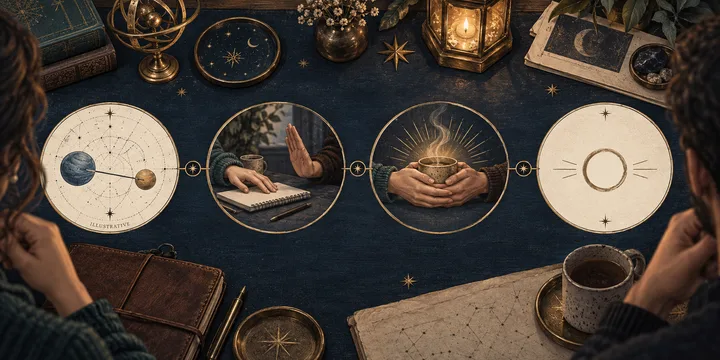
Sources: Ep. 165 Transcript: Synastry: The Astrology of Relationships | The Astrology Podcast; TAP Ep. 323 Transcript: Aspects in Astrology: The Five Major Configurations | The Astrology Podcast; Synastry: Venus-Mars Aspects Between Charts | Cafe Astrology
How do you rank several possible topics?
When a comparison offers many contacts, don’t discuss all of them. A crowded reading can make a couple feel informed while leaving them with nothing to say. Rank the themes.
First, choose the tightest major personal-planet contact you can support. If the degrees are supplied, record the exact separation and apply the report’s six-degree orb. A contact at 1 degree deserves a different level of attention from one at 5 degrees 40 minutes, even though both fall within the stated range. If a degree is missing, don’t pretend to rank exactness. Use the sign layer and say what remains unknown through the structure of the reading, not through a long warning.
Second, choose the planet pair closest to the decision in front of you. If tonight’s problem is a missed text, Mercury may matter more than a beautiful Venus-Jupiter contact. If the problem is different expectations about affection, Venus deserves the first question. If the issue is who initiates and who pulls away, Mars may give the clearest starting point. Relevance can outrank drama.
Third, choose the theme that has a matching observable example. A contact that sounds intense but has no expression in the couple’s life should remain a possibility, not the headline. A modest Moon sign contrast that explains the recurring Sunday-night tension may be more useful than a grand theory about Pluto. The best prompt is the one you can revisit after the conversation and recognize in the next ordinary week.
Fourth, look for support or contrast elsewhere in the supplied placements. If one contact suggests quick pursuit but both Venus signs prefer patience, the topic becomes pace. If a Moon contact promises ease but the Mars signs clash around conflict, the topic becomes what happens after the first warm response. Read the chart as a pattern, not a collection of slogans.
If two themes compete, prefer the one that explains both the attraction and the snag. A contact that only describes chemistry may be worth discussing later. A contact that explains why one person reaches out and why the other hesitates can guide the next conversation now. This doesn’t make the second contact more powerful in every reading. It makes it more useful for the decision at hand.
Test your ranking by finishing this sentence: If we talked about only one chart theme tonight, I’d choose this one because it would help us understand ____. If the blank fills with a real choice, such as how to ask for space or repair a sharp remark, keep the theme. If it fills with a fantasy, such as whether this person is destined for me, go back to the event and choose a smaller question.
Write the ranking in one sentence: Start with the strongest supported contact, check whether it matches the current decision, then choose the theme that leads to an example and a shared question. If two themes still tie, choose the one that both people can test within a week. That last filter matters. It turns a symbolic comparison into a usable decision without pretending that a chart has settled the relationship. Synastry chooses where to look. You choose what to do with what you find.
Sources: Ep. 165 Transcript: Synastry: The Astrology of Relationships | The Astrology Podcast; TAP Ep. 323 Transcript: Aspects in Astrology: The Five Major Configurations | The Astrology Podcast
What if the chart points one way and life points another?
Let lived behavior outrank an attractive interpretation. The chart can suggest a theme. Repeated experience tells you how that theme is being expressed.
Consider an example. A couple sees a warm Venus-Moon contact and assumes every hurt should resolve through closeness. But one partner keeps changing the subject whenever the other names a problem. The contact may describe affection and familiarity. It doesn’t erase avoidance. Their conversation should be about repair: Can we stay present for ten minutes while one person speaks, then switch? What does a real response look like?
Now reverse it. A couple sees a hard Mercury-Mars contact and expects every disagreement to become a fight. Yet they’ve learned to pause, write down the issue, and return when both can listen. The aspect may still describe a charged style of exchange. It can also describe a skill they’ve built around that charge. Ask what makes the pause work. Ask whether either person feels silenced by it. The chart opens the subject. The practice supplies the evidence.
This is where the strongest exception belongs. A contact may be technically exact and still not be the best first topic if the couple is facing a more immediate, concrete issue. A tight Saturn contact doesn’t make a late rent payment less urgent. A vivid Venus-Pluto contact doesn’t make jealousy a romantic obligation. A beautiful trine doesn’t turn a missing apology into a minor detail. Astrology can help you understand the pattern, but it can’t excuse conduct that violates the relationship’s stated boundaries.
Ask three grounded questions. What happened, in observable terms? What meaning did each person give it? What action would make the next version different? Then bring astrology back in. Does the chart theme help explain why the moment felt charged, tender, rushed, or confusing? If it does, keep the insight. If it doesn’t, set it down.
Let the chart sharpen your attention, then return to the person. If a reading makes you less curious about lived experience, it has gone too far.
Sources: Ep. 165 Transcript: Synastry: The Astrology of Relationships | The Astrology Podcast; TAP Ep. 323 Transcript: Aspects in Astrology: The Five Major Configurations | The Astrology Podcast
How do missing degrees change the conversation?
Missing degrees reduce the precision of the comparison, but they don’t make every question impossible. Change the claim, then keep going.
With known signs and unknown degrees, you can discuss the planet’s sign expression and the contrast between two placements. You can ask how a Cancer Moon and an Aquarius Moon each seek safety, or how Venus in Gemini and Venus in Taurus may differ in the way affection is shown. You can compare elements and modalities as interpretive layers. You cannot state that the Moons form a close opposition unless the actual degrees support that calculation. The missing number changes the kind of sentence you’re entitled to write, not your ability to begin a useful conversation.
With one person’s degrees missing, you also can’t honestly rank the aspect by exactness. The report’s stated six-degree orb applies when the necessary degrees are available. If the data falls short, mark the contact as unconfirmed and choose a sign-based topic instead. That might sound like a smaller reading. It is. It’s also a cleaner one.
Keep an evidence note beside each possible topic. Write the two placements, the degrees you have, the aspect you can verify, and the number that remains unknown. For example, you might record Venus at 14 degrees Taurus for one person and Mars in Sagittarius with no degree for the other. The signs suggest a style contrast, but the contact cannot be ranked inside a six-degree orb. Your note might read: possible Venus-Mars theme, degree unconfirmed, discuss pace only if the recent event supports it. This small habit stops a vivid interpretation from outrunning the data. It also makes a later correction easy. When the missing degree arrives, calculate the separation, decide whether the contact qualifies, and either strengthen the topic or retire it. Good chart work stays open to revision without throwing away what the first honest comparison already taught you.
House overlays require still more information. They depend on a reliable chart framework and a birth time. If your comparison contains only supplied Moon, Venus, and Mars placements, keep the discussion at the sign and aspect layers that the data can carry. Don’t decorate a placement-only reading with invented houses or angles. The reader deserves to know what the comparison actually contains.
The practical question becomes, What can we discuss without needing a tighter calculation? Start with one ordinary exchange. Who reached out, who paused, what did each person assume, and what happened next? From there, ask how each person gives reassurance, receives affection, takes initiative, handles a pause, or reacts to direct language. Compare what each person says they need with what they tend to offer. A sign-only reading can still reveal the question, as long as the event supplies the evidence.
A placement-only comparison can be especially good at revealing the question behind a general feeling. Instead of saying, We’re different, you can ask, Do we each treat quiet as care, distance, or preparation? Instead of saying, We have chemistry, you can ask, What kind of approach keeps desire mutual and unhurried? Instead of saying, We communicate badly, you can ask, Which part of the exchange breaks first: timing, tone, listening, or follow-through? The chart doesn’t need to provide every answer to improve the question.
If one person’s placement is uncertain, use language that holds the uncertainty without making the conversation stiff. You might say, This sign contrast gives me a possible way to describe the moment. Does it fit you? That invites correction. It also keeps the reading faithful to what you know. A careful boundary doesn’t weaken the tradition. It keeps the interpreter from pretending to see more than the chart data contains.
If you later obtain corrected degrees, update the ranking rather than rewriting the whole relationship story. A new tight contact may move one topic to the front. It may also confirm that the sign-based question was useful. Chart precision refines the conversation. It doesn’t invalidate the honest one you already had.
Sources: Ep. 165 Transcript: Synastry: The Astrology of Relationships | The Astrology Podcast; TAP Ep. 323 Transcript: Aspects in Astrology: The Five Major Configurations | The Astrology Podcast
What should you say, try, and decide after the reading?
Bring one theme, one example, and one question. Leave the chart out of the first sentence. Start with the event. I noticed that when our plans changed on Tuesday, I wanted to talk immediately and you went quiet. Then name your experience without assigning motive. I felt alone and started filling in the silence. Invite their view. What was happening for you? This opening gives the other person something real to answer.
After you’ve heard each other, introduce the astrological lens. Our Moon signs seem to describe different ways of finding safety. Does that fit what happened, or does another explanation fit better? This phrasing matters. It treats astrology as a meaningful language while allowing the person in front of you to add lived detail. You’re comparing a symbol with an experience.
If the topic comes from Venus, ask about affection. What makes you feel chosen in an ordinary week? What kind of attention feels natural to give you? If it comes from Mars, ask about action and heat. How do you want me to approach you when you’re frustrated? What tells you I’m ready to keep talking? If it comes from Mercury, ask about language. Do you want a direct answer, a softer opening, or time to think?
Make the next step small enough to try. For the next two plan changes, Maria and Daniel might agree that the person who needs space names a return time, while the person who wants contact asks once without chasing. That experiment doesn’t prove a chart. It turns a theme into behavior the couple can observe. Keep consent in the room. A partner can decline a chart discussion and still deserve a respectful conversation about the event itself. Don’t use astrology to corner someone, expose a private fear, or win an argument. The chart is most helpful when both people can put it down.
A good opening sounds ordinary. That’s a strength. The symbols may be old and rich, but the question should be clear enough to ask over coffee and specific enough to answer before the subject changes.
The decision isn’t whether the chart approves. It’s whether the two of you understand the topic well enough to choose a next action.
Use a short script if the symbols have made the subject feel larger than it is. Say, We’re learning how different needs for emotional timing affect our conversations. I can tell you when I need a pause instead of disappearing. You can ask for reassurance without treating the pause as proof of rejection. Does that feel fair to both of us? Then make one small agreement and test it twice. A pause needs a return time. A request needs an answer. A repair attempt needs a response. Different Moon, Venus, or Mars styles can become a shared practice when both people stay curious. Watch the behavior before you widen the interpretation.
Finally, decide what deserves another conversation. If the chart gave you a useful name for the problem, keep using that name as shorthand. If it made the problem feel fated, frightening, or bigger than the evidence, shrink it back to the event. If a new degree calculation changes the strongest contact, update the topic. If nothing changes in real life, let that fact speak.
Finish with a simple record. Write down the contact or sign contrast, the example you discussed, the question each person answered, and the behavior you agreed to try. Add a return date and one sign that the experiment is working. A return date turns the reading into practice. It lets the relationship show which part of the symbolism is alive, which part needs a different expression, and which part was never the right topic. Keep the record private, brief, and practical.
Synastry is at its best when it makes two people more articulate. It can show where attraction gathers, where needs rub, and where a relationship has a natural way in. The relationship is lived in choices. Choose the topic, ask the question, and watch what happens next. If the agreement holds, keep working with the theme. If it doesn’t, name the behavior plainly and decide what boundary or repair is needed. That is the point where interpretation ends and your shared choice begins.
Sources: Ep. 165 Transcript: Synastry: The Astrology of Relationships | The Astrology Podcast; TAP Ep. 323 Transcript: Aspects in Astrology: The Five Major Configurations | The Astrology Podcast
A little more clarity
Can synastry tell me what conversation my partner is ready to have?
It can suggest a topic, not read your partner’s private readiness. Use the strongest supported planet contact or sign contrast to frame a gentle question, then ask directly whether this is a good time to talk. Let their answer guide the timing.
What should I do if I only know our Moon, Venus, and Mars signs?
Stay with sign meanings and avoid claiming exact aspects, houses, or degrees. Compare how each person seeks care, gives affection, and takes action. Turn the clearest contrast into one question about a recent, observable moment.
Sources & further reading
- Ep. 165 Transcript: Synastry: The Astrology of Relationships | The Astrology Podcast
Supports using synastry to describe relationship dynamics, open communication, and understand repeating interaction patterns rather than seek a perfect relationship verdict.
- TAP Ep. 323 Transcript: Aspects in Astrology: The Five Major Configurations | The Astrology Podcast
Supports the distinction between sign-based and degree-based aspects, the five major aspects, and the idea that closeness can increase an aspect’s intensity.
- Synastry: Venus-Mars Aspects Between Charts | Cafe Astrology
Supports reading Venus-Mars contacts through attraction, pursuit, timing, and friction when romantic energies are not in tune.
- Synastry: Mercury-Venus Aspects | Cafe Astrology
Supports reading Mercury-Venus contacts through shared conversation, warmth, competing perspectives, listening, and conflict.
Synastry Comparison Report
Enter known placements for two people. Get an input-by-input comparison, selected aspect calculations and a clear record of what remains uncertain.
Compare our placements