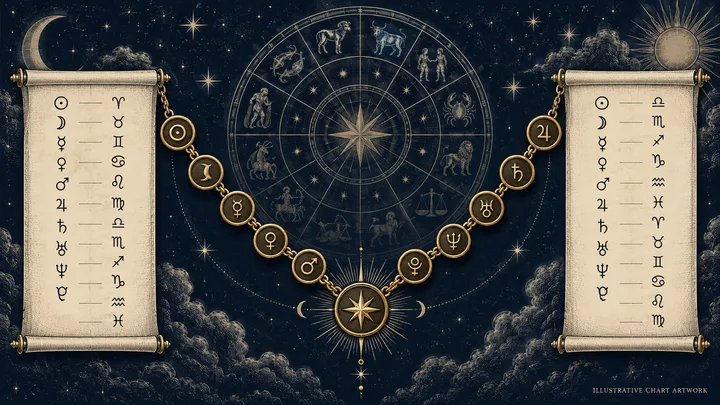
A dispositor chain explains a route, not the whole relationship
A dispositor is the planet that rules the sign another planet occupies. Venus in Gemini, for example, is disposed by Mercury because Mercury rules Gemini. If Mercury is in Aries, Mars disposes Mercury. The path is Venus to Mercury to Mars.
That path adds a useful layer. Venus in Gemini still describes a mind that wants words, variety, and mental play. Mercury’s sign shows how those needs move into expression. The dispositor refines Venus. It doesn’t replace Venus.
This distinction matters in synastry. A dispositor chain belongs to one chart or one supplied placement list. It follows sign rulership inside that map. It doesn’t mean Person B’s Mercury suddenly disposits Person A’s Venus because the two people are being compared. Build each internal chain first. Compare the maps afterward.
Skyscript describes a dispositor as a kind of manager for planets in its signs, while the Forrest Center places the technique after the basic sign, house, and aspect picture. Trace the route. Then judge what it adds to the actual contact between two charts.
The strongest use is narrow and practical. If Person A’s Venus routes through Mercury and Person B’s Mars contacts that Mercury, the Mars contact may activate the channel through which Person A’s affection is expressed. Ask how desire and speech meet. Don’t turn the pattern into a claim about control, loyalty, or fate.
Use a dispositor chain as a routing map, not as a compatibility score. Start with two separate placement lists. Name each planet’s sign, choose one rulership table, and follow the ruler until the path reaches a planet in its own sign or closes into a loop. Then compare what each map emphasizes. A final dispositor can gather several functions. A mutual reception can show a two-planet exchange. Neither replaces the Moon, Venus, or Mars contact you’re trying to understand. In a supplied-placement report, build and audit both chains first, rank direct major aspects next, and use the dispositor layer to explain how a placement may operate. If you have only Moon, Venus, and Mars signs, call the result partial. It can sharpen the reading, but it can’t speak for placements you weren’t given.
Sources: Dispositor, Skyscript Glossary; Planetary Dispositors, Forrest Center for Evolutionary Astrology; Dispositor in Astrology: Chains and Final Dispositors, Veritas
Why a final dispositor attracts too much attention
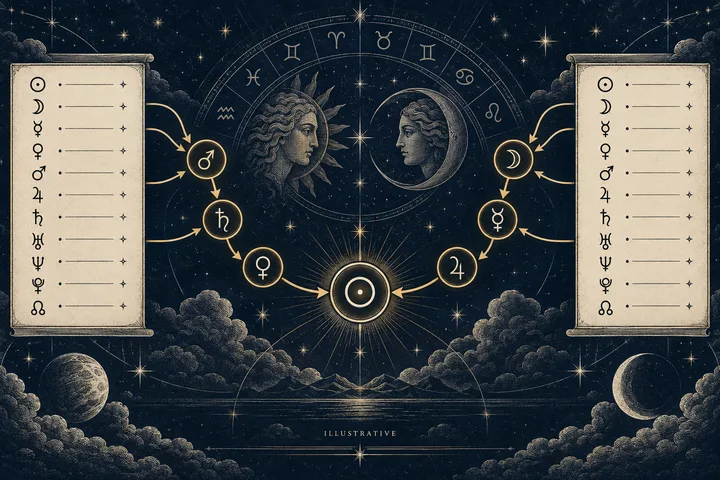
A long chain seems to promise one answer. Several arrows gather at Saturn in Capricorn, or a whole branch ends at Mercury in Virgo, and the diagram looks solved. But a final dispositor is an endpoint in a chosen map. It isn’t automatically the chart ruler, the dominant planet, or the ruler of the relationship.
A planet in its own sign has domicile dignity, so it has a familiar place from which to act. Astrodienst and the Forrest Center describe this kind of planet as an important organizing point. Importance still has to be tested against the rest of the chart.
Imagine Maria’s supplied placements are Moon in Aries, Mars in Taurus, Venus in Gemini, and Mercury in Virgo. Using traditional sign rulers, Moon points to Mars, Mars points to Venus, and Venus points to Mercury. Mercury is in its own sign, so the branch ends there: Moon to Mars to Venus to Mercury. Venus is not an endpoint, and Moon to Mars is not a loop. The useful reading is that Maria’s emotional response moves through action and affection before reaching Mercury’s channel of thought and speech.
Now consider a second list with Venus in Libra, Moon in Cancer, and Mars in Capricorn. Venus and Moon each stand in their own signs, while Mars points to Saturn. This map has more than one working center. It doesn’t make the second person more compatible. It tells you to ask where affection and feeling have direct access, and where effort must pass through structure.
The exception is a real concentration that also touches the other person’s personal planets. If several supplied placements route to Saturn and the other person’s Venus makes a close contact to Saturn, commitment, timing, duty, or restraint may become a central relationship theme. Even then, the endpoint is a theme. The sign, aspect, orb, and available condition decide its tone.
Sources: Dispositor, Skyscript Glossary; Planetary Dispositors, Forrest Center for Evolutionary Astrology; Dispositor in Astrology: Chains and Final Dispositors, Veritas; Chain of Dispositors, Astrodienst Astrowiki
How to build two chains from supplied signs
Start by writing down only what you have. Include each planet, its sign, any supplied degree, and the report’s stated aspect orb. A partial map is honest. Filling the gaps with guessed positions only makes the diagram look complete.
Next, declare the rulership system. In the traditional scheme, the Sun rules Leo, the Moon Cancer, Mercury Gemini and Virgo, Venus Taurus and Libra, Mars Aries and Scorpio, Jupiter Sagittarius and Pisces, and Saturn Capricorn and Aquarius. A modern scheme may give Scorpio, Aquarius, and Pisces to Pluto, Uranus, and Neptune, sometimes as co-rulers. Both approaches can be read consistently. Don’t switch systems halfway through.
For a supplied Moon, Venus, and Mars comparison, the traditional table is a clean first pass because it stays within the seven visible planets. If you want a modern comparison too, draw a second map and label it. Never blend the two into an undocumented hybrid.
Then assign the immediate ruler. Venus in Gemini becomes Venus to Mercury. Mars in Cancer becomes Mars to the Moon. Follow the ruler’s own sign until you reach a domicile planet, a repeated planet, or an unavailable placement. Mark a domicile endpoint. Mark a repeated sequence as a loop. A loop is not a failed final dispositor. It is a different structure.
Consider an example with limited data. Person A has Venus in Gemini, Moon in Aries, and Mars in Taurus. Person B has Venus in Capricorn, Moon in Libra, and Mars in Scorpio. Under traditional rulers, A’s Venus points to Mercury, A’s Moon to Mars, and A’s Mars to Venus. B’s Venus points to Saturn, B’s Moon to Venus, and B’s Mars points to Mars because Mars rules Scorpio. These are two small maps, not complete natal charts.
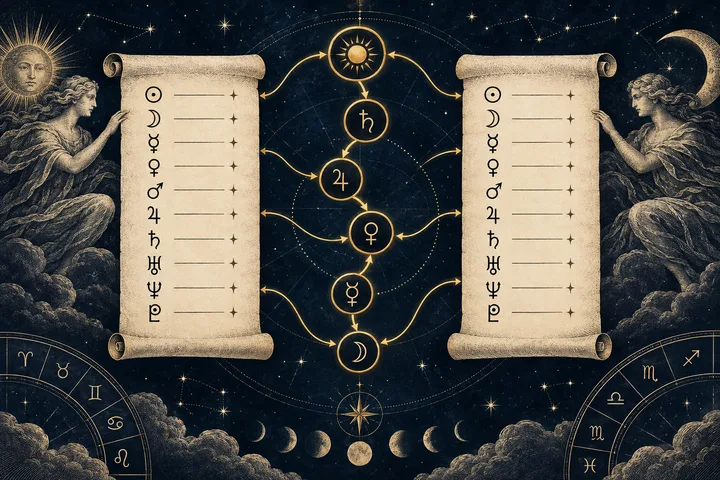
Keep the lists side by side, not merged. In a simple worksheet, use columns for planet, sign, immediate ruler, next sign, endpoint or loop, and cross-chart contact. This catches the error that matters most: treating one person’s planet as the other person’s dispositor without an astrological rule that permits it.
Sources: Dispositor, Skyscript Glossary; Dispositor in Astrology: Chains and Final Dispositors, Veritas; Chain of Dispositors, Astrodienst Astrowiki
How to compare the maps without inventing a hybrid
Compare the chains in layers. First, look for a shared endpoint or loop. If both people’s Venus routes through Mercury, communication becomes a reasonable shared theme in affection. If Person A’s Venus routes through Saturn and Person B has a Capricorn Moon, questions of reliability and time may become more visible. These are leads, not fixed behaviors.
Second, check direct cross-chart contact. Suppose Person A’s Venus in Gemini is disposed by Mercury, and Person B’s Mars makes a close major aspect to Person A’s Mercury. That aspect gives you a real bridge. It is stronger evidence than simply declaring Mercury important because it ends a chain.
Third, judge the condition you actually know. Sign, dignity, aspect, speed, sect, and house placement can all change a planet’s expression when those inputs are available. A placement-only report gives you less. Use the supplied signs and selected major aspects within the stated six-degree orb. Don’t quietly add houses or a complete dignity reading.
Fourth, keep the planet’s job in view. A Venus dispositor speaks first to affection, value, attraction, and pleasure. A Moon dispositor speaks to comfort, habit, and emotional regulation. A Mars dispositor speaks to desire, initiative, anger, and action. The same Saturn endpoint won’t mean the same thing in all three chains.
Imagine Maria’s Moon, Venus, and Mars all route through one repeated ruler, and her partner’s Venus contacts that ruler. The partner may bring that organizing theme into the relationship. The question might be whether care becomes dependable, verbal, restrained, or demanding. Read the ruler’s sign and aspect before choosing the language.
A shared endpoint can also stay in the background. If Person A’s Moon and Venus route through Jupiter but Person B’s personal planets contact Saturn and Mars instead, the direct contacts lead. Jupiter still describes an internal pattern for Person A. It simply isn’t the main synastry bridge.
Sources: Dispositor, Skyscript Glossary; Planetary Dispositors, Forrest Center for Evolutionary Astrology; Dispositor in Astrology: Chains and Final Dispositors, Veritas
What the chain can clarify, and what it can’t decide
A dispositor chain can show dependence, a repeated organizing planet, and the route by which a placement reaches expression. It can explain why two people with the same Venus sign may love in different ways when their Mercury placements differ. The surface sign is shared. The operating route isn’t.
It can also clarify mutual reception. If Person A’s Venus is in a Mars-ruled sign and Mars is in a Venus-ruled sign, the two planets exchange hosting roles. That is a closed circuit inside the person’s map. In synastry, ask whether the other chart contacts one side of the circuit or adds pressure to it.
The chain can’t decide whether someone is safe, loyal, ready, or worth dating. It can’t certify a soulmate bond. It can’t turn missing degrees into exact aspects, or create houses from sign-only data. Those decisions belong to behavior and conversation. Astrology gives you a way to name the pattern you’re examining.
This boundary keeps the technique sharp. A planet in its own sign may have a stronger channel, but strong doesn’t mean gentle. A difficult dispositor may describe delay, responsibility, or a skill that must be learned. A loop may show mutual dependence, tension, or circulation. The rest of the chart gives the pattern its form.
Consider Person A’s Venus in Capricorn, disposed by Saturn, while Person B’s Moon is also in Capricorn and Person B’s Mars closely squares Person A’s Saturn. The shared Capricorn theme can make commitment and reliability central. The square adds pressure. The reading is not bad compatibility. It is desire and feeling meeting a Saturn channel that needs clear agreements about pace, duty, and boundaries.
When a direct contact and a dispositor route point in different directions, name both. A warm Moon contact may show emotional ease, while a Saturn route shows the work required to make that ease dependable. Don’t average the signals into a vague middle. Rank them. Direct contact describes the meeting; the chain explains one route through it.
Sources: Planetary Dispositors, Forrest Center for Evolutionary Astrology; Dispositor in Astrology: Chains and Final Dispositors, Veritas; Chain of Dispositors, Astrodienst Astrowiki
A practical sequence for your next comparison
Begin with the real question. For emotional ease, start with both Moons and their dispositors. For attraction, start with Venus and Mars. For effort and commitment, include Saturn only when it appears in the supplied list or connects to a known placement.
Write the method line next: Person A’s placements, Person B’s placements, supplied degrees, rulership system, and six-degree orb for selected major aspects. This small step fixes the scope before the symbols start speaking.
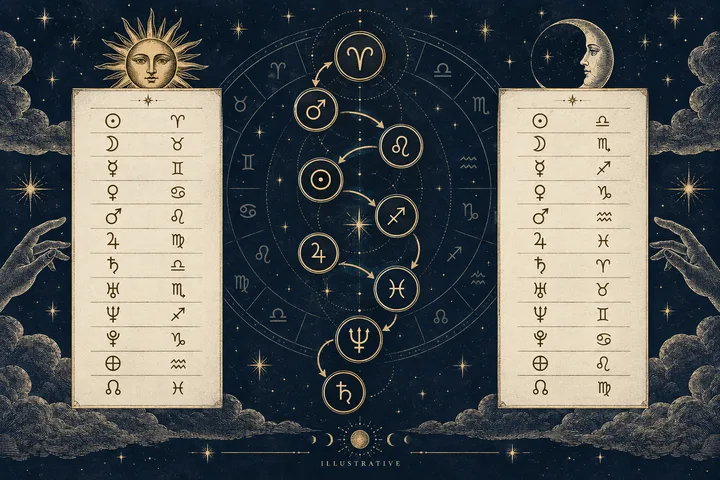
Draw the two internal chains. Check every arrow. Mark an endpoint, a loop, or an incomplete link. Then list the direct Moon, Venus, and Mars contacts. Those contacts lead because they describe what passes between the two people. Sign themes and dispositors explain how the pattern may work.
Read one planet at a time. For the Moon, ask what each person needs for comfort and how that need is routed. For Venus, ask what each person values and what must be present before affection flows. For Mars, ask how each person pursues desire, handles friction, and starts action. If one ruler repeats, treat it as a candidate theme.
Bring the other person into that theme. Does their Moon, Venus, or Mars contact the repeated ruler? Does their sign support the route, interrupt it, or demand another pace? Use verbs such as meets, presses, redirects, steadies, and translates. They describe interaction without pretending to prove an outcome.
Finish with three lines: what the direct contacts show, what the dispositor layer adds, and what the couple should discuss. If a modern rulership map changes the endpoint, show both maps separately. If a needed sign or degree is missing, name the next useful input instead of guessing.
So, how should you use a dispositor chain when comparing two supplied placement lists? Build two maps. Declare the rulers. Follow each path to an endpoint or loop. Rank the direct contacts first. Then let the chain sharpen one practical question. It’s a route through the chart, not a throne above it.
Sources: Dispositor, Skyscript Glossary; Planetary Dispositors, Forrest Center for Evolutionary Astrology; Dispositor in Astrology: Chains and Final Dispositors, Veritas; Chain of Dispositors, Astrodienst Astrowiki
A little more clarity
Can I compare dispositor chains if I only know Moon, Venus, and Mars signs?
Yes, but call it a partial comparison. Trace the supplied planets through one declared rulership table, then mark the endpoint, loop, or missing link the data supports. You can refine the Moon, Venus, and Mars reading. You can’t treat the result as a complete natal chain, calculate houses, or infer missing planetary condition.
Should I combine both people into one dispositor chain?
No. Build one chain for each person. A dispositor follows a planet to the ruler of its own sign, so merging the lists can create a rule astrology didn’t provide. After the separate maps are complete, compare endpoints, loops, sign themes, and direct synastry contacts. The other person can activate a ruler in the first person’s chain, but doesn’t become that ruler automatically.
Is a final dispositor more important than a Venus or Mars aspect?
Not by default. A final dispositor can gather several chains, but a direct major Venus or Mars aspect usually gives the more immediate relationship testimony. Read the aspect first. Then ask whether the dispositor explains its route or adds a repeated theme. If the endpoint has no meaningful connection to the relationship planets, keep it in the background.
Sources & further reading
- Dispositor, Skyscript Glossary
Defines a dispositor as the ruler of the sign holding a planet and explains how its condition can affect the planet’s expression.
- Planetary Dispositors, Forrest Center for Evolutionary Astrology
Explains sign-rulership chains, domicile endpoints, and why dispositors remain secondary to signs, houses, and aspects.
- Dispositor in Astrology: Chains and Final Dispositors, Veritas
Provides a worked chain method, distinguishes endpoints from loops, and compares traditional with modern rulership systems.
- Chain of Dispositors, Astrodienst Astrowiki
Defines arrows in a dispositor chain and identifies domicile planets and mutual reception structures.
Synastry Comparison Report
Enter known placements for two people. Get an input-by-input comparison, selected aspect calculations and a clear record of what remains uncertain.
Compare our placements