
Start with the corrected input, then audit the old and new comparisons line by line. A changed date can move the person's planetary placements and may require a full rebuild. A changed time chiefly affects the Ascendant, houses, angles, and the Moon's exact degree, though a time-zone error changes the universal moment used for the whole chart. A changed place can alter the angles and houses. Keep a sign theme only after checking that the placement still holds. Rerun every degree-based contact under the same zodiac, aspect list, and six-degree major-aspect orb. Mark each contact retained, changed, removed, or added. Then rewrite the interpretation around the closest surviving contacts. Don't patch one sentence in an old report and call it done. The important update may be the aspect you remove.
Name the correction before you read the chart
A corrected birth record doesn't rewrite every part of a synastry comparison. First name the field that changed: date, local clock time, place, time zone, or daylight-saving status. These inputs travel through a chart in different ways, so the revision needs a clear starting point.
A date correction is the broadest. It can move the Sun, Moon, Mercury, Venus, Mars, and the slower planets into new degrees or signs. Treat the old comparison as a draft and check every placement again. A small-looking calendar change isn't a small chart change.
A time correction works differently. The Ascendant and house cusps are time-sensitive, and Astrodienst says the Ascendant moves about one degree every four minutes on average. Even fifteen minutes can affect interpretation. The Moon moves more slowly, but its exact degree can still change a close contact or cross a sign boundary.
A place correction changes the local horizon and meridian. That can move the Ascendant, Midheaven, Descendant, Imum Coeli, and houses while leaving planetary signs unchanged when the universal moment stays the same. A time-zone or daylight-saving correction is more than a place label, though. It changes the moment used for the chart, so check the conversion before you judge any degree near an aspect boundary.
Write the old value, the corrected value, and the reason for the change. For example: Person B's local time changed from 14:00 to 13:00 after a hospital record was found; date, place, zodiac, and house system stayed the same. That sentence keeps the audit honest. It stops a software setting or a new memory from masquerading as a relationship revelation.
Sources: Birthtime/Hour - Astrodienst FAQ; Partner horoscopes - Astrodienst FAQ
Separate what stayed from what moved
Now divide the comparison into stable, moving, and conditional findings. Stable means the placement and the claim do not depend on a changed input. Moving means the degree, angle, house, or aspect status needs a fresh check. Conditional means the result depends on information that is still uncertain.
If only the clock time changes and the corrected time converts to the same universal date, many broad sign themes may survive. A Venus in Taurus can remain Venus in Taurus. A Mars in Libra can remain Mars in Libra. But a sign placement and an interchart aspect are different kinds of evidence. Keep the first only after checking it, and never assume the second survived with it.
The moving layer usually begins with the Ascendant and houses, then the Moon's exact position. Personal planets can also shift enough for a close contact to tighten, loosen, appear, or disappear. The exact result belongs to the corrected input. Don't estimate it from the number of minutes alone.
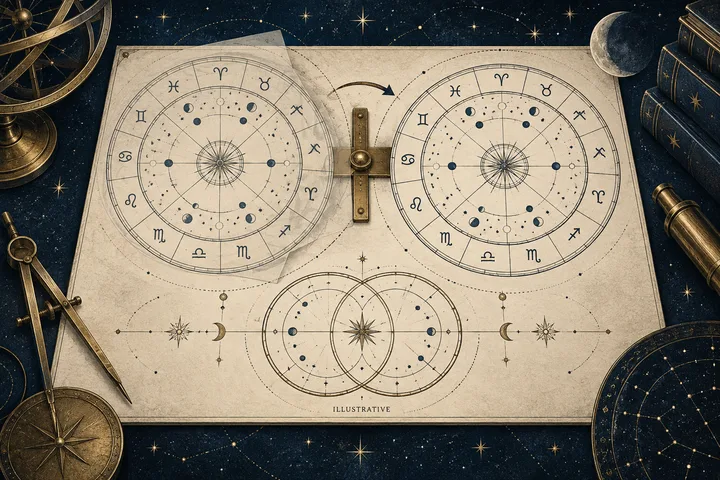
An aspect is the angular relationship between two chart factors. The major aspects are conjunction at 0 degrees, sextile at 60, square at 90, trine at 120, and opposition at 180. The orb is the distance allowed from that exact angle. This report uses selected major aspects within a six-degree orb, so the same rule must govern both the old and new comparison.
A useful test is simple. Keep a contact only when the two factors are still present, the angle remains within six degrees, and the contact belongs to the report's selected aspect list. A contact at 20 minutes deserves more emphasis than one at 5 degrees 40 minutes, even though both qualify under the same ceiling. Exactness ranks the surviving evidence; it doesn't promise an outcome.
Sources: Birthtime/Hour - Astrodienst FAQ; Partner horoscopes - Astrodienst FAQ; Aspects Between Charts - Cafe Astrology
Rerun the aspect layer before rewriting meaning
Do the comparison before you interpret it. Record each person's placement, degree if known, and the method used. Put the old and new lists side by side. Give every contact one label: retained, changed, removed, or added.
Use the same zodiac, aspect list, and six-degree orb for both versions. If the earlier report included houses but the corrected time remains uncertain, don't carry those houses forward as settled. Astrodienst describes synastry as a comparison of two birth charts, with planets interacting by aspects and house placement. The comparison is only as clear as the inputs and settings behind it.
Start with the personal planets. Check the Sun, Moon, Venus, and Mars first, then Mercury if it belongs to the supplied comparison. These contacts speak most directly to identity, emotional rhythm, affection, desire, and exchange. Review Jupiter and Saturn after them. Look at outer planets last, especially when a date correction has changed a generational placement or its degree.
Then compare the ranking. The most important result may be a removal. If an old Moon-Venus contact moves outside the six-degree orb, remove the emotional-ease language built on it. If a Venus-Mars contact tightens, let attraction and initiative rise in the new reading. Don't make the chart more flattering. Make it more exact.
Avoid double counting. A Venus-Mars contact, a shared fire emphasis, and three sentences about chemistry may all be one idea wearing different clothes. Keep the strongest sentence. Use the other observations only when they add a new layer, such as pace, affection, or conflict style.
Sources: Partner horoscopes - Astrodienst FAQ; Aspects Between Charts - Cafe Astrology; Synastry - Cafe Astrology
A worked before-and-after example
Imagine Maria and Daniel have compared supplied placements. Maria's data stays fixed. Daniel's birth time is corrected by forty-five minutes after his family finds a hospital record. The date and place don't change. They want to know which parts of the first comparison still stand.
The old report contains three useful audit labels: a Moon-Venus contact close to the report's six-degree boundary, a Venus-Mars contact comfortably inside the boundary, and a Mars-Saturn contact already outside it. This is an illustrative pattern, not a calculated chart. No degrees or post-correction positions have been assigned.
Now run the corrected data through the same chart method and compare the outputs. If the new result places Moon-Venus outside the six-degree orb, mark it removed. If Venus-Mars remains within the orb, mark it retained. Leave Mars-Saturn out unless the corrected comparison actually brings it into the selected aspect range. These are audit decisions based on the new output, not effects we can infer from forty-five minutes alone.
The interpretation changes with the evidence. Emotional ease no longer leads if the Moon-Venus contact has disappeared. Attraction, initiative, and the way affection meets desire can still lead through Venus and Mars if that contact survives. It doesn't prove commitment or permanence. It gives the couple a sharper theme to explore.
The time correction may also move Daniel's Ascendant and house cusps. If the comparison calculates houses, reread every house-overlay claim. If the report uses supplied Moon, Venus, and Mars placements with optional degrees, leave houses out. A missing calculation isn't an invitation to fill the gap by instinct.
Consider an example of a date correction instead. If Daniel's date changes by one day, check every planetary placement again. Don't preserve Venus or Mars because the shift feels modest. A date is a chart input, not a footnote.

When the corrected information is still uncertain
Sometimes the correction produces a range, not one exact answer. A family record may say 'around 3 p.m.' A certificate may give a clock time without making the historical time convention clear. A town may have changed administrative boundaries. Narrow the claim instead of forcing certainty.
If the date is known but the time isn't, compare the placements that remain usable within the report's scope. The Sun, Venus, and Mars may support a sign-based comparison, depending on the date and their motion. Check the Moon closely. If it changes sign during the possible time range, record both possibilities rather than choosing the cleaner one.
Without a reliable time, leave the Ascendant, houses, and angle contacts out. A hypothetical noon can organize a chart display, but noon isn't the person's recorded birth time. A tidy wheel doesn't create new evidence.
When the time-zone history is unclear, verify the local clock convention before judging a close degree. Astrodienst notes that time zones and daylight-saving rules must be handled for the place and period in question. If two conversions remain plausible, state the stable interpretation first and label the degree or angle reading as conditional.
A useful uncertainty note names the affected conclusion. Say, 'The Venus sign remains available, but the Moon-Venus orb is conditional,' or, 'The personal-planet signs remain in scope, while house overlays are withheld because the time is approximate.' Readers need a boundary they can use.
If another chart program gives a different result, compare inputs and settings before comparing meanings. Check the local time, historical offset, place, zodiac, house system, aspect list, and orb. Find the method difference first. Then decide which method belongs to the comparison you are updating.

Sources: Birthtime/Hour - Astrodienst FAQ; Partner horoscopes - Astrodienst FAQ; Aspects Between Charts - Cafe Astrology
Let the corrected ranking guide one conversation
Once the evidence is clean, return to the relationship. Synastry describes interaction between chart factors. It doesn't speak over the two people living that interaction. The best revised reading connects a surviving contact to something observable.
Rank the result in three passes. Name the closest surviving personal-planet contact. Name the main tension or contrast that remains. Then ask what those two themes require in daily life. This gives the report a spine instead of a pile of planet definitions.
Suppose the corrected comparison removes a Moon-Venus contact but retains a tight Venus-Mars contact and a wider Sun-Saturn contact within the stated orb. The new reading might say that attraction and initiative are easier to see than emotional reassurance, while responsibility adds weight to the bond. The useful question isn't 'Are we compatible?' It is, 'When affection becomes action, what pace and reassurance help both of us feel chosen?'
If the Moon contact survives, ask what helps each person settle after conflict and how each person asks for comfort. If Mars leads, ask about pace, directness, initiative, and boundaries. If Saturn matters, ask what commitment requires in time, work, and reliability. These questions translate a symbolic pattern into a conversation without turning a planet into a verdict.
For a structured comparison, bring the corrected Moon, Venus, and Mars signs and any available degrees to the Synastry Comparison Report. It compares supplied placements and selected major aspects within the stated six-degree orb. It doesn't calculate natal positions from birth details, add houses, or decide whether a relationship should continue. Enter missing degrees as missing.
The update is complete when you have a short list of supported themes, a short list of removed or conditional claims, and one honest question to ask each other. Start with this: 'Now that the corrected time removed the Moon contact but kept the Venus-Mars contact, how do we each recognize affection when desire and reassurance move at different speeds?'
Sources: Partner horoscopes - Astrodienst FAQ; Synastry - Cafe Astrology
A little more clarity
Do I need to rewrite the entire synastry report after correcting a birth time?
Rewrite the affected layers, then reread the synthesis. Check the Moon, Ascendant, houses, angles, and every degree-based aspect first. A date correction is broader and may require a complete rebuild.
Can a one-hour correction change a synastry aspect?
Yes. It can change the Moon's degree and the chart's angles, and a contact near the edge of the orb may move in or out of scope. Check the corrected degrees instead of estimating from the clock change.
What should I do if the corrected birth time is still approximate?
Record the possible time range, keep stable findings separate, and mark conditional contacts clearly. Leave houses and angles out when the time isn't reliable, and check whether the Moon or an aspect crosses a sign or six-degree boundary.
Can I compare synastry without a full calculated birth chart?
Yes, when you already know the placements you want to compare. The Synastry Comparison Report uses supplied Moon, Venus, and Mars signs, optional degrees, and selected major aspects within a six-degree orb. It doesn't calculate natal positions from birth details or add houses.
Sources & further reading
- Birthtime/Hour - Astrodienst FAQ
Supports the effects of precise birth time, average Ascendant movement, local clock entry, and historical time-zone and daylight-saving handling.
- Partner horoscopes - Astrodienst FAQ
Supports synastry as a comparison of two birth charts and explains interchart aspects and partner-chart methods.
- Aspects Between Charts - Cafe Astrology
Supports reading interchart contacts through planet pairs, sign and house context, and attention to inner-planet aspects.
- Synastry - Cafe Astrology
Supports the distinction between broad sign comparisons and fuller synastry using Venus, Mars, aspects, angles, and houses.
Synastry Comparison Report
Enter known placements for two people. Get an input-by-input comparison, selected aspect calculations and a clear record of what remains uncertain.
Compare our placements