When two synastry tools disagree about a six-degree aspect, don't pick the more flattering result. Find out whether the difference comes from the chart inputs, the zodiac, the aspect list, or the orb rule. Then calculate the angular distance from the exact degrees and give the contact a clear rank. A six-degree sextile may fall outside a four-degree limit, while a six-degree trine may fit a wider policy. Treat the contact as supporting or borderline until the method is clear, and let closer or repeated contacts lead. The Synastry Comparison Report compares supplied Moon, Venus, and Mars placements, with optional degrees, under a stated six-degree orb. It doesn't calculate a natal chart from birth details.
First identify what the tools actually disagree about
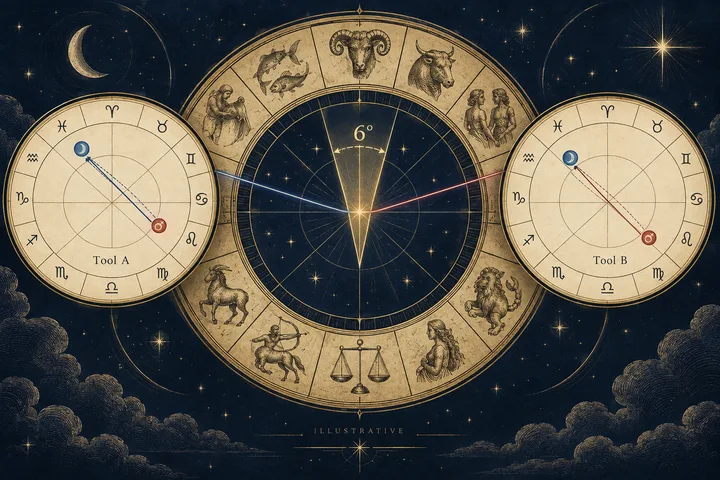
One synastry tool shows Venus trine Mars. Another shows no aspect. That isn't yet an astrological verdict. It is a question about the two calculations.
An aspect is the angular distance between two chart points. The major angles are 0 degrees for a conjunction, 60 for a sextile, 90 for a square, 120 for a trine, and 180 for an opposition. An orb is the distance allowed from the exact angle. So six degrees has no meaning by itself. Six degrees from a sextile is a different case from six degrees from a trine.
Make one comparison sheet. Record each planet's sign, degree, and minutes; the zodiac reference; the aspect name; the maximum orb; and whether the tool includes minor aspects, angles, or motion. If the placements differ, repair the inputs first. If the placements match but one tool includes the contact, you have found a difference in method. That is the useful discovery.
Sources: An Introduction to Aspects and Chart Shaping in Natal Astrology, Nicholas Campion; The Classical Origin and Traditional Use of Aspects, Deborah Houlding
Use the raw degrees to settle the geometry
Labels are handy. Degrees are testable. Place each point on the 360-degree circle. Aries begins at 0 degrees, Taurus at 30, Leo at 120, and Sagittarius at 240. Find the smaller circular distance, then measure how far it sits from the nearest exact aspect.
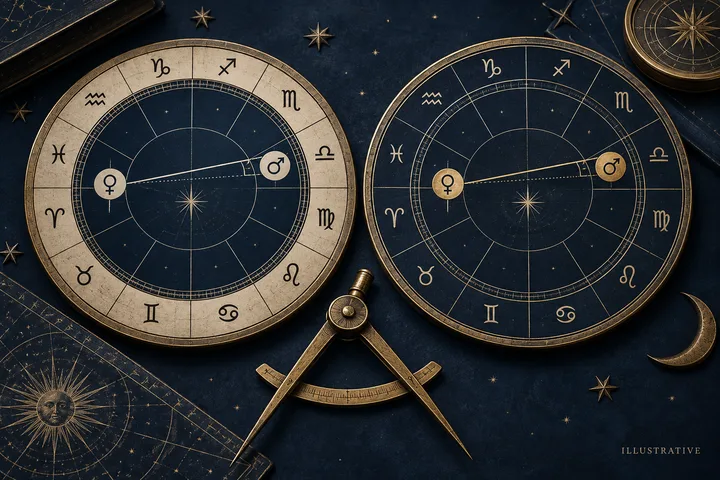
Imagine Maria's Venus at 14 degrees Leo and Daniel's Mars at 20 degrees Sagittarius. Venus sits at 134 degrees of the zodiac. Mars sits at 260. Their separation is 126 degrees. A trine is exact at 120, so the contact is six degrees wide. It can fit a six-degree policy, but it is not exact.
Now restore the minutes. If Mars is at 20 degrees 28 minutes Sagittarius, the separation is 126 degrees 28 minutes. The trine is 6 degrees 28 minutes wide, so a strict six-degree rule excludes it. If Mars is at 19 degrees 32 minutes, the contact is 5 degrees 32 minutes wide and the same rule includes it. A rounded whole number cannot settle a boundary this close.
This is what the disagreement should produce: a separation, an orb distance, and a transparent reason for inclusion or exclusion. If the raw degrees are unavailable, describe the possible method difference, but don't certify the contact.
Sources: An Introduction to Aspects and Chart Shaping in Natal Astrology, Nicholas Campion; The Classical Origin and Traditional Use of Aspects, Deborah Houlding
Choose the orb policy before you interpret it
An orb is permission, not strength. A contact six degrees from exactness is weaker than the same contact at one degree, even when both pass the same filter. Campion's reference table gives example limits of 8 degrees for conjunctions, squares, and oppositions, 12 for trines, and 4 for sextiles. Under that table, a six-degree sextile drops out while a six-degree trine remains included.
Traditional practice can use the planets' own orbs instead of one limit for each aspect. The Sun and Moon receive wider allowances in commonly cited tables. Venus and Mercury receive less. This is a different interpretive lens, not a correction that every tool must secretly be using. Name the lens and keep it steady across the comparison.
For a clean report, use three ranks. Exact contacts sit first. Supported contacts fit the chosen orb and matter alongside other chart testimony. Borderline contacts depend on rounding, a wide allowance, a sign boundary, or a genuine method split. A six-degree contact belongs in the reading only at the rank its method earns.
Sources: An Introduction to Aspects and Chart Shaping in Natal Astrology, Nicholas Campion; The Classical Origin and Traditional Use of Aspects, Deborah Houlding
Separate calculation settings from interpretation
If the raw numbers differ, check the construction before reading the symbolism. Tropical and sidereal zodiacs can place the same planet in different signs and degrees. Birth time and time zone matter especially for the Moon and angles. Preserve the supplied placements. Don't fill an unknown time with a guess.
Then compare the aspect list. One tool may scan only the five major aspects. Another may add minor aspects, parallels, or points. One may keep minutes in the calculation while displaying rounded degrees. Another may use a different maximum orb. These choices can change the list without either calculation being careless.
Applying and separating are a further layer. Applying means moving toward exactness; separating means moving away from it. Retrograde motion can reverse the apparent direction, so use this language only when the relevant motion data are available. A placement-only comparison can't establish it.
House systems answer a different question. They affect house overlays, not the angular distance between two planets. If a report uses only supplied Moon, Venus, and Mars placements, keep houses outside the reading.
Sources: An Introduction to Aspects and Chart Shaping in Natal Astrology, Nicholas Campion; The Classical Origin and Traditional Use of Aspects, Deborah Houlding; Separation, Skyscript Glossary
Read the sign and degree layers when they diverge
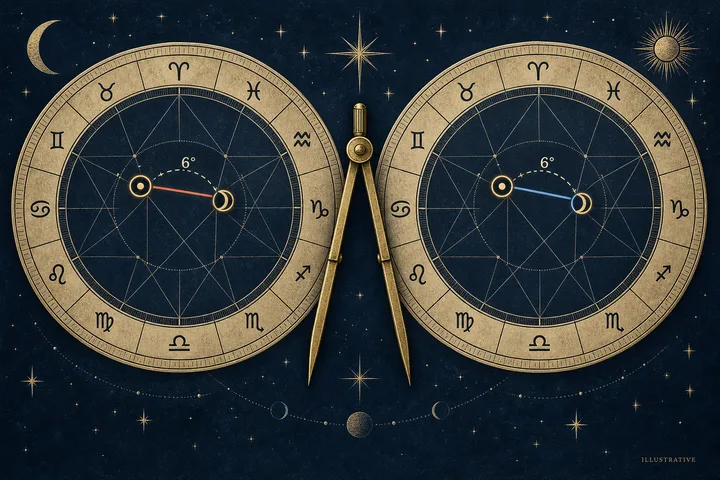
A contact can carry a sign layer and a degree layer at the same time. Consider an example: Venus at 28 degrees Leo and Mars at 2 degrees Sagittarius occupy signs related by trine, but their degree separation is 94 degrees, only four degrees from a square. Houlding describes this kind of dissociate relationship as one in which the sign relationship and the degree relationship need separate attention.
Don't make the layers vote. The sign relationship gives the broad field and style. Here, the fire signs suggest warmth, visibility, and direct expression. The closer square gives the sharper geometry: affection and action may rub when one person wants affirmation and the other pushes for movement. If the chosen orb includes the square, lead with it by degree, then let the sign relationship qualify the reading.
The same principle applies to a close conjunction across a sign boundary. A planet at 29 degrees of one sign and another at 2 degrees of the next can be close by degree while carrying different sign meanings. Say which layer leads. That sentence is more useful than forcing the contact into a single label.
Sources: An Introduction to Aspects and Chart Shaping in Natal Astrology, Nicholas Campion; The Classical Origin and Traditional Use of Aspects, Deborah Houlding; Dissociate Aspect, Skyscript Glossary
Turn the surviving contact into a useful reading
You don't need two tools to agree. You need one method you can state and apply to the whole comparison. A useful note might say: 'This reading uses the supplied tropical Moon, Venus, and Mars positions. Major aspects use a six-degree maximum orb. Exact degrees were supplied for the contacts discussed. Houses and unprovided chart factors are outside the report.'
Now interpret the rank, not the argument between websites. In Maria and Daniel's example, the six-degree Venus-Mars trine is supporting rather than exact. If the same comparison contains a one-degree Moon-Venus conjunction, that closer contact leads. The trine can describe ease around attraction or initiative, but it shouldn't explain the whole bond.
Ask what the leading contact helps the couple notice. A Venus-Mars comparison might open a conversation about initiating plans, affection, desire, and consent. A Moon contact might point toward reassurance and emotional timing. The aspect gives language to a pattern. The couple supplies the lived evidence.
Your next steps are simple: match the inputs, calculate the separation, choose the orb, label the rank, and write one observable question. If the contact still depends on a reasonable method choice, keep it borderline and move on to the closer pattern. The Synastry Comparison Report can organize supplied Moon, Venus, and Mars placements with optional degrees under a stated six-degree orb. It doesn't calculate a natal chart, add houses, or predict relationship success.
Sources: An Introduction to Aspects and Chart Shaping in Natal Astrology, Nicholas Campion; The Classical Origin and Traditional Use of Aspects, Deborah Houlding; Dissociate Aspect, Skyscript Glossary; Separation, Skyscript Glossary
A little more clarity
Is a six-degree synastry aspect real?
It can be valid under the orb policy you choose. A six-degree square, conjunction, trine, or opposition may fit a wider modern rule, while a six-degree sextile may exceed a tighter four-degree rule. Check the exact degrees, the planets, the aspect, and the method before interpreting it. Treat a wide contact as supporting rather than exact.
Why does one tool show a sextile and another show nothing?
The tools may use different maximum orbs. Sextiles are often given a tighter allowance than conjunctions, squares, trines, and oppositions. The disagreement can also come from rounded positions, tropical versus sidereal zodiac settings, different birth data, or different aspect lists. Compare the calculation settings line by line.
Should applying or separating change how I read the aspect?
It can add a timing and emphasis layer when exact planetary motion is available. Applying contacts move toward exactness, while separating contacts have passed exactness but remain within orb. Retrograde motion can change the apparent direction. In a placement-only report without exact motion data, leave this layer out rather than guessing.
What should I do with an aspect one report includes and another excludes?
Record the raw degrees and choose one consistent orb policy for the whole comparison. Keep the contact if it fits that policy, but label it borderline or supporting when it is wide, rounded, dissociate, or unsupported by other contacts. Let closer and repeated themes lead the reading.
Sources & further reading
- An Introduction to Aspects and Chart Shaping in Natal Astrology, Nicholas Campion
Provides a reference table for major aspect angles and illustrates that orb policies vary by aspect and planetary prominence.
- The Classical Origin and Traditional Use of Aspects, Deborah Houlding
Explains degree-based and sign-based aspects, dissociate contacts, applying and separating motion, and traditional planetary orb methods.
- Dissociate Aspect, Skyscript Glossary
Defines a dissociate aspect and shows how sign relationship and degree relationship can describe different layers of one contact.
- Separation, Skyscript Glossary
Clarifies separating aspects and explains why retrograde motion must be checked before assigning applying or separating status.
Synastry Comparison Report
Enter known placements for two people. Get an input-by-input comparison, selected aspect calculations and a clear record of what remains uncertain.
Compare our placements