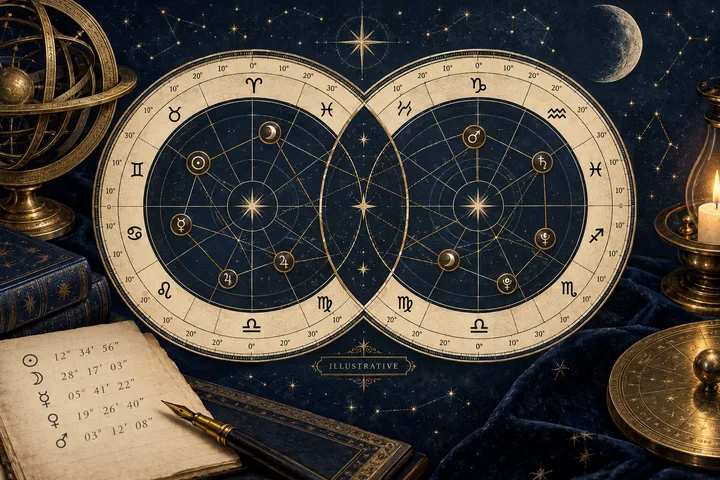
Imagine the same couple on two different worksheets
Imagine Maria and Daniel comparing a printed chart with a phone screenshot. Maria’s Venus appears as 14° Taurus. Daniel’s Mars appears as 20° Scorpio. They copy the signs, notice the opposition by sign, and start talking about attraction, stubbornness, and the push-pull between them. Then Maria opens the original chart export. Her Venus is 14° 27' 36" Taurus. Daniel’s Mars is 20° 18' 04" Scorpio. The interpretation has not collapsed. But the comparison has become measurable.
That small difference matters because a synastry aspect is an angular relationship, not a mood attached to two sign names. The degree tells you where a planet sits inside its sign. The minutes and seconds tell you how far it has moved beyond that degree. They let you distinguish a contact that is close from one that only resembles a contact by sign. The two versions of the worksheet may still point to the same broad theme, yet they do not carry the same weight.
A reader usually asks, How do our charts fit together? Before that question can be answered well, another question comes first: what exactly did each chart report? If you copy a placement loosely, you can create a false aspect, miss a real one, or make two reports look different when they are using the same sky position. The careful habit is simple. Preserve the original notation, convert only when needed, and interpret only after the numbers agree.
This guide uses a deliberately illustrative case. Maria and Daniel are not real clients, and their placements are examples for the method. The point is not to assign them a personal story. It is to show you how a clean record protects the astrological reading from avoidable transcription errors.
What the three numbers actually mean
A zodiac position is commonly written with degrees, arcminutes, and arcseconds. You may see it as 14° 27' 36" Taurus, 14 Taurus 27'36", or 14°27'36" Tau. The typography changes. The structure does not. The first number is the degree within the sign. The prime mark, ', identifies arcminutes. The double-prime mark, ", identifies arcseconds. These are angular measurements, not minutes and seconds of clock time.
Each sign occupies 30 degrees. Each degree contains 60 arcminutes. Each arcminute contains 60 arcseconds. That is the sexagesimal system used for angular positions in astrology and astronomy. The full zodiac contains 360 degrees, divided into twelve signs. When a chart says a planet is at 29° 59' 59" Gemini, it is almost at the end of Gemini. One second later in zodiacal longitude would not make it 30° Gemini. It would carry the position into 0° Cancer.
Astrodienst’s general explanation gives the planet-position pattern as degree, sign, arcminute, and arcsecond. That order is worth copying because it keeps the sign in view while you transcribe. A line such as 23° 31' 02" Leo contains more information than 23° Leo. It also prevents a common mistake: reading 31'02" as a decimal number or treating 02 as a second degree value. The symbols do the work. Read them.
The sign is not a decorative label. It is the 30-degree sector that houses the placement. The degree, minute, and second locate the planet inside that sector. If you later convert the position into a single longitude, you are not replacing the sign. You are giving the same position a form that makes distance easier to calculate.
Write the source line exactly before you simplify it. If it says Venus 14° 27' 36" Taurus, copy Venus, the number, the sign, and any motion marker such as R for retrograde into your notes. Retrograde motion does not reverse the zodiac degree for this comparison. It describes the planet’s apparent motion. The position still belongs at its reported longitude.
Decimal degrees are useful, but only when you convert them correctly. The notation 14.46° Taurus does not mean 14° 46' Taurus. The digits after the decimal are a fraction of a degree. To turn 0.46 degrees into arcminutes, multiply by 60. The result is 27.6 minutes, or 27' 36" after you convert the remaining 0.6 minute into seconds. So 14.46° Taurus is 14° 27' 36" Taurus, not 14° 46'.
The reverse conversion follows the same rule. Start with 14° 27' 36". Convert the minutes to degrees by dividing 27 by 60. Convert the seconds by dividing 36 by 3,600. Add them to 14. The result is 14.46°. In formula form: decimal degrees = degrees + minutes/60 + seconds/3,600. For a position written in degrees, minutes, and seconds, this is the cleanest way to create one comparison number.
Here is a practical mini-table. 14° 30' 00" equals 14.5°. 14° 15' 00" equals 14.25°. 14° 27' 36" equals 14.46°. Notice what is happening. The decimal does not preserve the visual shape of the minutes. It compresses them into a fraction. That is why you should keep the original sexagesimal form beside the decimal form in your worksheet.
Rounding can change a close call. A source position of 14° 59' 50" Taurus may display as 15° Taurus if a website rounds to whole degrees. It has not moved to the middle of the 15th degree. It is ten arcseconds short of 15°00'. If another planet sits near an aspect threshold, that lost detail can decide whether the contact falls inside your chosen orb. Record the displayed precision, and do not claim more than the source gives you.
The safest sequence is copy, convert, compare, then round for display. Never round first because the rounded number is easier to read. It may be easier to read and harder to trust.
Transcribe every placement in the same three-part form first: sign, degree, minute, and second. For example, write 14° 27' 36" Taurus, not just 14° Taurus and not 14.46° Taurus until you have checked the original. Keep the sign attached to the number, preserve retrograde notation separately, and never treat minutes or seconds as decimal hundredths. Sixty arcminutes make one degree, and sixty arcseconds make one arcminute. After copying, convert the placement to absolute zodiac longitude only if you need to compare two planets by aspect. A 14° 27' 36" Taurus placement becomes 44° 27' 36" from 0° Aries. Then compare the two longitudes, take the smaller distance around the 360° circle, and measure its difference from the chosen aspect. In this report’s stated method, major synastry contacts use a six-degree orb. If the source gives no minutes or seconds, keep that uncertainty visible. Do not invent precision.
Sources: Sexagesimal System, Astrodienst Astrowiki; Astrodienst General FAQ: Planet Position Notation
The worksheet that keeps sign and longitude together
Use one row for each placement. A useful worksheet has these columns: person, planet, source notation, sign, degree, minute, second, decimal degree within sign, absolute zodiac longitude, motion, and confidence. The confidence column is not a judgment about the chart. It records whether the value was copied exactly, rounded by the source, or supplied without minutes and seconds.
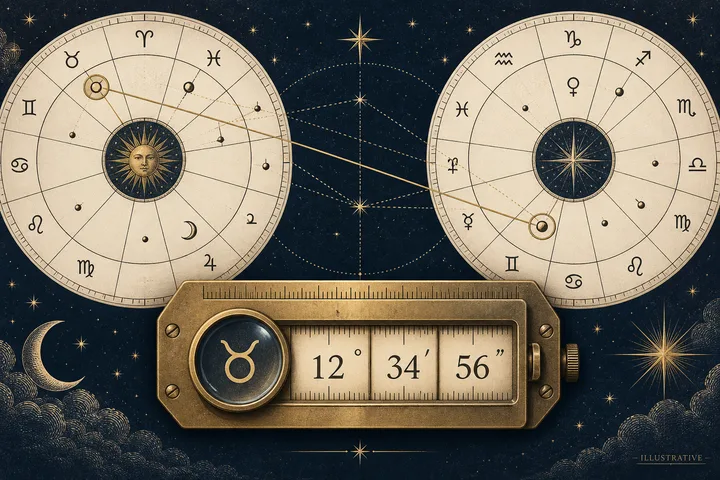
Consider an example. Maria’s Venus is 14° 27' 36" Taurus. Taurus begins 30 degrees after Aries, so the absolute longitude is 30° + 14° 27' 36" = 44° 27' 36". Daniel’s Mars is 20° 18' 04" Scorpio. Scorpio begins at 210°, so the absolute longitude is 230° 18' 04". Keep both forms: 14° Taurus tells you the sign expression; 44°27'36" tells you where to place the point on the full zodiac circle.
The sign-start values are fixed in the tropical zodiac: Aries 0°, Taurus 30°, Gemini 60°, Cancer 90°, Leo 120°, Virgo 150°, Libra 180°, Scorpio 210°, Sagittarius 240°, Capricorn 270°, Aquarius 300°, and Pisces 330°. Add the within-sign position to the sign start. If the result reaches 360°, return to 0°. A placement at 29°59'59" Pisces is still just before 360°, while 0°00'00" Aries begins the next circuit.
This conversion is a comparison tool. It does not decide the whole reading. Absolute longitude helps you measure the distance between planets, especially when signs are not enough to show how close the contact is. The sign remains essential because two placements can be close by longitude while crossing a sign boundary, and astrologers differ on how much weight to give an out-of-sign or dissociate contact.
Do not mix zodiac reference frames in one worksheet. If one source uses a tropical zodiac and another uses a sidereal zodiac, the sign labels and longitudes will not be interchangeable. The issue is not that one report has a more attractive answer. The issue is that you are comparing positions built from different reference choices. Choose one frame for the comparison and write it at the top of the page.
A missing minute is not a zero minute. If a source says 14° Taurus, record the placement as 14°00' only when the source clearly means an exact whole-degree value. If the site has rounded the display, mark it as rounded. If you do not know which, write 14° Taurus, precision unknown. That one note can keep a later aspect claim honest.
A good worksheet also keeps the source beside the value. Write the chart site or export name, the zodiac reference frame, and the date you copied it. If you later open a second report, you can see whether the disagreement comes from the chart settings or from your own notes. This is especially helpful when one screen uses glyphs, another uses abbreviations, and a third gives decimal longitude only.
Do one visual check before calculating. Read down the rows and look for impossible entries: 60 minutes, 60 seconds, a degree of 30 inside a sign, a sign omitted from one person’s placements, or a retrograde mark copied into the degree field. Normalize those entries before you compare. A tidy table is not busywork. It is the shortest path to a trustworthy interpretation.
Sources: Sexagesimal System, Astrodienst Astrowiki; Astrodienst General FAQ: Planet Position Notation
How to compare two placements without losing the circle
Once both placements have absolute longitudes, subtract one from the other. Then take the smaller of the direct distance and the distance obtained by going the other way around the 360-degree circle. This matters near 0° Aries. A planet at 28° Pisces and another at 2° Aries are not 334 degrees apart in the useful astrological sense. Their smaller separation is 26 degrees.
For Maria’s Venus at 44°27'36" and Daniel’s Mars at 230°18'04", the direct difference is 185°50'28". The shorter circle distance is 174°09'32". That is close to an opposition, whose exact angle is 180°. The orb is 5°50'28". Under this guide’s six-degree major-aspect method, the contact falls inside the stated orb, though it is close enough to the boundary that the source precision deserves attention.
The calculation has four parts. First, identify the exact aspect angle: 0° for a conjunction, 60° for a sextile, 90° for a square, 120° for a trine, or 180° for an opposition. Second, find the smaller angular separation. Third, subtract the exact aspect angle from that separation and use the absolute value. Fourth, compare the result with the orb you have chosen. The closer the result is to zero, the tighter the contact.
Astrodienst defines aspects through a deviation from exactness within a chosen orb. Skyscript’s introductory aspect guide makes the same practical point: an orb is the distance allowed from the exact aspect, and a closer aspect is generally treated as stronger than a looser one. The sites and traditions do not all use one universal orb. That is why a report should name its rule instead of presenting an aspect label as if the label explains itself.
You can do a quick hand check without converting every value to decimals. If the two planets form an opposition, compare one position with the point 180 degrees away. If Maria’s Venus is 14°27'36" Taurus, the exact opposite is 14°27'36" Scorpio. Daniel’s Mars at 20°18'04" Scorpio is 5°50'28" beyond that point. The hand check confirms the longitude calculation and gives you a readable picture of the orb.
Do not double-count the sign story and the aspect story. Venus in Taurus opposite Mars in Scorpio has a sign-based polarity and a degree-based opposition. Those layers belong in one interpretation. They are not two independent votes that turn a single contact into extra evidence.
If the planets are separated by more than 180 degrees in the direct subtraction, reverse the direction rather than forcing a negative orb. The zodiac is a circle, so the same contact can be measured clockwise or counterclockwise. Your notes should show the smaller route. This prevents a trine from being mistaken for a wide quincunx simply because the subtraction started from the wrong planet.
A hand calculation is also a useful audit of software output. If a report calls two supplied placements a square, calculate their longitudes independently and see whether the separation supports that label. The audit does not replace the report’s stated settings. It tells you whether you have copied the inputs correctly and whether the label belongs to the chosen aspect family.
When you write the result for someone else, show enough of the path that they can follow it. You do not need to print a long formula beside every sentence. Give the original values, the converted longitudes, and the final angle. That small trail of evidence lets a reader spot whether the issue is a wrong sign, a wrong subtraction, or a different orb rule.
This is also why the sign should stay visible in the final note. A bare number such as 44.46° may be correct, but it does not tell the reader whether the point came from 14° Taurus, 14° Gemini, or a different zodiac frame. A synastry interpretation needs both location and relationship. Absolute longitude supplies the first kind of clarity. The sign supplies the second.
Sources: An Introduction to Aspects and Chart Shaping in Natal Astrology, Nicholas Campion; Aspect, Astrodienst Astrowiki; Orb, Astrodienst Astrowiki
What changes when a placement crosses a sign boundary
The hardest transcription cases sit near 0° or 30° of a sign. Suppose Maria’s Venus is 29°58'40" Aries and Daniel’s Mars is 0°04'20" Leo. Their longitudes are 29°58'40" and 120°04'20". The separation is 90°05'40", which is just beyond an exact square by 0°05'40", or 5 arcminutes 40 arcseconds. A reader who sees only 29° Aries and 0° Leo may still identify a square by sign, but the exact numbers show how close the contact is and which side of the angle it occupies.
Now consider an out-of-sign conjunction. One planet sits at 29°59' Aries. The other sits at 0°20' Taurus. Their absolute longitudes are only 21 arcminutes apart. By distance, the conjunction is extremely tight. By sign, the planets occupy adjacent signs. Some astrologers will give the close degree contact strong weight while describing the crossing as a modifier. Others will limit the interpretation because the signs do not normally combine as a same-sign conjunction. The right editorial move is to state both facts and rank them, not hide the tension.
The same issue appears with an out-of-sign opposition. A Moon at 29° Aries and a Sun at 2° Scorpio are three degrees apart from the exact opposition by longitude, yet the signs are not the usual Aries-Libra or Taurus-Scorpio pair. Astrodienst’s discussion of orbs notes that some astrologers discount an aspect when the signs are dissociate even if the degree distance is close. This is a real interpretive choice, not a transcription error.
Transcription comes first because you cannot make that choice until you know the numbers. If a rounded display turns 29°59' into 0° of the next sign, you may miss the boundary entirely. If a decimal is copied as though its digits were minutes, you may move a planet by many arcminutes. The boundary is where sloppy notation becomes a false interpretation fastest.
For a beginner, use a two-line description. Say, The planets are within a close conjunction by longitude, but the conjunction crosses from late Aries into early Taurus. Then explain what you are giving priority to and why. A close contact remains close. The signs add context.
Sign boundaries can also expose a hidden rounding error between two people’s notes. One person may write 0° Taurus after rounding, while another preserves 29°59' Aries from the same chart. Those entries look like different signs, but they may describe nearly the same longitude. Compare the underlying precision before deciding that the reports disagree.
When the boundary is central to the interpretation, keep the language measured but clear. Name the exact contact first. Name the sign relationship second. Then say what the boundary changes in emphasis. That order gives the reader a stable technical fact before the interpretive judgment.
A sign boundary can matter even when the aspect itself is not in doubt. A late-degree planet may carry the style of one sign while standing very close to the next sign’s threshold. Different schools may describe that as a transition, a completed placement, or a contact with a dissociate quality. You do not have to flatten those traditions into one rule. State the calculation, state the convention, and keep the priority clear.
For couples, the useful question is often not Which label wins? It is What does each layer describe? The tight longitude contact may describe the immediate pull between two planets. The sign crossing may describe why that pull does not behave in the expected way. That distinction turns a technical complication into a better conversation about timing, language, and response.
Sources: An Introduction to Aspects and Chart Shaping in Natal Astrology, Nicholas Campion; Orb, Astrodienst Astrowiki
How the six-degree method ranks a contact
This article’s comparison scope uses supplied placements and a stated six-degree orb for selected major aspects. That is a method choice. It is not a claim that every astrologer uses six degrees for every planet and every aspect. A clear method helps you decide what enters the main reading, what stays as background, and what should not be presented as an aspect at all.
Rank the contact by exactness before you decorate it with adjectives. A separation of 0°20' is very tight. A separation of 2°40' is close. A separation of 5°50' is technically inside a six-degree boundary but deserves softer language than a near-exact contact. A separation of 6°10' sits outside that method. You may mention it as a possible background resonance only if your editorial rule allows that, but you should not quietly call it a six-degree aspect.
This ranking becomes especially useful when several contacts appear. Put the tightest Moon, Venus, or Mars contacts first. Then consider the planet roles and the aspect type. A close Moon-Venus contact speaks to feeling and affection in a different way from a close Venus-Mars contact, even though both can be described as relational. A square is not a failed trine. It describes friction that may require a different form of skill.
The classic major aspects are conjunction, opposition, square, trine, and sextile. Astrodienst lists these as the main aspects and describes an orb as the allowed deviation from exactness. Skyscript’s table also shows that astrologers commonly assign different default orbs to different aspects, with major aspects generally receiving more room than minor aspects. In a placement-only report, the important discipline is not to collect every possible label. It is to disclose which labels the report actually recognizes.
A contact outside the orb is not a personal verdict. It simply does not meet the selected measurement rule. The couple may still recognize a meaningful sign pattern, a house overlay in a separately calculated chart, or another planet contact that explains the experience better. The reader needs a ranked interpretation, not a pile of borderline aspects.
Write down the orb beside every aspect: Venus opposite Mars, 5°50', six-degree method. That note turns a vague claim into a reproducible one. It also makes later corrections easy if the source provides more precise values.
You can use a simple three-tier note beside the orb. Mark contacts under one degree as exact or very tight, contacts from one to three degrees as close, and contacts from three to six degrees as present but looser under this method. These labels are editorial shorthand, not a new astrological law. Their purpose is to keep a wide contact from taking the same space as an exact one.
The ranking also protects the reader from a familiar trap: treating every listed aspect as equally loud. A chart report may display many lines. The reading should not give each line the same paragraph. Lead with the contact whose geometry is strongest and whose planets matter most to the question. Let the rest refine that first answer.
Do not let the six-degree rule tempt you into false certainty. A contact at 5°59' is inside the chosen limit, but it is still a wide contact in the context of a very tight chart comparison. A contact at 6°01' is outside the limit, but the sign relationship may still be a useful background clue. The rule controls the report’s main aspect list. It does not forbid you from noticing the rest of the chart. It tells you how prominently to speak about it.
If a report uses a different orb, place the rule beside the report name. One reader may be comparing a six-degree editorial method with a calculator that gives a larger default for the Sun or Moon. The apparent disagreement may be a threshold choice, not a different planetary position. Once that is clear, the couple can decide which method they want to use consistently.
Sources: An Introduction to Aspects and Chart Shaping in Natal Astrology, Nicholas Campion; Orb, Astrodienst Astrowiki
What missing precision changes, and what it cannot change
Sometimes you have only 14° Taurus. Sometimes one partner sends a screenshot with 14°27' but no seconds. Sometimes the chart site rounds every position to the nearest minute. Work with what you have. Just make the uncertainty visible.
If a placement is known only to the nearest degree, its true position may sit anywhere within the display range allowed by the source’s rounding rule. You can usually discuss the sign and a broad sign relationship. You should be careful with a borderline aspect. If two placements appear to sit exactly six degrees apart using rounded values, the unrounded values could move the contact inside or outside the chosen orb.
If the minutes are known but seconds are missing, preserve the minutes and write seconds unknown. In many ordinary comparisons, missing seconds will not change the broad interpretation. They can matter when a contact is almost exact or when two reports disagree by a small amount. The answer is not to fill in 00" automatically. The answer is to label the precision you actually possess.
A missing birth time creates a different kind of limit. If you already have the Moon, Venus, and Mars placements supplied by a reliable source, you can compare those supplied placements within the report’s scope. You cannot use the absence of a birth time as permission to invent houses, angles, or a recalculated Moon position. Degrees and minutes tell you how precise a placement is. They do not supply missing chart inputs.
This distinction keeps the report useful. It can say, The supplied Venus positions form a close sextile by the reported degrees. It cannot say, Your seventh-house overlay proves the relationship pattern, if no birth times and calculated houses are available. Precision is not the same thing as completeness. A perfectly copied partial chart is still partial.
When two tools disagree, return to the source record. Check the zodiac frame, the selected chart type, the displayed precision, the sign boundary, and whether one value was rounded. Then compare the raw placements again. Do not average the two answers. An average may produce a number that neither chart actually reported.
When the uncertainty is too large for a firm aspect call, use a conditional sentence. If the unrounded Venus remains within six degrees of the exact trine, the contact belongs in the main reading; if the displayed value is rounded across the boundary, keep it as a possible background contact. This is more useful than pretending the missing seconds do not exist, and more honest than throwing away a meaningful near-contact entirely.
You can still make a practical decision with incomplete precision. If the signs and broad planet roles agree, begin with the shared theme. If the degree relationship is uncertain, ask a question that tests the theme rather than claiming the aspect proves it. The chart can suggest where to look. The couple’s lived pattern tells you how the symbolism is being carried.
The same care applies to a screenshot. Crop marks, small type, and mobile display can hide a prime or double-prime symbol. A line that reads 12° 18' may be mistaken for 12.18°, especially when the chart uses a compact font. Ask for the original placement list when the contact is close to the orb boundary. A clear source is usually faster than a long argument about a blurry image.
When you cannot recover the missing precision, say what remains safe to read. Sign-based themes, planet roles, and contacts far inside the orb are usually more stable than a barely qualifying aspect. Put the uncertain claim later and avoid building the whole relationship story on one rounded number.
Sources: Sexagesimal System, Astrodienst Astrowiki; Astrodienst General FAQ: Planet Position Notation; Orb, Astrodienst Astrowiki
The clean handoff from transcription to relationship reading
Once the numbers are stable, stop staring at the worksheet. Astrology is not a contest to find the longest decimal. The numbers serve the interpretation. They tell you which contacts deserve the front of the reading and which ones need a lighter touch.
Start with the strongest supported contact. Name the planets, the aspect, the signs, and the orb. Then translate the symbolism into a relationship question. A close Venus-Mars opposition may describe a strong pull with different rhythms of desire, pursuit, pleasure, or timing. It does not decide whether two people should date. It gives you a pattern to observe and a conversation to have.
Next, look for a meaningful exception. The strongest aspect may not explain everything. A close Moon contact can change how the same Venus-Mars tension feels in daily life. A supportive contact can give the pair a way to work with a hard contact. A sign affinity can make a pattern easier to recognize, while a close square can show where recognition does not automatically become ease. The exception sharpens the reading.
Then separate what the chart comparison can show from what the couple must learn through living. A synastry contact can describe attraction, emotional resonance, pressure, or differing styles of action. It cannot substitute for consent, honesty, repair, or the ordinary evidence of how two people treat each other. That is not a retreat from astrology. It is a proper respect for the chart’s layer of meaning.
If you are using a placement-only report, enter the signs and degrees exactly as supplied. Add optional degrees only when you have them. The Synastry Comparison Report can compare supplied Moon, Venus, and Mars placements and selected major aspects using the stated six-degree orb. It does not calculate a natal chart from birth details, calculate houses, or assign a compatibility score. Use the report to organize the comparison, then bring the result back to real questions: What feels easy? Where do we need timing and boundaries? Which pattern are we willing to practice differently?
The best next step is small. Create one clean table for both people. Mark each value as exact, rounded, or unknown. Circle the closest major contact. Write one sentence about how that contact might show up, and one question that would test the interpretation in lived experience. The worksheet ends there. The conversation begins.
If you want a compact final record, keep four lines for every contact: the two original placements, the two absolute longitudes, the exact aspect and measured orb, and the interpretive question. For example: Maria Venus 14°27'36" Taurus; Daniel Mars 20°18'04" Scorpio; opposition 5°50'28"; where do attraction and timing pull in different directions? That format keeps the arithmetic visible without making the final reading feel like a spreadsheet.
Return to the opening question now. How do the charts fit together? They fit together through patterns that can be measured, ranked, and then recognized in the relationship. Transcription does not make the reading colder. It makes the meaning cleaner. Copy carefully, compare the real positions, and let the closest contact earn the reader’s attention.
Before you share the reading, run one last four-question check. Did I copy the sign and degree from the same source? Did I convert minutes and seconds as fractions of a degree rather than as decimal digits? Did I use the shorter distance around the zodiac? Did I name the orb and the missing information? If the answer is yes, the reader can understand both the strength of the interpretation and its proper limit.
That is the practical discipline behind a precise synastry comparison. The chart does not need inflated language. It needs faithful inputs, a visible method, and an interpretation that knows what deserves emphasis. Start with the numbers. End with the human question they help you ask.
A final note belongs on the worksheet when the values came from different people. Ask each person to send the placement list in the same format, then compare the lists before discussing the meaning. This removes a surprisingly common source of tension: one partner is working from exact degrees while the other is working from rounded sign labels. Agreement about the inputs gives the interpretation room to be intimate instead of argumentative.
Use a shared naming rule before you compare the lists. Put the planet first, then the full position, then the motion marker: Venus 14°27'36" Taurus, direct. If seconds are missing, write seconds unknown. If the source rounds to a whole degree, write rounded after the position. Keep tropical or sidereal at the top of the page, and name the source beside each list. These small choices prevent a silent change of meaning halfway through the reading. They also make it easy to return to one disputed contact without reopening every chart screen. A couple can then ask the useful question: are we disagreeing about the symbolism, or are we still using different inputs? Settle the record first. Interpret second.
That is the point of careful transcription. It does not turn love into arithmetic. It keeps arithmetic from distorting the symbols you came to understand. A precise record leaves more room for meaning because you no longer have to wonder whether the contact itself was copied correctly. The method serves the reading, and the reading serves the relationship.
Sources: An Introduction to Aspects and Chart Shaping in Natal Astrology, Nicholas Campion; Aspect, Astrodienst Astrowiki; Orb, Astrodienst Astrowiki
Sources & further reading
- Sexagesimal System, Astrodienst Astrowiki
Supports the base-60 structure of degrees, arcminutes, and arcseconds and the 360-degree zodiac circle.
- Astrodienst General FAQ: Planet Position Notation
Supports the displayed order of degree, sign, arcminute, and arcsecond in a reported planet position.
- An Introduction to Aspects and Chart Shaping in Natal Astrology, Nicholas Campion
Supports major aspect angles, the meaning of orb, strength by exactness, and the distinction between close and loose contacts.
- Aspect, Astrodienst Astrowiki
Supports the definition of aspects as angular relationships and the major-aspect list used in the comparison method.
- Orb, Astrodienst Astrowiki
Supports the interpretive meaning of an orb and the fact that astrologers use different orb rules.
Synastry Comparison Report
Enter known placements for two people. Get an input-by-input comparison, selected aspect calculations and a clear record of what remains uncertain.
Compare our placements