Topocentric can refer to Polich-Page house cusps, observer-based planetary positions, or both, depending on the report. Identify which calculation the setting changes before interpreting a difference. A house-system change can affect a planet’s house overlay without changing its sign or its angular relationship to another unchanged planet. A position-mode change matters to a contact only if the reported coordinates change enough to affect the interpretation.
What does Topocentric change in a synastry report?
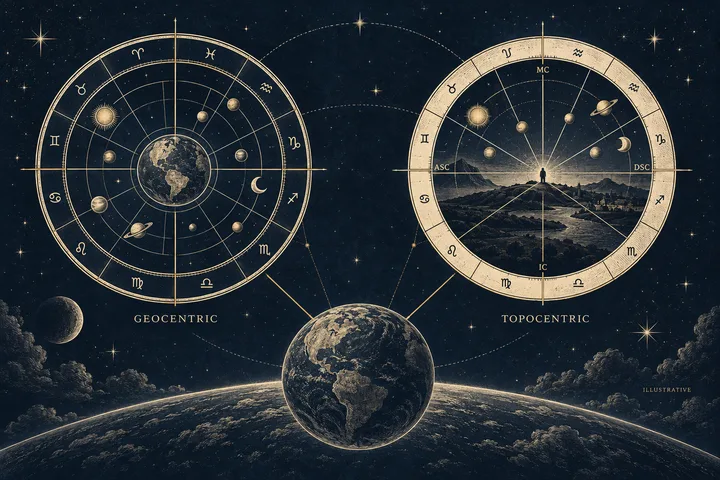
A Topocentric setting can change a synastry report in two different ways. It may select the Polich-Page house system, changing house cusps, or it may request topocentric planetary positions, changing the coordinates used for degree-sensitive contacts. The label alone doesn’t tell you which calculation changed, so identify the control’s effect before interpreting a new result. Swiss Ephemeris makes the distinction clear in its technical documentation. Its house-system list names Polich-Page as the topocentric house method, while separate position functions and setup instructions cover topocentric planetary calculations. The method name and the coordinate mode therefore belong to different chart layers. A changed cusp can place a partner’s planet in a neighboring house while leaving that planet’s sign and its angular relationship to another unchanged planet intact. A changed planetary coordinate, by contrast, can alter a degree-sensitive contact only if the report recalculates the position and the difference reaches a relevant boundary. This distinction gives you a simple first step: ask what the setting changes, then compare that output alone. If it changes houses, inspect the overlay. If it changes planetary coordinates, compare the reported positions and contacts. Don’t treat the setting name itself as an interpretation.
Sources: Swiss Ephemeris Programming Documentation; Swiss Ephemeris Programming Documentation
Why can one menu label name two different choices?
The label can point to two separate steps in chart calculation. One step sets the house framework; another calculates a planet's position from a chosen viewpoint. In Swiss Ephemeris, those steps have different controls, even though both can carry the word “topocentric.” A report that shows only a single toggle may hide that distinction, so ask what its setting changes before interpreting a changed result. In the programming reference, the house-system list assigns code T to Polich-Page and calls it the “topocentric” system. A house system divides the chart into twelve areas by calculating house cusps, the boundaries between houses. Choosing Polich-Page therefore selects a way to calculate those boundaries. By itself, that choice does not request a different set of planetary coordinates. In a synastry overlay, the house framework determines which house receives a partner’s planet; the planet’s sign and longitude are a separate matter. The same Swiss Ephemeris documentation describes topocentric planetary positions through another function, swe_set_topo. Before those positions are computed, the program supplies geographic longitude, latitude, and altitude for the birthplace, then requests the topocentric mode in its calculation flags. Here, topocentric means that the planetary coordinates are referred to an observer at a specified place. It is a position mode, not the name of a house system. This technical distinction is useful because it identifies two different possible outputs: house cusps on one hand, planetary coordinates on the other. Time and place matter to these calculations in different ways. Planetary positions are calculated for a date and time; the topocentric position setup also requires the observer’s geographic location. House calculations use a time-based chart framework and geographic context to establish the cusps. The zodiac frame and the provider’s other calculation conventions matter too, because comparing reports fairly requires knowing which choices stayed fixed. The Swiss Ephemeris programming interface documents these controls for its own library. It does not tell us how another provider wired a menu label or which defaults that provider selected. So ask a concrete question: “Does Topocentric change the house system, the planetary position mode, or both?” Then ask which birth time and location fields the calculation uses, and whether the provider can show the selected house method and unrounded positions. If the answer is unclear, treat the label as unresolved. A setting name alone cannot tell you whether an overlay or a degree-sensitive contact changed.
Sources: Swiss Ephemeris Programming Documentation; Swiss Ephemeris Programming Documentation
What does Topocentric change when it means Polich-Page houses?
When Topocentric means Polich-Page, the report has changed its house system. It has recalculated the cusps, the boundaries that divide a timed chart into twelve houses. It has not moved a planet's zodiac longitude simply by changing that setting. A planet can receive a different house label while retaining its sign and its angular relationship to another planet. Astrodienst's ‘Polich-Page “topocentric” table of houses’ describes the system through the birth place's geographic latitude and compares it with Placidus. In low and middle latitudes, its cusps tend to differ from Placidus cusps by less than one degree. Astrodienst says the differences grow more pronounced closer to and beyond the polar circles; beyond them, the system can sometimes produce impractical house positions. That is a latitude-conditioned description, not a promise that every chart will show near-identical cusps or a claim that one system is universally preferable. Think of a cusp as a line used to classify where a planet falls in the house structure. If a planet sits well inside a house, a small movement in that line will usually leave its placement unchanged. If the planet lies close to a cusp, even a modest difference between systems may place it on the other side. The report then offers a different overlay label. It has not changed the planet's sign, and a house-system switch alone has not created a new aspect between unchanged planetary longitudes. For example, imagine a partner's planet near a house boundary in the receiving person's chart. Under one system, the planet falls on one side; under Polich-Page, the cusp may sit across it. Read the two house interpretations as alternatives conditional on the framework, rather than treating the new label as a newly discovered trait or relationship verdict. If the planet remains well inside the same house under both systems, the setting has made little practical difference to that overlay. The comparison is most useful when you can inspect the actual cusps and planetary positions for both charts. Confirm the birth time and place used for each chart. Then check how far the relevant planet lies from the disputed cusp, and note the house system named in each output. At high latitudes, pay close attention to calculation warnings or impractical results; do not assume a displayed house placement is automatically useful to interpret. Astrodienst identifies this possible limitation, but it does not tell you which cusp will change in a particular chart. Ask for the values, not just the setting name. A changed overlay deserves attention when a planet is near a cusp and the birth inputs are dependable. Otherwise, keep the stable sign and contact reading in view, and weigh any house difference according to its actual size and context.
Sources: Polich-Page 'topocentric' table of houses; Swiss Ephemeris Programming Documentation
Why does a changed overlay need to be read in one direction at a time?
A synastry house overlay asks two linked questions: whose planet is being placed, and whose houses receive it? If A’s Moon falls in B’s fourth house, the reading begins with A’s lunar nature entering B’s fourth-house field. Reverse the charts and ask where B’s Moon falls in A’s houses. That is a separate overlay, with its own planet, house framework, and emphasis. A change in one direction does not automatically change the other. Cafe Astrology’s “Synastry: Planet Overlays in Houses” describes the overlay as placing one person’s chart over the other’s, then reversing the bi-wheel to see where the first person’s planets fall in the second person’s chart. The same page explains the interpretive roles: the planet person brings a planetary function into the other person’s house, while the house person experiences that function through the concerns of that house. These roles interact, but they aren’t interchangeable. A Moon person may bring emotional attention; the house person’s fourth-house framework colors where that attention lands. “Romantic Compatibility Synastry House Overlays,” also from Cafe Astrology, makes the directional point through its two separate bi-wheels. One wheel shows one person’s planets in the other’s houses; the reverse wheel changes which chart supplies the houses. If a cusp change moves A’s Venus from one of B’s houses to the next, record that as a possible change in how B’s house areas frame A’s Venus. Then inspect B’s planets in A’s houses independently. The reverse overlay might remain stable, or a different planet near a different cusp might be the only one affected. Consider an illustration, not a calculated couple: A’s Venus sits close to a house boundary in B’s chart. Under one house setting, the reading may emphasize how affection and attraction enter one area of B’s life; under another, the neighboring house brings a different life area into focus. Venus remains A’s Venus, with the same sign and planetary meaning. Only the house context under review has shifted. Nothing in that change establishes how B feels, and it doesn’t erase the rest of the synastry. So label every overlay with both names: “A’s Venus in B’s houses,” then “B’s Venus in A’s houses.” This simple notation prevents a one-way chart observation from becoming a mutual verdict. Ask which person’s boundary changed, and whether the placement sits close enough to the cusp to keep the interpretation conditional.
Sources: Romantic Compatibility Synastry House Overlays; Synastry: Planet Overlays in Houses
What changes when the report means topocentric planetary positions?
A topocentric planetary position is calculated for an observer at a particular place on Earth. That makes it different from selecting Polich-Page houses, even though both can appear under the word “topocentric.” Swiss Ephemeris documents a separate setup for topocentric positions using geographic longitude, latitude, and altitude. Its house calculations have their own functions and method codes. The U.S. Naval Observatory’s Topocentric Positions service also makes the observer basis clear: users provide latitude and longitude to request positions for selected solar-system bodies. These references define a calculation mode; they don’t tell us which mode a particular synastry report uses. Ask the provider what its control changes before interpreting a difference. An aspect depends on the planets’ longitudes in the frame the report uses. A house-system change alone doesn’t alter the angular distance between unchanged longitudes. A switch in planetary position mode could change a displayed longitude, but that possibility isn’t proof that a specific contact changed. Compare actual values using the same birth inputs, zodiac frame, and aspect rules. If the longitudes match at the precision used for interpretation, there’s no position difference to explain. If they differ, recalculate the shortest angular separation and compare it with the stated orb. Keep the result conditional when rounded values don’t show whether the contact falls inside or outside that boundary. Imagine a report labels a contact close to its orb limit. If the provider confirms that Topocentric changes planetary coordinates, request unrounded longitudes in both modes. The contact deserves a second look only if the changed values move its separation across the stated limit. If the setting changes house cusps alone, the contact’s angular relationship stays as it was; only the overlay may need review. This distinction keeps a house label from being mistaken for a changed aspect. The Moon is sensible to check when a provider says its positions are observer-based, since the USNO service includes it among the solar-system bodies with topocentric positions. But neither that fact nor the label supplies the size of a chart-specific shift. Don’t assume the Moon moved by a meaningful amount, or that an aspect crossed an orb, without the report’s values. The same rule applies at sign or aspect boundaries: inspect the calculation used, not the menu label alone. Ask for the position mode and unrounded degrees when a contact sits near a sign, aspect, or orb threshold. If the provider can’t show those values, preserve the reading as conditional. First establish which coordinate mode produced the chart; then weigh the contact according to the values and rules the report states.
Sources: Topocentric Positions; Swiss Ephemeris Programming Documentation
How should a reader rank a changed overlay against a stable aspect?
Keep the aspect and overlay in separate columns. An aspect describes the angular relationship between two planetary positions. A house overlay describes where one person's planet falls in the other's house framework. If a house-system setting changes while both planetary longitudes stay the same, their angular separation stays the same too. The aspect remains; context may change.
That distinction gives you a practical ranking. Start with a close degree contact, interpreted under the report's stated aspect and orb rules. Then use each planet's sign to describe its style. Add the overlay as context, and mark it conditional if a planet sits near a cusp. This is a reading order, not a claim that one layer matters more in every relationship. It keeps a setting-sensitive house label from erasing a contact the setting did not change.
The distinction follows from what each layer measures. The Astrodienst reference on Polich-Page describes house-cusp differences relative to Placidus. Those boundaries can alter a near-cusp planet's house assignment; they do not, by themselves, recalculate its longitude. The Cafe Astrology guide to synastry planets in houses reads overlays through the receiving person's house themes. Together, these sources support a useful separation: an aspect describes the meeting of planetary functions, while an overlay suggests the life area where that meeting may be expressed. House meaning remains interpretation, not a second measurement of the aspect.
Imagine a hypothetical pair with a Venus-Mars contact that remains close under the same planetary positions and the report's same orb rule. Suppose one person's Venus also falls close to the other person's fifth/sixth-house boundary. Under one house system, the overlay might be read through fifth-house themes of pleasure and creative expression; under another, through sixth-house themes of daily work and routine. The contact itself still describes the Venus-Mars exchange. The changed overlay offers a different setting for considering it.
Don't count the two readings as independent confirmations of one conclusion. The Venus-Mars aspect and the house overlay answer related but distinct questions. One describes how affection, attraction, or desire meet in the chart's symbolic language; the other suggests a life area where that planetary function may become salient. If the overlay shifts with the house system, keep both readings conditional. Neither placement tells you how the couple behaves without considering their choices and experience.
Use a simple test: ask which parts remain true under both house readings. The stable contact can anchor the interpretation. Then ask whether the fifth-house and sixth-house descriptions fit the relationship, or whether one better reflects the couple's shared life. If neither fits, don't force the chart to choose. Keep the overlay tentative and return to contacts that don't depend on that cusp. A changed overlay can refine a synastry reading, but shouldn't reverse it when the aspect is unchanged.
Sources: Polich-Page 'topocentric' table of houses; Synastry: Planet Overlays in Houses
When does birth information make the setting relevant?
A house overlay is only as dependable as the birth information used to build the house frame. The birth time and place matter because house cusps are calculated for a particular moment and geographic location. If either person's time is missing, rounded, or uncertain, selecting Polich-Page houses cannot make that person's overlay precise. The method may be exact; the input may not be. This is why input confidence and method sensitivity need separate checks. A report can calculate two house systems consistently and still give a fragile reading if the recorded birth time is off, or if the birthplace or time-zone handling is wrong. Astrodienst's *Tables of Houses* describes Polich-Page as a latitude-based system and says its cusps tend to differ from Placidus by less than one degree in low and middle latitudes, with larger differences nearer and beyond the polar circles. That comparison tells you where a system change may be modest or more pronounced. It does not tell you whether a particular person's recorded birth time is accurate. Consider two placements in the same hypothetical comparison. One partner's planet sits comfortably inside a house under both systems. A small cusp shift would not move it across a boundary, so the overlay reading is comparatively stable. Another planet lies close to a cusp. A small change in the cusp, may place it on the other side. That overlay deserves a conditional reading: the planet's sign and symbolism remain, while the house area depends on the chart's inputs and chosen system. No universal time tolerance settles this; the cusp distance and source record matter. Check each person's chart separately. In synastry, one person's planets fall into the other person's houses, and then the direction reverses. If one birth time is firm and the other's is approximate, the first overlay may be more secure than the second. Do not let confidence in one chart lend false certainty to both. A precise-looking list can hide unequal inputs. Before debating Topocentric, ask the report provider how it handled each recorded birth time, birthplace, time zone, and daylight-saving rule, and whether the displayed house cusps can be compared. Swiss Ephemeris documentation treats location and time as inputs to chart calculations, but it cannot verify the details entered into a particular report. If the time or place remains uncertain, keep the reading with the supplied signs and any well-supported aspects, and set the house overlay aside. If the inputs are dependable, inspect the planet's distance from the cusp and the chart's latitude before deciding whether the setting changes anything useful.

Sources: Polich-Page 'topocentric' table of houses; Swiss Ephemeris Programming Documentation
How can two synastry reports be compared fairly?
Change one setting at a time. Keep both people's birth date, time, and place fixed, along with the zodiac frame, ephemeris, and aspect rules. Compare house systems first. Then compare planetary coordinate modes separately, if the software identifies them. When several inputs change together, you can't tell which choice produced the difference. The Swiss Ephemeris programming documentation lists Polich-Page as a house method and topocentric planetary positions as a separate calculation. Ask which output each control changes. Begin with each person's birth inputs. Confirm the same recorded time and place, time-zone handling, and daylight-saving adjustment. A corrected birth time can change house cusps; that's an input change, not a house-system effect. The Swiss Ephemeris documentation treats house calculation and planetary position calculation as distinct operations, so one can change without the other. Keep the zodiac frame and ephemeris fixed as well. Now compare outputs by layer. For a house-system comparison, check whether cusps and overlays change while planetary longitudes stay fixed. For a coordinate-mode comparison, check whether the reported positions change and whether that affects a degree-based contact under unchanged aspect rules. | Check | Compare | Status to record | | --- | --- | --- | | Birth inputs | Date, time, place, time handling | Stable or corrected | | Position mode | Geocentric or topocentric, if identified | Stable, changed, unavailable | | House system | Cusps and each directional overlay | Stable, conditional, unavailable | | Aspect output | Longitudes and same aspect rules | Stable, changed, not comparable | “Unavailable” doesn't mean unchanged. It means the report hides settings or values needed to compare. “Conditional” means the interpretation depends on a boundary, such as a planet near a cusp or a contact near the stated orb. A “stable” result holds under the controlled comparison. Ask its provider for the settings and, when possible, paired output. Keep the record short: list the fixed inputs, name the one setting changed, note affected values, and mark each reading stable, conditional, or unavailable. This separates an overlay from an aspect and a data correction from a calculation preference. If the provider can't say which layer Topocentric controls, treat the difference as unresolved.
Sources: Swiss Ephemeris Programming Documentation; Swiss Ephemeris Programming Documentation
What can this publication's Synastry Comparison Report actually compare?
The Synastry Comparison Report works from placements you already know. You enter each person's Moon, Venus, and Mars sign, then add a degree when you have it. The report compares sign-level elemental and modal themes. When both degrees are supplied, it calculates the shortest zodiac angle and checks five major aspects within a fixed 6° orb, as the report page explains. Those are placement comparisons, not a newly calculated natal chart. That distinction sets the boundary for a Topocentric question. The report asks you to bring known placements; it does not ask for birth dates, calculate natal positions from birth details, or assign house overlays. So it cannot tell you whether a partner's planet falls in your fifth house under Polich-Page, or compare that overlay with another house system. A Topocentric house setting belongs to the chart calculation that produced the houses. You would need to consult that chart's provider and settings. Optional degrees still have a useful role. They let the report compare the angular distance between two supplied placements against its five selected major aspects and stated six-degree orb. The source of those degrees matters: use positions from a chart whose calculation method you understand. The report does not independently check whether a degree came from geocentric or observer-based topocentric coordinates. It compares what you enter. This lets one report clarify a layer while leaving another open. If you and your partner already have Moon, Venus, and Mars placements, the comparison can organize sign themes and eligible degree-based contacts. But if you want to know where a planet lands in the other person's houses, this report has no house assignment to interpret. The Swiss Ephemeris programming reference treats house calculation and topocentric planetary positions as separate operations; the report's described inputs don't expose either as a setting. Use the original chart provider's documented settings to investigate a house overlay. Use the Synastry Comparison Report to compare supplied placements and, when both degrees are known, selected aspects. You can [compare your placements](/compatibility-test). For a Topocentric house question, ask the chart provider: “Does this setting change the house cusps, planetary coordinates, or both?”
Choose the setting by the question you want the chart to answer
Topocentric is worth examining when you know which chart layer it changes and that layer matters to your question. A cusp-sensitive house overlay may deserve a second look; so may a degree-sensitive contact. Stable signs and contacts remain the foundation. The setting is a refinement, not a verdict. Ask the report provider: “Does Topocentric change your house cusps, your planetary coordinates, or both? Can I see the exact values and birth inputs?” The Swiss Ephemeris programming interface lists Polich-Page as a house method and documents topocentric planetary positions separately. If the provider says the house method changed, compare overlays. If the position mode changed, check the displayed degrees and any contact near the report’s orb. Without that detail, keep the reading conditional. Then bring the interpretation into a real conversation. If two house areas remain plausible for a partner’s planet, ask where those themes show up in your shared life. Do you experience that person’s care through private emotional support, or through the routines you build together? Cafe Astrology’s “Romantic Compatibility Synastry House Overlays” describes one person’s planets falling in the other person’s houses; each direction is read separately. Hold both possibilities open, compare them with lived experience, and ask the provider for the calculation details before deciding how much weight the setting deserves.
Sources: Swiss Ephemeris Programming Documentation; Romantic Compatibility Synastry House Overlays
Sources & further reading
- Swiss Ephemeris Programming Documentation
Identifies Polich-Page as house-system code T and documents house methods separately from planetary position calculations.
- Swiss Ephemeris Programming Documentation
Documents observer-location setup for topocentric planetary positions separately from house calculation methods.
- Polich-Page 'topocentric' table of houses
Describes latitude-related cusp differences between Polich-Page and Placidus and notes possible impractical results at high latitudes.
- Romantic Compatibility Synastry House Overlays
Explains directional synastry house overlays by showing each person's planets in the other person's houses.
- Synastry: Planet Overlays in Houses
Describes the interpretive distinction between a planet person's function and the receiving person's house themes.
- Topocentric Positions
Defines observer-based positions and requests geographic coordinates for topocentric position calculations.
- Synastry Comparison Report
Describes the report's supplied Moon, Venus, and Mars signs, optional degrees, selected major aspects, and stated six-degree orb.
Synastry Comparison Report
Enter known placements for two people. Get an input-by-input comparison, selected aspect calculations and a clear record of what remains uncertain.
Compare our placements