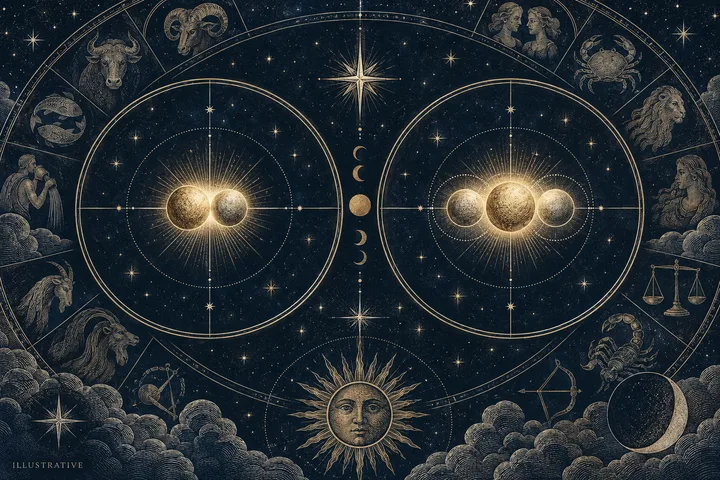
A third planet changes the reading, not by simple multiplication
Three planets close together can look like one giant answer. It isn't. A two-planet conjunction shows one direct blend of functions. A third planet turns that blend into a small system: one pair forms the core, and the extra planet adds a job, pressure, or bridge.
That is the difference between a compact cluster and a dramatic label. Moon, Venus, and Mars in one synastry zone can bring feeling, affection, and desire into the same conversation. They don't become one new planet. Each keeps its own voice, and the tightest contact usually speaks first.
Astrologers may call several closely joined planets a stellium or a triple conjunction, though definitions vary. The useful test here is practical. Are the planets actually close by degree? Do they form cross-chart contacts, or does one person already carry a natal pair that the other person activates? A same-sign group with wide gaps can describe emphasis without behaving like one close three-planet conjunction.
So the answer is clear: the third planet adds complexity and a new relationship question. It doesn't promise three times the intensity. Read the pair. Then ask what the third planet requires from the bond.
Sources: Aspect - Astrodienst Astrowiki; Conjunction - Astrodienst Astrowiki; Aspects Between Charts - Cafe Astrology
Set the chart scope before you name the pattern
This guide works from supplied Moon, Venus, and Mars signs, with optional degrees. Its Synastry Comparison Report can examine selected major aspects using a stated six-degree working orb. It doesn't calculate natal positions from birth details, houses, or a relationship outcome. That scope is enough for a careful placement comparison, provided you keep the inputs visible.
Write each placement with its owner. For example: Person A Moon at 12 degrees Taurus, Person A Venus at 18 degrees Taurus, and Person B Mars at 14 degrees Taurus. This is an illustrative set of placements, not a personal chart. The names keep the geometry honest.
A conjunction is based on angular distance. Twelve degrees Taurus and 15 degrees Taurus are 3 degrees apart. Twenty-nine degrees Aries and 1 degree Taurus are 2 degrees apart across the sign boundary. The signs describe style, but the distance tells you whether the aspect is close enough for the chosen method.
Use six degrees as the report's outer limit, not as a law for every astrologer. A 1-degree contact deserves more weight than a 5-degree contact. A same-sign placement outside the working orb may still color the story, but call it sign emphasis rather than a close conjunction. That one distinction prevents most overstatements.
Sources: Aspect - Astrodienst Astrowiki; Aspects Between Charts - Cafe Astrology; Synastry - Astrodienst Astrowiki
Work one example from geometry to meaning
Consider the example above. Person A's Moon at 12 degrees Taurus and Person A's Venus at 18 degrees Taurus form a 6-degree natal conjunction. Person B's Mars at 14 degrees Taurus is 2 degrees from the Moon and 4 degrees from Venus. This is not one three-planet interchart aspect. It is a natal Moon-Venus pair activated by two cross-chart Mars contacts.
Read the tightest contact first. Person A's Moon with Person B's Mars joins immediate feeling with initiative, heat, and movement. The contact may feel exciting. It may also feel intrusive if Mars moves faster than the Moon can settle. In either case, activation is the first word. Don't jump straight to a promise of harmony or conflict.
Next, read Person A's Venus with Person B's Mars. Venus describes affection, pleasure, taste, and the way attraction is offered. Mars pursues. Together, they can create physical pull and a difference in pace. Venus may want choice and sweetness. Mars may want a clear response. The contact becomes useful when you ask how the pair handles timing and consent.
Only then bring in Taurus. The sign gives the exchanges a tangible, steady, sensual style. Comfort, loyalty, touch, money, food, and routine may matter more than abstract declarations. Taurus doesn't erase the difference between Moon-Mars and Venus-Mars. It gives both contacts the same ground to stand on.
Chart ownership completes the reading. Person A carried the Moon-Venus pattern before the relationship appeared. Person B's Mars doesn't create that natal structure. It enters it. In synastry, the other person's planet can activate a pattern that already has a history inside the chart owner. That is why the same contact can feel more familiar to one person and more provocative to the other.
Sources: Aspects Between Charts - Cafe Astrology; Synastry - Cafe Astrology; Synastry - Astrodienst Astrowiki
Give the third planet one clear job
Once the core pair is clear, the third planet tells you what the connection must learn to carry. Mars adds initiative, desire, and speed. Saturn adds weight, limits, duty, and the need for consistency. Mercury adds language, questions, and the need to explain. Jupiter adds room, confidence, and the risk of excess. The planet doesn't guarantee a skill. It shows the skill or pressure the bond keeps rehearsing.
A supportive third planet can act as a bridge. Imagine Person A's Moon and Person B's Venus within 2 degrees, with Person B's Mercury within 3 degrees of both. Feeling, affection, and speech share one channel. The couple may find it easier to name a feeling, offer reassurance, and turn warmth into conversation. That still requires practice. The pattern is a route, not a result.
A demanding third planet changes the task. Imagine Person A's Moon at 10 degrees Cancer, Person B's Venus at 12 degrees Cancer, and Person B's Saturn at 15 degrees Cancer. Moon and Venus remain the affectionate core. Saturn asks whether closeness can become reliable without becoming a test. The same planet can give a bond structure or make one person wait for approval. Watch the behavior that follows the symbolism.
This is where the two-planet and three-planet readings part company. Moon-Venus alone may describe ease, receptivity, and fondness. Add Mars, and the bond has to manage pursuit. Add Saturn, and it has to manage responsibility. Add Mercury, and it has to manage words. The third planet doesn't merely make the first pair louder. It changes what the pair must do.
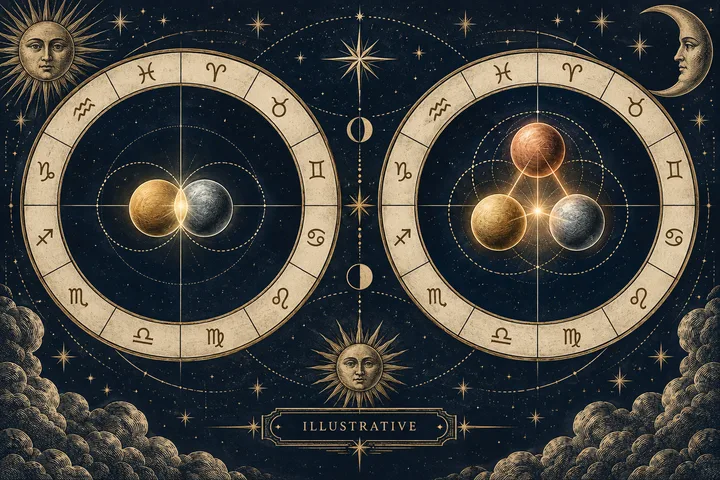
A two-planet synastry conjunction is one cross-chart contact. A third planet can create a connected pattern across the two charts, but it doesn't automatically create one three-planet synastry conjunction. First ask where the planets belong. A Moon and Venus joined in Person A's natal chart form a natal conjunction or stellium; Person B's Mars touching both can activate that natal pattern through two synastry contacts. That is different from a natal pair being activated by a partner's planet. Rank the exact contacts, then read the shared sign and the practical demand of the third planet. This guide uses supplied Moon, Venus, and Mars placements with optional degrees and a six-degree working orb. It doesn't calculate natal positions, houses, or a relationship outcome. Record each chart owner before you interpret the cluster.
Sources: Conjunction - Astrodienst Astrowiki; Aspects Between Charts - Cafe Astrology; Synastry - Cafe Astrology
Let degree order outrank the visual cluster
A cluster can look unified on a chart wheel while its pairwise contacts carry different weight. Imagine planets at 3, 5, and 9 degrees Virgo. The first pair is 2 degrees apart, the second is 4 degrees apart, and the outer pair is 6 degrees apart. Under this guide's method, all three can be listed, but the 3-to-5 contact leads. The 5-to-9 contact supports it. The 3-to-9 contact is the widest link.
Now imagine 1, 12, and 23 degrees Virgo. The planets share a sign, but they don't form one compact conjunction under a six-degree method. Virgo can still describe a shared style of care, usefulness, and improvement. It can't replace the missing degree connection. A report that calls the whole group one conjunction gives the reader a false sense of unity.
Sign boundaries need the same care. A planet at 29 degrees Aries and another at 1 degree Taurus can be conjunct by distance while carrying different sign languages. Initiation meets consolidation. Speed meets patience. Name the aspect and the signs. The tension between them is part of the reading.
A natal pair and a synastry pair also answer different questions. Person A's Sun at 7 degrees Gemini and Mercury at 10 degrees Gemini may form a natal conjunction. Person B's Venus at 9 degrees Gemini touches both, creating two interchart contacts. Venus activates Person A's way of thinking and speaking, but Person B isn't part of the natal conjunction itself. Keep the columns separate.
Sources: Aspect - Astrodienst Astrowiki; Conjunction - Astrodienst Astrowiki; Synastry - Astrodienst Astrowiki
Finish with a ranked reading and a usable question
The strongest exception is simple: the most visible three-planet cluster may not be the most important pattern in the report. A tighter aspect elsewhere can answer the reader's real concern more directly. If the question is emotional safety, a close Moon-Saturn contact may outrank a wider Venus-Mars link. If the question is communication, Mercury contacts deserve the first look. Relevance matters alongside closeness.
Translate the astrology into something you can observe. In the Taurus example, the Moon-Mars contact asks whether emotion and initiative can move at a shared pace. Venus-Mars asks how desire is expressed without turning access into an obligation. The Taurus setting asks what steadiness, touch, routine, and shared value look like in daily life. Those are questions a couple can answer through conduct.
Use this final worksheet. List each pair, its orb, and the chart owner. Mark each contact as natal or cross-chart. Rank it as core, supporting, or contextual under the six-degree scope. Then write one sentence in plain language: what does this planet bring, and what does it ask the relationship to do? Don't average competing contacts into one soft verdict.
The decision is not whether three planets make a connection destined or three times as powerful. The decision is which contact leads, what the third planet changes, and what behavior would confirm that reading. Compare your supplied Moon, Venus, and Mars placements, keep the degrees intact, and let the couple's next honest conversation test the interpretation.
Sources: Aspects Between Charts - Cafe Astrology; Synastry - Cafe Astrology
Sources & further reading
- Aspect - Astrodienst Astrowiki
Supports the definition of aspects as angular relationships, the role of degrees and orbs, and the priority of major aspects in interpretation.
- Conjunction - Astrodienst Astrowiki
Supports conjunction as a close blending of planetary functions and stellium as the term for several planets in conjunction.
- Aspects Between Charts - Cafe Astrology
Supports reading each person's planetary role in synastry and weighing sign, house, and inner-planet contacts.
- Synastry - Cafe Astrology
Supports conjunctions as powerful points of interaction and gives grounded interpretive meanings for Moon, Venus, Mars, Saturn, and other contacts.
- Synastry - Astrodienst Astrowiki
Supports synastry as a comparison of two horoscopes and the distinction between interchart aspects and natal chart structure.
Synastry Comparison Report
Enter known placements for two people. Get an input-by-input comparison, selected aspect calculations and a clear record of what remains uncertain.
Compare our placements