Imagine Maria notices the pattern before she opens the chart
Imagine Maria and Daniel have been seeing each other for four months. Daniel is warm when they’re together. He plans the evening, reaches for her hand, and talks as if the relationship has a future. Then the ordinary week arrives. He answers slowly, postpones plans, and returns with a grand gesture when Maria starts to pull away. She notices the same rhythm three times. Closeness, distance, alarm, reunion. Now she opens their synastry and sees a strong Venus-Mars contact. The temptation is immediate: the chart explains everything.
It might describe part of the attraction. It doesn’t settle the behavior. Maria’s useful question is narrower. Does the synastry theme help her name a repeated interaction, or is she using it to excuse a pattern that hurts? That distinction changes the reading. Astrology gives language to the bond between two charts. It doesn’t remove the need to watch what two people do with that bond on Tuesday night, after a misunderstanding, when one person says no, or when plans become inconvenient.
This is the test. Begin with the lived pattern. Describe it without astrological words. Then bring in the chart and ask what layer it may illuminate. Finally, return to the behavior and decide what the pattern calls for. The route matters because a chart-first reading can make every event look like confirmation. A behavior-first reading gives the symbolism something real to meet.
Maria doesn’t need to decide whether Daniel is good or bad from this scene. She needs to decide what she can observe, what she needs to ask, and what would count as change. That is the proper scale of a synastry reading. It can sharpen a conversation. It can show where attraction, care, pressure, or timing may gather. It can’t make a choice for her.
The case also shows why timing matters. A pattern repeated during the first months of dating may mean something different from the same pattern after a clear commitment and shared routine. The symbols haven’t changed, but the relationship has asked them to do more. Test the theme at the stage where your actual question lives. A chart reading about attraction should not quietly become a promise about permanence.
Build a three-pass test from one repeated exchange
Write the behavior in plain language. “He is emotionally unavailable” is a conclusion. “He talks about intimacy in person, then takes two days to answer a direct question” is an observation. “We have intense chemistry” is also a conclusion. “We flirt easily, but our conversations become arguments when one of us asks for a plan” gives you something you can test. The more concrete the sentence, the less room you leave for the chart to bend around it.
Use a short record rather than a dramatic memory. Note the date or situation, the action, your response, and what happened next. You’re not trying to turn love into a spreadsheet. You’re separating a recurring pattern from one vivid moment. Three similar examples carry more interpretive value than one night that felt fated, frightening, or unusually tender.
Astrologers compare two charts by looking at interaspects and at the signs and houses involved. The chart can suggest a role in a particular exchange. A Saturn person may feel like the one who sets limits or asks for structure, while the person whose Sun is contacted may feel judged, contained, or supported. But the same symbolism can take different forms depending on the planets, signs, houses, and each person’s natal condition. The behavior gives you the first boundary around the interpretation.
Use three passes, in order. First name the exchange: who initiates, who receives, who sets the pace, and what each person does next. Then mark the boundary: does the pattern appear around plans, vulnerability, sex, money, or only during exhaustion? Last, watch the response after the tension is visible. That sequence separates a planetary interaction from a story you’ve already decided to tell.
You can make the record even more useful by writing the smallest complete scene. Include the request, not just the reaction. “I asked whether we were still meeting Friday. He said I was pressuring him. We made no plan, and he sent flowers the next morning.” That sequence is richer than “he avoids commitment.” It shows the trigger, the response, the repair attempt, and the unresolved point. A chart theme can be compared with every part of that sequence.
Notice your own participation without taking responsibility for another person’s choices. You may pursue clarity when anxious, soften a request to keep peace, or withdraw before you hear the answer. Those are relevant facts. They’re not proof that you caused the other person’s pattern. Record your move as part of the exchange, then ask what happened when you changed it once. A theme that remains visible after one person tries a different response is more useful than a label attached to a fixed role.
Use a synastry theme as a three-pass question. First identify the exchange: which planets are meeting, and what do they ask each person to do? Next find the boundary: when does the theme appear, and when does it disappear? Finally watch the response after the pattern is named. A close Venus-Mars contact may describe attraction, pursuit, or creative heat, but the useful distinction is whether the charge becomes mutual movement or a chase that leaves one person behind. Exact degrees and a stated six-degree working orb matter. So do the ordinary scenes around the contact. Record three examples, include the strongest counterexample, and make one small request. If the response changes, the theme has a workable expression. If it doesn’t, name the limit plainly. The chart sharpens the question. Repeated conduct tells you which question deserves your attention next.
Sources: Synastry, Astrodienst Astrowiki; Aspects Between Charts, Cafe Astrology
Read the exchange, not a personality label
A synastry theme can arrive through several layers, and each layer answers a different question. Sign comparison describes style. An aspect describes the angle of contact between two chart factors. The planets describe the jobs being brought into the relationship. Houses show where the contact lands in the other person’s life, when house data is reliable. The natal chart supplies the larger context. If you collapse all of that into “we have a strong connection,” you lose the very detail that could test the claim.
Start with the planets. The Moon speaks to feeling, habit, comfort, and the ways a person seeks care. Venus describes attraction, taste, affection, and values. Mars describes desire, initiative, heat, and the way a person pushes into life. Mercury belongs in the conversation whenever the repeated behavior involves words, timing, interpretation, or conflict. Saturn matters when the issue concerns commitment, limits, duty, fear, or endurance. The planet tells you what kind of exchange to look for.
Then read the aspect. A conjunction concentrates the two functions. An opposition can create attraction and polarity, with each person feeling the other across a line of difference. A trine or sextile often makes blending easier. A square can create friction that demands a new way of working together. None of these labels replaces the planets. Venus square Mars is not the same story as Mercury square Saturn. The geometry describes how the story moves, not what the story is about.
Finally, check the signs and houses without letting them overrule the core contact. A Venus-Mars tension in fixed signs may repeat as a stand-off. In mutable signs it may show as changing terms, mixed signals, or a restless argument that keeps reopening. A house overlay can show the life area that gets activated, but only if the birth times support that layer. When a birth time is missing or approximate, keep the reading at the sign and aspect level. Precision begins with knowing what the chart can actually say.
A common mistake is to turn the planet person into a fixed character. “He is Saturn, so he is cold.” “She is Mars, so she is aggressive.” This makes the chart smaller and the person less free. Read planets as verbs instead. Saturn can structure, delay, test, protect, fear, or restrict. Mars can pursue, initiate, defend, cut through, compete, or desire. Venus can welcome, soften, value, attract, avoid conflict, or seek pleasure. The behavior tells you which verb is active.
Return to Maria and Daniel. If Daniel’s Saturn contacts Maria’s Venus, the chart may describe a relationship in which affection meets questions of timing, responsibility, or permission. In one expression, Daniel helps give the bond a shape that lasts. In another, Maria feels that every desire must pass an inspection. The aspect doesn’t choose between those expressions. Their conduct does. Does Daniel explain the limit and make room for Maria’s needs? Does Maria feel steadier, or smaller?
The person whose planet is contacted may also experience the exchange differently from the planet person. A Venus person may seek warmth while the other person experiences Venus as approval or expectation. A Mars person may feel energized by a partner’s Moon, while the Moon person experiences that Mars as pressure. Use both sides of the contact. Ask what each person brings, what each person receives, and what each person does when the contact is strained.
This approach protects the reading from blame. It also makes it more useful. Instead of saying, “Saturn makes him controlling,” say, “When commitment feels uncertain, he responds by setting more rules, and she experiences those rules as criticism.” Now you can ask a real question. Can the couple create a clear agreement without turning the agreement into surveillance? Astrology has given you a pattern. The relationship still has to choose its expression.
Sources: Synastry, Astrodienst Astrowiki; Aspects Between Charts, Cafe Astrology
Use a specificity ladder for the chart evidence
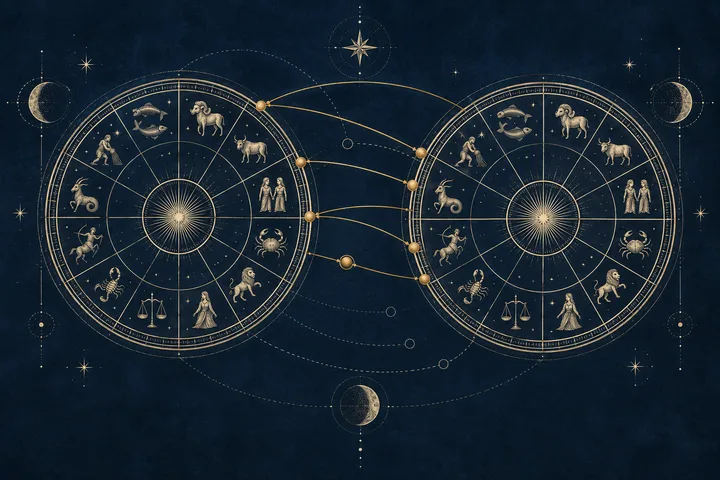
Not every resemblance between two charts deserves equal weight. A same-sign placement can create a recognizable style, but it isn’t automatically an aspect. An aspect depends on degree distance as well as sign relationship. In this report’s working method, major synastry contacts use a six-degree orb. The closer the planets are to exact, the more confidently you can treat the contact as a central thread. A contact outside that scope may still be an interesting background note, but it shouldn’t lead the reading.
Think of the hierarchy as a funnel. First, ask whether the two planets form a major aspect within the stated orb. Second, ask whether the planets belong to the topic you’re investigating. Third, ask whether the sign expression fits the behavior. Fourth, check whether other major contacts repeat or modify the same story. Only then should a broad sign similarity enter the conclusion. This keeps one attractive phrase from overpowering the whole comparison.
Add a specificity label to each observation: exact, probable, thematic, or unknown. Exact means the degrees establish a major contact inside the chosen orb. Probable means the sign relationship and available data point in one direction, but a missing degree or time leaves a question open. Thematic means the planet symbolism helps you frame the exchange without proving an aspect. Unknown means you don’t have enough information to read that layer. These labels stop a broad resemblance from quietly borrowing the authority of an exact contact.
For example, suppose a couple reports a recurring chase-and-retreat rhythm. A close Venus-Mars square may describe attraction mixed with irritation. That is a stronger starting point than simply seeing Venus in a fire sign and Mars in another fire sign. If Mercury-Saturn also forms a close hard aspect, the relationship may add a communication bottleneck: desire appears quickly, but difficult questions meet caution, silence, or correction. If Moon-Jupiter is close and supportive, warmth and forgiveness may help the couple return to the conversation.
Ranked reading doesn’t mean mechanical reading. The tightest contact isn’t always the loudest event in every week. A planet can be central in the chart and quiet in a particular season. A wider contact can become noticeable when the same theme is activated elsewhere. Still, you need a stable order of attention. Start with what is exact, relevant, and repeated. Move outward only when the evidence earns it.
One way to check your ranking is to remove the most exciting contact and see whether the interpretation still stands. If the entire story collapses when you stop talking about Venus-Mars, you may be admiring chemistry rather than reading the relationship. If the same behavior is also reflected in Mercury-Saturn, Moon-Mars, or a repeated sign pattern, the theme has more support. Don’t count contacts like votes. Look for independent descriptions of the same interaction.
The reverse test helps too. Keep the behavior and remove the astrological labels. Can you still describe the issue clearly? If yes, the chart is serving the reader. If no, the chart may be hiding a vague claim. Astrology should make an observed pattern more precise. It shouldn’t be the only thing holding the sentence together.
You can rank a theme by asking how many kinds of evidence meet it. Degree strength is one kind. Repetition across situations is another. A similar dynamic appearing through more than one relevant contact adds a third. The partner’s own description adds a fourth, though it may refine the symbolism rather than confirm your first guess. This is not a score. It is a way to stop one shiny placement from carrying the entire reading.
For instance, a close Mercury-Saturn contact may be easy to notice in a couple who debates every word. But if both people report that serious talks become clearer after they slow down, the contact is not only a blockage. It may also describe the discipline that makes clarity possible. The interpretation should include the obstacle and the skill it asks for. Otherwise you’ve described the friction and missed the relationship’s answer to it.
Sources: Partner Horoscopes FAQ, Astrodienst; Aspect, Astrodienst Astrowiki
Find the boundary where the theme changes form
The boundary pass asks where the theme stops being recognizable. Draw four small boxes: private closeness, public life, practical cooperation, and rupture or repair. Put the same exchange in each box only when you’ve actually seen it there. If the pattern appears in one box and not the others, that difference is part of the interpretation. It may show a setting that activates the contact, not a trait that follows the couple everywhere.
Suppose you’re testing Moon-Mars contacts because one partner seems easily provoked. In conflict, the Mars person may push for an answer while the Moon person withdraws or reacts defensively. That fits one possible expression of the contact. But what happens when the couple cooks together, travels, or deals with a small household problem? Does Mars bring useful action to Moon’s needs? Does Moon help Mars slow down and notice feeling? If the same functions cooperate in calm conditions, the hard contact may be a source of heat that needs skill, not a permanent verdict.
Do the same with easy contacts. A Moon-Venus connection can show tenderness, familiarity, and a wish to share physical space. It may also encourage a couple to smooth over a problem because comfort feels better than truth. If one partner makes a joke whenever the other raises hurt, the warm symbolism may be present, but it isn’t doing the whole job. The question becomes whether affection can tolerate honesty.
Keep the comparison paired. If you’re studying pursuit, place one pursued moment beside one moment of mutual initiative. If you’re studying restraint, place a delayed answer beside a careful promise that was kept. If you’re studying tenderness, place a warm gesture beside the way hurt was received. The contrast tells you more than a pile of matching examples because it shows the contact’s range.
The boundary can be a condition, too. A theme may appear when plans are vague, then soften after the couple agrees on a time. It may flare in private but disappear around friends. It may belong to the first reply, while the second reply shows a practiced repair. Write the condition beside the example. “Mars pushes when the answer is delayed” is more precise than “Mars causes conflict,” and it points toward a question about delay, not a judgment about character.
Give special attention to transitions. Many couples look harmonious when nothing is being asked of them and become revealing when a plan changes, a limit appears, or one person needs more time. Watch the first response and the second response. The first may be reflex. The second shows whether the person can reflect, repair, and choose differently. A synastry contact may describe the reflex, while maturity shows what happens next.
Don’t average the boxes into a single score. A contact can be generous in practical work and sharp in emotional exposure. It can be quiet in public and vivid in private. Keep those distinctions. They tell you what question to ask next: whether the couple needs a shared practice for one setting, or whether the same exchange is spreading into every part of the bond.
Sources: Synastry, Astrodienst Astrowiki; Aspects Between Charts, Cafe Astrology
Compare the chart story with the situational story
A fair reading needs an alternative explanation. Not because the chart is irrelevant, but because one symbol can attract too much attention. If the couple keeps arguing about response time, the synastry may show Mercury contacts, Moon needs, or Saturnian caution. The alternative may be a demanding work schedule, a different communication habit, an old agreement that no longer fits, or simple uncertainty about the relationship. The chart can describe the style of the problem without being the only cause you consider.
Write the two explanations in parallel. “A close Mercury-Saturn contact may make difficult conversations feel weighty, and we also haven’t agreed on how quickly we expect replies.” “A Venus-Mars square may turn desire into irritation, and we may be using teasing instead of asking directly for intimacy.” The second clause keeps the couple responsible for the choices in front of them. It also gives the chart a practical place to work.
A three-column note keeps the test clean. In the first column, record the exchange and its setting without an astrological label. In the second, write the planet pair, aspect, and verb that might describe it. In the third, list another explanation and one observation that would weaken it. The goal isn’t to make the chart lose. It’s to stop either story from becoming unfalsifiable.
You can add a fourth line beneath each entry: what would count as a different expression? For a Venus-Mars pursuit pattern, it might be a direct invitation followed by room for a real answer. For Saturn around commitment, it might be a limit explained without withholding warmth. This gives the couple something to recognize when the contact matures. It also prevents the word “pattern” from meaning only the version that first caused pain.
Then look for evidence that would weaken each explanation. If the response-time issue disappears during a less busy week, circumstance matters. If it returns whenever vulnerability enters the conversation, the emotional pattern matters more. If the couple argues about sex but can discuss money with ease, a general communication label is too broad. If every topic turns into a contest, Mars, Mercury, Saturn, or fixed-sign dynamics may be part of a larger pattern.
This is where conviction and humility meet. You can say that a close contact strongly describes a tension between desire and response. You can’t say the contact proves why a person behaved badly on a specific night. Read the chart boldly at the level it supports. Keep the story open where the evidence is mixed. That makes the interpretation more faithful, not less certain.
Sources: Synastry, Astrodienst Astrowiki; Aspects Between Charts, Cafe Astrology
The exception: a contact can be active without its cliché
Sometimes the chart theme is unmistakable and the lived pattern refuses to follow the expected script. A couple may have a tense Venus-Mars contact, yet they rarely fight about desire. They may have Saturn touching a personal planet, yet the relationship feels light, generous, and easy to sustain. Don’t force the match. Ask what the symbolism is doing elsewhere. The contact may describe a shared craft, a way of motivating one another, a private sexual language, or a tension that has already found a mature form.
A chart doesn’t have to appear as the first interpretation attached to a planet. Venus-Mars can mean attraction, but it can also mean that one person’s style of pleasure activates the other person’s drive. The couple may channel that charge into travel, exercise, art, business, or playful competition. Saturn can feel heavy, but it can also make a promise concrete. The strongest exception is not a reason to discard the aspect. It is a reason to widen the verbs before you narrow the conclusion.
Also check the natal charts. Astrologers commonly read a synastry contact in the context of each individual chart. A person with a strong natal Saturn may experience a Saturn contact as familiar competence rather than coldness. Someone with a natal Venus-Mars pattern may recognize the heat and know how to use it. The same interaspect can land differently because each person brings an existing language to it.
If the repeated behavior contradicts the first interpretation, let the behavior revise the interpretation. Say, “This contact is active as sustained effort and desire, not as recurring conflict.” That is a stronger reading than “the couple must be fighting underneath.” The chart should illuminate what is there. It shouldn’t make you invent a hidden problem to preserve a preferred theory.
Sources: Synastry, Astrodienst Astrowiki; Synastry, Astrology.com
Name the theme and watch the response
When the exchange, boundary, and alternative all hold up, name the theme in one sentence that includes a verb. “When she asks for reassurance, he moves into problem-solving, and both leave feeling alone” is testable. “They have difficult synastry” is not. Then ask, “What would a better expression of this contact look like in the next ordinary instance?” The question turns symbolism into a shared task without turning either person into the chart.
Give each person a turn to answer without interpreting the other. The Venus person can describe what feels loving. The Mars person can describe what creates momentum. The Moon person can name what brings safety. The Saturn person can explain what responsibility or fear is present. Then compare the answers. Where do they agree? Where does one person’s need feel like the other person’s demand? The chart becomes a shared map rather than evidence used in an argument.
Use specific requests. “Please tell me by Wednesday if Saturday still works.” “When I share hurt, listen first and solve later.” “If you need space, say when you’ll return to the conversation.” These requests test the theme in the real world. They also create a way to observe change without demanding a perfect personality transformation. A relationship doesn’t need to erase a difficult contact. It needs a practice that lets the contact serve the bond.
If the conversation goes well, the astrology may help you name a pattern you had felt but couldn’t describe. If it goes badly, notice that too. A partner who disagrees with an interpretation can still respond with curiosity. No one has to accept a chart reading as a charge. The useful question is whether both people can discuss the experience, respect the answer, and choose a better next action.
Set one observation window and one success condition. You might watch the next three planning conversations and look for a clear answer within the agreed time. Or you might watch the next two moments of hurt and look for listening before advice. This isn’t a compatibility score. It’s a way to keep the interpretation tied to the exact exchange you’re studying, rather than letting every later event become new proof.
Don’t keep moving the goalposts. Decide in advance what a meaningful response looks like. It might be one honest answer, a kept plan, an apology with changed conduct, or a respectful disagreement. It doesn’t need to be flawless. It does need to be repeated enough that you can tell a new habit from a single performance. This is how a synastry reading stays connected to time, choice, and the life the charts are actually sharing.
Sources: Aspects Between Charts, Cafe Astrology; Synastry, Astrology.com
Stop the test where the birth data stops
Your conclusion should match the data you supplied. If you know only Moon, Venus, and Mars signs, you can compare sign styles and discuss broad themes. If you also know exact degrees, you can test major aspects within the stated six-degree orb. If the birth time is missing or uncertain, don’t treat house overlays or the Ascendant as settled. If a Moon degree is unknown, avoid declaring an exact Moon aspect that depends on it. Missing information narrows the reading. It doesn’t make the known placements useless.
The Synastry Comparison Report works from supplied placements and optional degrees. It doesn’t calculate a natal chart from birth details, calculate houses, or assign a compatibility score. That scope is part of the method. You bring the placements you want compared. The report can then help organize the Moon, Venus, Mars, and selected major-aspect layers, while keeping unknowns visible.
This matters when a tempting theme rests on a shaky detail. Someone may say, “Our Moons are conjunct,” because both Moons are in the same sign. If the degrees aren’t known, the conjunction may be close, wide, or not present within the working orb. Phrase the result honestly: “Your Moons share a sign, which can create familiar emotional style. The exact degree distance would show whether a major conjunction is present.” That sentence gives the reader something useful without pretending to know more.
The same rule applies to behavior. Don’t ask incomplete chart data to answer a question it can’t hold. Use known placements to frame the conversation, then let the couple’s repeated choices supply the missing texture. Precision is not a wall around astrology. It is how you keep a meaningful symbol from being stretched past its strength.
When you lack degrees, compare the signs without calling the result an exact aspect. When you lack birth times, avoid building the conclusion on angles or houses. When you know only one person’s placements, read that person’s style, not the whole relationship. The smaller claim is often the better one because you can actually use it. It gives you a question to bring to the other chart or to the next conversation.
If the data changes, the reading should change with it. A newly confirmed birth time may add houses and angles. A corrected degree may move an aspect inside or outside your chosen orb. Don’t defend the old interpretation out of loyalty to the story. Re-read the contact, compare it with the behavior, and say what the new detail makes clearer. Revision is part of sound chart work.
Sources: Synastry, Astrodienst Astrowiki; Partner Horoscopes FAQ, Astrodienst
Choose the next question, not a grand verdict
At the end of the test, you should be able to state three things. What theme is supported? What is the strongest exception? What action follows? For Maria, the supported theme might be attraction that intensifies when availability feels uncertain. The exception might be that Daniel is attentive and consistent when they make a clear plan. The action might be one direct conversation about response times, followed by watching whether the agreement survives an ordinary busy week.
Don’t make the decision larger than the evidence. A synastry reading can help you decide what to discuss first, what pattern to watch, and which layer deserves more study. It cannot certify that a person will change, declare that two people must stay together, or turn chemistry into a promise. The relationship’s repeated conduct remains the final test of its conduct.
Use a simple sequence. Name the behavior. Identify the most relevant planets. Confirm the aspect and orb if degrees are available. Read the signs and houses only as securely as the data allows. Compare the pattern across calm and difficult moments. Keep one alternative explanation alive. Then make one request that would let you see the theme more clearly. Give the request enough time to meet real life.
Choose the request before you choose the interpretation’s final tone. If you need reliability, ask for a clear plan and a clear update. If you need gentleness, ask for listening before advice. If you need room, ask for space without punishment. The request turns a symbolic idea into a visible experiment in the relationship. You’re not testing whether the stars are right. You’re testing whether the two of you can meet the issue with awareness.
The theme has done enough work when it separates the chart’s invitation from the relationship’s answer. You can see what the contact may awaken, what setting activates it, and what practice would give it a healthier channel. That is a precise reading. It doesn’t need a dramatic conclusion.
The final decision may be to continue exploring, to change the agreement, or to step back. Astrology can support any of those choices when it helps you see the pattern clearly. It should never make staying feel mandatory because the contact is rare, or leaving feel mandatory because the aspect is difficult. Rank the behavior first. Then decide whether the relationship has the willingness and capacity to work with what the chart describes.
If you’re comparing placements with a partner, share the interpretation as an invitation. Say, “This contact makes me wonder whether we handle desire differently,” rather than, “Your Mars proves you do this.” That small change leaves room for the other person’s experience. It also protects the reading from becoming a verdict before the conversation begins.
Sources: Synastry, Astrodienst Astrowiki; Aspects Between Charts, Cafe Astrology
A little more clarity
What is the quickest way to test a synastry theme without forcing it?
Choose one exchange, not the whole relationship. Describe what happened in plain language, identify the most relevant planet pair and aspect, then state the boundary where the pattern changes. Keep one alternative explanation beside the chart. After that, make a small request that fits the theme and watch the response more than the promise. If the contact is Venus-Mars, ask whether desire becomes mutual initiative or repeated pursuit and retreat. If it is Saturn with a personal planet, watch whether structure creates trust or shrinks room to respond. Recheck degrees and the six-degree working orb when they’re available. If the chart seems to fit but the behavior does not, change the planetary verb before inventing a hidden problem. The reading is working when it gives you a sharper question and a visible next step.
Sources & further reading
- Synastry, Astrodienst Astrowiki
Supports synastry as a comparison of charts, interaspects, sign and house context, and the need to read each natal chart before the comparison.
- Aspects Between Charts, Cafe Astrology
Supports reading planet roles in an interchart contact and weighing the planets, signs, houses, and relationship context together.
- Partner Horoscopes FAQ, Astrodienst
Supports synastry as two birth charts compared together and explains that synastry aspect drawings use a narrower orb.
- Aspect, Astrodienst Astrowiki
Supports the definitions of major aspects, degree deviation, orb, and the distinction between major and minor aspects.
- Synastry, Cafe Astrology
Supports the interpretive roles of Venus, Mars, Moon, Saturn, conjunctions, oppositions, squares, trines, and sextiles in synastry.
- Synastry, Astrology.com
Supports using degree distance and a tighter orb to judge the strength of an astrological connection.
Synastry Comparison Report
Enter known placements for two people. Get an input-by-input comparison, selected aspect calculations and a clear record of what remains uncertain.
Compare our placements