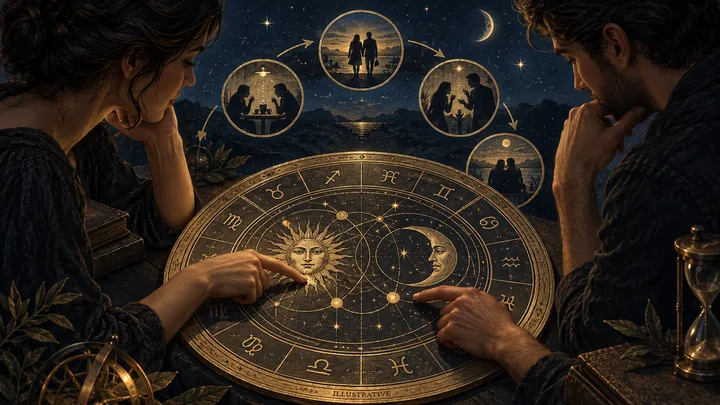
Imagine the same argument arriving every Sunday
Imagine Maria and Daniel at the kitchen table. They have been together long enough to know the script. Maria asks when they are leaving for dinner with friends. Daniel looks at his phone and says, “Soon.” She asks again. He hears pressure and snaps that she is making a simple evening heavy. She hears dismissal and starts planning without him. By the time they leave, both feel alone in the same car.
This is a fictional example, not a testimonial. It gives us something better than a vague compatibility question: a repeatable event with a beginning, a middle, and a result. The synastry interpretation under examination is a close Moon-Mars square. Maria's Moon is the receiving point in this example. Daniel's Mars is the activating point. In astrological language, her emotional rhythm meets his way of asserting, pursuing, and reacting. A square doesn't promise failure. It describes friction that asks for a conscious way through.
The first test is simple. Does the interpretation name what actually repeats? If the report says “emotional tension” and the couple can't find a scene that contains tension, the phrase is too loose to help. If the same request, tone, interruption, or silence keeps setting off the same response, the aspect has a live candidate. The chart doesn't replace the scene. It gives the scene a symbolic lens.
That distinction protects the reading from two opposite mistakes. One mistake treats an aspect as a sentence handed down by the heavens. The other throws away the chart because a single line didn't describe every part of the relationship. A synastry contact is a relationship between two chart factors. It can become visible in more than one situation, and it can stay quiet when another part of the chart has the stronger voice.
Synastry itself is chart comparison. Astrologers examine the contacts between one person's planets and points and the other person's planets and points. The aspect tells you the type of contact. The planets tell you what functions are meeting. The signs tell you how those functions speak. Houses, when reliable birth times are available, show where the exchange lands in a person's life. This order matters because “Moon square Mars” says more than “these two signs are incompatible,” but less than a full reading of every layer.
For this kind of test, start with one situation, one interpretation, and one time window. Don't collect ten dramatic aspects and search for evidence for all of them at once. That turns reflection into confirmation hunting. Choose the theme that feels both specific and important. Then watch what happens in ordinary moments. Sunday dinner is enough. So is bedtime, money talk, texting after work, or deciding who will visit family.
The couple's aim is not to prove that astrology caused the argument. Their aim is to discover whether the interpretation helps them see the exchange clearly enough to change it. That is the standard. A reading earns its place when it makes a hidden role visible and points toward a better choice.
Choose the scene because it matters, not because it is spectacular. The most revealing pattern may be the ten-minute delay before a text, the way one person handles a grocery list, or the silence after a small disappointment. A dramatic holiday argument contains too many ingredients to isolate one synastry theme.
Write the event in two columns. In the first, record what a camera could see: “At 5:45, Maria asked for a time. Daniel looked away. She asked again. He raised his voice.” In the second, record the inner reading: “I felt I had to carry the evening.” Both columns matter, but they aren't the same thing. The first gives you a clean trigger and sequence. The second shows what the contact may be touching.
A good case has three features: it recurs, it costs the couple something, and it leaves room for a different move. If the event happens once a year, keep the observation window open longer. If it happens three times before breakfast, you can begin today. Decide in advance what improvement means. “We didn't argue” may mean ease, or it may mean one person went quiet. Mutual clarity is a better sign: the request was heard, the answer was direct, and both people knew what would happen next.
That two-column record also gives the couple a fair way to disagree. Maria may write “he delayed,” while Daniel writes “she repeated the question before I could answer.” Neither account has to win before the pattern can be read. Compare the timing, the words, and the feeling each person attached to them. The gap between the accounts may be the most important expression of the contact.
Sources: Interaspect - Astrodienst Astrowiki; Aspects Between Charts - Cafe Astrology; Synastry - Skyscript Glossary
Name the chart inputs before you name the meaning
A clean test begins with clean inputs. Write down whose planet is whose. Record the planet, sign, degree if known, aspect, and orb. If the data is sign-only, say so. If the degree is rounded, keep the wording modest. You can still explore a sign relationship, but you can't honestly treat a close conjunction or square as confirmed without the degrees that show the distance between the planets.
For example, a useful worksheet might read: Maria's Moon in Taurus, degree unknown; Daniel's Mars in Leo, degree unknown; possible square by sign, exact orb not available. That is enough to explore a symbolic question about steadiness meeting heat, but it isn't enough to rank the contact as the central aspect in a complete synastry comparison. If exact positions are supplied, add them: Maria's Moon at 14° Taurus, Daniel's Mars at 18° Leo, a 4° square. The numbers in this example are illustrative only. They are not a personal chart calculation.
An orb is the distance from an exact aspect. A conjunction gathers planets near the same degree. A square is close to 90 degrees. An opposition is close to 180 degrees. A trine is close to 120 degrees, and a sextile is close to 60 degrees. The closer the planets are to the exact angle, the more tightly many astrologers read the contact. Synastry often uses a narrower orb than a natal chart because two charts create many possible cross-chart contacts. A tighter setting keeps the interpretation from becoming a pile of equally loud statements.
This doesn't make six degrees a law of nature. It makes six degrees a practical editorial boundary for this report. Use the same boundary for every candidate aspect so the comparison stays fair. If one calculator includes a 7° square and another excludes it, don't treat the disagreement as a mystical contradiction. Check the aspect settings, the zodiac, the house system if houses are involved, and whether the displayed degrees are rounded.
Next, separate the levels of the reading. The planet is the function. The sign is the style. The aspect is the relationship between the functions. The house is the life area, when the birth time supports it. In Maria and Daniel's example, the Moon can describe felt safety, habit, and the need to settle. Mars can describe action, heat, desire, anger, and the urge to move. The square suggests that the two functions don't automatically cooperate. It doesn't tell you which person is morally right.
Direction matters, too. Maria may experience Daniel as the person who presses the emotional bruise, while Daniel may experience Maria as the person whose needs interrupt his freedom to act. Both descriptions belong to the contact. Cafe Astrology's synastry guidance describes this as a role exchange: each person can take on the role of the planet they bring when the other person's planet is being expressed. That is why “her Moon, his Mars” should become two questions, not one label.
Ask what each person does in the scene. Ask what each person receives. Ask what each person assumes the other person's action means. Those answers are the bridge between chart language and lived experience. Without them, interpretation stays decorative.
Use a small input table before the reading begins: person, planet, sign, degree, aspect, orb, and confidence. Mark each line as confirmed, possible by sign, or unknown. Those states shouldn't share the same tone. If two reports disagree, copy their settings beside the data. One may show major aspects only, while another includes minor aspects or wider orbs. More lines don't automatically mean more truth.
Then write a scope sentence before the interpretation: “We have supplied Moon and Mars signs, but no exact degrees or reliable houses, so this is a sign-based theme, not a confirmed close square.” Or: “The supplied degrees place the Moon and Mars 4° apart in a square, and we are reading that contact within a six-degree orb.” This sentence keeps the chart reading honest when the conversation becomes vivid.
Imagine Maria and Daniel having the same argument every Sunday: she asks what time they will leave for dinner, he says they will work it out, and she feels abandoned when he stays vague. Their synastry report says Maria's Moon is closely square Daniel's Mars. The useful question isn't whether that aspect explains the whole relationship. It is whether its symbolism gives them a sharper description of this one loop. They can test it by naming the trigger, each person's role, the feeling underneath, and the repair that changes the next repetition. Compare the chart meaning with a short record of what happens for three or four weeks. If the pattern fits, keep the interpretation as a working theme. If it doesn't, lower its rank. Use supplied Moon, Venus, and Mars signs, plus exact degrees when available. A six-degree orb can guide the comparison, but this report doesn't calculate natal charts, houses, or relationship outcomes from birth details.
Sources: Aspects Between Charts - Cafe Astrology; Synastry - Skyscript Glossary; What’s Your Sign? An Intro to Synastry Charts and Astrological Compatibility - Astrology.com
Run the four-pass pattern test
The most useful test has four passes. You can do it in one conversation, then repeat it in a notebook after the next few incidents. Keep the passes separate. The first describes the event. The second maps the chart roles. The third checks the exception. The fourth chooses an experiment for the next time.
Pass one is the trigger. What happened first, before either person told the story about it? Maria asked for a departure time. Daniel delayed answering. That is more useful than saying “we fought about respect.” Respect may be the meaning they attach later. The trigger is the observable opening. Write the words if you remember them. Note the setting, the time pressure, and what each person was doing.
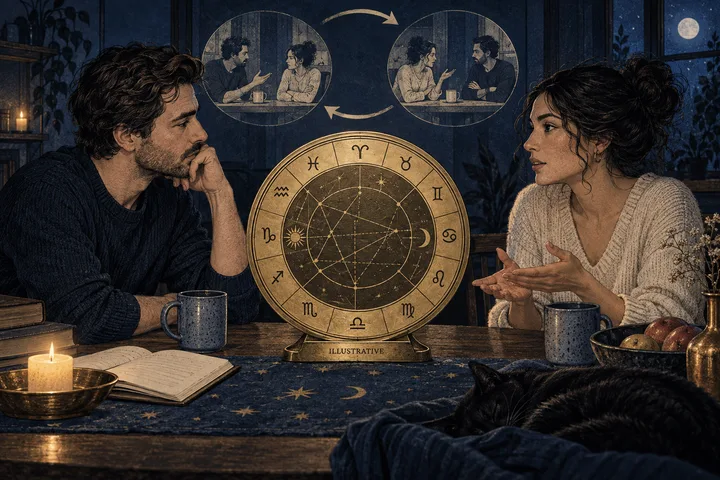
Pass two is the sequence. What did Maria do next? She repeated the question. What did Daniel do? He heard the repetition as a demand and used a sharp tone. What did Maria do then? She stopped asking and began preparing alone. The sequence shows the contact as a loop: need, pressure, defense, withdrawal, and more need. A good interpretation should illuminate the order, not merely describe the mood.
Pass three is the planetary role. Maria's Moon may describe her need for a settled emotional field before she can enjoy the evening. Daniel's Mars may describe his instinct to act when the moment arrives, not discuss every step in advance. The square shows why the same practical question can feel emotional to one person and controlling to the other. It also shows the strongest exception: if Daniel's Mars is well supported elsewhere, he may respond to pressure with direct action rather than anger. If Maria's Moon has strong Saturn contacts, she may prefer a clear plan and stay calm while asking for one. A single contact never gets to speak alone.
Pass four is the repair experiment. Maria can ask once with a concrete choice: “Do you want to leave at 6:30 or 7?” Daniel can answer before defending himself: “7. I need ten minutes, then I'll be ready.” If the tension rises, either person can name the pattern without using the chart as a weapon: “We're in the Sunday loop. I need an answer, and you need room.” Then they test the new behavior in the next similar scene.
The experiment should be small enough to repeat. Don't promise to become a different person. Change one move. Replace repeated questions with two options. Replace a defensive joke with a time. Replace silent withdrawal with a direct pause. The point is not to make the square disappear. The point is to give its energy a better channel.
Afterward, record four things: Did the trigger occur? Did the old sequence begin? Which new move was attempted? What changed in the result? You don't need a score. A few plain sentences are enough. “She asked at 5:45. He answered with a time. She still felt tense, but did not ask again. They left together.” That record lets the couple refine the interpretation instead of performing it.
If the chart language becomes more precise as the couple observes, keep it. “Moon-Mars tension” may become “uncertainty makes her pursue reassurance, and pursuit makes him rush or resist.” That is a real gain. The chart has helped name a mechanism the couple can work with.
You can also run the passes separately with each partner. Maria writes what she remembers without seeing Daniel's notes. Daniel does the same. Then compare the two accounts. The differences are part of the pattern. If one person remembers a request and the other remembers an accusation, the gap may be more important than the original sentence. A synastry reading grows richer when it can hold both experiences at once.
Don't choose an experiment that only one person can perform. “She should stop asking” is not a shared repair. She asks once with a choice, and he gives a time or names when he can answer. Both people get a move. That matters when a planet-role reading risks making one person the sensitive Moon and the other the difficult Mars.
Give the test an end point. Three or four repetitions usually reveal more than one charged evening, while a longer period may be needed for a rare event. At the review, keep the interpretation only if it became more exact, more balanced, or more useful. If it stayed vague, let it go. A smaller set of working themes will serve the couple better than a report full of labels they never use.
If the result is mixed, say exactly how. Perhaps the argument became shorter but the hurt remained. Perhaps Daniel answered clearly, yet Maria still felt unsafe because the old cancellations have not been repaired. Mixed results are valuable. They show which part belongs to the chart pattern and which part needs a promise, an apology, or time to rebuild trust. That is still progress, because the couple now knows which question belongs to astrology and which belongs to the relationship itself.
Sources: Interaspect - Astrodienst Astrowiki; Aspects Between Charts - Cafe Astrology; What’s Your Sign? An Intro to Synastry Charts and Astrological Compatibility - Astrology.com
Rank the interpretation against the rest of the synastry
One recurring scene can make one aspect feel enormous. It may be important. It may also be the only aspect you happened to read first. Rank it before you build a story around it.
Start with closeness. A tight major aspect usually deserves more attention than a wide contact of the same type, especially when the chart data is exact. Then look at the planets. Contacts involving the luminaries and personal planets often describe experiences a couple notices directly: identity, emotion, affection, desire, speech, and action. This does not make outer-planet contacts irrelevant. It gives you a sensible first pass.
Then look for repetition within the chart. Does the same theme appear through more than one contact? Maria and Daniel's Moon-Mars square may be joined by a Venus-Saturn contact, which could add caution around affection, or by Mercury-Mars, which could put heat into their words. Those contacts do not prove the same event. They give the theme more than one doorway. If several links point toward pressure around timing, desire, or response, the recurring scene deserves a higher rank.
Now look for ease. A difficult contact may describe the friction, while a trine, sextile, or supportive Moon-Venus connection describes why the couple can repair after it. Astrology doesn't ask you to choose between “good” and “bad” synastry. It asks what the whole exchange is doing. A contact that creates spark may also create agitation. A contact that creates comfort may also let an issue go unspoken. The useful question is how the parts cooperate.
Cafe Astrology advises readers to consider the sign and house placement of the planets as well as the aspect, and to pay close attention to inner-planet interaspects. That gives the couple a ranking method. A close Moon-Mars square in fixed signs may repeat through stubborn pauses and escalating pressure. The same aspect across cardinal signs may show up as fast starts, fast reactions, and a fight over who gets to initiate. The aspect is the skeleton. Sign and house give it a room and a way of moving.
A sign-only comparison has a lower ceiling. You can discuss element, modality, and broad planetary style. You can't honestly use it to choose between a close square, a loose trine, and no major aspect. If degrees are missing, mark the reading as provisional and let the lived pattern carry more weight. If house cusps are missing, keep the interpretation to planets, signs, and confirmed aspects. Precision means saying what is known and using only that much.
Finally, ask whether the alternative explanation is stronger. Maybe Daniel is not reacting from Mars symbolism at all. Maybe he is exhausted, worried about money, or annoyed because the dinner plan changed three times. Maybe Maria has learned from past cancellations that a vague answer means she will carry the whole evening. Those facts don't cancel the chart. They tell you where the chart might be describing a sensitivity rather than a complete cause.
The highest-ranked interpretation is the one that explains the most of the repeated scene with the fewest invented assumptions and still leaves room for the couple's choices. Keep that one. Put the rest in the margin.
A practical ranking can use four questions. Is the contact confirmed by exact degrees? Does it involve planets that match the behavior? Does another chart layer repeat or modify the theme? Does the interpretation help the couple choose a repair? An aspect that is technically close but says nothing about the scene may rank below a broader, clearly lived planetary pattern. Technical closeness earns attention. Recognition and usefulness earn priority.
Watch for double-counting. If several descriptions all come from the same planet pair, they may be different sentences for one theme. A close Venus-Mars conjunction shouldn't become three separate votes simply because a report describes chemistry, pursuit, and irritation in separate paragraphs. Count the contact once, then ask what its sign and house layers add. This keeps a crowded chart from overpowering the actual relationship question.
Rank the person's experience as carefully as the aspect. A contact can be exact and still feel different to each partner because each natal planet has its own condition and story. One person may welcome direct Mars energy; another may brace against it. The cross-chart contact describes the meeting, while the natal chart describes what each person brings.
When the evidence is mixed, choose the narrower sentence: “This contact may make timing sensitive when one person asks for reassurance and the other wants immediate action.” That is stronger than “you have a challenging relationship” because it names where to look and what would prove the sentence incomplete. Specificity makes an interpretation testable.
A simple comparison can prevent one vivid aspect from taking over. Read the candidate contact once without interpretation, then list the two or three other contacts most likely to touch the same behavior. Ask what each adds: trigger, tone, persistence, or repair. If none adds anything, don't count the same contact again under new names. The final reading should have one lead theme, supporting themes, and a clear reason the lead won.
Sources: Interaspect - Astrodienst Astrowiki; Aspects Between Charts - Cafe Astrology; Synastry - Skyscript Glossary
Know when the pattern changes its meaning
The same aspect can wear different clothes. That is not a flaw in synastry. It is the reason signs, houses, planetary condition, and the people themselves matter. A Moon-Mars contact can show care meeting action, attraction meeting irritation, or a shared ability to move quickly when someone feels threatened. Don't flatten it into “fights.” Find the exact behavior.
In Maria's case, the pattern changes if the trigger changes. If she asks for a departure time because Daniel has missed three important dinners, her question carries memory. The chart may describe how the old wound gets activated, but the repair also needs a promise that can be kept. If Daniel has just received bad news at work, his short answer may reflect a flooded nervous system or a private crisis in addition to the synastry. The interpretation must get wider when the facts get wider.
It also changes if the role reverses. Perhaps Daniel is the one who asks for a plan on workdays, while Maria wants to improvise on weekends. Then “Maria's Moon needs certainty, Daniel's Mars resists it” is too crude. The contact may be more mutual: whoever feels pressed becomes Mars, and whoever feels unheld becomes Moon. Cafe Astrology's role model is useful here because it keeps both people inside the aspect rather than turning one person into the problem.
A supportive chart layer can change the expression again. A close Moon-Venus contact may give Maria and Daniel a warm instinct to soothe each other after conflict. A Mercury-Saturn contact may help them make and keep clear agreements, though it could also make conversations feel formal. A Jupiter connection may restore generosity, but it won't erase a repeated practical failure. A lovely contact is a resource. It is not a pardon for behavior that remains hurtful.
The strongest exception is the scene that refuses to fit. Suppose Maria and Daniel have the same Moon-Mars square, yet the recurring situation is not conflict. When plans change, Daniel takes initiative and Maria relaxes. They both move quickly. The aspect may be operating as energizing cooperation rather than friction. Don't force the square to become a fight because a reference book used the word tension. In this couple's life, the better interpretation is emotional urgency that becomes teamwork when both people trust the plan.
This is where a real pattern test beats an aspect keyword. Keywords are doors. They aren't rooms. The couple supplies the room through its history, habits, signs, houses, and choices. A close contact gets attention, not automatic control over the story.
Repeat the observation after the experiment. If the new agreement changes the pattern, the chart theme may be real and workable. If nothing changes, inspect the practical problem again. Perhaps the pair needs a calendar, a boundary, an apology, counseling, or a decision about whether the arrangement is sustainable. A chart can clarify the style of a difficulty, but the couple still has to change the action.
If the pattern changes for good, update the interpretation. The point of a living reading is not to protect the first sentence. It is to keep seeing.
Timing can matter without becoming a new chart claim. A recurring pattern may flare during a move, a new job, illness in the family, or a period when the couple has too little rest. Those conditions can give a natal contact a louder stage. They can also create a situation no natal comparison could predict. Name the season of life alongside the aspect. The reading becomes more humane when it sees both.
There is a difference between a changed expression and a suppressed one. If Maria stops asking because she fears Daniel's response, the visible argument may disappear while the problem grows. A quiet pattern is not automatically a healed pattern. Look for freedom, directness, and mutual participation in the new scene. The repair should make both people more able to speak, not merely make the room quieter.
Sources: Aspects Between Charts - Cafe Astrology; Synastry - Skyscript Glossary; What’s Your Sign? An Intro to Synastry Charts and Astrological Compatibility - Astrology.com
Turn the reading into one honest conversation
A synastry interpretation has done its job when it improves a conversation. Not when it produces the most dramatic paragraph. Not when it gives one partner a label to quote during the next fight. The couple should leave the reading with a shared question and one behavior to try.
Begin with the scene, not the chart. “When we make evening plans, I ask several times and you go quiet or snap.” That sentence gives both people something they can recognize. Then add the inner experience. “I ask because I feel exposed when I don't know whether I can rely on the plan.” “I go quiet because I hear the questions as a demand and expect to disappoint you.” These are hypotheses, not verdicts. Let the other person correct them.
Only then bring in the chart. “Our Moon-Mars square gives us a way to talk about emotion meeting action. It may be why my need for reassurance hits your urge to get moving.” Keep the wording open enough for both people to stay present. Never say, “Your Mars makes you angry,” as if the chart has removed choice. Say, “When your action energy feels blocked, you may become sharp. Does that match what you notice?” A good interpretation invites recognition. It doesn't corner anyone.
Choose a repair that can be seen. Maria can ask for a time and a backup plan. Daniel can answer within a minute or say when he can answer. If either person needs a pause, the pause gets a return time. “I need twenty minutes, and I'll come back at 7:10” is different from disappearing. The couple is testing a symbolic theme through a practical change. That makes the reading accountable to life.
You can use the same method for other placements. Moon-Venus can be tested through the way comfort and affection are offered. Venus-Mars can be tested through desire, initiative, touch, and the way attraction handles frustration. Mars-Mars can be tested through decisions, pace, and conflict. Saturn contacts can be tested through duty, timing, fear, loyalty, and the agreements that make a bond durable. Name the planet function first. Then notice the sign style. Then watch the aspect in the scene.
A Moon-Venus theme, for instance, may look obvious because both people feel affectionate. Test the details anyway. Does one person offer food while the other wants words? Does a loving touch help, or does it arrive before the hurt has been heard? Venus-Mars needs the same care: attraction may support repair, or it may pull two people back into closeness before they name what happened. In each case, the scene tells you whether the contact creates comfort, misses the need, or teaches a shared language.
The Synastry Comparison Report can help you organize supplied Moon, Venus, and Mars placements, optional degrees, and selected major aspects using the stated six-degree orb. It can help you compare a chart theme with the question you are already living. It doesn't calculate a natal chart from birth details, add houses, or turn the relationship into a percentage. That limit is useful here. You are not asking a report to decide for you. You are using it to ask a better question together.
For Maria and Daniel, the final conversation might be: “When plans are vague, I chase an answer, and you feel pushed. When you delay or snap, I feel I have to carry the evening alone. For the next month, let's choose a leaving time by five, and if either of us needs a change, we say it directly. We can keep noticing the Moon-Mars pattern, but our agreement is what we will judge.”
That is the answer to the original question. Test one interpretation against one recurring situation. Describe what happens, map the chart roles, check the strongest exception, and try one repair. Then rank the interpretation by whether it helped you see and change the pattern. Start with the scene you both know.
The conversation also needs a boundary around interpretation. Agree that either person can say, That reading doesn't fit me, or, That part fits, but the reason is different. Astrology is relational language. It works best when both people can answer back. If one partner uses the chart to overrule the other's account, the chart has stopped serving the relationship and started serving the argument.
Make the review date specific. After three similar situations, sit down for fifteen minutes. Ask what triggered the loop, which role each person took, whether the chosen repair happened, and what the next experiment should be. If the same harm continues, the next step may be a firmer boundary or outside support rather than another layer of symbolism. The chart can remain meaningful while the decision becomes practical.
Sources: Interaspect - Astrodienst Astrowiki; Aspects Between Charts - Cafe Astrology; What’s Your Sign? An Intro to Synastry Charts and Astrological Compatibility - Astrology.com
A little more clarity
Can a recurring argument confirm a synastry aspect?
It can make an interpretation more useful, but it doesn't confirm a chart calculation by itself. First verify the supplied placements, degrees, aspect type, and orb. Then ask whether the interpretation describes the trigger, roles, and sequence of the recurring event. If it does, keep it as a working theme and test a small repair. If the pattern doesn't fit, lower the aspect's rank or revise the meaning.
What if I only know our Moon, Venus, and Mars signs?
Use sign-only inputs for broad themes such as element, modality, and planetary style. Don't claim a close major aspect, house placement, or exact ranking without degrees and reliable chart data. You can still compare a sign-based interpretation with a real situation. Treat the result as provisional, and make the observable behavior more precise than the astrological label.
Should a difficult synastry aspect be treated as the cause of conflict?
No. Read it as a pattern of exchange, not a sentence. A square or opposition can describe friction, attraction, polarity, or a task that asks for skill. The situation, chart layers, history, and choices shape its expression. Look for the strongest exception. If the same contact regularly becomes teamwork, read the energy as cooperation under pressure, not automatic conflict.
Sources & further reading
- Interaspect - Astrodienst Astrowiki
Defines interaspects and synastry, and explains why a smaller orb can keep cross-chart interpretation readable.
- Aspects Between Charts - Cafe Astrology
Supports reading planetary roles in each direction and considering signs, houses, and inner-planet interaspects.
- Synastry - Skyscript Glossary
Provides a traditional definition of synastry as chart comparison through planetary aspects and condition.
- What’s Your Sign? An Intro to Synastry Charts and Astrological Compatibility - Astrology.com
Explains planetary meanings in common synastry contacts and relates degree distance to aspect strength.
Synastry Comparison Report
Enter known placements for two people. Get an input-by-input comparison, selected aspect calculations and a clear record of what remains uncertain.
Compare our placements