What Can a Bound Refine—and What Can’t It Create?
Terms, also called bounds or limits, divide each zodiac sign into five unequal stretches. Each stretch has a ruler: one of the five traditional planets other than the Sun and Moon. Astrodienst’s reference, The ‘Terms’ of the Zodiac Signs, describes these divisions and shows that the tradition preserves more than one table. The Egyptian bounds page likewise describes degree-level rulership. A planet occupying a stretch is not the same thing as its bound lord. The occupying planet is the placement being read; the bound lord rules the interval containing that planet’s degree. This adds a finer layer to the placement, but doesn’t replace it.
That distinction matters in synastry. First identify the planets, signs, aspect, and orb under your chosen convention. That establishes the cross-chart contact. Only then can a bound ruler add a modest qualification to how one planet’s expression might be interpreted. The bound doesn’t form an aspect or establish compatibility. Traditional sources describe rulership and dignity; translating that into relationship style is an interpretive step. Ask what the refinement would clarify before checking a table. Would it help distinguish two plausible readings of a close Moon, Venus, or Mars contact? If not, leave it aside. The main contact gives you the useful starting point, and no extra technical layer should outrank it without a clear reason.
Why Does Naming the Table Change the Reading?
A degree does not have one table-independent term ruler. Name the table and version you use, because Egyptian and Ptolemaean tables can place a cutoff at different degrees. That choice affects the local ruler assigned to a planet; it does not change the planet’s zodiac position or the angular distance between two planets in synastry. Astrodienst’s reference, “The ‘Terms’ of the Zodiac Signs,” presents separate Egyptian and Ptolemean (Lilly) tables. Its Libra row makes the difference easy to see. In the Egyptian table, the successive boundaries are 0°, 6°, 14°, 21°, 28°, and 30°. In the listed Ptolemean (Lilly) table, they are 0°, 6°, 11°, 16°, 24°, and 30°. The table also gives the rulers associated with each interval. A Libra placement between 11° and 14° therefore falls under different rulers in these two displays. The lookup is precise only after you say which display you followed. For synastry, consistency matters because a term ruler is an interpretive modifier, not a new contact. A broad label alone may not identify the version clearly enough to reproduce the reading. The historical names need equal care. In chapter XXIII of “Tetrabiblos,” Ptolemy describes the Egyptian terms as an old arrangement admitted by many through earlier tradition. He criticizes their order and the unequal quantities assigned to planets, then says the Egyptian distribution seems more reliable than the Chaldean method he discusses. The next chapter, “The Terms According to Ptolemy,” sets out another arrangement. So a modern heading such as “Ptolemean Terms (Lilly)” should not be silently treated as the table Ptolemy himself gives. Astrodienst notes that transmission of Ptolemaean terms has several versions and identifies its current Lilly version as one of them. Even a table labeled Egyptian may need a source citation. The opened Valens-attributed table on “Egyptian Term Table by Zodiac Sign” gives Libra boundaries of 0°, 6°, 11°, 19°, 26°, and 30°, which differ from the Egyptian row shown by Astrodienst. That discrepancy is visible in the sources, but these pages alone do not establish why the tables differ or settle which one a reader should prefer. Don’t blend their cutoffs to build a convenient hybrid. Use a simple rule: choose one named table, keep its source with the reading, and apply its intervals consistently. If two readers give different bound rulers for the same degree, compare their table, edition, and boundary convention before debating what the ruler might add. The table choice can change that secondary interpretation. It cannot alter the aspect already established from the supplied placements. Naming the source turns a disagreement into a checkable difference in method.
Sources: The "Terms" of the Zodiac Signs; The Disposition of the Terms; The Terms According to Ptolemy; Egyptian Term Table by Zodiac Sign
Rank the contact before adding its bound ruler
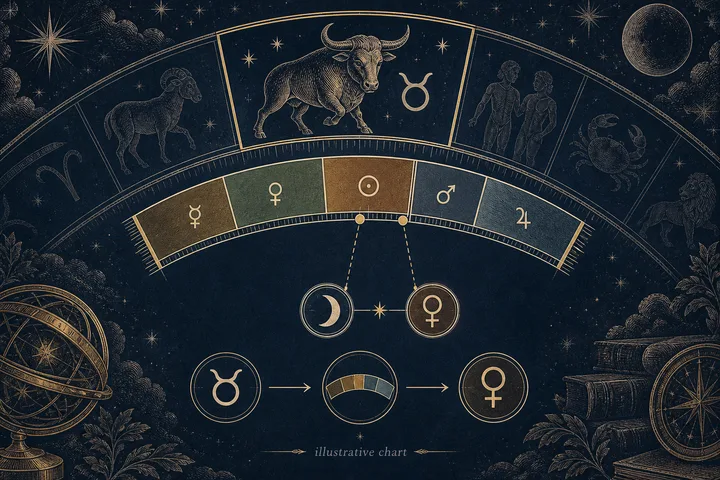
Before assigning a bound ruler, establish what the two planets are doing together. A term can color a degree, but it cannot turn two unrelated positions into a synastry aspect. Start with each planet, sign, and supplied zodiac longitude. Compare the longitudes across charts; their angle identifies an aspect under your chosen practice. This order matters because astrologers have not always used one method for aspects. “The Classical Origin and Traditional Use of Aspects” describes sign-based aspects in historical practice, alongside degree-based judgments and different ways to set an orb. It notes that a planet near the end of one sign and another near the start of a second can relate by sign while forming a different close angle by degree. Historical authors also disagreed about how far from exactness an aspect remains effective. For a degree-based comparison, state the aspect angle and the orb convention before interpreting. Find the exact angular separation, compare it with the exact angle of the aspect, and record the difference. That difference is the orb. For example, if two supplied longitudes are 88 degrees apart, their separation is 2 degrees from an exact square. The geometry is one part of the interpretation. An aspect may be exact, or it may fall within an accepted orb. Those are different statements. A closer orb can be ranked as tighter under the method you have chosen, but don’t turn that ranking into a universal measure of relationship intensity. The historical survey documents varied allowances, including approaches based on the planets’ own orbs and other fixed limits. A six-degree cutoff belongs to the comparison report’s stated convention. It isn’t a timeless boundary shared by every school. Only after the contact is clear should you check the terms. “The Terms of the Zodiac Signs” presents multiple term tables, which is a reminder to name the one you used. If the chosen table assigns each supplied degree a ruler, you can add that ruler as a modest interpretive layer. Keep the description precise: “Their Venus and Mars form a square with a two-degree orb under this comparison’s degree-based method; in the named table, Venus falls in Saturn’s term.” The first clause states the contact and convention. The second gives the degree-level refinement. If the chosen method does not count an aspect, a shared or contrasting term ruler cannot rescue it. If it does count one, the bound may help you ask a more specific question about how the contact is expressed. Write the main contact in a complete sentence first. Then add the bound ruler, keeping supplied chart facts, chosen conventions, and your interpretation distinct.
Sources: The Classical Origin and Traditional Use of Aspects; The "Terms" of the Zodiac Signs
How exact degrees and boundary minutes alter the lookup
Use the planet’s exact longitude within its sign, then locate that degree in one named table. 18°42′ Gemini means the planet is 18 degrees and 42 minutes past the start of Gemini. This within-sign longitude is not the distance between two planets. The inter-chart distance determines whether the planets make an aspect and how close it is. The within-sign longitude determines which bound contains each planet. First settle the contact under the aspect method and orb you are using. Then use the bound table as a finer lookup for each supplied position. A boundary can change the local ruler without changing the signs or broad aspect.
For a clear example, the Egyptian bounds table on the Classical Astronomy & Astrology page divides Gemini into Mercury from 0° to 6°, Jupiter from 6° to 12°, Venus from 12° to 17°, Mars from 17° to 24°, and Saturn from 24° to 30°. The same page explains its lookup as a half-open interval: include the starting boundary, but exclude the next one. So 18°42′ Gemini falls in Mars’s interval. Exactly 17°00′ has entered that interval; exactly 24°00′ has left it and entered Saturn’s. Astrodienst’s page, “The ‘Terms’ of the Zodiac Signs,” also presents the Egyptian Gemini cutoffs as 0°, 6°, 12°, 17°, 24°, and 30°. These references support the interval lookup. The interpretive step comes afterward: an astrologer may consider Mars as a secondary ruler coloring the planet’s expression, but the degree alone does not tell you what that expression means in a relationship.
Minutes matter most when a placement sits near a cutoff. Imagine one supplied placement at 23°58′ Gemini and another version of the same placement at 24°02′ Gemini. Under the stated Egyptian convention, the first remains in Mars’s interval and the second is in Saturn’s. The change is only four arcminutes, yet the bound label changes. That does not make the aspect itself four arcminutes closer or farther. If the other person’s planet remains at the same longitude, their angular separation from this planet changes by four arcminutes too, a tiny adjustment that may or may not affect the aspect or orb judgment under the method being used. The key distinction is stable: the table lookup crosses a boundary, while the larger synastry reading still begins with the planets, signs, aspect, and measured orb. Treat the new ruler as a narrow refinement, not a dramatic change in the relationship story.
Precision has limits. A chart may show a whole degree, such as 24° Gemini, while the underlying position lies just before or after the 24° boundary. If the display rounds to the nearest degree, that label may not reveal which side the unrounded longitude occupies. Don’t infer minutes that the supplied data do not provide. An absent degree is a different problem: knowing only that a planet is in Gemini gives no way to choose among its five intervals. Uncertain birth information can also leave a calculated position uncertain, especially when the plausible range crosses a cutoff. In each case, keep the sign and any well-supported cross-chart aspect in view, but mark the bound ruler unresolved. The Classical Astronomy & Astrology reference notes that a few degrees can move a placement into another bound; that is a property of the table’s small intervals, not proof that a person’s behavior changed at that point.
A careful record makes the comparison repeatable. Write the supplied sign and degree, identify the exact table and version, note the interval and its ruler, and preserve the minutes or the stated rounding. If the position is 18°42′ Gemini in the Egyptian table, record “17° inclusive to 24° exclusive, Mars.” If only “Gemini” is known, record that the bound cannot be identified from the available input. If a rounded value sits at 24°, don’t quietly choose Mars or Saturn; ask for a more precise supplied longitude if one is available, or leave the refinement open. You can still compare the known signs and aspect under its stated convention. The bound layer earns a place only when exact data support the lookup and the distinction helps clarify a specific interpretive question.
Terms, or bounds, assign a local ruler to each degree interval within a sign. In synastry, they can refine a planet already involved in a contact; they don’t create that contact. First identify the planets, signs, aspect, and orb under a stated convention. Then name one bound table and check each exact degree. Treat its ruler as a secondary interpretive layer. If a degree is missing, rounded near a boundary, or uncertain, leave the bound unresolved.
When a bound ruler becomes term reception
A planet’s degree can be ruled by another planet’s term lord without the two planets being in reception. The planet occupying the degree is the occupant; the planet ruling the interval is its bound lord. Reception is a further judgment about how planets connect through dignity, and traditional authors set different conditions. Record the ruler, then ask whether the planets meet your chosen rule.
Suppose the supplied Venus degree falls in a Mars term. You can say Mars rules Venus’s degree in the selected table. That fact alone doesn’t show that Venus and Mars are mutually receptive, or establish how either person behaves in a relationship. To investigate reception, check whether the planets have the required contact and whether each occupies a dignity of the other under the chosen doctrine. If those conditions aren’t met, describe the bound ruler and stop there.
The historical comparison “A brief comparison of the use of reception by historical authors” makes the variation plain. In its account of Abu Ma’shar, reception can occur when one planet applies to another from the receiver’s house, exaltation, term, triplicity, or face, or when the receiver occupies the applying planet’s dignity. House and exaltation lead in strength; term, triplicity, or face alone are weak unless lesser dignities combine. Ibn Ezra’s treatment is graded too: term, triplicity, or face reception is weak, while combinations can strengthen it.
These are historical formulations, not one rule shared by every school. The comparison records differences over contact: authors discuss application, aspect, conjunction, or combinations of dignities. Its account of Abu Ma’shar allows reception by aspect without application in some circumstances, while treating application as stronger. Ibn Ezra distinguishes perfect from weaker reception. Deborah Houlding’s “The Classical Origin and Traditional Use of Aspects” helps keep terms clear: an aspect describes an angular relationship; application describes planets moving toward exactness under a particular method. They’re related judgments, not interchangeable words.
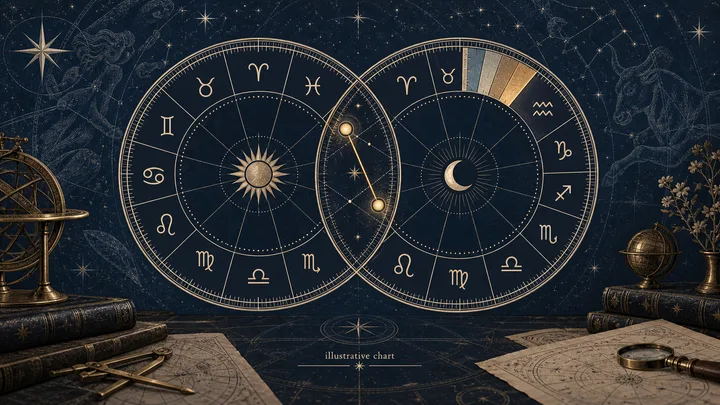
So “both planets fall in each other’s terms” needs care. Mutual reception makes a stronger technical claim than saying each has a term connection to the other. Name the table and reception convention, verify both degree rulers, and check the required contact or additional dignities. Historical formulations differ, including on whether aspect is required. Don’t combine them into a universal test.
For synastry, keep each level visible. If Venus’s degree is in Mars’s term and the planets meet the selected framework’s contact conditions, investigate whether it supports reception. If not, don’t call them mutually receptive. Translating even a valid traditional judgment into attraction, care, or pursuit is interpretation. The cited texts describe dignity and planetary relations, not a modern relationship script.
That interpretive step can still help when it stays modest. Ask whether affection and initiative seem to support one another, or whether one person’s interest feels easy for the other to receive. Treat the chart as a prompt, not proof. The aspect remains separate; the bound ruler is local context. Neither settles lived experience.
Use reception only when you can name the rule and show why the placements qualify. Otherwise, call it a bound ruler or local dignity and let the main synastry contact lead. That leaves room for the rest of the chart and the couple’s own account.
Sources: A Brief Comparison of the Use of Reception by Historical Authors; The Classical Origin and Traditional Use of Aspects
What the bound layer may say about Moon, Venus, and Mars contacts
A bound ruler can suggest a secondary mode for a planet’s function: the Moon’s emotional response, Venus’s attraction and agreement, or Mars’s pursuit and assertion. The sign remains the main style context. The aspect remains the link between the two charts. Use it only when it clarifies a specific difference in a close contact.
Consider an illustrative comparison, not a birth chart: one person’s Moon is at 13° Gemini, and the other person’s Venus is at 15° Libra. Under the Egyptian table shown in “The ‘Terms’ of the Zodiac Signs,” 13° Gemini falls in Venus’s interval, which runs from 12° to 17°. At 15° Libra, Venus falls in Jupiter’s interval, from 14° to 21°. The table gives us those rulers. It doesn’t tell us how these two people behave, and it doesn’t define their synastry by itself. The Moon and Venus are near a trine; read its orb before interpreting either bound.
Only after that main reading would I ask what the two local rulers add. As an astrological interpretation, Venus ruling the Moon’s degree might suggest that emotional ease is colored by affection, harmony, or a wish to meet halfway. Jupiter ruling Venus’s degree might suggest that attraction or agreement grows through openness, generosity, or a wider view. Those are possible emphases, not fixed traits. The Gemini Moon and Libra Venus remain the primary sign contexts; the trine remains the relationship between the placements. If the added rulers offer no useful distinction, leave them out.
The comparison changes if a planet’s degree falls in another interval. A Moon in Mercury’s bound, for example, could invite a question about whether naming, sorting, or discussing feelings helps the person respond. A Venus in Mars’s bound could invite a question about whether desire becomes more direct or active. These are interpretive prompts drawn from the rulers’ traditional associations, not extra facts about the people. The reading should stay anchored in the actual planet, sign, and aspect. Don’t turn every possible ruler into a catalogue of personality adjectives.
A repeated bound ruler across several relevant placements may deserve a closer look. If Venus rules both a Moon’s bound and another person’s Venus or Mars bound, the repetition could give the couple a focused theme to explore: do affection and emotional comfort tend to meet through similar forms of harmony or connection? But repetition is still repetition within the same chosen interpretive method. It isn’t independent proof, a score multiplier, or evidence that the people must experience the theme alike. A single occurrence may be meaningful too, if it clarifies a live question.
Other contacts can complicate the picture. A close Moon–Venus contact may describe a point of emotional and affectionate ease, while a separate supplied Mars contact may suggest a different pace around initiative or disagreement. One layer doesn’t cancel the other. Nor should a bound ruler be used to smooth away a contrast that the signs or aspects make plain. Work with the placements actually supplied and let mixed indications remain mixed.
The useful result is a question the pair can test in conversation. Does one person want an immediate emotional response while the other first seeks reassurance, perspective, or room to think? The bound layer may help name a possible style difference. The answer comes from what the two people recognize in their shared life, not from assigning a character to a degree.
Which reading should lead when the chart tells mixed stories?
When a chart seems to tell two stories, let the clearest close contact lead. A bound ruler can qualify that contact, but it cannot erase another testimony or turn a weak link into the main event. Deborah Houlding’s “The Classical Origin and Traditional Use of Aspects” describes sign relationships and degree-based methods, with differing approaches to orbs. State your convention before ranking contacts. Compare angular distance with the aspect and its orb. A tighter contact can lead within that method; it isn’t a universal measure of how strongly two people feel.
Consider this illustrative comparison, with hypothetical placements only: one person’s Moon forms a close trine to the other person’s Venus, while a wider square between other personal planets also falls within the chosen orb. Read the Moon–Venus contact first, then examine the signs. Then ask whether each degree’s bound ruler sharpens a difference in emotional response or affectionate style. The square still belongs in the reading. It may show effort or adjustment; the trine doesn’t cancel it. Houlding notes that a trine’s character depends on the planets and their condition, and that a square need not be simply harmful. Don’t turn aspect names into a verdict before considering context.
Now compare two versions of the illustration. If one bound table assigns a ruler that suggests a useful contrast, while another assigns a different ruler, the Moon–Venus aspect remains the same. Table choice changes the refinement, not the angular relationship. Astrodienst’s “The ‘Terms’ of the Zodiac Signs” displays Egyptian and Ptolemean (Lilly) tables. Name which one you used; don’t blend them. If degrees sit near a cutoff and supplied precision cannot settle the interval, keep the main contact and mark its bound reading open. More detail isn’t automatically better evidence.
Term reception is separate. Deborah Houlding’s “A Brief Comparison of the Use of Reception by Historical Authors” describes traditions that treat reception through terms as a lesser dignity, with differing conditions. Don’t call a contact receptive merely because a planet’s degree falls in another planet’s term; check your convention. The strongest exception is a repeated, relevant ruler pattern or a boundary distinction that clarifies a contrast. It may deserve attention, but it can’t settle what the relationship means. Keep the mixed testimony. Ask which degree, table choice, or conversation would help you understand the uncertainty.
Sources: The Classical Origin and Traditional Use of Aspects; A Brief Comparison of the Use of Reception by Historical Authors; The "Terms" of the Zodiac Signs
A practical next step for the placements you have
Start with the placements you have. Record each planet, sign, and exact degree, then write the cross-chart aspect and its orb under your chosen convention. “Aspects” describes several approaches to aspects and orbs, so treat the Synastry Comparison Report’s six-degree limit as its stated scope, not a rule for every tradition. Choose one bound table and name it. “The Terms of the Zodiac Signs” displays distinct Egyptian and Ptolemaean tables; don’t combine their cutoffs. Note each degree’s interval and ruler, and whether its minutes are exact, rounded, or uncertain. If a position could fall on either side of a boundary, leave that ruler unresolved. State the main contact plainly. Add the bound reading only if it sharpens a real question about how the planetary styles meet. You might ask whether one person moves toward emotional expression while the other needs reassurance. Treat that as a conversation prompt, not a conclusion about either person. If the bound layer adds no useful distinction, the aspect and sign reading are enough. The Synastry Comparison Report uses placements you supply, optional degrees, and selected major aspects within its stated six-degree scope. It doesn’t calculate natal positions from birth details or provide houses. Compare the placements you know, then ask each other one specific question about how the interpretation fits your shared experience.
Sources: The "Terms" of the Zodiac Signs; The Classical Origin and Traditional Use of Aspects
A little more clarity
Do terms or bounds create a synastry aspect?
No. They assign a local ruler to a degree within a sign. Identify the cross-chart aspect and its orb under a stated convention first; the bound ruler may then refine the interpretation.
What if a supplied degree is rounded or close to a bound boundary?
If the available precision cannot establish which interval contains the placement, leave its bound ruler unresolved. Continue with the sign and any aspect supported by the supplied placements.
Sources & further reading
- The "Terms" of the Zodiac Signs
Defines terms and displays multiple tables whose different boundaries can assign a degree different rulers.
- Egyptian Bounds
Lists Egyptian bounds and explains the half-open interval convention used for exact boundary lookups.
- The Disposition of the Terms
Ptolemy discusses commonly accepted Egyptian terms and their distinction from other arrangements.
- The Terms According to Ptolemy
Presents a separate arrangement of terms attributed to Ptolemy, relevant to distinguishing named historical tables.
- Egyptian Term Table by Zodiac Sign
Shows a Valens-attributed table with Libra boundaries that differ from the Egyptian sequence displayed by Astrodienst.
- The Classical Origin and Traditional Use of Aspects
Describes historical variation in sign-based and degree-based aspects and in orb methods.
- A Brief Comparison of the Use of Reception by Historical Authors
Compares historical reception doctrines, including formulations that treat reception by term as a lesser dignity.
Synastry Comparison Report
Enter known placements for two people. Get an input-by-input comparison, selected aspect calculations and a clear record of what remains uncertain.
Compare our placements