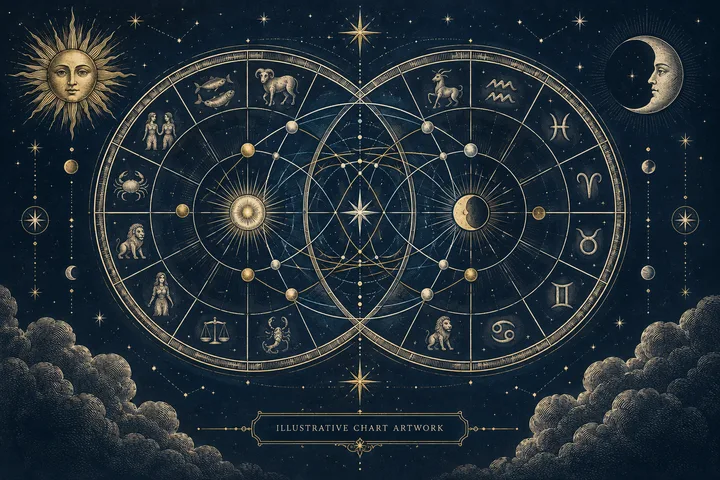
The table is precise, but it is not the whole conversation
You open a synastry report and see a clean list: Moon trine Venus, Venus square Mars, Mercury opposite Saturn. It feels reassuring. The contacts have names. The orbs have numbers. You can point to the line that seems to explain the attraction, the argument, or the strange pull between you. Then you open the wheel and find a tangle of lines, symbols, houses, and two rings of planets. Which one should you trust?
Trust both, but give them different jobs. The aspect table is the exact inventory. It answers, “What angle do these two chart points make?” The wheel is the geography. It answers, “Where do these planets sit, what signs shape their expression, and what parts of each life do they activate?” A table can tell you that one person’s Venus squares the other person’s Mars. It won’t, by itself, show that the contact falls across the second and fifth houses, touches an angle, or belongs to a larger pattern involving both people’s Moon placements.
That distinction matters because no aspect lives alone. Astrologers read a planet through its sign, an aspect through the planets involved, and a synastry contact through both natal charts. Cafe Astrology’s interchart guidance makes the same point: consider the sign and house placements of each planet, not only the named aspect. Astrodienst describes synastry as comparing horoscopes to find interaspects, while also noting that a partner’s planets in a particular house can emphasize that house’s themes. The wheel lets you see those layers together.
The common assumption is that the aspect table is the serious part and the wheel is decoration. That assumption is too narrow. The table is better for checking geometry. The wheel is better for ranking meaning. A close Venus-Mars contact deserves attention, but its house placement tells you whether the charge is showing up through romance, shared resources, work, friendship, or public life. A cluster of a partner’s planets in your fourth house tells a different story from the same planets scattered through your third, seventh, and tenth houses.
The strongest reading moves in one direction: verify the aspect, place it in sign and house context, then look for repetition. Don’t let a bright line make the whole decision for you. Follow the pattern.
A synastry aspect table tells you which planet-to-planet contacts exist, how exact they are, and whether they are conjunctions, squares, trines, oppositions, or sextiles. The wheel adds the missing map. It shows where each person’s planets fall by sign and house, which angles they touch, whether several contacts gather in one life area, and whether the same theme repeats across the picture. That changes the reading from a stack of isolated sentences into a relationship pattern. Start with the tightest major contacts, then use the wheel to ask where those contacts land and who experiences that house emphasis. If birth times are missing, keep the reading to supplied placements and reliable planet-to-planet aspects. Houses and angles need accurate times. A useful synastry reading doesn’t choose between table and wheel. It uses the table for exact geometry and the wheel for context, emphasis, and direction.
Sources: Synastry - Astrodienst Astrowiki; How to Read a Synastry Chart; Aspects Between Charts
What an aspect table gives you first
An aspect table earns its place because it makes comparison readable. A wheel may show two planets sitting at a pleasing distance, but the table names the contact and often gives the orb. The orb is the gap between the exact angle and the actual positions. A smaller orb usually gives the aspect more force, especially when personal planets or angles are involved. You can inspect the geometry instead of guessing from color or visual drama.
The five major aspects form a useful first vocabulary. A conjunction joins two functions and intensifies their meeting. An opposition creates a polarity that asks for balance. A square brings friction, pressure, and movement. A trine offers flow through a shared element. A sextile opens a cooperative possibility that still needs participation. None of these is a moral grade. A square can keep two people engaged with a real problem. A trine can make affection easy, but it can also leave a talent unused because neither person has to name it.
The table also protects you from a common mistake: reading signs as if they were exact aspects. Two planets in compatible elements may share a tone without forming a close major aspect. Two planets in signs that look difficult may still be too far apart to count as a tight contact. Degrees settle that question. Astro.com’s chart documentation separates the wheel from the additional aspect table and data sheet, which is a useful reminder that the visual display and the numerical record serve different purposes.
Read each line as a sentence with four parts: planet A, aspect, planet B, and orb. Venus square Mars at 1° says something different from Venus square Mars at 5°30'. Then add the sign. Venus in Taurus meeting Mars in Leo doesn’t express the same way as Venus in Gemini meeting Mars in Virgo. Finally, ask whether either planet is already prominent in its own chart. Synastry shows the meeting. The natal chart shows what each person brings to it.
Use the table to sort the evidence. Keep close major contacts at the front, and set wide or uncertain contacts aside until the main pattern is clear. In a Venus-Mars contact, write down the planetary roles before you add houses. Both people participate, but different natal conditions can make the same meeting inviting to one person and demanding to the other.
Sources: Overview: Available Chart Types in the Extended Chart Selection; How to Read a Synastry Chart; Aspects Between Charts
The wheel restores sign context around the contact
The first thing the wheel puts back is the zodiac itself. Each planet has a sign, and the sign describes how that planet operates. In synastry, the aspect tells you the relationship between two functions. The signs tell you the style of the meeting. That style can soften, sharpen, speed up, slow down, or redirect the aspect’s usual meaning.
Consider an example. Person A’s Venus is at 14° Taurus and Person B’s Mars is at 16° Cancer. The table shows a sextile with a 2° orb. The contact can support attraction and cooperation, but the signs add texture. Taurus seeks steadiness and tangible affection. Cancer moves through protection, mood, and emotional memory. The bond may grow through food, touch, private routines, and a sense of being cared for. Now change only the signs: Person A’s Venus is at 14° Gemini and Person B’s Mars is at 16° Leo. The same sextile has a brighter, more verbal, more playful rhythm. The geometry stays supportive. The lived language changes.
The wheel also lets you see sign boundaries. A conjunction can be close by degree while crossing from one sign into another. That is not the same as two planets occupying the same sign. An out-of-sign conjunction still joins the planets by degree, but the sign conditions don’t blend as neatly. You may feel the two functions pulling toward contact while speaking different dialects. A table that labels only “conjunction” can hide this distinction unless you check the actual degrees and ring positions.
Signs also reveal element and modality patterns. A couple may have several contacts between fire signs, bringing speed, candor, and a need for room to act. Another couple may have many contacts across fixed signs, making loyalty strong and change harder. These are not scores. They are the climate around the specific contacts. A Venus-Mars square in cardinal signs may push toward immediate action. The same square in fixed signs may hold tension longer, then resist compromise once a position is chosen.
Use the wheel for the question behind the aspect: how does this contact want to move? The table says what happened geometrically. The signs show the manner of exchange.
A sextile still needs a way to act through its signs. Fire may want quick expression while earth wants proof and time. Water may need safety before action. Air may need words and room. Read the sign as a style, not as a replacement for the exact aspect, and use it to ask what pace and conditions let the contact work.
Sources: How to Read a Synastry Chart; Synastry Chart for Couples: Compare Two Charts to Make a Relationship Chart; Aspects Between Charts
House overlays show where the relationship lands
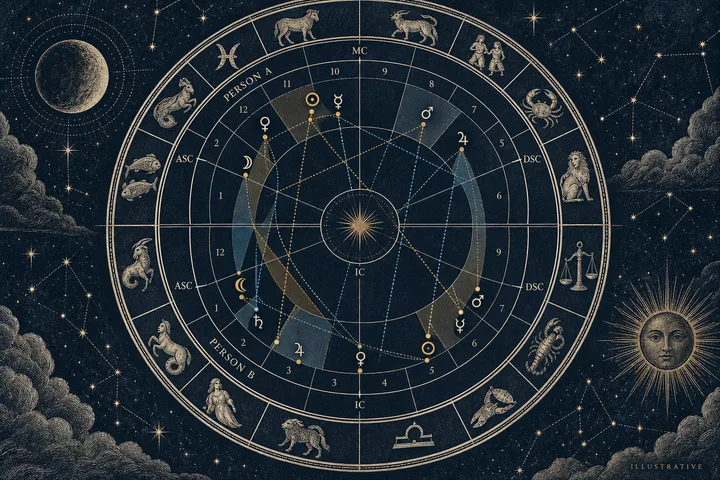
Aspects describe how two planets interact. House overlays describe where the interaction becomes noticeable in a person’s life. To read an overlay, place one person’s planets around the other person’s natal wheel and see which houses they occupy. Then reverse the view. Your Venus may fall in your partner’s seventh house while their Venus falls in your fifth. Both people feel attraction, but they may name it differently. One may experience partnership and commitment. The other may experience romance, play, and creative pleasure.
This is the wheel’s most important addition for many readers. A table can list Moon trine Venus. It cannot tell you whether the Moon person’s planet falls in the other person’s fourth house of home and emotional roots, the sixth house of daily work, or the eleventh house of friendship and shared hopes. The aspect remains the same. The setting changes.
Cafe Astrology describes a house overlay as similar to a lasting transit to the house receiving the other person’s planet. That image is useful when you keep it practical. Someone’s Mercury in your sixth house may draw conversation toward schedules, errands, health routines, and the small systems that keep life moving. Their Sun in your third may make talking, learning, commuting, and everyday exchange central to how you experience them. Their Saturn in your fourth may bring seriousness to family, privacy, or the question of what home should mean.
Read overlays in both directions. The planet person and house person don’t occupy identical roles. The planet person brings a function into the other person’s field. The house person experiences that field as activated. This can explain why a connection feels more central to one person in a particular area, even when the aspect itself is mutual. It doesn’t assign blame or prove intent. It gives you a sharper question: whose life area is being lit up, and what does that person actually do with the energy?
House placement depends on reliable birth times and a stated house system. If the time is missing or uncertain, don’t invent a seventh-house overlay because the relationship feels serious. Keep the useful parts. Read the supplied signs and planet-to-planet aspects, then mark houses and angles as unavailable until the data supports them.
Write both sides plainly: “B’s Venus in A’s fourth” and “A’s Venus in B’s seventh.” If the two notes point to different needs, that difference is part of the reading. Near a house cusp, keep the language conditional unless the birth-time accuracy and house system support a firm placement.
Sources: Synastry - Astrodienst Astrowiki; How to Read a Synastry Chart; Synastry Chart for Couples: Compare Two Charts to Make a Relationship Chart; Synastry: Planet Overlays in Houses
The wheel shows angles, chart emphasis, and direction
The four angles give the wheel a set of sensitive points that an ordinary aspect list may not foreground: the Ascendant, Descendant, Midheaven, and Imum Coeli. They describe the horizon and meridian of a natal chart. When a partner’s planet closely contacts one of them, the connection can feel immediate, personal, public, private, or hard to ignore, depending on the angle and planet involved.
A partner’s Sun near your Ascendant may make their presence register through your body, style, and first response to the world. Their Venus near your Descendant can color what you look for in one-to-one partnership. Their Mars near your Midheaven may stir ambition, visibility, or conflict around direction. Their Moon near your IC can touch the private place where memory, family, and belonging live. These are interpretive starting points, not promises about what either person will do.
The wheel also shows concentration. Count where the contacts gather. Do several of your partner’s planets fall in one quadrant or one house group? Do Moon, Venus, and Mars contacts all pull toward the fifth, seventh, or eighth houses? Does Saturn repeat through angles and personal planets? Repetition is often more useful than a single dramatic line because it tells you which theme keeps returning in different forms.
Direction matters, too. A bi-wheel has an inner person and an outer person, but those labels are only a reading arrangement. They don’t mean one person is the main character. Read the overlay from A into B, then B into A. The aspect table may call a contact “A’s Venus square B’s Mars,” which helps identify the planetary roles. The wheel adds the receiving house and angle in each chart. That can clarify why the same contact feels like affection and pursuit to one person, but like pressure and interruption to the other.
Astrostyle’s wheel-to-wheel explanation makes this practical: two charts are placed together, then flipped for a second reading so each person’s houses can be considered. Don’t skip the flip. A one-direction reading is a partial map.
Angles deserve the same two-way discipline. A partner’s planet on your Descendant is not the same statement as your planet on their Descendant. One chart may experience the contact through its image of partnership, while the other experiences it through identity, home, or public direction. Record the angle for each person before describing the effect. Otherwise “angular chemistry” stays too vague to be useful.
A Midheaven contact may put the relationship’s influence into work or direction. An IC contact may work through home, memory, and belonging. The wheel can show that contrast even when the table presents both contacts in the same format.
Sources: Overview: Available Chart Types in the Extended Chart Selection; How to Read a Synastry Chart; Synastry Chart for Couples: Compare Two Charts to Make a Relationship Chart
Patterns in the wheel outrank isolated lines
The prettiest line on a wheel is not automatically the central story. A synastry reading becomes useful when separate contacts begin to say the same thing. That is what the wheel can show at a glance. It lets you see a web, not just a list.
Imagine a placement-only comparison with these supplied sign contacts: one person’s Moon trines the other’s Venus, their Venus squares the other’s Mars, and both people have several planets in earth signs. The table gives three separate statements. The wheel invites a synthesis: affection may feel steady and embodied, desire may arrive with friction or mismatched timing, and practical proof may matter more than grand declarations. If one person’s Venus also falls in the other’s sixth house, everyday care becomes part of the attraction story. That last layer is invisible in the aspect names alone.
Now imagine a different pattern. The aspect table has one close Venus-Mars conjunction, but the wheel shows no other personal-planet contacts and the conjunction falls in a house that neither person understands clearly because one birth time is uncertain. The contact can still matter. It simply shouldn’t carry the weight of a complete relationship verdict. Strong chemistry is a thread, not the whole fabric.
You can group a wheel into themes such as emotional safety, affection, desire, communication, responsibility, and shared direction. Start with the Moon, Venus, and Mars because they belong close to the lived relationship: feeling, relating, and acting. Add Mercury for communication. Then look at Saturn for seriousness and pressure. Bring in outer planets, nodes, and other points after the personal pattern is visible. A dramatic outer-planet contact may deepen the story, but it shouldn’t erase the everyday chart.
Cafe Astrology’s synastry summary separates temperament, interchart aspects, house overlays, and composite work for a reason. They answer different questions. The wheel can help you see the first three in relation to one another. It cannot turn them into a single score. Rank repeated themes, then test them against the actual relationship.
A simple ranking test is to ask three questions of every theme. Is the contact close enough to lead? Does another contact echo the same planet, sign, house, or life problem? Can you describe how it would appear in an ordinary exchange? “Intensity” fails the third test. “One person reaches for reassurance while the other answers by taking action” gives you something to observe. The wheel earns its keep when it turns pattern into recognizable behavior.
Give extra weight to a theme when different layers point to the same place. A close Moon-Venus contact plus a Moon overlay in the fourth house supports a comfort-and-home theme more strongly than either symbol alone. A loose outer-planet line shouldn’t displace a close personal-planet contact.
Sources: How to Read a Synastry Chart; Aspects Between Charts; Summary of Techniques in Synastry, Relationship Astrology
A worked comparison: same contacts, different map
Here’s the cleanest way to see the difference. Keep the aspect table constant and change the wheel context. The exercise is illustrative. It uses supplied placements as a method example, not a personal chart calculation.
Consider an example with three contacts: Person A’s Moon trine Person B’s Venus at 2°, Person A’s Venus square Person B’s Mars at 1°, and Person A’s Mercury opposite Person B’s Saturn at 4°. The table suggests emotional warmth, attraction with friction, and a serious or guarded communication pattern. That is already useful. It tells you what to watch.
In the first wheel, Person B’s Venus falls in Person A’s fourth house, Person B’s Mars falls in Person A’s seventh, and Person B’s Saturn falls in Person A’s third. Person A may experience the relationship as emotionally familiar, highly partnership-focused, and demanding around words, plans, or difficult conversations. Person B’s Venus brings softness into the private sphere. Their Mars activates one-to-one negotiation. Their Saturn sits where messages, timing, and interpretation matter. The aspect table could not show that the friction is likely to be felt most sharply in the partnership space while communication carries the weight.
Flip the wheel. Person A’s Moon falls in Person B’s fifth house, Person A’s Venus falls in Person B’s tenth, and Person A’s Mercury falls in Person B’s eighth. The same three aspects now land differently. Person B may feel emotionally nourished through play and romance, see Person A’s affection as tied to public goals or reputation, and experience Person A’s words as probing private fears or shared resources. The relationship hasn’t changed its geometry. The lived emphasis has.
Compare the two maps without deciding that one is better. In the first, the relationship’s pressure gathers around partnership and communication. In the second, it gathers around romance, visibility, and trust. The Moon-Venus trine remains a resource in both. The Venus-Mars square remains a source of heat and friction. What changes is the life department where each contact asks for attention. That is precisely the information a table leaves out.
Now imagine that Person B’s birth time is uncertain by several hours. Keep contacts that survive the check, and label possible houses or angles as conditional. If you only have signs and optional degrees, compare those inputs and orbs. Add two-way overlays only when accurate birth times and a stated house system support them.
What the wheel still cannot tell you by itself
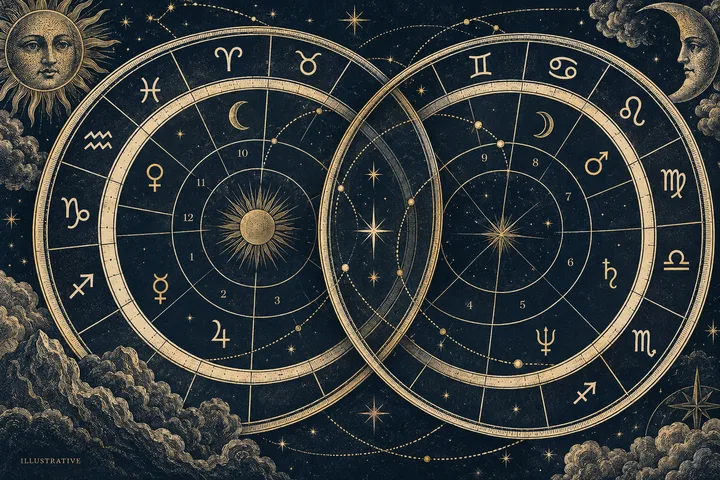
A fuller picture still needs judgment. Dense lines, a packed house, or a planet on an angle can draw the eye, but visual drama isn’t a ranking system. Houses and angles depend on time, and a planet near a sign boundary may need a time-range check. Keep stable inputs and label the rest conditional.
The wheel doesn’t replace the natal charts. Synastry describes the meeting between two existing chart languages. It also doesn’t calculate whether to date, stay, marry, or leave. Astrology can name a pattern and suggest where care or honesty matter. The lived relationship remains the final place to test it.
Finally, a synastry wheel is not a composite chart. Synastry compares two charts point by point. A composite chart uses midpoint calculations to describe the relationship as a unit. Cafe Astrology distinguishes these methods clearly. Don’t read a relationship chart into a synastry wheel simply because both have circles and planetary symbols. Ask which question you’re holding. “How do we activate each other?” is synastry. “What kind of entity do we become together?” belongs to composite work.
Sources: Synastry - Astrodienst Astrowiki; How to Read a Synastry Chart; Summary of Techniques in Synastry, Relationship Astrology
Turn the wheel into a decision aid
Use a four-pass workflow: audit the data, trace the strongest contacts, rank the repeated themes, then take one question back to the relationship. Each pass removes a different kind of confusion.
Start by recording the people, zodiac reference frame, degrees, aspect names, house system, and orb settings. Keep the three strongest stable contacts. The report’s comparison scope uses a six-degree orb, so a wider contact shouldn’t receive equal weight just because its line is bright or central.
Next, orient the wheel. Identify the inner and outer person, find the Ascendant and Midheaven, and trace only the contacts you kept. Add sign style, receiving houses, and angle contacts where the birth data supports them. Then flip the view so each person’s activated life areas are visible.
If two reports disagree, compare their settings first. Tropical or sidereal zodiac, house system, time zone, selected points, and orb limits can change the picture. Planet-to-planet geometry may stay fixed while house placement changes. Record those settings beside the chart so a technical difference doesn’t become a false interpretive dispute.
A disagreement can also come from what each report chose to display. One wheel may include minor aspects, asteroids, nodes, or angle contacts while another shows only major planets. Strip both reports back to the same comparison set before you rank the result. If the core contacts agree, read the extra lines as a second pass. If the core contacts differ, return to degrees, zodiac frame, and birth-time data before interpreting the story.
Now rank three themes. Give priority to close personal-planet contacts, repeated symbols, and the question you actually brought to the chart. Write each leading contact in four fields: planet pair and aspect, orb, sign expression, and confirmed house setting. “A’s Venus square B’s Mars, 1°20', fixed signs, B’s seventh house” gives you a path toward affection, desire, pace, and one-to-one negotiation. “This is intense” doesn’t.
Don’t confuse visual closeness with interpretive priority. The planets may look near one another because the wheel compresses the zodiac, while a table may reveal a wider orb. Conversely, an exact contact can be easy to miss in a crowded center. Use the degree difference to establish the contact, the signs to describe its style, and the houses to locate its field. Those jobs stay clear even when the drawing is busy.
When the layers disagree, don’t average them into fog. Say which one leads and what qualifies it. A Moon-Venus trine may make comfort available while Mercury-Saturn asks for patient repair. A strong overlay may show where the theme lands while the aspect shows how the two people meet it. Together, they make a better question.
Here’s the strongest exception. With no dependable birth time, let stable placements and aspects lead. Houses and angles remain unavailable, and the Moon or any planet near a boundary needs a time-range check. Keep what remains stable. Mark the rest conditional.
The Synastry Comparison Report helps with the supplied Moon, Venus, and Mars placements and optional degrees. It compares those inputs and selected major aspects using a six-degree orb. It doesn’t calculate natal positions, houses, or angles from birth details. Use it to organize the personal-planet pattern, then add wheel context only when your chart data can support it.
Finish with one observable question: where does the strongest pattern appear in ordinary life? Does it show up as reassurance, pursuit, silence, planning, or repair? Write the answer beside the aspect, sign, and confirmed overlay. Your partner can then question the interpretation without having to untangle the chart’s construction.
A useful final note might read: “The closest contact is Venus square Mars, so attraction and pace deserve attention. The signs describe how each person offers warmth. The confirmed overlay shows where the tension appears. The repeated Moon contact offers a way back to care.” That sentence ranks the chart and gives the couple a shared next step.
Sources: Overview: Available Chart Types in the Extended Chart Selection; How to Read a Synastry Chart; Aspects Between Charts
A little more clarity
Can an aspect table replace a synastry wheel?
It can support a placement-based reading, especially when you have reliable planet signs, optional degrees, and no dependable birth times. The table is strong for planet-to-planet geometry, aspect type, and orb. It won’t show house overlays, angles, or how contacts cluster through one person’s chart. Add the wheel when accurate birth times and a clear house system make those layers available.
Which should I read first in a synastry report?
Start with the aspect table. Confirm the people, degrees, aspect names, and orbs. Read the tightest major contacts involving the Moon, Venus, Mars, and Mercury. Then use the wheel to add signs, houses, angles, and repeated themes. Read overlays in both directions. Finish by turning the strongest pattern into a practical question about communication, affection, timing, or care.
Sources & further reading
- Synastry - Astrodienst Astrowiki
Supports the distinction between comparing interaspects and reading a partner’s planets through activated houses.
- Overview: Available Chart Types in the Extended Chart Selection
Supports the separate roles of the synastry wheel, chart data sheet, and mutual aspect table.
- How to Read a Synastry Chart
Supports the reading order, major-aspect vocabulary, orb priority, house overlays, angles, and repeating themes.
- Synastry Chart for Couples: Compare Two Charts to Make a Relationship Chart
Supports wheel-to-wheel comparison, two-way house overlays, sign-based aspect context, and the need for accurate birth times for houses.
- Aspects Between Charts
Supports reading interchart planet roles together with each planet’s sign and house placement.
- Synastry: Planet Overlays in Houses
Supports the planet-person and house-person distinction and the practical meaning of transposed houses.
- Summary of Techniques in Synastry, Relationship Astrology
Supports separating natal temperament, interchart aspects, house overlays, and composite chart interpretation.
Synastry Comparison Report
Enter known placements for two people. Get an input-by-input comparison, selected aspect calculations and a clear record of what remains uncertain.
Compare our placements