
Imagine the same story appearing twice
Imagine Maria and Daniel comparing charts after several months together. In synastry, Maria's Venus forms a close square to Daniel's Mars. She experiences his drive as heat and urgency. He experiences her affection as an invitation to act. The square belongs to an exchange between two people, so it has direction: her Venus, his Mars, and the tension between them.
Their midpoint composite also shows Venus and Mars in a close conjunction in the fifth house. That repetition matters, but it isn't a duplicate sentence. The synastry describes magnetic contact between Maria and Daniel. The composite describes a relationship that gathers around desire, play, pursuit, romance, and making something together.
This is the useful answer to the question. One symbolic family can operate at two levels. Synastry compares two natal charts point by point. A midpoint composite takes the mathematical midpoint between corresponding planets and points, then reads the result as the chart of the relationship. The methods overlap because they begin with the same people. Their jobs differ.
So treat the echo as a priority marker. Ask what the planet does between you. Then ask what the relationship does with that energy. That wording keeps a composite from becoming a louder copy of synastry, and it gives you a better question than whether one chart confirms the other.
Sources: Composite Chart & Synastry - Cafe Astrology; The Composite Chart: Relationship Astrology - Cafe Astrology; Synastry in More Detail - Cafe Astrology
Keep the two people visible in synastry
Synastry starts with two separate natal charts. You compare interchart aspects and, when the birth information supports it, house overlays. Your Moon may touch his Venus. His Saturn may square your Sun. Your Mars may fall in his seventh house. Each statement keeps the people distinct. That is what makes the reading specific.
The planets keep their owners in this layer. If your Venus squares his Mars, read how your style of affection meets his way of pursuing, asserting, and desiring. The contact may feel mutual, but the roles aren't interchangeable. One person may initiate. The other may feel pressed, invited, reassured, or challenged.
Signs describe the style of the exchange. Houses describe where it enters each life. A partner's planet in your fourth house may stir family memories or a wish to build a home, while that same planet can land in his tenth house and affect his ambition. One contact can therefore matter differently to each person before the composite gathers it into a shared concern.
Write the aspect with two subjects before you move on. ‘Her Venus square his Mars creates attraction mixed with irritation’ tells you more than ‘Venus-Mars is intense.’ It gives you something to observe: who reaches, who retreats, who asks for clarity, and who experiences pressure. The chart offers a pattern. The people show its expression.
A synastry theme can repeat in a composite chart because the two charts describe related layers of one bond. Synastry shows how your planets meet his, including attraction, friction, support, and the roles each person tends to play. A midpoint composite blends corresponding points from both natal charts and describes the relationship as a shared field. When the same symbolism appears in both, give it priority. But change the sentence you use. A Venus-Mars contact in synastry can describe personal chemistry between you. Venus and Mars emphasized in the composite can describe how the relationship expresses desire, play, conflict, and repair when you act as a pair. Start with the repeated planet or aspect, name its synastry role, then read its composite sign, house, and aspects. An echo is a reason to look closer, not proof that the charts say the same thing.
Sources: Synastry in More Detail - Cafe Astrology; Composite Chart & Synastry - Cafe Astrology
Let the composite describe the relationship
A midpoint composite is built from the midpoint between the same planets or points in two natal charts. It resembles a natal chart, but astrologers read it as the chart of the relationship itself. It isn't a third person's private birth chart. It is a new picture of how two people combine.
The grammar changes. In synastry, you might say, ‘Her Mercury squares his Saturn.’ In the composite, you might say, ‘The relationship carries a Mercury-Saturn pattern.’ That shared pattern can make important conversations careful, serious, delayed, or unusually focused on competence and promises. It doesn't assign one person permanent ownership of Mercury or Saturn.
Composite signs show the style of the relationship's pattern. Composite houses show where it becomes visible. A fifth-house emphasis can draw the bond toward pleasure, romance, and creative work. An eighth-house emphasis can make trust, intimacy, obligations, and shared resources harder to avoid. Angular placements often make the relationship's tone more public or immediate.
Read the composite after you understand what each person brings. Otherwise, the shared chart can blur the difference between personal reaction and relationship atmosphere. A hard aspect describes work the bond asks for. A flowing aspect offers a resource. Neither one removes choice, and neither one excuses behavior that hurts.
Sources: Composite Chart & Synastry - Cafe Astrology; The Composite Chart: Relationship Astrology - Cafe Astrology; The Composite Chart: More on Houses - Cafe Astrology
Read the repeated symbol at two levels
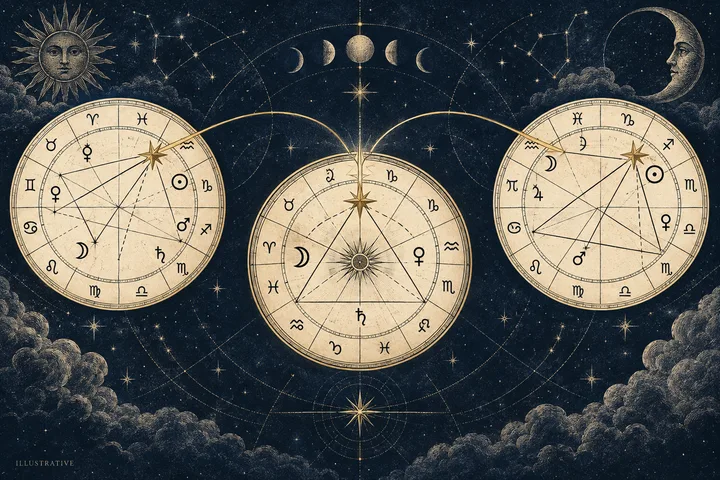
A theme can repeat through the same planet, sign, house, element, or axis without repeating through the same aspect. Venus may appear in a synastry contact and become prominent in the composite. Mars may connect the natal charts while the composite places Mars in a central house. Saturn may touch one person's Venus and also shape the composite Moon. The symbolic family returns, but its mechanism changes.
Consider Maria and Daniel's Saturn pattern instead. Suppose his Saturn squares her Venus in synastry. She may experience caution or standards as a brake on affection. He may feel responsible for the pace of the bond. Now suppose composite Saturn sits in the seventh house and trines Mercury. The relationship still carries seriousness, but it also has a structure for agreements and honest planning. The composite shows what the pair can build around the personal tension.
Change the composite aspect to a Saturn-Moon square. The shared atmosphere may become guarded when either person needs comfort. That isn't the same as his Saturn pressing on her Venus. The first describes a personal exchange. The second makes emotional safety a relationship-wide task. One person can't solve it with a burst of affection. The pair needs a dependable way to handle disappointment, distance, family pressure, and broken promises.
This is why ‘Does the composite confirm synastry?’ is a weaker question than ‘What does the composite make mutual or structural?’ Venus can attract and irritate. Saturn can bind and burden. Neptune can soften and blur. Mars can energize and provoke. Rank the likely expression, then name the condition that would bring out its other side. A repeated symbol deserves attention, not obedience.
Sources: The Composite Chart: Relationship Astrology - Cafe Astrology; Synastry in More Detail - Cafe Astrology; The Composite Chart: More on Houses - Cafe Astrology
Use a reading order that prevents double-counting
First, put the repeated theme into plain language. ‘We keep turning desire into a negotiation’ is a usable hypothesis. ‘There are Venus, Mars, Saturn, and Pluto contacts’ is only inventory. Start with the behavior or feeling the symbolism might organize. Keep the sentence open to revision.
Second, read the synastry contact by contact. Name the planets, aspect, signs, and houses when the birth information supports house work. Say who brings which planet and who receives it. If degrees are available, note the orb. This report uses a six-degree working orb for selected major aspects, so a close contact should outrank a wide one even when the wider symbolism sounds more dramatic.
Third, inspect the composite planet or pattern. Check its sign, house, major aspects, and relationship to the composite angles. A planet near an angle can make the theme more visible. Several close aspects can give it more reach than one isolated contact. Now decide whether the repetition is central, supportive, or background material.
Fourth, compare the composite with each natal chart. If a composite personal planet touches one person's Moon, Venus, Mars, Sun, or Ascendant, that person may identify with the relationship's expression more strongly. The other person can still live the same bond through a different channel. This step explains unequal experience without making either person the whole relationship.
Last, test the reading against an ordinary moment. Does the pattern appear in planning, sex, money talks, family visits, public events, or silence after conflict? What does each person do next? If shared Saturn becomes reliable agreements, read its structure. If easy Venus symbolism sits beside repeated avoidance of repair, don't let pleasant language hide the missing behavior.
Sources: Composite Chart & Synastry - Cafe Astrology; Synastry in More Detail - Cafe Astrology; The Composite Chart: More on Houses - Cafe Astrology
The strongest exception is a missing repetition
An important synastry theme may not appear strongly in the composite. That doesn't make the synastry wrong. It means the individual exchange can matter without becoming the organizing principle of the relationship as a whole. Two people may feel intense chemistry in one channel and build their shared life around another.
Consider a strong Venus-Mars square in synastry with a composite Moon-Saturn conjunction in the fourth house. Attraction may arrive quickly, while the shared life centers on home, care, duty, and emotional restraint. The chemistry is real. It simply isn't the bond's foundation.
The reverse can happen. A synastry pattern may feel ordinary at first, while the composite gives a theme a central house, angle, or cluster of aspects. A composite Uranus emphasis can make the bond unconventional or changeable. A composite eighth-house focus can pull the pair toward trust, shared resources, and deeper intimacy. The relationship can bring out a form neither person expected from the first attraction.
When the layers disagree, keep both statements. ‘We activate each other's Mars’ can sit beside ‘our relationship needs emotional safety before that heat feels good.’ One layer names what pulls you together. The other names what happens after you become a pair. The apparent contradiction may be the story you need to work with.
Chart scope matters here. A precise composite house or angle requires dependable birth information. If you know only Moon, Venus, and Mars signs, stay with sign themes and known combinations. If degrees are supplied but birth times are not reliable, inspect selected interplanetary aspects and leave angles and houses aside. Don't invent detail to make the charts line up.
Sources: The Composite Chart: Relationship Astrology - Cafe Astrology; Composite Chart & Synastry - Cafe Astrology
Turn the echo into one useful decision
Write the repeated symbol in two sentences. First: how your planets meet his. Second: how the relationship expresses that symbolism as a unit. Then rank it by closeness, personal-planet or luminary involvement, dependable house emphasis, angularity, and daily reach. The most passionate contact isn't always the one organizing your shared life.
Choose one ordinary situation to watch. When tension rises, do you need touch, explanation, time, or a clear promise? With Moon, Venus, and Mars signs, stay with emotional style, affection, desire, and how those functions meet. With optional degrees, inspect selected major aspects within the six-degree working scope. Add composite houses or angles only when the supplied data supports them.
The Synastry Comparison Report organizes the Moon, Venus, and Mars placements you enter, with optional degrees and selected major aspects. It doesn't calculate missing natal positions, houses, or a composite chart from birth details. Use the report to compare known inputs, then bring the result back to life: name the pattern, choose the next conversation, and watch what both people do.
Sources: Composite Chart & Synastry - Cafe Astrology; The Composite Chart: Relationship Astrology - Cafe Astrology; Synastry in More Detail - Cafe Astrology; The Composite Chart: More on Houses - Cafe Astrology
Sources & further reading
- Composite Chart & Synastry - Cafe Astrology
Supports the central distinction between recurring themes, person-to-person synastry, and the composite relationship as a unit.
- The Composite Chart: Relationship Astrology - Cafe Astrology
Explains midpoint construction, the composite as a relationship chart, development, and comparison with natal charts.
- Synastry in More Detail - Cafe Astrology
Supports reading interchart planets, signs, houses, and roles as a directed exchange between two people.
- The Composite Chart: More on Houses - Cafe Astrology
Supports interpreting composite houses and giving added visibility to angular relationship placements.
Synastry Comparison Report
Enter known placements for two people. Get an input-by-input comparison, selected aspect calculations and a clear record of what remains uncertain.
Compare our placements