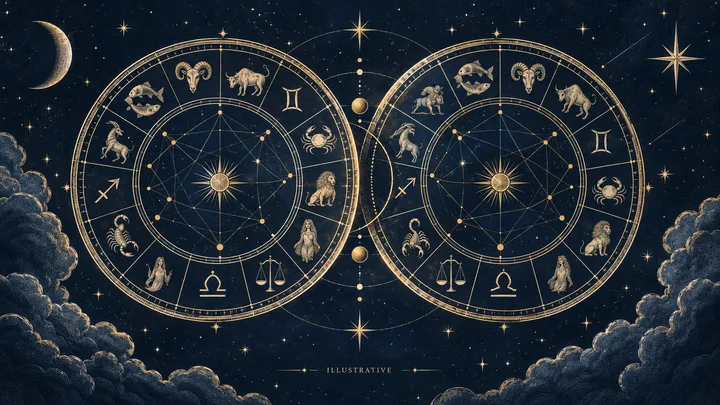
Why strong chemistry can make a couple rush
The message arrives at midnight. You answer before you think. A second date becomes a weekend plan, the weekend plan becomes a conversation about moving in, and suddenly the pace feels less like a choice than a current carrying both of you downstream. The attraction is real. So is the unease.
This is where many couples ask synastry to do too much. They see a Venus-Mars conjunction, a Pluto contact, or a cluster of planets in the fifth or eighth house and ask whether the intensity means they should trust the momentum. The better question is narrower: what kind of desire is this, and what does the rest of the comparison say about holding it well?
Astrology gives desire a language. Venus describes attraction, taste, pleasure, and the way affection is offered. Mars describes pursuit, heat, initiative, and the way a person moves toward what they want. When one person's Venus contacts the other person's Mars, the couple may notice immediate romantic or physical pull. Cafe Astrology treats Venus-Mars contacts as classic attraction signatures, while also distinguishing smooth aspects from more friction-filled squares and oppositions. That distinction matters because chemistry can feel easy, provocative, or both.
The common assumption is simple: if the desire is powerful, the connection must be ready for more. I don't read it that way. Desire tells you that something has caught fire. It doesn't tell you whether the room has a hearth, a chimney, or a safe door. The chart can describe the fire. The couple still decides how close to stand.
A hard aspect isn't automatically a warning, either. The Astrology Podcast's discussion of synastry emphasizes that difficult aspects can bring passion, interest, and the urge to work something out. Easy aspects can bring ease and companionship, but they aren't a promise of depth. This is why a strong square may feel more urgent than a gentle trine. Tension creates motion. Motion can become growth, argument, seduction, or pressure.
The first interpretive correction is therefore a ranking correction. Put the strongest attraction indicators first when you want to explain why the pace feels fast. Don't put them first when you want to decide whether speed is wise. For that decision, you need the placements that speak to feeling, speech, restraint, and repair.
Consider an example. Maria has Venus in Leo and Alex has Mars in Taurus. Even without degrees, the signs suggest different love languages and a potentially charged fixed-sign meeting. Maria may want visible warmth and expressive reassurance. Alex may pursue through touch, persistence, and tangible presence. If their degrees form a square, the attraction may arrive with timing friction. If no degree is known, call it a sign-level possibility, not a calculated aspect.
Now add behavior. Alex asks to see Maria every night. Maria says she wants two evenings alone. If Alex laughs, negotiates once, then respects the answer, the same desire has room to become trust. If Alex sulks, threatens to leave, or keeps asking until she gives in, the chart is not a reason to reinterpret pressure as passion. The human event ranks higher than the romantic story attached to it.
Notice the difference between urgency and intimacy. Urgency says, decide now so the feeling won't disappear. Intimacy says, I can tell you what I want and still let you answer in your own time. A chart may describe why urgency is vivid. The Moon, Mercury, and Saturn layers help you ask whether the bond can make room for intimacy instead.
You can also separate the pace of contact from the pace of commitment. Two people may want frequent physical closeness while remaining uncertain about exclusivity, family plans, or shared money. These are different decisions. A strong Mars signature may make the next meeting feel obvious, while Saturn asks what the couple can responsibly promise. Keep each decision small enough to answer honestly.
The pace can also feel unsafe because the couple has different meanings for closeness. One person hears daily contact as care. The other hears it as a loss of room. One sees a future conversation as joyful imagination. The other feels asked to promise before experience has caught up. Synastry can help name the contrast, but the couple must negotiate the meaning rather than making one person's style the standard.
That is the foundation for the rest of the reading. Synastry can explain why two people feel pulled together. It can also show where the pull meets a tender place. It cannot turn a boundary into an obstacle that love should overcome. Before you count more contacts, ask what each person does when the other says, not yet.
Read strong desire as a real synastry signal, but don't mistake it for a green light to move faster. Start with Venus and Mars to describe attraction and pursuit. Then check the Moon for emotional safety, Mercury for how you name needs, and Saturn for the relationship's capacity to hold time, limits, and responsibility. A tight square or opposition can create heat and urgency. It doesn't decide what either person should consent to. Compare the chart pattern with repeated behavior: does the person respect a slower answer, keep plans, repair pressure, and make room for your pace? If you know only sign placements, stay with the broad symbolism. If you have degrees, rank close major aspects first and use a stated six-degree orb. A useful synastry reading won't certify a soulmate or issue a dating verdict. It will show where desire is loud, where trust needs proof, and which conversation deserves to happen before the next step.
Sources: Partner horoscopes and synastry chart orbs; Synastry: The Astrology of Relationships, Episode 165 transcript; Synastry: Venus-Mars Aspects Between Two Charts
What Venus and Mars describe, and what they leave out
Venus and Mars are the clearest place to begin when the question is desire. They are not the whole relationship. Venus shows how pleasure, affection, beauty, and values move between two people. Mars shows appetite, pursuit, courage, heat, and the way each person takes action. Their contact can make attraction visible before the couple has built a shared routine.
A conjunction brings the two planetary functions into the same space. The Venus person may experience the Mars person as compelling, vivid, or physically attractive. The Mars person may feel welcomed by Venus and energized by the response. Because the planets are close, the contact can feel immediate. It can also make each person push the other's buttons without meaning to.
A trine or sextile often lets affection and desire cooperate with less struggle. The couple may find it natural to express attraction, offer warmth, and respond to initiative. The ease still needs attention. Cafe Astrology's reading of the sextile describes chemistry that must be appreciated and encouraged to stay active. Ease is not self-maintaining. It becomes a resource when the couple uses it generously.
A square or opposition creates a different picture. The attraction may be strong, but the timing, style, or appetite may not match. One person reaches while the other is still deciding how open to be. One person uses direct language; the other needs tenderness first. One person experiences pursuit as thrilling; the other experiences the same move as too much. The contact does not mean either person is wrong. It names a live difference.
This is the part that gets lost when a couple reads a Venus-Mars aspect as proof. A chart can show that desire travels quickly between two people. It cannot show that both people want the same level of access at the same moment. The aspect describes an exchange. Consent describes a choice. Those belong in the same conversation, but they are not the same thing. [Mars-Venus synastry and the pursuit-response pattern](/journal/mars-venus-synastry-pursuit-response) gives you another way to name that exchange without turning it into a fixed role.
Look at reception and direction, too. Whose planet is Venus? Whose is Mars? The roles can switch from contact to contact, and neither planet makes one person permanently passive or dominant. A woman with Mars in a synastry contact may be the pursuer in one exchange and the person who wants more time in another. Keep the language flexible. Planet roles describe a mode of interaction, not a fixed gender script.
Then compare the aspect with each person's natal condition. The same synastry Mars contact can land differently for someone whose natal Mars is confident, someone whose Mars is under pressure from Saturn, and someone whose Mars sits in a private or guarded pattern. The Astrology Podcast discussion warns against cookbook interpretations that ignore the natal chart and the other contacts surrounding a planet. Synastry activates a person. It doesn't replace that person's chart. For a fuller method, see [how a natal stellium amplifies a partner's planet](/journal/natal-stellium-partners-planet-synastry), especially when the contact seems louder than the rest of the comparison.
Imagine Maria's Venus at 18 degrees Leo and Alex's Mars at 20 degrees Taurus. With a six-degree working orb, that is a square by degree. The 2-degree distance gives it priority over a possible 6-degree contact elsewhere. Maria may feel Alex's pursuit strongly, but the fixed signs can hold their positions. The interpretive sentence should be precise: strong attraction may meet stubborn pacing and different ways of showing interest. It should not become, Alex is unsafe, or this is destined.
Venus and Mars also say something about mismatch without declaring failure. The Venus person may want the feeling to be named, savored, or made beautiful. The Mars person may want movement, proof, or a clear physical response. Sometimes each offers exactly what the other needs. Sometimes each offers more of his or her own language and waits for gratitude. The contact becomes useful when the couple learns to translate rather than demand fluency.
Ask what happens after the attractive moment. Does Venus receive care once Mars has initiated? Does Mars feel welcomed without needing to intensify the pursuit? Can either person change the plan without losing affection? These questions bring the planet pair into ordinary life. They also protect the reading from the old mistake of treating attraction as a permanent resource that requires no tending.
If you have signs but no degrees, write down the possible symbolism and stop there. If you have degrees, identify the aspect, calculate the distance from exactness, and rank it beside the rest of the chart. If one person has only a date and no reliable birth time, don't invent houses or an Ascendant. A careful report says what it knows, then makes the next useful question visible: does the attraction leave room for a freely chosen yes?
Sources: Synastry: The Astrology of Relationships, Episode 165 transcript; Synastry: Venus-Mars Aspects Between Two Charts
How the Moon changes a hot reading into a human one
Desire gets attention because it announces itself. The Moon works more quietly. It shows instinctive feeling, emotional habit, comfort, and the conditions under which a person can soften. When a couple feels pulled together but one partner keeps wondering whether it is safe to slow down, Moon contacts deserve a serious place near the top of the reading.
A Moon-Venus contact can help affection feel received. The Moon person may sense that Venus understands what feels pleasant or kind. The Venus person may feel welcomed by the Moon's emotional response. This doesn't erase differences. It can give the couple a language for making warmth tangible: a check-in, a familiar meal, a quiet evening, or a clear expression of appreciation.
Moon-Mars contacts are more active. Mars may stir the Moon's feelings, protectiveness, anger, or desire. The Moon person may feel awakened and pursued. They may also feel interrupted or exposed. In a couple moving quickly, this contact can describe why a small action carries a large emotional charge. The reading should ask what helps the Moon settle after the spark, not only what makes the spark bright.
Moon-Saturn contacts bring another layer. Saturn can offer steadiness, commitment, and the willingness to stay present through ordinary difficulty. It can also feel heavy when one person becomes the judge, gatekeeper, or keeper of the rules. The contact needs context. A Saturn person who respects timing and shares responsibility can help a relationship gain shape. A Saturn person who uses seriousness to control the other person creates a different story. Compare this with [Saturn in synastry to the Moon, Venus, and Mars](/journal/saturn-synastry-moon-venus-mars) when several relationship planets receive the same Saturn emphasis.
This is why emotional safety can't be reduced to a list of soft aspects. A trine may help two people soothe each other, but a square may reveal a pattern they need to learn consciously. The useful question is not, do we have enough harmonious Moon contacts? Ask instead, what happens when one person's feelings ask the other person to pause?
A Moon reading also needs sign and house discipline. Moon in water signs may seek emotional merging or intuitive reassurance, but the house and natal condition still matter. Moon in an air sign may need conversation and space before closeness feels sincere. These are broad sign-level tendencies. They aren't substitutes for the actual degrees, aspects, house overlays, and lived pattern.
Consider an example. Maria's Moon in Libra contacts Alex's Mars in Cancer by a close square. Alex's pursuit may stir Maria's desire and her alarm about conflict at the same time. Maria may need a calm explanation before she can respond warmly. Alex may read the pause as rejection and push harder. The aspect becomes more useful when it names the loop: pursuit increases pressure, pressure delays response, delay increases pursuit.
The repair is practical and astrological at once. Alex asks, Would you like me to stay close or give you an hour? Maria gives an answer without making Alex guess. If both can follow that pattern, the Moon-Mars tension has a channel. If only one person adapts while the other keeps escalating, the chart has described the friction but the behavior has supplied the verdict about whether the friction is being handled well.
Reassurance has a shape, and Moon synastry can help you discover which shape matters. One person may want a warm sentence. Another may need predictable contact, a private room, or time to feel an emotion before explaining it. A couple can have loving intentions and still miss this difference. Read the Moon by asking what calms the nervous system of the relationship, not by assigning one partner the role of permanently soothing the other.
The Moon also reminds you that safety can be relationally specific. A person may feel bold in public and cautious in private. She may enjoy spontaneous dates but need advance notice before a sexual or emotional step. These details don't contradict a passionate chart. They reveal the conditions under which passion becomes welcome. The right interpretation makes those conditions easier to say aloud.
If the Moon degree is unknown, say so. The Moon moves quickly, so a date alone may leave its exact position or house uncertain. The report can still discuss a supplied Moon sign, but it shouldn't present a precise Moon aspect as settled without the degree. That small act of restraint protects the reading's usefulness. It lets the couple spend their attention on what the Moon is asking for right now: a pace at which feeling can catch up with desire.
Sources: Partner horoscopes and synastry chart orbs; Synastry: The Astrology of Relationships, Episode 165 transcript; Synastry - Astrodienst Astrowiki
Where Mercury and Saturn show whether pace can hold
A fast relationship creates more than physical intensity. It creates decisions. When will you meet? Are you exclusive? What does privacy mean? How often do you talk? What does no mean after a yes? Mercury and Saturn help you read whether the couple can turn heat into a structure that both people can inhabit.
Mercury describes speech, listening, interpretation, and the way a person links one thought to the next. Mercury contacts in synastry can show how quickly two people understand each other, where they become curious, and where words start to sting. A Mercury-Mars contact may make conversation lively and direct. It may also turn a practical question into a contest if neither person knows how to slow the exchange.
Start with a real sentence, not a planetary label. One partner says, I want to see you again, but I don't want to meet your friends yet. What does the other person do with that sentence? Does he ask what would help? Does he hear the limit and answer the actual question? Or does he argue with the hesitation until the first sentence disappears? That event gives the Mercury layer something concrete to interpret.
A Mercury-Saturn contact can support careful thought, loyalty to a plan, and conversations that take responsibility seriously. It can also make one person feel corrected, silenced, or tested. The chart doesn't choose the expression. The couple does. A mature Saturn response says, I hear the limit. Let's make a plan that respects it. An immature expression turns caution into a character flaw.
Saturn in synastry is often feared because it can feel binding. Yet the astrological tradition also gives Saturn the work of endurance, form, time, and commitment. The Astrology Podcast notes that long-term relationships commonly contain Saturn connections, even when those contacts bring difficulty. That observation changes the question. Don't ask whether Saturn is good or bad. Ask what responsibility the contact is trying to teach, and whether both people carry it.
For a couple whose pace feels unsafe, Saturn should be read through behavior that takes time seriously. Can the person wait without punishing you? Can he keep a small promise? Can he accept that intimacy grows through repeated ordinary choices? Does he make plans that include your capacity, or does he treat your capacity as a problem to solve? Saturn is not only the pressure. It is the test of what lasts after the pressure passes.
The same principle applies to Mercury. A promising chart can't rescue a conversation that never becomes mutual. If one person speaks and the other performs listening only until he can resume the pitch, the Mercury layer is not functioning as exchange. If both can name what they want, reflect what they heard, and correct a misunderstanding without humiliation, even a tense Mercury contact can become a working skill.
Imagine Maria tells Alex, I like you, and I need Sunday alone. Alex has Mercury square Maria's Saturn by 3 degrees. He may experience the limit as a wall, while Maria may experience his questions as pressure. The better reading ranks two interpretations. First, the contact can make boundaries feel consequential and invite a serious agreement. Second, if Alex repeatedly treats the agreement as negotiable, the same symbolism is expressing control rather than responsibility. The exception is not decorative. It changes what the couple should do next.
A pace agreement should leave room for revision. Saturn is not a demand to freeze the relationship in one arrangement. It is a way to make time visible. You might agree to revisit exclusivity after three more dates, or to spend one weekend apart before making a travel plan. The point is not the number. The point is that both people know what has been decided and what remains open. That clarity can feel less cinematic than a sudden promise, but it gives each person a fair chance to participate in the promise instead of being swept into it.
Watch for the difference between reassurance and compliance. A person may say yes to a slower pace and then punish you with distance, sarcasm, or constant reminders of what he has given up. That response turns an agreement into a debt. A sound Saturn expression can tolerate the space it agreed to. A sound Mercury expression can name disappointment without using it to reopen the limit.
Use a written pace agreement if speech keeps collapsing under chemistry. Name the next step, the things you aren't deciding yet, and the signal that means pause. This isn't a substitute for romance. It gives romance somewhere to land. When Mercury has words and Saturn has a limit, desire can stay strong without having to prove itself by moving faster.
Sources: Partner horoscopes and synastry chart orbs; Synastry: The Astrology of Relationships, Episode 165 transcript; Synastry - Astrodienst Astrowiki
How to rank aspects, orbs, houses, and missing data
Once the main story is visible, technical order keeps the reading from becoming a pile of meanings. Synastry compares two birth charts. Astrodienst describes it as placing the charts together so the planets can form inter-chart aspects, while the AstroWiki also notes that one person's planets fall into the other person's houses. These are related layers, but they do different jobs.
Begin with the natal charts before you interpret the relationship. What are Venus, Mars, Moon, Mercury, and Saturn doing in each person's own chart? Which planet is prominent? Is there a natal pattern that the other person's planet activates? The Astrology Podcast discussion recommends looking at major natal patterns and seeing which partner's planets touch them. This prevents the synastry contact from being treated as an isolated personality machine.
Next, rank close major cross-aspects. In this guide, use a six-degree orb for selected major aspects. An orb is the distance between an exact aspect and the actual planetary positions. A 1-degree conjunction deserves more weight than a 6-degree conjunction of the same planets. A 7-degree contact falls outside this stated working range. Write the number down. Precision changes the order of the reading.
Astrodienst's chart FAQ explains that its drawn synastry aspects use half the natal orb because two charts create many more possible contacts. Different astrologers and tools use different conventions. That is why a report should state its own method instead of presenting one universal orb rule. Here, a six-degree orb is the editorial scope for selected major aspects, not a claim that every tradition measures influence in exactly the same way.
Then identify the aspect type. Conjunction blends. Opposition polarizes and creates a live axis. Square creates friction that asks for action. Trine supports flow and familiar ease. Sextile offers an opening that becomes stronger through choice. None of those words means good or bad on its own. A hard aspect can carry erotic tension and a useful challenge. An easy aspect can be ignored until its gift goes quiet.
After aspects, look at house overlays if reliable birth times are available. A partner's planet in your fifth house may bring attention to romance, pleasure, creativity, and play. In the seventh, the person may activate partnership themes. In the eighth, intimacy, trust, shared resources, and vulnerability can become more vivid. These are arenas of experience, not proof of outcome. If the birth time is missing, don't calculate the houses or Ascendant and don't fill the gap with a confident guess.
Finally, check the data boundary. Supplied Moon, Venus, and Mars signs support a sign-level comparison. Optional degrees support selected major aspects within the six-degree orb. The Synastry Comparison Report described for this publication can compare supplied placements and degrees, but it doesn't calculate a natal chart from birth details, calculate houses, or predict relationship success. That limitation is useful because it tells you what kind of question the report can answer.
Consider an example with incomplete data. Maria knows her Moon is in Libra and Alex knows his Moon is in Cancer, but neither has a confirmed Moon degree. You can discuss the sign contrast and the emotional styles it may suggest. You cannot honestly announce a precise Moon square, a house overlay, or a tight orb. If Maria has Venus at 18 Leo and Alex has Mars at 20 Taurus, that 2-degree square can be ranked, provided those degrees are supplied accurately.
Do not let the number of contacts become the number of conclusions. Ten loose aspects can create less interpretive weight than one close contact that repeats a natal theme. Look for convergence. If Venus-Mars describes pursuit, the Moon describes sensitivity to that pursuit, and Mercury describes how the couple talks about it, you have a pattern. If each aspect points in a different direction, keep the tension instead of forcing a single label.
Outer planets deserve care because they can make an encounter feel larger than the people involved. Uranus may bring excitement and disruption. Neptune may invite idealization, longing, and projection. Pluto may intensify attachment, power, or fear of loss. These contacts can be profound. They can also eclipse the quieter facts of timing and consent. Read them after the personal planets, then ask how the couple grounds the experience.
Build a small table before writing the interpretation. List planet pair, aspect, orb, whose planet is whose, and the life area or behavior it may touch. Mark unknowns. Then write the strongest supported view and its strongest exception. This method keeps the reading alive. It also stops a dramatic outer-planet contact or an attractive sign pairing from drowning out the closer personal-planet pattern that explains what the couple actually feels day to day. If the wheel feels crowded, [read a synastry aspect table faster](/journal/read-synastry-aspect-faster-planet-retrograde) by sorting exactness and unknowns before symbolism.
Sources: Partner horoscopes and synastry chart orbs; Synastry: The Astrology of Relationships, Episode 165 transcript; Synastry: Venus-Mars Aspects Between Two Charts
The conversation that lets desire move at a safe speed
A good synastry reading should end in a conversation, not a verdict. The chart has done its work when it helps you name the pull, the tender spot, and the choice that will test both. You don't need to make the desire smaller. You need to make the pace mutual.
Start with the observable pattern. Say what is happening without turning it into a diagnosis: We have strong chemistry, and the last two weeks have moved faster than I can process. I want to keep seeing you. I don't want to decide exclusivity tonight. This sentence protects both truths. It honors attraction without handing attraction the steering wheel.
Then describe the astrological layer as a possibility. You might say, Our Venus-Mars contact helps explain why this feels immediate. My Moon needs more time to feel settled, and our Mercury pattern may make this conversation sharper than we intend. That wording leaves room for both people. It invites reflection. It doesn't use a planet as evidence against a partner.
Ask one question that requires a real answer: What would a pace we both choose look like over the next month? Keep the answer concrete. It may mean two dates a week, no surprise visits, one check-in after intimacy, or waiting before introducing family. The exact plan belongs to the couple. The chart can help you see why the plan matters, especially when Mars wants action and Saturn asks for time.
Notice the response. A healthy response doesn't have to be perfectly calm. Desire can feel disappointed. A person can need a moment. The important point is whether he returns to respect, hears the answer, and helps build a pace that leaves you free. A response that mocks, guilt-trips, threatens, repeatedly tests, or reframes your limit as proof that you don't care is not made safer by a beautiful synastry contact.
This is the strongest exception to the romantic reading. Suppose the couple has a tight Venus-Mars conjunction, supportive Moon contacts, and Saturn links that suggest staying power. Suppose one partner still keeps pressing after a clear no. The chart may describe attraction, tenderness, and endurance. It does not cancel the repeated choice to ignore a boundary. In the ranked interpretation, behavior overrides symbolism when the question is whether the pace is safe for both people.
If the conversation goes well, revisit the chart after lived experience gives it texture. You may find that the square is less a fight than a difference in timing. You may find that Saturn's seriousness helps you keep promises. You may find that a Moon contact needs more quiet than either of you expected. A report is a snapshot of a comparison. The relationship keeps showing you how the symbolism is being used.
If the data is incomplete, use the tool for the question it can answer. Enter the known Moon, Venus, and Mars placements, add degrees when you have them, and treat missing birth information as a limit on what can be compared. The report can help organize the attraction, emotional, and initiative layers. It won't calculate a natal chart from birth details or tell you whether to date someone. You remain the reader of your life.
You can make the conversation even more useful by separating request, reason, and response. The request is the limit or pace you want. The reason gives context, but it doesn't have to persuade the other person that your limit is objectively correct. The response is what you need to observe. This keeps the exchange from becoming a courtroom in which you must prove that your comfort deserves protection.
If both people want to continue, choose a small experiment. Keep the next week predictable. Meet in public if that helps. Leave one evening unplanned. Talk about contraception, exclusivity, privacy, or travel before the moment when desire makes the answer harder to give. Then check how the arrangement felt. A relationship earns speed through repeated proof, not through a single dazzling night.
A pause can protect desire from turning into a test. If you slow down and the attraction remains warm, you learn that the connection has more than urgency. If the other person vanishes because access was delayed, you learn that the pace was carrying more of the bond than you realized. Neither result requires a dramatic chart conclusion. Both are clear information. The pause may feel awkward, especially when a Pluto or Mars contact makes every delay seem loaded. Let the awkwardness speak without letting it decide. A relationship that can survive one honest pause has learned something valuable about its own strength.
Here is the conversation to initiate tonight: I feel how strong this is, and I want to keep exploring it. For me to feel good about the next step, I need us to slow down in this specific way. Can you agree to that without trying to change my answer? Then listen. The answer will tell you more about the relationship's present capacity than any promise made in the heat of the beginning. Let the response be information, not a puzzle you must explain away. That protects a freely chosen pace for both partners.
Sources: Synastry: The Astrology of Relationships, Episode 165 transcript; Synastry: Venus-Mars Aspects Between Two Charts
A little more clarity
Does strong Venus-Mars synastry mean we should move faster?
No. Venus-Mars synastry can describe powerful romantic and physical attraction, especially when the aspect is close, but it doesn't decide the right pace. Read the Moon, Mercury, and Saturn layers alongside it, then compare the chart with behavior. The useful test is whether both people can slow down, respect a clear limit, and keep choosing the connection freely.
Sources & further reading
- Partner horoscopes and synastry chart orbs
Supports the definition of synastry as a comparison of two birth charts and explains the use of reduced drawn orbs in synastry charts.
- Synastry: The Astrology of Relationships, Episode 165 transcript
Supports prioritizing cross-aspects, using natal patterns and house overlays for context, and reading close and difficult aspects without treating them as automatically negative.
- Synastry: Venus-Mars Aspects Between Two Charts
Supports the distinction between Venus-Mars attraction, easier and challenging aspect styles, timing friction, and the need to handle conflict fairly.
- Synastry - Astrodienst Astrowiki
Supports the use of inter-aspects and house placements in chart comparison and the view that tense contacts can demand effort while supportive contacts can ease exchange.
Synastry Comparison Report
Enter known placements for two people. Get an input-by-input comparison, selected aspect calculations and a clear record of what remains uncertain.
Compare our placements