From flow to invitation: the central distinction
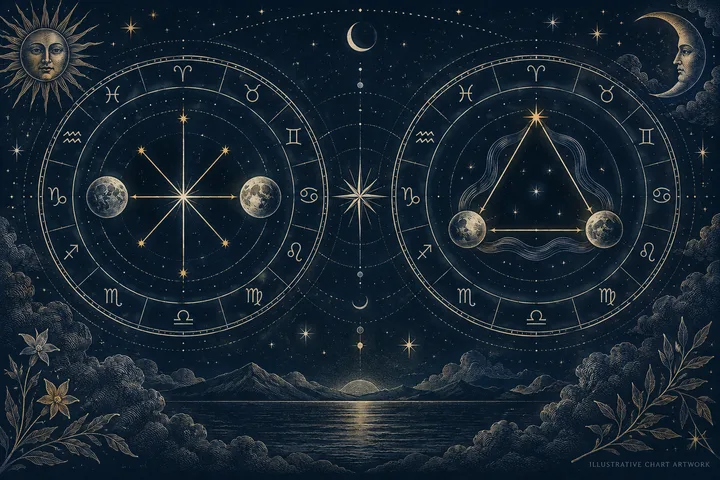
What makes a synastry sextile different from a trine in everyday relationship choices? A trine often describes two planetary functions working together with little prompting. A sextile describes compatible functions that can become a shared resource when both people notice and use the opening. One may feel like an easy rhythm; the other, an invitation worth accepting. Neither is automatically better. The distinction is a way to read the contact, not a rule about how either person must behave. The Meaning of the Aspects in Astrology describes trines as natural or instinctive flows and sextiles as energies that can be directed. Synastry: Love and Relationship Astrology places those contacts between two charts and considers the planets and signs involved. Together, these ideas suggest a practical question: what seems to come easily, what might need a clear invitation, and how would both people take part? Begin with the planet pair and the choice you’re considering. Then look at the signs, how close the contact is to exact, and whether the wider chart repeats the theme. A chart can help you name a conversation or small experiment; it can’t make that choice for you.
Sources: The Meaning of the Aspects in Astrology; Synastry: Love and Relationship Astrology
What does the angle change—and what doesn't it?
In synastry, the angle tells you how two chart factors relate; the planets tell you what is relating. A sextile places them about 60 degrees apart. A trine places them about 120 degrees apart. Those numbers describe the geometry between positions in two charts, not a measure of how much two people care, how often they agree, or whether a relationship will last. The Synastry: Love and Relationship Astrology guide defines synastry as the interplay between individual charts and cautions that a Sun-sign comparison alone is general. So begin with the actual planet pair, not the aspect word by itself. The traditional reading gives each angle a different texture. In The Meaning of the Aspects in Astrology, trines are described as natural and easy, sometimes so familiar that people may take their strengths for granted. Sextiles also carry ease, but their potential is more available when noticed and directed. In an everyday choice, that can mean a trine symbolizes a shared rhythm that starts without much planning, while a sextile suggests a compatible opening that benefits from attention. This is a way to frame a conversation, not a rule that predicts what either person will do. Both people still choose whether to respond. The degree names the exact relationship, while the zodiac signs add another layer of context. A trine commonly links signs of the same element: fire with fire, earth with earth, air with air, or water with water. A sextile commonly links signs whose elements can work together, such as fire and air or earth and water. These are broad patterns. A sign relationship can suggest why two styles feel familiar or complementary, but the signs alone do not confirm that the planets form an exact sextile or trine. Check the planets' degrees against the angle. That distinction matters because chart shorthand can make a sign pairing sound more definite than the available information allows. Two people may know each other's signs yet lack the degrees needed to tell how close the contact is to exact. Astrologers allow an orb, the distance from exactness within which they count an aspect, and their allowances vary. The Beginners Astrology Course, Lesson 10 gives one teaching policy: eight degrees for several major aspects and six for sextiles. That is the course's method, not a universal cutoff. A sign-based reading can still describe possible styles, but it should not be presented as a verified degree contact when the degrees are unknown. Read the contact, then, in two parts: angle and planetary meaning. The angle offers a clue about whether the exchange may feel familiar or call for more deliberate use; it does not name the subject on its own. Ask whether it helps both people make a choice they can recognize and share.
A trine often describes two planetary functions working together with little prompting; a sextile describes compatible functions that can become a shared resource when both people notice and use the opening. Neither is automatically better. Start with the planet pair and the choice you’re considering, then consider signs, exactness, and the wider chart. Use the reading to guide a mutual conversation or small experiment, not to decide the relationship’s fate.
Sources: Beginners Astrology Course, Lesson 10; The Meaning of the Aspects in Astrology; Synastry: Love and Relationship Astrology
How signs change the expression without replacing the aspect
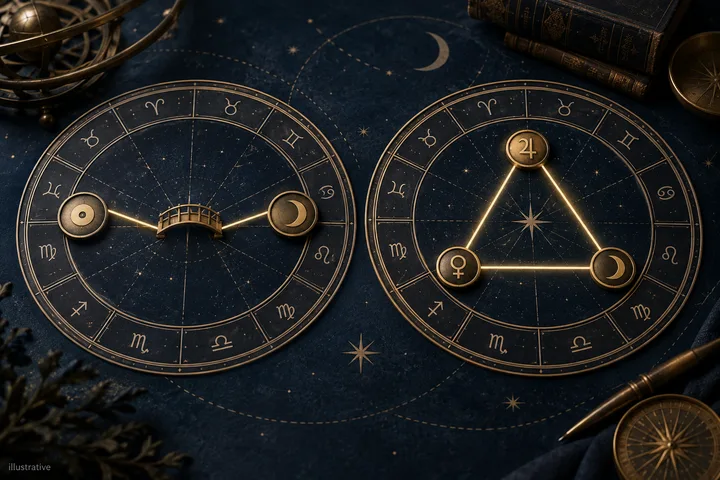
Signs add style to an aspect; they don't replace its geometry. A trine describes a 120-degree relationship between chart factors; a sextile describes 60 degrees. Usually, a trine links signs of the same element, and a sextile links compatible signs from different elements. The angle describes how planetary functions relate; signs suggest their style of expression. Neither layer is a verdict about how a couple will behave.
The Elements in Astrology groups signs by fire, earth, air, and water as broad tendencies. It treats qualities, or modes, as ways of expressing activity. In synastry, element can suggest the tone of a shared task, while mode can describe how each person starts, maintains, or adjusts it. These are clues, not fixed instructions. Read the planets and signs involved; don't let one element label stand in for a person or relationship.
Consider a hypothetical decision about how to spend a free afternoon. A fire-air sextile might suggest an opening between enthusiasm and ideas: one person brings momentum, the other offers options, and both can turn the difference into a plan. A same-element fire trine might suggest a familiar rhythm around spontaneous action. The first emphasizes coordination between distinct styles; the second, a style that may feel readily understood. Both could be enjoyable, depending on what the pair chooses to do.
This contrast helps you ask a better question; it doesn't supply the answer. If a plan stalls, sextile symbolism doesn't mean one person must keep initiating. If a trine feels easy, that doesn't prove the pair has discussed preferences or shared effort. Ask what the signs suggest about approach, then check the exchange: did each person contribute, and did the plan work for both? Signs can name a difference without assigning blame or predicting an outcome.
Skyscript's Beginners Astrology Course, Lesson 10 defines sextile as 60 degrees and trine as 120 degrees, and explains that aspects may be read within an orb rather than only at exactness. It also says astrologers vary in the orb they allow. Sign relationships can help you recognize a pattern, but signs alone don't show how close a contact is to exact. Keep a sign-only reading broad when degrees aren't available.
Pay attention when a planet sits near a sign boundary. The element pairing may not describe the exact angular relationship neatly, because degrees determine separation. Check them before ranking a contact or calling it an exact sextile or trine. Sign context enriches the reading; the aspect and planet pair frame how the charts meet.
Sources: The Elements in Astrology; Beginners Astrology Course, Lesson 10
An emotional-care comparison: Moon with Venus or Mars
Imagine one partner comes home after a draining day and goes quiet. The other wants to offer comfort, but a hug, a meal, a question, or some room could each be welcome. In synastry, a Moon-Venus contact gives this moment a language of emotional needs meeting affection. The Moon describes comfort needs; Venus, affection and relating. The aspect suggests how those functions may meet, not exactly what either person needs. With a Moon-Venus trine, the pair may find a familiar rhythm. One notices the mood; the other offers easy warmth. Synastry: Love and Relationship Astrology describes Moon-Venus contacts through familiarity, tenderness, and care. Cafe Astrology’s Moon-Venus aspect guide groups sextiles and trines as naturally affectionate and inclined to seek mutual ground. These descriptions suggest ease, not that every need will be understood. The same evening can show the sextile’s more deliberate opening. One partner might ask, “Would you like company, help, or some space?” The Moon-Venus guide groups both aspects, so this contrast applies the broader distinction in Synastry: Love and Relationship Astrology: trines blend energies, while sextiles are points a couple may notice and appreciate. A clear invitation can help make the resource usable. An easy trine can still miss. A partner might bring food when the other wants to talk. The Moon-Venus guide notes that someone may avoid saying what needs to be said to preserve peace. Ease is not mind-reading. If a gesture lands poorly, ask and adjust rather than insisting the chart promised harmony. Now change Venus to Mars. The question shifts from “What comfort feels loving?” to “When should I act, or give the other person room?” Cafe Astrology’s Synastry: Moon-Mars Aspects describes the Moon as soothing Mars and Mars as encouraging the Moon toward confidence, while noting spontaneous reactions and possible arguments. Under a trine, initiative may feel familiar: “Want to take a walk?” Under a sextile, it may work best as a check-in: “I can take care of this if that would help.” These are illustrations, not fixed behaviors. Care has two participants. One offers; the other can accept, decline, or suggest otherwise. The Moon-Mars guide describes harmonious contacts as lively and instinctive, yet sometimes tumultuous. A couple may have an easy rhythm and still need to slow down when one person feels rushed. A trine is no reason to skip consent or conversation. Try the scene as a small experiment, not a verdict. Each person can name one kind of support that helps after a difficult day, then ask what the other prefers. If the pattern works, appreciate it and leave room for changing needs. If the chart suggests an opening, offer it plainly and see whether both find it useful. The reading earns its place when it sharpens that mutual question; it does not replace the answer the couple gives through their choices.
Sources: Synastry: Love and Relationship Astrology; Synastry: Moon-Venus Aspects Between Charts; Synastry: Moon-Mars Aspects
A choice-and-initiative comparison: Venus with Mars
Venus-Mars contacts bring affection and initiative into the same conversation. In synastry, Venus can describe how someone approaches pleasure, affection, and relating; Mars brings assertion, desire, and the urge to act. The question here is not whether two people feel a guaranteed attraction. It is how an offer of connection meets a response, and whether both people like the pace. The Synastry: Love and Relationship Astrology guide treats Venus-Mars as a notable contact, while also stressing that the rest of the chart matters.
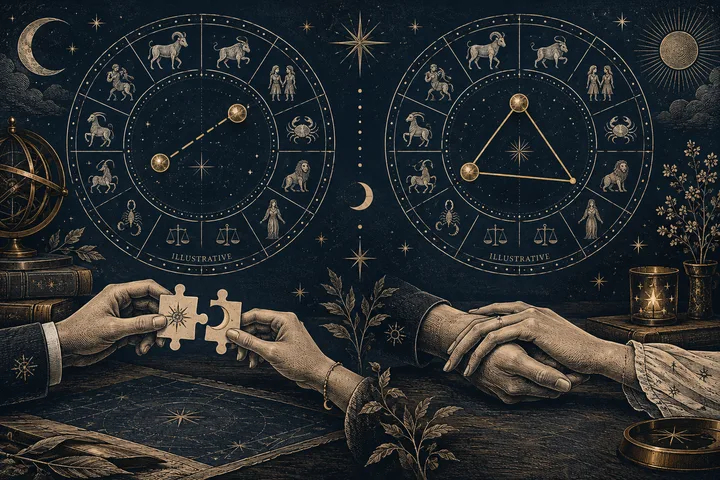
Imagine one person would enjoy a planned evening together, while the other tends to act on the moment. With a Venus-Mars trine, the symbolic picture may be an easy rhythm: one offers a plan or a gesture, and the other responds in a way that feels natural to both. The useful question is whether each recognizes the other's contribution, or whether a familiar pattern has become so ordinary that neither names it. In the Synastry: Venus-Mars Aspects Between Two Charts guide, the trine is described through easygoing energy and appreciation. Those are interpretive themes, not guarantees about how any particular pair behaves.
With a sextile, the same evening may benefit from making the opening clearer. One person might say, “Would you like me to plan something for us this week?” The other can answer honestly, suggest a different time, or offer an idea of their own. The guide presents the sextile as a subtler chemistry that needs appreciation and encouragement to become active. Read that as an invitation to notice and cultivate an exchange, not as proof that the pair has chemistry or that one person must do the work. A sextile becomes useful in practice when both people can take part freely.
Signs add style to either picture. They can suggest whether an invitation comes through direct action, steady attention, playful conversation, or another mode of expression; the actual signs and degrees are needed to make that comparison specific. Don't turn an element shorthand into a script for the couple. The Synastry: Love and Relationship Astrology guide notes that Venus-Mars contacts may feel smooth, but also warns that attraction can coexist with friction. So ask what each person prefers, then watch the response. A trine can be overlooked or taken for granted; a sextile can remain only an opening if it isn't welcomed. Neither aspect settles the matter. Try one low-stakes question: “How do you like us to make time together?” The answer, and the care each person brings to it, gives the chart reading a practical test without turning it into a verdict about attraction or the future.
Sources: Synastry: Venus-Mars Aspects Between Two Charts; Synastry: Love and Relationship Astrology
Read the planet pair before ranking the aspect
The planet pair should answer your question before the aspect label does. If you’re wondering about emotional comfort, begin with the Moon. If the question concerns initiative or assertion, Mars changes the focus. A sextile or trine describes how two functions meet; it doesn’t tell you whether the contact addresses the issue you care about. In Synastry: Love and Relationship Astrology, Cafe Astrology advises readers to consider both the interchart aspect and the signs involved. Relevance comes before rank.
Imagine comparing two known contacts while deciding how to talk about emotional support. One is a Moon-Venus sextile; another is a Venus-Mars trine. The first may speak more directly to comfort and affection, while the second brings affection together with initiative. Use the contact that speaks to the question, not a universal ladder where every trine outranks every sextile. Cafe Astrology’s Synastry: Moon-Venus Aspects Between Charts discusses tenderness, compromise, and common ground in this pair. Its Moon-Mars guide brings emotional response into contact with action and instinct. These are themes to explore, not predictions of behavior.
For a practical comparison, separate four questions. What are you trying to understand: comfort, affection, or initiative? Which planets carry that theme? Does the contact read as smoother flow or as an opening that benefits from attention? Then add the signs’ style and, if you have degrees, consider how close the contact is to exact. Repetition adds context, but one contact cannot stand for the whole relationship. Starting with the aspect label can make a harmonious contact sound more relevant than it is.
Now imagine the question is how a couple begins time together. Venus-Mars may be more pertinent than Moon-Venus, because the former brings affection and initiative into the same comparison. Cafe Astrology’s Synastry: Venus-Mars Aspects Between Charts describes the trine and sextile as smooth, pleasant contacts. Its broader synastry guide distinguishes trines as energies that combine well and sextiles as compatibility partners notice and appreciate. Ask what happens easily and what invitation would help. It isn’t evidence of guaranteed attraction or reciprocity. An invitation matters only if both people can respond freely.
Use the same method without building a score. Name the decision, choose the planetary pair that speaks to it, read the aspect’s style, and bring in sign expression. Only then weigh exactness or repetition, if those details are known. A close sextile tied to the question may be the more useful contact to discuss; a closer or repeated trine could be more relevant in another comparison. This is contextual, not a formula for relationship quality. If the chart points to ease, ask whether you both notice it. If it points to an opening, make one clear, mutual request and see what you learn from the exchange.
Sources: Synastry: Love and Relationship Astrology; Synastry: Moon-Venus Aspects Between Charts; Synastry: Moon-Mars Aspects; Synastry: Venus-Mars Aspects Between Two Charts
How much confidence should degrees and orb allow?
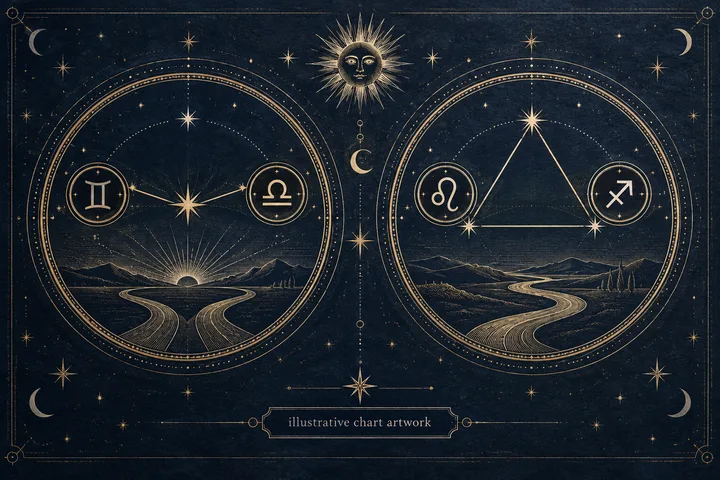
An orb is the distance between an aspect’s exact angle and the measured angle between two placements. If two planets are exactly 60 degrees apart, they form an exact sextile; if they are exactly 120 degrees apart, they form an exact trine. If the distance is a little wider or narrower, astrologers may still count the contact when it falls within an allowed orb. The question is how wide that allowance should be. There isn’t one rule used by every astrologer. In “Beginners Astrology Course, Lesson 10,” Skyscript defines the sextile as 60 degrees and the trine as 120 degrees, then gives a clear example of one practice: the Canopus course allows an orb of eight degrees for conjunctions, squares, trines, and oppositions, and six degrees for sextiles. The lesson also says astrologers vary in what they allow. A six-degree cutoff can make a comparison consistent, but it isn’t a rule shared by all astrologers. This is one teaching approach, not a universal synastry standard. For a couple comparing known placements, the practical use of degrees is straightforward. Measure the separation between the two planetary positions, then compare it with the exact angle for the aspect under discussion. The difference between the measured separation and 60 or 120 degrees is the orb. A smaller difference means the contact is closer to exact. Within a chosen method, that makes it a stronger technical candidate for interpretation. It does not prove that the contact will be more noticeable in daily life, or that one person will respond in a particular way. That distinction keeps technical precision in its proper place. “The Meaning of the Aspects in Astrology” describes trine qualities as natural and sometimes taken for granted, while sextile qualities can be noticed and directed. Those are interpretive descriptions of how an aspect may be experienced. Degrees answer a narrower question: how close is this contact to its exact angle? They don’t settle which theme matters most to a couple, whether both people welcome it, or how the wider synastry shapes it. A closer contact can deserve attention, but planet relevance and the lived situation still guide the reading. The Synastry Comparison Report applies one stated method: it compares supplied Moon, Venus, and Mars placements, uses degrees when they’re provided, and checks selected major aspects with a six-degree orb. It doesn’t calculate natal positions from birth details or calculate houses. Without degrees, you can discuss sign-based themes, but exactness remains unknown and contacts can’t be ranked by orb with confidence. If a placement itself is missing, the comparison can’t fill it in. The useful conclusion is modest and clear: use degrees to see whether a contact falls within the chosen method, and use the rest of the chart and your mutual experience to decide what that contact means in practice.
Sources: Beginners Astrology Course, Lesson 10; The Meaning of the Aspects in Astrology
When the wider pattern changes the reading
A harmonious contact can be inviting, but it cannot describe the whole relationship. Several contacts may speak to one question, while another part of the chart points to a different exchange. Cafe Astrology's “Synastry: Love and Relationship Astrology” describes synastry as interplay between individual charts and cautions that Sun-sign comparison is only general. That wider frame keeps one trine or sextile from becoming a verdict. Consider an illustrative example. Two people are making plans after a busy week. One known contact suggests an easy rhythm around affection or initiative; another points to different preferences about timing. The first can still be a resource. It doesn't settle the second question. They might enjoy time together, yet still need to ask whether Friday or Sunday works better. The chart's symbolic pattern helps them name ease and difference. Repeated contacts can make a theme worth examining. If several known contacts bring similar planetary functions into the comparison, ask whether cooperation appears in more than one situation. That's a reason to look for a pattern, not proof that the relationship will behave a certain way. “The Meaning of the Aspects in Astrology” distinguishes a trine's natural flow from a sextile's directed potential. The interpretation remains a prompt for observation. The strongest exception to a simple “trine flows, sextile needs action” summary is a trine that is closer to exact, more relevant to the question, or reinforced by related contacts. It may deserve more attention than a wider sextile on a less relevant pair. This is a contextual reading, not a universal ranking formula. The reverse can also be true: a sextile may be the clearest symbolic opening for the issue the couple wants to discuss. Cafe Astrology's synastry guide describes both sextiles and trines as supportive in several planet pairings, while noting that the planets involved shape interpretation. The aspect name alone cannot settle priority. A harmonious contact can coexist with strain elsewhere in the chart. That doesn't cancel its resource, just as one easy contact doesn't make every exchange effortless. Keep each observation tied to its scope: which planetary functions are involved, what question you're considering, and whether the contact repeats a theme. Don't use a trine to explain away silence or one-sided effort. Don't treat a sextile as evidence that someone will respond if invited. Neither geometry replaces what each person chooses to do. Widen the reading only when the pattern adds information. If one contact speaks to the question and the comparison offers no clear repetition, keep the conclusion modest. If several contacts point toward similar cooperation, name that as a possibility and ask whether both people recognize it. Then look at the actual exchange: do both offer, listen, and adjust?
Sources: Synastry: Love and Relationship Astrology; The Meaning of the Aspects in Astrology
Turn the contact into one mutual next step
A trine can help you notice a rhythm that already feels easy; a sextile can help you name an opening you might choose to develop. Neither makes the choice for you. Ask each other: where does cooperation happen naturally, and where would a direct invitation help? One person might name when a request for comfort landed well; the other, when a clear invitation helped. The point isn't to prove the chart right. It's to learn which exchange feels mutual. Then choose one small experiment. Name an easy rhythm you value and ask if the other person feels it too. If you see an opening, make a specific request and leave room for an honest answer. Try checking in before offering advice. These are prompts, not predictions. Either person can accept, decline, or revise the suggestion. Afterward, ask what happened. Did you both take part, and did it meet the need? If not, adjust the request or set the chart idea aside. “Synastry: Love and Relationship Astrology” treats interchart contacts as part of a broader comparison, and advises reading contacts in context. Missing placements leave that part open; missing degrees leave exactness unresolved. A placement reading can clarify supplied contacts, but can't fill in positions that weren't provided. If you know your Moon, Venus, or Mars signs, the Synastry Comparison Report can compare those supplied placements and optional degrees. It applies its stated six-degree orb to selected major aspects; it doesn't calculate positions from birth details or include houses. The prompt works without a report. Start with the exchange you both recognize, choose one action, and see whether it serves you both.
A little more clarity
What is the main difference between a sextile and a trine in synastry?
A sextile is a 60-degree contact and a trine is a 120-degree contact. In traditional interpretation, a trine often suggests a smoother, more familiar exchange, while a sextile suggests compatible potential that can be noticed and used. The planet pair, signs, degrees, and wider chart shape the reading.
Can a sextile be more important than a trine?
For a specific question, a sextile may be more relevant if it involves the planets tied to that topic and the trine does not. Closeness to exactness and repeated themes can add context, but there is no universal ranking formula for relationship quality.
Sources & further reading
- The Meaning of the Aspects in Astrology
Supports the interpretive contrast between natural trine flow and sextile potential that can be noticed and directed.
- Synastry: Love and Relationship Astrology
Supports reading interchart contacts through the planets and signs involved, within the broader comparison of two charts.
- Beginners Astrology Course, Lesson 10
Defines sextile and trine angles and illustrates that astrologers use varying orb allowances.
- The Elements in Astrology
Supports describing elements and qualities as distinct ways to interpret sign context.
- Synastry: Moon-Venus Aspects Between Charts
Supports the symbolic reading of Moon-Venus contacts through affection, compromise, and common ground.
- Synastry: Moon-Mars Aspects
Supports using Moon-Mars to discuss emotional response alongside initiative, instinct, and possible friction.
- Synastry: Venus-Mars Aspects Between Two Charts
Supports comparing Venus-Mars trine ease with sextile potential that may benefit from attention and appreciation.
Synastry Comparison Report
Enter known placements for two people. Get an input-by-input comparison, selected aspect calculations and a clear record of what remains uncertain.
Compare our placements