Is a major-only synastry report useful?
Imagine Maria and Sam comparing two synastry summaries before they talk through a recurring difference in how they make plans. One summary lists five major aspect types and explains the planet pairs. The other prints several minor contacts too, but gives each only a short label. Which is more useful? The answer depends less on the number of symbols than on what Maria and Sam want to understand.
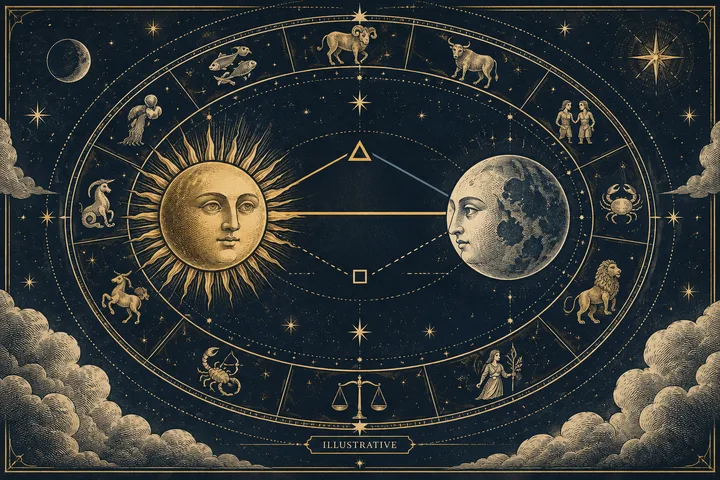
A major-only report can be useful when the question is how the central planet contacts fit together. In common modern Western usage, those contacts are conjunction, sextile, square, trine, and opposition. A report can describe the planets involved, the angle between them, and the interpretive meaning assigned to that contact. That is a focused reading, not a complete inventory of every relationship two charts could form.
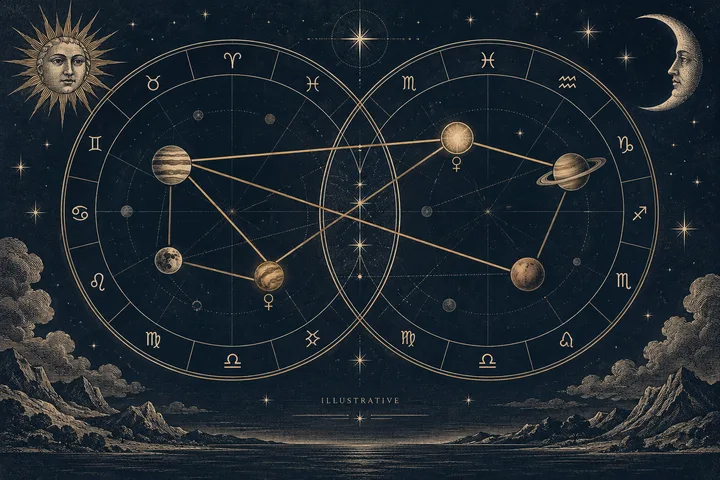
The distinction matters because synastry is already a comparison of two sets of placements. Each interpretation asks what one person's planet signifies, what the other's planet signifies, and how their angular relationship joins or contrasts those functions. The Astrology Podcast's episode on the five major configurations describes aspects as the way chart factors interact; its separate discussion of minor aspects shows that astrologers differ on whether those additional relationships deserve weight. Those are different schools of emphasis, not a simple contest between a good and bad report.
The useful test is two-part. First, does the report make its scope clear and interpret the included contacts coherently? Then, is there one omitted contact that a chosen tradition or a specific open question gives you reason to examine? If the first answer is yes and the second is no, the major-only reading may be enough for now.
Sources: The Quadripartite Mathematical Treatise, or Tetrabiblos; An Introduction to Aspects and Chart Shaping in Natal Astrology
What counts as a major aspect, and what does the label leave out?
The five aspects commonly grouped as major are conjunction at 0 degrees, sextile at 60, square at 90, trine at 120, and opposition at 180. In synastry, these angles describe relationships between factors in two charts. Minor aspects commonly include the semi-sextile, semi-square, sesquiquadrate, quincunx, quintile, biquintile, septile and others. There is no single list used by every astrologer, so ask what a report means by 'minor' before deciding what its omission means.
The categories have a history. Ptolemy's Tetrabiblos discusses the angular configurations of opposition, trine, square and sextile within a sign-based framework; conjunction is part of the wider aspect vocabulary treated by later astrological teaching. Modern references often present five major aspects together. Nicholas Campion's introduction at Skyscript uses that familiar five-aspect grouping and distinguishes it from several minor contacts. The Astrology Podcast's historical overview says some minor aspects now in use were introduced by Johannes Kepler in the seventeenth century and that their adoption has varied among astrologers.
That history helps explain the label, but it doesn't turn the label into a universal ranking. A traditional astrologer may center the major configurations because they connect signs through a particular doctrine. Another practitioner may use harmonic relationships such as quintiles or septiles as a deliberate interpretive layer. A modern report may define its set for practical clarity. Each choice makes a different map. The right comparison is between the map and the question, not between the word 'major' and the word 'minor' as if one automatically meant important and the other trivial.
An aspect set also differs from a list of planets. A report might count only major angles between selected planets, or it might include additional chart factors. If the input omits birth times, angles such as the Ascendant and Midheaven may not be dependable. Philip Graves's synastry guide explicitly recommends recording which person's factor is which and notes that angles should be used only when birth time is accurate. The boundary is practical: a clear report tells you which placements it compares and what it leaves outside the grid.
So translate a marketing phrase into a concrete inventory. Does 'major aspects' mean those five angles between the supplied planets? Does it include the Moon, nodes, or chart angles? Are sign-based relationships included, or only contacts measured by degree? A reader can then understand the report's promise without assuming it covers every technique in relationship astrology.
Yes. A synastry report limited to the five commonly named major aspects can give a useful, coherent reading of those contacts when it states its placements, aspect rules, and orb clearly. The five are conjunction, sextile, square, trine, and opposition. A major-only scope does not include every contact used by every astrological tradition, so it may omit a close quincunx, quintile, or another minor aspect. Judge the report by how well it interprets the planet pairs it includes, not by its aspect count. Then consider one omitted contact only if a chosen tradition or a specific unresolved question gives you a reason to examine it. A larger list alone does not make a reading more useful.
Sources: An Introduction to Aspects and Chart Shaping in Natal Astrology; TAP Ep. 323 Transcript: Aspects in Astrology: The Five Major Configurations; The Classical Aspects, in Full: Conjunction, Sextile, Square, Trine & Opposition
What does an orb tell you, and why should the report name its rule?
An orb is the distance a contact may sit from its exact angle and still count under a chosen method. If two planets form an exact square, their separation is 90 degrees. A report that allows a six-degree orb may include separations from 84 through 96 degrees, depending on the rule it applies. That example explains the arithmetic only; it does not make six degrees a standard shared by all astrologers.
Orbs matter because the same pair can appear in one report and disappear from another. Campion's reference says modern practice may set an orb by aspect, while traditional approaches may also consider the planets involved. It describes closer aspects as stronger within that interpretive scheme. The Astrology Podcast transcript likewise records disagreement and fluidity in how astrologers use orbs, including a distinction between sign-based relationships and closeness by degree. The reader therefore needs the report's rule before comparing its results with another source.
A sign-based aspect asks whether signs bear a relationship under a tradition's rules. A degree-based aspect asks how close two placements are to an exact angular angle. Some astrologers use both, with degree closeness refining the contact; others make a more strictly degree-based list. The two approaches are related, but they are not interchangeable labels. A report that states only 'we use aspects' leaves the reader unable to tell what its list means.
The Synastry Comparison Report offered here uses supplied placements and optional degrees. Its selected major-aspect calculations use a stated six-degree orb. It does not calculate natal positions from birth details or calculate houses. That makes it important to provide known placements accurately and to understand that a sign-only comparison cannot establish exact degree distance. The six-degree rule belongs to this report's scope, not to astrology as a whole.
When comparing two reports, write down the orb beside the aspect set. If one includes a contact and the other excludes it, first check whether they used the same placements, angle definitions, and orb. Only then is it fair to compare interpretation. A difference in inclusion may come from method rather than from a disagreement over what the relationship means.
Sources: An Introduction to Aspects and Chart Shaping in Natal Astrology; TAP Ep. 323 Transcript: Aspects in Astrology: The Five Major Configurations
Why the planet pair matters more than the aspect count
An aspect name is a starting point, not a complete reading. A square tells you about an angular relationship. The planets tell you which functions are meeting. In synastry, the interpretation also needs to keep track of whose planet is whose, because the two people may experience a contact differently. A list of twenty contacts with no account of the planet pairs can be less useful than a shorter list that explains what each connection brings into the comparison.
The classical astrology teaching page on aspects lays out an interpretive sequence: identify the configuration, consider the planets involved, then refine the reading through degree closeness and application or separation. It presents a particular traditional method, not a rule binding every school, but the sequence is useful as a reader's check. Does the report name the aspect? Does it explain the two planets? Does it show how its closeness or chosen tradition affects the emphasis? If not, added minor contacts may only multiply labels.
Take a purely illustrative example, with no actual couple or chart positions: suppose a report describes one person's Mercury in a square with the other's Saturn. A useful reading would explain the interpretive roles assigned to Mercury and Saturn, then describe the square as a point of friction or effort within that school's language. It might invite the pair to notice how they handle careful wording, timing, or correction. It should not declare that one person is controlling, that communication must fail, or that the contact determines the bond. The aspect gives a symbolic lens; the people bring the lived situation.
Now compare a Venus-Mars trine. A report might interpret ease between relating and pursuing, while still asking how the people express those functions in practice. The square and trine do not rank relationship quality. A square can mark friction that asks for attention; a trine can describe an easy channel that may be taken for granted. The traditional reference page on classical aspects gives the trine an ease that can go unused and treats the square as demanding engagement. These are interpretive descriptions, not predictions of success or failure.
The same caution applies when a report adds minor aspects. A close minor contact between planets may offer a fine-grained theme in a school that works with it. But if the report does not explain why those particular planets matter or how the aspect alters the reading, the extra line does little. Ask what the contact contributes that the major ones did not already say.
Sources: TAP Ep. 323 Transcript: Aspects in Astrology: The Five Major Configurations; The Classical Aspects, in Full: Conjunction, Sextile, Square, Trine & Opposition; Minor Aspects in Astrology, with Rick Levine
How should you compare two reports fairly?
Compare reports only after aligning their inputs and rules. Make a small checklist: which placements are supplied, which chart factors are included, which aspects count, what orb is used, and whether the report explains each contact. Then ask whether the interpretation helps you reflect on a concrete question. This is a fairer measure than counting lines or symbols.
For example, Report A might include the five major aspects for the supplied Moon, Venus, and Mars signs, with optional degrees and a stated six-degree orb. Report B might include more planets and minor aspects but assume exact birth data or use different orbs. Their outputs do not answer the same question. A longer list may reflect broader inputs, a wider net, or a different school. It does not by itself show greater insight.
Graves's synastry guide makes the practical burden of a large grid visible. It describes comparing factors from each person's chart and setting an allowance for each aspect. It gives distinct orb values by aspect and recommends restricting attention so that a large number of factors does not obscure the overall picture. Those exact values are one author's method, not a universal formula. The useful point is that two charts can generate many possible pairings, so a report needs a principle for selection and interpretation.
Read for traceability. Can you follow the route from placement to contact to interpretation? If a report says the charts show a strong pull, does it name the contact behind that statement? If it calls a contact close, does it give the degrees or explain its inclusion rule? If it makes a claim about the relationship, does it stay within what an astrological interpretation can responsibly describe? Plain reasoning lets you judge the report rather than simply absorb its tone.
Then compare usefulness against your purpose. If you want an overview of major planet contacts, a concise report that explains its five-aspect scope may serve you well. If you are studying a tradition built around harmonics, a major-only report omits a layer you intentionally want to see. If you are trying to resolve a practical disagreement, neither report can decide what happened between you; use its language to frame a conversation, not replace one.
A report can also be limited by the data it receives. If the placements are unknown, this offer does not derive them from birth dates. If degrees are absent, it cannot distinguish an exact contact from a wider same-sign relationship. If the birth time is uncertain, do not treat chart angles or houses as settled inputs. Naming these limits makes the comparison sharper, not weaker.
Sources: Introduction to Relationship Astrology 2: Synastry; An Introduction to Aspects and Chart Shaping in Natal Astrology; Minor Aspects in Astrology, with Rick Levine
When could an omitted minor aspect change the reading?
An omitted minor aspect may matter when the interpretive tradition you are using treats it as meaningful, or when one specific contact could speak to a pattern the major contacts leave unresolved. Its absence from a major-only report marks the report's boundary. It does not prove that the contact has no meaning in every system.
The strongest case for adding one is not 'more detail must be better.' It is a precise question. Perhaps a reader has already considered the major contacts and wants to explore a recurring sense of adjustment that the chosen interpretive framework associates with a quincunx. Or an astrologer working with harmonic aspects wants to examine a quintile as part of that method. In either case, the added contact should be named, its orb rule stated, and its interpretation connected to the question.
The practitioner conversation in The Astrology Podcast's episode on minor aspects provides a genuine alternative to a major-only reading. The episode describes several minor aspects, their varied history, and their uneven adoption; the transcript includes practitioners who assign them meaning and others who give some contacts less weight. It is a record of interpretive debate, not a consensus rule. That debate is precisely why a report should disclose its chosen framework.
There is also a strong reason to stop. Two-chart comparison can produce a long set of possible contacts, especially as more planets and points enter the calculation. Graves argues for limiting the list to contacts likely to matter, warning that tiny influences can be drowned out by a crowded picture. His thresholds are not binding, but the practical problem remains: an interpretation that treats every possible contact as equally loud gives the reader no hierarchy.
Use a one-contact follow-up. Identify the omitted angle, name the planets, check the degree distance if known, and ask what interpretive idea it adds beyond the major reading. If you cannot say what question it answers, set it aside. If it offers a coherent, distinct lens within your chosen tradition, consider it as a second pass. The decision is about relevance, not about fear of missing every possible symbol.
Sources: The Quadripartite Mathematical Treatise, or Tetrabiblos; Introduction to Relationship Astrology 2: Synastry
What does a useful first pass reveal, and what can it not settle?
A useful major-only reading gives you an organized account of selected contacts. It can help you see which planetary functions a tradition treats as flowing together, meeting with friction, or standing in contrast. It can give you terms for reflection and a manageable place to begin. It cannot show every possible aspect if its scope excludes minor contacts, and it cannot settle the value or future of a relationship.
Imagine Maria and Sam return to their two reports. One explains several major contacts in plain language and makes clear that it uses supplied placements, optional degrees, and a defined orb. The other includes additional minor aspects but offers no reason for selecting them or tying them to the reader's question. Maria and Sam can use the first to begin a discussion, even if it is narrower. They may later ask an astrologer who works with minor aspects to examine one contact that addresses something still unclear. They need not treat the second report's longer list as a deeper answer.
A good first pass should preserve complexity without becoming shapeless. It should distinguish the aspect's geometry from its interpretation. It should explain the planet pair before turning the contact into advice. It should rank the most relevant contacts under its stated rules rather than implying every line has equal force. The Astrology Podcast's major-aspect discussion emphasizes that aspects describe interactions between chart factors; its minor-aspect discussion shows why interpretive scope deserves to be named. Together, these sources support a modest but useful judgment: a bounded reading can be coherent without being exhaustive.
Historical relationship astrology offers a related reminder. In Tetrabiblos IV.5, Ptolemy's discussion considers factors in both nativities and more than an isolated tally of aspects. Its ancient framework and social assumptions are far from a modern couple's guide, so it should not be borrowed as relationship advice. But it does show that chart comparison has long involved context beyond simply counting contacts. A contemporary report can make its own scope clear without pretending that one aspect count is the whole craft.
There are meaningful exceptions. If your question concerns a particular minor-aspect technique, a major-only report is not designed to answer it. If the report gives only sign placements and no degrees, it cannot tell you which degree-based contacts fall within a chosen orb. If the interpretation is vague, adding more aspect types may increase the volume without improving the answer. And if a practical relationship question needs a conversation, the chart cannot conduct it for you.
Use the chart as a language for noticing patterns, not a verdict on whether two people should stay together. A major aspect may help name a dynamic to discuss. The people involved still decide what they experience, what they want, and what they do next.
Sources: An Introduction to Aspects and Chart Shaping in Natal Astrology; The Quadripartite Mathematical Treatise, or Tetrabiblos; Minor Aspects in Astrology, with Rick Levine
Choose the scope that answers your question
If you want to understand the major planet contacts, a clearly scoped major-only synastry report is a useful first choice. Look for the placements it uses, the five aspects it includes, the orb rule, and an explanation of each planet pair. Add a minor aspect only when you can name the tradition or question that makes it relevant.
That is the verdict for Maria and Sam's original choice. The shorter report is sufficient for a focused first reading if it interprets the major contacts well. It is not exhaustive, and that matters when their purpose calls for a broader technique. The best next step is not to chase every omitted symbol. It is to note one unresolved question, then decide whether a specific additional contact could illuminate it.
The Synastry Comparison Report at /compatibility-test works from placements you supply, with optional degrees; it does not calculate natal charts from birth details. If you already know your placements, use its major-contact scope to compare them in a structured way. If you want minor aspects, first make sure you know which contact and interpretive approach you want to explore. That gives you a grounded second question instead of an endless list.
Sources: Introduction to Relationship Astrology 2: Synastry; TAP Ep. 323 Transcript: Aspects in Astrology: The Five Major Configurations
Sources & further reading
- The Quadripartite Mathematical Treatise, or Tetrabiblos
Ptolemy's historical treatment provides context for sign-based configurations and chart interpretation beyond a modern aspect tally.
- An Introduction to Aspects and Chart Shaping in Natal Astrology
Defines orbs and presents a modern five-major versus minor-aspect grouping, while noting interpretive differences.
- TAP Ep. 323 Transcript: Aspects in Astrology: The Five Major Configurations
Explains aspects as chart-factor relationships and discusses major angles, sign-based and degree-based aspects, orbs, and synastry.
- The Classical Aspects, in Full: Conjunction, Sextile, Square, Trine & Opposition
Shows one traditional interpretive sequence that considers configuration, planetary meanings, and exactness rather than aspect labels alone.
- Introduction to Relationship Astrology 2: Synastry
Gives a synastry grid method, aspect-specific orb recommendations, and an argument for restricting contacts to keep the overall picture legible.
- Minor Aspects in Astrology, with Rick Levine
Documents a contemporary practitioner discussion of minor aspects, their varied history, and uneven adoption among astrologers.
- TAP Ep. 328 Transcript: Minor Aspects in Astrology, with Rick Levine
Records a practitioner debate illustrating why astrologers may assign different weight to additional aspect families.
- Synastry Aspects Explained: How Two Charts Actually Interact
A current search-result comparison illustrates how commercial synastry guides explain aspect scope, orb, planet pairs, and the limits of relationship verdicts.
Synastry Comparison Report
Enter known placements for two people. Get an input-by-input comparison, selected aspect calculations and a clear record of what remains uncertain.
Compare our placements