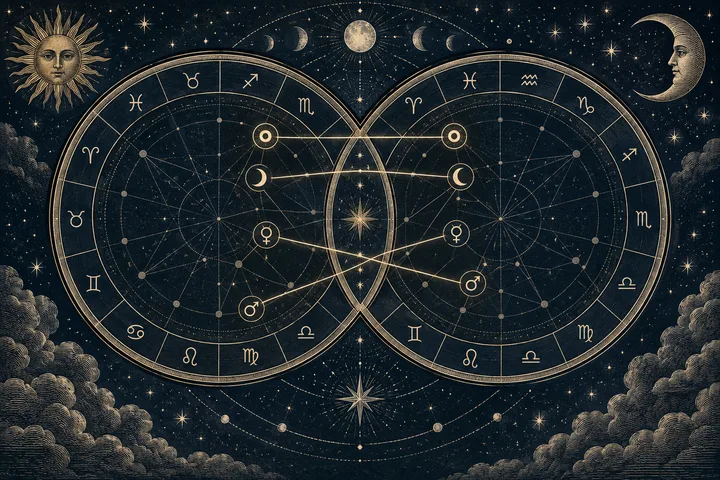
When both placements’ degrees are supplied, the Synastry Comparison Report checks their shorter zodiacal separation against five angles: 0°, 60°, 90°, 120°, and 180°. A selected major aspect qualifies when it falls within six degrees of one of those angles. This is the report’s inclusion rule, not a universal orb standard. If a degree is missing or rounded near the boundary, eligibility may remain undecided.
What rule decides whether an aspect gets into this report?
An aspect is the angular relationship between two chart positions. For this report, the selected major aspects are measured against five exact angles: conjunction at 0°, sextile at 60°, square at 90°, trine at 120°, and opposition at 180°. The report compares the shorter zodiacal separation between two supplied placements with those targets. When both degrees are available, a contact qualifies if its distance from one of the five exact angles is six degrees or less. That distance is the orb. A 90° separation is an exact square, so its orb is 0°. At 95°, the separation is five degrees from the exact square angle, giving a 5° orb. At 97°, it is seven degrees away. The first falls within this report’s limit; the second does not. The six-degree ceiling belongs to this report’s method. It isn’t a universal rule for every astrologer or every synastry reading. The order matters. First identify the two measured positions. Then find their shorter separation, compare it with the five angles, and measure the gap from the nearest relevant angle. Finally, check whether that gap is at most six degrees. The publication’s “Synastry aspects explained” page states that, with both degrees supplied, the report calculates the shortest zodiac angle and checks the five major aspects within a fixed 6° orb. It also says the placements are supplied by the reader; the report does not calculate natal positions from birth details. The shortest separation accounts for the zodiac’s circular shape. The same page gives 359° and 1° as an example: although subtracting in one direction gives 358°, the shorter distance across the zodiac boundary is 2°. That is the separation to compare with an exact aspect angle. This step keeps a contact near the end and beginning of the zodiac from appearing farther apart than it is. “Understanding the Free Natal Chart Report” by Cafe Astrology explains that an orb measures how far an aspect is from exactness. Its example records a 0°30′ orb, showing that degrees and minutes can express the distance more finely than a whole-degree figure. It also notes that astrologers allow different orbs. That distinction helps separate the geometry from the convention: the angular gap can be measured, while the six-degree cutoff is the report’s chosen threshold for deciding which selected contacts appear. So the first question is specific: do the supplied degrees place this pair within six degrees of 0°, 60°, 90°, 120°, or 180°? A sign pairing alone cannot answer that degree-based question. Passing the test makes a contact eligible for the list; it doesn’t tell you what the aspect means or how much attention it deserves. Those are the next interpretive steps.
Sources: Synastry aspects explained; Understanding the Free Natal Chart Report
How does a six-degree boundary change the list?
A six-degree limit changes the edge of the list, not the aspect angles themselves. The report checks the shorter separation between two supplied placements against its selected major angles. If that separation lies within six degrees of a target, the contact qualifies; if farther away, it does not appear. Exactly six degrees is included because the stated maximum is six. The report’s “Synastry aspects explained” page names this as its fixed limit for selected major-aspect calculations. It also says orb conventions vary, so this boundary describes the report’s method rather than every astrologer’s practice. Consider a mathematical illustration, not a personal chart. A square has an exact angle of 90°. If two positions are separated by 95°, they are 5° from that target and fall inside the limit. At 97°, they are 7° away and fall outside. The calculation asks how far the measured separation sits from the target, not whether positions look close by sign alone. Cafe Astrology’s “Understanding the Free Natal Chart Report” defines orb as distance from exactness and shows a report value in degrees and minutes. The aspect label stays square in both examples; only eligibility changes. The same arithmetic works with minutes. A separation of 90°40′ is 40 minutes beyond an exact square, or an orb of 0°40′. That is inside six degrees. Astrology.ac’s “Aspects are angles” gives a parallel example of a square at 90.4° having a 0.4° orb, and distinguishes exactness from whether a contact is good. “Square” names the angular relationship; “0°40′” or “5°” tells you how far the separation is from exact 90°. A cutoff makes a sharp decision even when the geometry changes slightly. At 96°, a square sits exactly six degrees from 90° and qualifies. Move the separation just beyond 96°, and it no longer passes. Its listing rule means a small numerical change can alter the output while the underlying positions remain nearly alike. Another stated orb policy may treat a near-miss differently. Astrology.ac, for example, publishes aspect-specific limits for a natal chart engine, including seven degrees for squares. That is a different convention, not a replacement rule for this synastry report. When an expected aspect is absent, check the measured separation before interpreting the absence. If it lies outside six degrees, it failed this report’s inclusion test. That does not prove the positions have no meaning in every astrological approach; another method may use a wider allowance or consider a different chart layer. It explains why this report leaves the contact off its selected major-aspect list. A listed contact has passed the gate, but inclusion alone does not make it the main theme or give it the same weight as every other contact. Cafe Astrology separates mathematical orb from subjective weighting, while Astrology.ac says exactness describes proximity, not whether a contact is good. When a contact you expected is missing, compare its separation with the target angle and six-degree boundary before drawing conclusions. When it is present, treat that as permission to interpret it, not as a verdict about the relationship. The cutoff answers a narrow question: does this contact qualify for this list? The planets, signs, and wider reading answer what it may mean.
Sources: Synastry aspects explained; Aspects are angles. Interpretation starts after the math; Understanding the Free Natal Chart Report
What can missing or rounded degrees tell you?
If either placement’s degree is missing, the report cannot confirm whether the pair falls within six degrees of a major aspect. A sign tells you where a planet sits by zodiac sign, but it does not give the exact distance between two positions. The report’s method page says that when both degrees are supplied, it calculates the shorter zodiacal separation and checks it against the selected major angles. Without both degree inputs, that check remains open. An absent result in this situation is not proof that the contact lies beyond the orb. Keep three outcomes distinct. A contact is confirmed inside the limit when the supplied degrees show it is no more than six degrees from a target angle. It is confirmed outside when the measured difference exceeds six degrees. It is undecidable when one or both degrees are unavailable, or when the displayed precision cannot settle which side of the boundary the true value falls on. These outcomes may look alike in a short list, but they mean different things. One is included, one fails this report’s rule, and one has not been established from the available inputs. Rounding matters most near the edge. Cafe Astrology’s “Understanding the Free Natal Chart Report” shows positions and aspect orbs in degrees and minutes, including an example orb of 0°30′. That format makes clear that an orb can contain a fraction of a degree. If two displayed placements are rounded to whole degrees and their displayed separation is exactly six degrees, the underlying positions could be a little closer or a little farther apart, depending on the discarded minutes and how the values were rounded. The rounded display alone cannot decide. Nor can a reader recover hidden minutes from the sign labels; more precise source data would be needed. This is a limit on certainty, not a reason to force a yes or no. The report uses supplied placements and optional degrees, so it can only apply its degree-based test to the information entered. If a degree is missing, describe the contact as unconfirmed under this method. If the values are rounded at the six-degree edge, call the result uncertain at that precision. If complete degrees place it beyond the cutoff, say that it does not qualify for this report’s selected aspect list. Other astrologers may use another orb policy, but that is a separate method question; it does not change what the available numbers establish here. The practical distinction is simple: “not listed because it failed the test” is different from “not confirmed because the inputs are incomplete or rounded.” Keep that difference visible when comparing charts. Use only the certainty the supplied degrees allow, and leave an unresolved boundary unresolved. Sign-level interpretation can still describe the placements’ styles, but it answers a different question from whether their measured separation meets an aspect’s angular boundary. Keeping those questions separate prevents a meaningful sign comparison from being mistaken for a confirmed degree-based contact.
Sources: Synastry aspects explained; Understanding the Free Natal Chart Report
Which contacts does the report’s selected major-aspect set cover?
The report checks five selected major aspects: conjunctions at 0°, sextiles at 60°, squares at 90°, trines at 120°, and oppositions at 180°. Its six-degree ceiling applies to these calculations. It doesn’t mean the report checks every possible angular relationship, chart point, house contact, or technique used in synastry. The report’s “Synastry aspects explained” page states that, when both degrees are supplied, it calculates the shorter zodiac angle and checks these five angles within a fixed six-degree orb. That is the scope of this list. It helps to separate two ideas. An aspect family names the target geometry between two positions; the orb measures how far their actual separation falls from that exact angle. So a pair separated by 90° forms a square, while the orb tells you whether the measured contact is close to exact and whether it fits the report’s chosen limit. The report’s page names the five target angles and describes six degrees as its starting setting, not a universal rule. That distinction matters: the ceiling is applied to the report’s selected aspect families, rather than expanding the list to every angle that an astrologer might find meaningful. For example, a 30° or 150° separation is not one of the five angles this report names. Another astrological method may study such a relationship, but it shouldn’t be silently relabeled as one of the report’s included major aspects. Deborah Houlding’s “The Classical Origin and Traditional Use of Aspects” discusses the symbolism of angular relationships and notes that modern orb practice took simpler forms over time. It also describes historical approaches that considered sign relationships and degree-based closeness in different ways. That history gives useful context for why astrologers may frame the same chart geometry through distinct methods; it doesn’t change the report’s stated calculation. The report uses supplied Moon, Venus, and Mars placements, with optional degrees. A limited aspect list is therefore a defined slice of a synastry comparison, not a claim that other chart layers have no meaning. If you want to discuss a contact outside the five-angle set, keep it separate: name the additional angle or chart factor and the method you’re using, then interpret it on those terms. This preserves a clear reading. You can see which contacts passed the report’s stated filter without mistaking that filter for a complete account of everything two charts may express. This boundary also helps when comparing the report with another reading. Ask whether both methods include the same aspect families and chart factors, then compare their stated angles. A different list may reflect a wider interpretive scope, rather than disagreement about contacts this report evaluates. Keep the methods distinct and the comparison stays useful. This avoids false disagreement.
Sources: Synastry aspects explained; The Classical Origin and Traditional Use of Aspects
Why might another legitimate aspect list look different?
Astrologers and tools can choose different orb policies. Some use one maximum for several aspects; others allow more room for certain angles or planet pairs and less for others. Hold the placements and target angles steady, then change only the orb rule. The resulting lists can differ even when both methods measure the same chart positions. That is a method difference, not necessarily a calculation error. The source must state its rule clearly for comparison. The Synastry Comparison Report uses one six-degree ceiling for its selected major aspects. Wanga’s “Synastry Orbs: Which Aspects Actually Matter” gives a more selective synastry example: it proposes roughly six degrees for conjunctions and oppositions, four to five for squares and trines, and two to three for sextiles. The article calls these working conventions, not laws. Under that scheme, a contact can fall within this report’s six-degree limit but outside Wanga’s suggested range for that aspect. The difference comes from the admission rule, not from a changed angle. “Relationship Astrology 2: Synastry” on Astrolearn also recommends separate limits: six degrees for conjunctions, five for oppositions, four and a half for squares, four for trines, and 2.7 for sextiles. It describes building a cross-chart grid from the two sets of placements and filtering the many possible contacts. Its figures are that author’s recommendations. They do not override the report’s stated rule or establish a universal standard. Still, they show why two synastry lists can include different contacts while each follows a clear method. Context matters when comparing sources. Astrology.ac’s “Aspects are angles. Interpretation starts after the math” publishes its own birth-chart engine settings: eight degrees for conjunctions and oppositions, five for sextiles, and seven for squares and trines. Those are natal-engine limits, not the site’s synastry recommendations. So this is a useful example of another published policy, but it is not a like-for-like synastry comparison. The page itself says other astrologers may use different orb policies. Compare chart context as well as the number. There is a longer history behind the choice. Deborah Houlding’s “The Classical Origin and Traditional Use of Aspects” describes varied historical approaches, including allowances tied to the planets involved and later methods based on the nature of the aspect. This does not make every modern convention interchangeable. It does show that a single fixed modern cutoff is one way to organize interpretation, not the only way astrologers have framed orb. The practical comparison is simple: confirm the same placements, confirm the same aspect set, then compare each source’s stated orb allowance. For example, if one method admits a square at five degrees while another sets a four-and-a-half-degree limit, the first list may include it and the second may leave it out. The report’s six-degree ceiling answers its own eligibility question consistently. Wanga and Astrolearn offer narrower, aspect-specific synastry guidelines; Astrology.ac supplies a different natal setting. None of these sources proves one rule superior. Before treating two lists as contradictory, ask what chart context and orb convention each uses. Then compare the meanings of contacts admitted under the same terms.
Sources: Synastry Orbs: Which Aspects Actually Matter; Relationship Astrology 2: Synastry; Aspects are angles. Interpretation starts after the math; The Classical Origin and Traditional Use of Aspects
Why is a consistent cutoff useful even when it is not universal?
A consistent cutoff gives you a clear first question: does this supplied planet pair fall within six degrees of one of the report’s selected major angles? The same maximum applies across those selected aspects, so you can understand why a contact enters the list without guessing at a separate hidden limit for each angle. That makes the report’s method easier to follow and repeat. It does not make six degrees the only sound choice. Astrologers may set narrower or wider limits, and those choices can produce different lists from the same placements. The benefit here is legibility: the rule is stated, and its boundary can be checked.
That clarity matters in synastry because a comparison can produce many possible cross-chart contacts. Astrolearn’s relationship astrology guide describes building an aspect grid from the two charts and recommends filtering the possibilities so the reader is not left with an unwieldy set. Its own scheme assigns different limits to different major aspects. Wanga’s synastry orb guide also describes a large field of possible contacts and proposes tighter working ranges for some aspects, including sextiles, than for conjunctions and oppositions. These sources explain why an astrologer might choose to narrow the list. They do not establish a universal rule, or show that one cutoff produces a truer reading.
The report makes a different tradeoff. Its single six-degree ceiling is simple to communicate across the selected major aspects. A reader can apply one admission rule, then see which supplied contacts pass it. The cost is that the same ceiling may admit a contact another astrologer would screen out under a tighter aspect-specific allowance. Conversely, a practitioner using a wider limit for a particular aspect could include a contact the report leaves off. Those differences concern the method used to build the list. They do not necessarily mean the two readers have different planetary positions or disagree about what an aspect means once identified. A shared limit also helps keep the comparison focused on the report’s stated scope: supplied placements and selected major aspects. It gives readers a stable way to ask what qualified before they move on to the planets, signs, and relationship question involved. That order is useful when comparing two readings, since it makes the source of a difference easier to name.
A uniform threshold is therefore useful as a first-pass filter, not as a claim that every admitted contact deserves equal attention. The publication’s inference is that a consistent rule makes the report easier to inspect: readers can distinguish inclusion from later interpretation. It cannot settle which orb convention best serves every chart question. If another astrologer’s list differs, compare the stated placements, aspect set, chart context, and orb policy before comparing conclusions. Then interpret each contact on its own terms. Astrolearn’s aspect-specific recommendations and Wanga’s narrower working ranges are alternatives to understand, not corrections that silently override the report’s published six-degree rule. Keep that distinction in view when using the result: consistency describes how the list is assembled, while interpretation asks what its contacts contribute. Neither step turns the output into a verdict about the relationship.
Sources: Relationship Astrology 2: Synastry; Synastry Orbs: Which Aspects Actually Matter; Synastry aspects explained
After a contact qualifies, what does the orb tell you—and what does it leave open?
The orb answers a precise question: how far is this contact from its exact angle? It does not answer what the contact means by itself. A smaller orb places the chart factors closer to exactness; it does not turn a square into a trine, or decide whether the exchange feels supportive, difficult, or equally important to both people. Treat admission and interpretation as separate passes. First, record the aspect and its orb. A contact at 0°30′ sits closer to exact than one at 5°50′. Both fall within this report’s six-degree maximum, but they are not equally exact. Cafe Astrology’s “Understanding the Free Natal Chart Report” distinguishes mathematical distance from exactness from a report’s subjective weighting. Its example also shows that a chart reader may weigh the planets involved alongside closeness. That is a useful distinction, not a formula to transfer mechanically into synastry: the cutoff tells you which selected contacts qualify, while the orb describes their relative exactness. Then name the planets and signs involved. In synastry, the aspect connects a factor from one chart with one from the other. The planetary pair gives the contact its subject; the aspect describes the relationship between those factors. A close square remains a square, with its own tension and movement. A wider trine remains a trine, with a different style of exchange. Exactness refines how closely the contact meets its angle. It does not erase the meaning carried by the planets or aspect, and it cannot tell you how either person experiences the link. “Synastry Relationship Astrology 2: Synastry” advises keeping each person’s chart factor identified when building an aspect grid, and notes that the two people need not experience a synastric link in the same way. That matters when you read a contact between one person’s Venus and the other’s Mars: the aspect name alone does not describe both people’s inner experience in equal terms. Read the factors as a relationship between distinct chart placements, not as a single blended trait or a verdict about the couple. Wanga’s “Synastry Orbs: Which Aspects Actually Matter” offers one publisher’s ranking approach and cautions against treating every listed contact as equal. Its priorities are a working convention, not a universal strength scale. Use a clear sequence: check whether the contact qualifies, note how close it is to exact, then interpret the planets, signs, and aspect together. If a wider contact passes the boundary, it can still add context when its planetary pairing speaks to your question or echoes another supplied theme. It need not outrank a tighter contact to matter. An orb measures exactness, not a score for affection, ease, friction, or destiny. A qualifying contact at 5°50′ belongs in the eligible set; compared with one at 0°30′, it is less exact, so read each on its own terms. Ask what the planets bring together, how the aspect shapes their exchange, and which part of the relationship you want to understand. That keeps the six-degree gate clear while leaving interpretation open to the chart factors involved.
Sources: Understanding the Free Natal Chart Report; Synastry Orbs: Which Aspects Actually Matter; Relationship Astrology 2: Synastry
How should you rank contacts that all pass the same gate?
Do not count qualifying aspects as votes. The six-degree rule answers whether a selected contact enters the report; ranking asks what to read first among those that pass. Start with the closest contact, then test its relevance to the question you brought to the chart. A repeated theme may add context, but neither repetition nor a long list turns synastry into a relationship score. The Synastry aspects explained page defines the report’s supplied-placement scope, while Synastry Orbs: Which Aspects Actually Matter makes the useful distinction between admitting contacts and giving them equal weight. A practical order keeps those jobs separate. First, verify the degrees and record each contact’s orb. Then group the contacts by closeness: a contact at 0°30′ sits nearer exactness than one at 5°50′, though both fall within a six-degree maximum. Next, name the aspect and the planets involved. In this report, the available comparison centers on supplied Moon, Venus, and Mars placements, so ask what those particular functions contribute to the question at hand: emotional response, affection, or desire. These are interpretive prompts, not predictions about what either person will do. After that, look for an echo. If more than one supplied contact bears on the same concern, read them together while preserving their differences. A Moon contact and a Venus contact may both touch affection, for example, but they do not become interchangeable simply because they repeat a broad theme. Synastry Relationship Astrology 2 recommends keeping each person’s chart factor distinct in a cross-chart grid, and notes that the two people may not experience a linkage in the same way. That gives the reader a useful question: whose planet is involved, and what is it connecting to? The report can organize that comparison; it does not provide a complete judgment of the relationship. Consider two abstract contacts that both pass the gate. A very close contact may deserve the first look because it lies nearer its exact angle. But if its planet pair does not speak to the concern being explored, a wider qualifying contact involving a relevant Moon, Venus, or Mars placement may offer the more useful reflection. This is not a claim that the wider contact is stronger. It is a way to choose what to examine first. Wanga’s guide favors close personal-planet contacts and warns against treating every line as equal; Astrolearn likewise asks readers to identify whose factors connect. Their ranking conventions are interpretive guidance, not a universal formula. So use closeness as an opening sort, not a verdict. Read the aspect’s geometry, the planetary roles, and any repeated theme, then ask which contact gives you the clearest question to reflect on. A close square remains a square; a wider trine remains a trine. The orb tells you proximity to exactness, while the aspect and planets supply different symbolic material. The report’s list helps you focus on eligible contacts. That distinction keeps a useful reading from becoming a scorecard. It cannot decide what the relationship means, and no tally of aspects can make that decision for you.
Sources: Synastry Orbs: Which Aspects Actually Matter; Relationship Astrology 2: Synastry; Synastry aspects explained
What should you check before comparing your placements?
Start with the placements you know. Enter each person’s Moon, Venus, and Mars signs, then add degrees where you have them. The Synastry Comparison Report uses those supplied placements and optional degrees; it doesn’t calculate natal positions from birth details. Its aspects page says selected major contacts are checked against a six-degree limit. Ask which contacts qualify under this report’s rule.
For each listed contact, note the aspect and its orb, then look at the planets involved. Cafe Astrology’s guide to reading a chart report distinguishes the orb measurement from the weight a reader gives it. A contact can pass the limit without becoming the main theme. Focus on contacts that are relatively close and relevant to what you’re trying to understand.
If a degree is missing, leave that comparison undecided. A sign can still give you material for interpretation, but it can’t confirm whether the separation falls within six degrees. Remember the boundary’s scope: it defines this report’s selected major-aspect list. Another method may use different limits, and this list remains one layer of synastry. Compare your known placements and use qualifying contacts to choose a focused question for reflection.
Sources: Synastry aspects explained; Understanding the Free Natal Chart Report
A little more clarity
Does exactly six degrees count?
Yes. The report’s stated maximum is six degrees, so a selected major aspect exactly six degrees from its target angle qualifies.
Does the report calculate my chart from birth details?
No. It uses supplied placements and optional degrees; it does not calculate natal positions from birth details.
Why might another synastry tool list a contact this report leaves out?
Methods can use different orb limits or aspect sets. Compare their stated chart context and rules before comparing the lists.
Sources & further reading
- Synastry aspects explained
Defines the report’s supplied-placement scope, five selected major angles, shortest-separation check, and fixed six-degree limit.
- Understanding the Free Natal Chart Report
Explains orb as distance from exactness, shows degree-and-minute precision, and notes that astrologers allow different orbs.
- Aspects are angles. Interpretation starts after the math
Lists major aspect angles and publishes natal-engine orb settings that differ by aspect.
- Synastry Orbs: Which Aspects Actually Matter
Offers aspect-specific synastry working ranges and distinguishes admitting contacts from ranking their interpretive weight.
- Relationship Astrology 2: Synastry
Gives aspect-specific recommended synastry orbs and discusses cross-chart grids and distinct planetary roles.
- The Classical Origin and Traditional Use of Aspects
Provides historical context on angular relationships and changing approaches to orb practice.
Synastry Comparison Report
Enter known placements for two people. Get an input-by-input comparison, selected aspect calculations and a clear record of what remains uncertain.
Compare our placements