
A sample should show its reading method, not just its answer
Imagine Maria and Daniel comparing a report sample before they decide whether to order one. The sample gives them a flowing contact and a tense one. The first sounds reassuring; the second sounds like a warning. They don’t need the sample to decide their future. They need to see how the reader reached those descriptions and whether both can belong in the same reading.
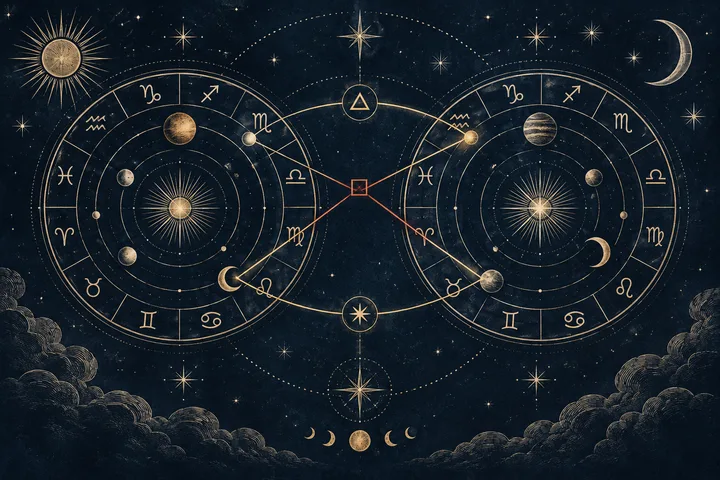
That is the right standard for a sample. It should make the tension legible, then show how the interpretation is weighed. It shouldn’t hide a difficult contact to keep the report pleasant. Nor should it turn one aspect into a sentence handed down on the couple. Synastry compares features in two charts, including the relationships between one person’s planets and the other’s. A sample shows craft when it lets you follow the move from placements, to contact, to interpretation, to context.
This matters because a sign-pair overview and an inter-chart aspect answer different questions. A sign comparison describes broad styles associated with placements. A degree-based aspect identifies a particular angular relationship between two positions. You can’t infer a close degree contact from signs alone. The Astrology Podcast’s overview names conjunction, opposition, trine, square and sextile as the five major aspects, and treats aspect as a way planets relate within a chart. Astrology University’s relationship course describes moving from one natal chart to the other and then examining inter-aspects and patterns. Together, those sources point to a process, not a compatibility recipe.
The report in this brief has a defined scope: it works from Moon, Venus and Mars placements that the reader supplies, can use optional degrees, and considers selected major aspects under a six-degree orb. That is the product’s rule, not a universal rule for astrologers. In this article, Maria and Daniel are an invented teaching example. No chart has been calculated for them. The useful pre-purchase question is whether a sample shows enough of its reasoning for you to decide if this kind of placement comparison fits what you want to explore.
Sources: Relationship Astrology 101 – Synastry; Aspects in Astrology: The Five Major Configurations
What must a sample tell you about the contact itself?
Start with the contact record. A sample should tell you whose planets are being compared, name the aspect, give the degree distance or orb when degrees are part of the example, and say what rule determines whether that contact is included. Without those details, a dramatic paragraph may sound precise while leaving you unable to check what it describes.
An inter-chart contact is a relationship between a planet in one chart and a planet in another. An aspect names the geometry between them. In the common major-aspect set, a conjunction brings two planets together; an opposition places them across from one another; a square marks a tension-bearing angle; a trine describes an easeful flow; and a sextile offers a connecting opportunity. Those are starting descriptions, not moral ratings. The planetary pair matters. So does the tradition used to interpret it.
An orb is the distance between the actual angle and the exact angle associated with an aspect. The Astrology Podcast’s aspect overview separates sign-based and degree-based considerations and includes discussion of orbs. A public astrology basics guide explains that practitioners allow different ranges, sometimes varying them by the planets involved and the aspect type. Deborah Houlding’s historical account describes changing orb approaches across astrological eras. There is no single threshold every astrologer must use. A report should make its chosen threshold visible.
This is where a sign-only comparison must be kept distinct from a degree-based aspect. If you know only that two placements share signs or elements, you may explore symbolic resemblance. You can’t verify the exact angular distance. If a sample uses degrees, it should let you see how its orb follows from those positions. If it uses signs alone, it should not imply that it has demonstrated a close contact. Houlding’s account even describes historical traditions that used sign relationships broadly alongside approaches that considered exact degrees, which shows why readers should ask what kind of statement a report is making.
For the report described here, six degrees is the stated operational limit for selected major aspects. That lets the reader judge whether the sample follows the product’s own rule. It does not establish that six degrees is best for every planetary pair or every school of astrology. The sample earns confidence by being consistent: the same input basis and orb rule should be clear across the interpretation, not appear only when a contact sounds useful.
A useful synastry report sample should show how its reader handles a difficult contact from start to finish. Look for the planets involved, the aspect and orb when degrees are available, a clear interpretation of both people’s roles, and an explanation of how other supplied contacts change or reinforce the theme. It should state its method and limits, too. A square or opposition is not a relationship verdict, and a trine is not a guarantee of ease. The sample earns your trust when you can follow its reasoning and see what information it used. For the Synastry Comparison Report described here, that means supplied Moon, Venus and Mars placements, optional degrees and selected major aspects using a six-degree orb. It does not calculate natal charts from birth details or include houses. Use the sample to judge the reading method and fit with your question, then ask what placements the report needs before you buy.
Sources: Aspects in Astrology: The Five Major Configurations; Astrology Basics: The Orb of an Aspect; Ep. 165 Transcript: Synastry: The Astrology of Relationships; The Classical Origin and Traditional Use of Aspects
How should a sample interpret a difficult contact?
A sample should describe the friction in a square or opposition without calling it a doomed relationship. It should show what the planetary pair brings into contact, what makes the meeting challenging, and what could make that tension workable or harder to carry. The geometry sets a tone; the planets and the wider reading give it substance.
Consider an example involving one person’s Mars contacting the other person’s Venus by a square. This is an illustration, not a calculated chart. Venus can speak to attraction, pleasure and relating; Mars can speak to desire, action and assertion. In a square, the two principles may press on each other. One person’s direct pursuit might feel energizing at one moment and too forceful at another. The other person’s wish to maintain ease or choose the pace might feel inviting to one side and frustrating to the other. That is a possible symbolic reading, not a claim about what a real pair will do.
A thin sample might stop at ‘passion, but conflict.’ A more useful one explains why it reads the contact that way, then gives the tension room to develop. Attraction and irritation can sit close together in a symbolic interpretation. Friction can sharpen awareness or prompt a couple to negotiate pace. It can also become wearing if their actual exchanges leave one person feeling pressed or dismissed. The reading should offer both possibilities and show what information would favor one emphasis.
The Astrology Podcast’s transcript on relationship astrology discusses why easy aspects should not automatically be treated as good and hard aspects as bad; it also describes tension as capable of being compelling while noting that recurring difficulty can be constructive or troublesome. Houlding’s history makes a related point from a different tradition: the square was not universally judged damaging in classical texts, and the planets’ nature, strength and condition affected its expression. These are distinct interpretive settings, not a single merged doctrine. They support a narrower conclusion: geometry alone doesn’t settle the value of a contact.
A sample should therefore name a constructive possibility without using it to soften every warning. If it speaks only in ominous terms, it has mistaken intensity for a verdict. If it promises that chemistry resolves every difference, it has mistaken attraction for ease. The reader should come away with a clear symbolic theme and a real question to consider: where do our preferred pace and style of expressing desire meet, and what happens when they don’t?
Sources: Ep. 165 Transcript: Synastry: The Astrology of Relationships; How to Judge Aspects in Your Birth Chart; Aspects Between Charts
A useful sample reads the contact in both directions
The sample should explain how each person may experience the same contact. It should not make one partner the cause and the other the passive recipient. Both planets belong to someone’s chart, and the exchange can feel different from either side.
Take a Saturn-to-Moon contact as a generic illustration. Saturn symbolizes structure, limits, responsibility and caution; the Moon speaks to emotional response, habit and the need for safety. The Saturn person might experience their contribution as steadiness, practical care or a needed boundary. The Moon person might experience that same response as restraint, criticism or distance. Meanwhile, the Saturn person may feel that emotional needs arrive with urgency, while the Moon person may feel exposed when a practical answer comes before comfort. These are interpretive possibilities, not fixed personalities or claims about intention.
Cafe Astrology’s synastry guidance explicitly advises readers to consider the role taken by each person whose planet is involved. It also says sign placement changes how the interaction expresses itself. The Astrology Podcast transcript discusses subjective differences in how a shared contact may be experienced. A sample that says only ‘Saturn blocks Moon’ skips that exchange. It implies a single actor and a single effect where the reading calls for two points of view.
Reciprocal reading does not mean the experiences must be equal. One partner may feel a contact more acutely, and chart context may give one planet a stronger voice. The standard is that both sides receive a thoughtful reading before the author decides where the emphasis falls. A clear sample uses phrases such as ‘may experience,’ ‘can feel like’ and ‘one possible expression’ to leave space for individual chart context. It avoids converting a symbolic role into a claim that someone is controlling, needy, cold or unkind.
This is useful before purchase because you can test whether the report gives both people language to reflect with. Can each recognize a possible side of the interaction, even if neither takes the passage as a literal description? Does the reading leave room for what they already know of one another? Most of all, does it distinguish what a planet may symbolize from what a person intends? Those questions reveal more than a reassuring label.
Sources: Ep. 165 Transcript: Synastry: The Astrology of Relationships; What’s Your Sign? An Intro to Synastry Charts and Astrological Compatibility
Which contacts deserve emphasis when the sample has several?
A sample should show why one contact leads the interpretation. It might be closer under its stated orb rule, connect personal planets, repeat a theme found elsewhere in the supplied placements, or sit beside another contact that changes its tone. A list that gives every line the same weight doesn’t show judgment.
A useful review order begins with closeness. A tighter aspect is nearer to its exact angle under the report’s chosen convention. Then look at the planetary pair. A contact involving Moon, Venus or Mars often gives a reader more immediate material for reflecting on emotional needs, affection or desire than a broad contact between slower, generational planets. Finally, ask whether the same theme repeats or meets a different one elsewhere in the placements the report actually has. This hierarchy is an editorial reading aid, not a universal scoring formula.
Astrology University’s guide to judging aspects recommends looking at the planets before deciding what an aspect means and considering the broader chart and repeated themes. Its relationship course describes using aspect grids to articulate patterns between charts. Cafe Astrology likewise points readers toward inner-planet inter-aspects and the sign placements of the planets. These sources support the idea that an aspect table is raw material, while interpretation depends on selection and context.
Compare a tight contact between two personal planets with a wide contact involving two slower planets. The personal contact may speak directly to a recurring difference in how two people connect. The slower contact may describe a background quality shared by many people born in a similar period. Neither is automatically more important in every case. A repeated outer-planet contact can matter if it is closely tied to personal placements, while a personal-planet contact may be less central if the report’s question concerns another theme.
A good sample says why its emphasis fits this example and what might change that choice. It doesn’t claim that one trine cancels a square, or that five easy contacts erase a pattern the couple recognizes as difficult. Nor should it quietly add house overlays, chart rulers or natal patterns that its inputs don’t establish. The report described here uses supplied Moon, Venus and Mars signs, optional degrees and selected major aspects. Its sample should stay within that evidence and make its interpretive priorities visible.
Sources: Relationship Astrology 101 – Synastry; Astrology Basics: The Orb of an Aspect; What’s Your Sign? An Intro to Synastry Charts and Astrological Compatibility
What evidence of judgment should the sample make visible?
A convincing sample completes one interpretive move. It identifies the contact, explains the planetary theme and aspect, reads the exchange from both sides, then shows how another supplied contact may reinforce or modify the first. It ends with a useful reflection, not a promise about what the couple will become.
Return to Maria and Daniel’s imagined sample. Suppose it includes one tense contact and one flowing contact, but no usable signs or degrees. The author can still describe those contacts as part of the fictional example, but should not invent a precise orb or claim a calculated chart. The report might explain that the tense contact brings two different ways of approaching a shared matter into focus. The easier one may point to a route for understanding or enjoyment. Neither deletes the other. The combined reading is an interpretation of symbolic layers, not a measurement of relationship quality.
Now compare two sample passages. The first says, ‘This aspect creates conflict. The other aspect brings harmony. Your compatibility is strong.’ It names outcomes but hides its route to them. The second says which planets are involved, how close the contact is under the stated method, what each person may experience, and how the other contact offers a different resource. It then asks a grounded question: when a disagreement starts, how does each person prefer to pause and return to it? The second passage gives a couple something they can actually discuss.
This is the contact-to-context test. Check the contact: who, which planets, what geometry and, if available, what orb? Translate the planetary pair into a recognizable relational theme. Read the exchange in both directions. Weigh repetition and modifying contacts that the report actually includes. Then check the limits: what is known, what is missing, and what the reading cannot infer? Five small checks turn a vague impression of quality into a practical pre-purchase decision.
The method fits the way synastry is taught as chart comparison rather than a recipe. Astrology University’s course outline moves from each individual chart to chart comparison, aspect grids and patterns. Cafe Astrology’s guidance likewise discusses planetary roles in both directions. The original contribution here is not a new astrological doctrine. It is a buyer’s audit built from those interpretive steps, so a reader can judge whether the sample shows its work rather than simply selling a mood.
The useful test is simple: after reading the sample, can you name the theme, follow the reasoning and find one question worth discussing together? If yes, it has done more than advertise a result. If all you can repeat is a score or a sweeping label, you still haven’t seen how the report handles a mixed chart picture.
Sources: Relationship Astrology 101 – Synastry; Ep. 165 Transcript: Synastry: The Astrology of Relationships; What’s Your Sign? An Intro to Synastry Charts and Astrological Compatibility
What caveats should change your buying decision?
Pause when a sample promises a relationship outcome, hides its orb rule, gives precision without showing the inputs, or implies calculations the product does not perform. Those are useful buying signals because they tell you whether the service matches the chart information you want interpreted.
The strongest exception to the recommendation is an excerpted sample. A short excerpt may show only one contact and therefore cannot display a whole-chart synthesis. That alone doesn’t make it a poor sample. It can still be useful if it labels itself as an excerpt, identifies what context is missing and avoids claiming that the single contact represents the entire relationship. A reader should judge what the sample claims to demonstrate, not demand that a page do a full report’s work.
Different astrologers also set different orb boundaries and interpretive priorities. The Astrology Podcast’s aspect overview covers sign-based and degree-based aspects, orbs and the five major configurations. Houlding’s historical account traces how orb conventions changed. An accessible Astrology.com introduction, by contrast, gives a broad threshold for aspects and strongly positive readings of several conjunctions. That page is a useful example of confident generalized presentation, but it doesn’t establish that any single contact guarantees a lasting bond. A buyer should look for a report that names its own method rather than assuming all sources share one.
Scope matters just as much. The Synastry Comparison Report in this brief uses supplied Moon, Venus and Mars placements, optional degrees, and selected major aspects with a six-degree orb. It does not calculate natal charts from birth details or include houses. If you want a complete chart calculated from birth date, time and place, or a reading of house overlays, this offer does not answer that need. Ask before paying rather than treating a polished sample as proof of a feature it never promises.
This boundary is about the reading’s actual material. Sign placements can support a sign-based reflection; optional degrees can support the selected aspect calculation. Without a degree, an exact orb cannot be shown. Without birth-time-based chart calculation, a sample cannot establish houses or rising signs. There is no need to dress those limits as a judgment on astrology. They simply define what this comparison can responsibly interpret.
A sample that states what it leaves out can still be strong. The buyer’s concern is fit: will this report help me reflect on the placements I know, using a method I can follow? Ask how the report treats conflicting contacts, which placements it uses, whether degrees are needed, and what its orb includes. If the answer matches the sample and your question, you can make an informed choice. If it relies on unexplained scores, guarantees, or calculations outside its stated scope, keep looking.
Sources: Astrology Basics: The Orb of an Aspect; The Classical Origin and Traditional Use of Aspects; How to Judge Aspects in Your Birth Chart; Aspects Between Charts
Before you buy, ask what the sample can actually show
Choose a report whose sample makes the contact, reasoning, reciprocal interpretation, context and limits visible. Conflict belongs in the sample. Context decides its weight. A list of meanings or an unexplained compatibility score can’t show the same care.
Before deciding, talk with your partner about one concrete moment when your ways of showing affection, asking for closeness or handling disagreement felt different. Ask what each of you noticed and what helped the conversation move forward. Then ask whether comparing known Moon, Venus and Mars placements would add language to what you already understand. That exchange is more useful than asking a chart to decide the relationship for you.
If a placement comparison would help, review the sample against the method it claims to use. The report here works from placements you supply and optional degrees within its stated scope. Use the sample to decide whether its reading style suits you, then compare your placements.
Sources: Relationship Astrology 101 – Synastry; Astrology Basics: The Orb of an Aspect
A little more clarity
Should a synastry report sample include difficult aspects?
Yes. A useful sample should show at least how it interprets a difficult contact, including the planets, aspect and orb when degrees are available, each person’s possible experience, and the context that may reinforce or modify the theme. A square or opposition should not be treated as an automatic relationship verdict.
Sources & further reading
- Relationship Astrology 101 – Synastry
Its course outline describes reading each chart, then comparing planets, aspect grids and patterns between charts.
- Aspects in Astrology: The Five Major Configurations
It names the five major aspects and distinguishes sign-based, degree-based and orb topics in its technical outline.
- Astrology Basics: The Orb of an Aspect
It explains orb as distance from exactness and describes varying orb allowances by planet and aspect.
- Ep. 165 Transcript: Synastry: The Astrology of Relationships
The discussion complicates a simple good-easy versus bad-hard aspect distinction and considers tension’s different expressions.
- The Classical Origin and Traditional Use of Aspects
It documents historical variation in aspect and orb practice and explains why a square’s meaning depended on planetary context.
- How to Judge Aspects in Your Birth Chart
The accessible page addresses aspect judgment, context and orb practice; the cited synthesis applies these as review heuristics to synastry.
- Aspects Between Charts
Its synastry guidance discusses reciprocal planetary roles, sign context and attention to inner-planet interaspects.
- What’s Your Sign? An Intro to Synastry Charts and Astrological Compatibility
It presents a broad orb threshold and confident conjunction interpretations, illustrating one generalized style a buyer can compare with a sample.
Synastry Comparison Report
Enter known placements for two people. Get an input-by-input comparison, selected aspect calculations and a clear record of what remains uncertain.
Compare our placements