What a blank space means before you interpret it
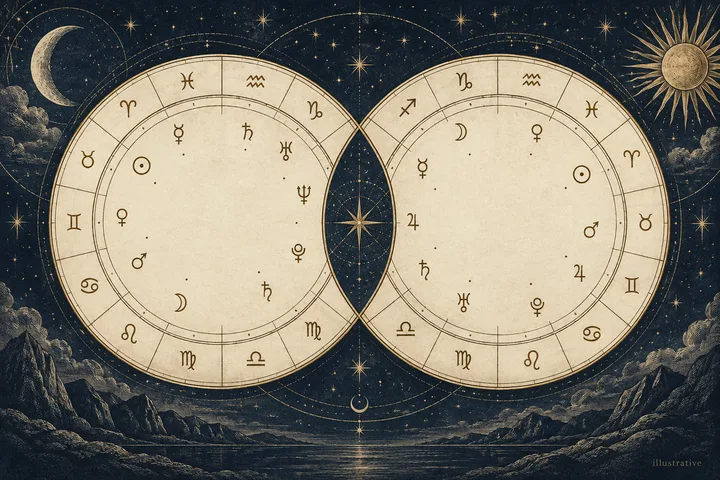
A quiet stretch on a synastry wheel can feel louder than a crowded one. You expected a Moon-Venus line or a Venus-Mars contact, and the chart offers empty space. Don't turn that space into a message about the relationship yet. First ask what the report actually measured.
Synastry compares two charts. Astrologers read signs, planets, houses, and aspects together. An aspect describes the angle between two planets and the way their functions meet. A sign describes the style of that planet. A house shows where the other person's planet lands when reliable birth times make houses available.
No visible line means no displayed aspect between that pair under those settings. It doesn't mean the planets have nothing to say. Cafe Astrology places planet roles alongside sign and house placements, while Astrology.com presents synastry as a layered reading in which aspects describe planetary interaction.
Sources: Aspects Between Charts; What Is a Synastry Chart? Birth Chart Compatibility
Check degrees and orb before you blame the chart
The first audit is numerical. Write down each planet's exact position, including degrees and minutes when the report gives them. Measure the shortest distance between the two planets on the 360-degree zodiac.
Suppose one Venus sits at 12 degrees Taurus and the other Mars sits at 19 degrees Taurus. They share a sign, but their separation is 7 degrees. A report using a six-degree orb may leave the conjunction off the aspect list. A wider orb may include it, with less force than a contact at 1 or 2 degrees.
The orb is the allowed distance from an exact aspect. A conjunction is exact at 0 degrees, an opposition at 180 degrees, a square at 90 degrees, a trine at 120 degrees, and a sextile at 60 degrees. The closer the measured angle is to the exact angle, the tighter the orb.
Rounded placements can hide a boundary. Venus shown at 12 degrees may actually be at 12 degrees 48 minutes. A planet near 29 degrees can form a close aspect to a planet near 0 degrees of the next sign. Astrology.com explains that degree distance and smaller orbs matter. This publication's Synastry Comparison Report uses supplied Moon, Venus, and Mars placements, optional degrees, selected major aspects, and a stated six-degree orb. With signs only, it can discuss sign symbolism, but it can't verify a degree-based aspect.
Sources: Aspects Between Charts; What’s Your Sign? An Intro to Synastry Charts and Astrological Compatibility
Read sign relationships as a separate layer
A sign connection and an aspect are related, but they aren't interchangeable. Two Venus placements in the same sign may share a style of affection without sitting close enough by degree to form a conjunction. Two planets in signs that don't match by element may still form a powerful square or opposition. The angle tells you how the planets meet. The signs tell you how each one operates.
When the report looks quiet, read the element first. Fire and air can feed movement, expression, and play. Earth and water can support steadiness, care, and emotional depth. Those are broad sign-level themes, not a final judgment. Then check modality: cardinal signs start, fixed signs sustain, and mutable signs adapt.
Use the sign reading with restraint. A same-sign placement isn't a substitute for a conjunction. An opposite sign isn't automatically an opposition. Exact geometry ranks higher when you're asking whether two planets directly activate each other.
Sources: What Is a Synastry Chart? Birth Chart Compatibility; What’s Your Sign? An Intro to Synastry Charts and Astrological Compatibility
Audit what the report is actually showing
If the degrees look close enough, inspect the report itself. A wheel and an aspect table may show different amounts of information. The wheel may draw only major aspects. The table may include minor aspects. One report may include points while another shows only the planets you selected.
Check which chart type you opened, which planets are included, which aspects are selected, what orb is allowed, and whether the line colors have a legend. Synastry keeps each person's planets distinct. A composite chart describes the relationship as a single chart, so it answers a different question.
Don't add a second coordinate system just because the first one looks empty. Declination parallels, midpoints, progressions, and other techniques can be meaningful within their own methods, but they aren't ordinary longitude aspects. Cafe Astrology separates these layers because each changes the question. Compare the table with the wheel, and record a pair as unconfirmed if neither shows it. A sparse report may simply be easier to rank.
When a synastry report shows no line between the planets you expected, treat it as a technical result first. Check exact degrees, the selected orb, the aspect list, and the planet set. Then read signs, available houses, and the wider Moon, Venus, and Mars pattern. A missing line means that one planet-to-planet contact isn't active in this calculation. It doesn't erase the rest of the comparison.
Consider an example: Maria and Daniel's quiet Venus-Mars pair
Consider an example. Maria's Venus is at 12 degrees Taurus. Daniel's Mars is at 19 degrees Taurus. She expected a Venus-Mars conjunction because the signs match, but her report uses a six-degree orb and draws no line.
The first conclusion is narrow: this report doesn't count the pair as a major conjunction. The sign layer still suggests a steady, sensual, practical tone. But it doesn't tell you whether Maria experiences Daniel's initiative as reassuring or slow, or whether Daniel experiences her affection as welcoming or hard to read.
Now inspect the rest of the comparison. If Maria's Moon and Daniel's Venus form a close sextile, emotional comfort may carry more weight than the absent Venus-Mars line. If Daniel's Mars squares Maria's Moon, desire may come with friction that the same-sign Venus placements don't explain. Ask which verified contact best describes how they give care, receive affection, and take action.
This example also shows why absence is not a ranking. The missing conjunction tells you what not to overstate. The Taurus sign layer tells you what style to explore. The Moon contact, if one exists, tells you where comfort or strain may be felt. Each layer earns its place by answering a different question. That is a cleaner reading than counting every line and calling a crowded wheel more meaningful.
Rank Moon, Venus, and Mars instead of counting lines
Once the audit is complete, start with the Moon for comfort and emotional timing. Read Venus for affection, values, pleasure, and what each person offers or seeks. Read Mars for desire, initiative, anger, and the way each person moves toward a goal.
A close contact between these planets deserves more attention than a loose contact elsewhere. A repeated theme deserves more attention than a single dramatic symbol. If Moon contacts repeat, emotional safety may lead. If Venus and Mars repeat, attraction and action may lead. If Saturn also touches a personal planet, discuss duties and limits alongside warmth.
This isn't a scoring system. Astrology.com describes aspects as different forms of planetary interaction and notes that tense aspects can still describe meaningful challenges. Cafe Astrology advises readers to consider sign and house rather than isolating the angle. The strongest exception is a close contact omitted by one display rule. If another report uses a different orb, compare the methods and label them.
Keep the order visible when you write down the result. First note the technical fact. Next name the sign tone. Then name the closest relevant contact. Finally write one sentence about how that pattern might appear in choices, timing, affection, or repair. This keeps the interpretation specific without turning a chart symbol into a promise.
Sources: Aspects Between Charts; Synastry in More Detail; What Is a Synastry Chart? Birth Chart Compatibility
Use the missing line to choose one better question
A blank space is useful when it stops you from forcing a story. If Moon contacts are close but Venus-Mars is quiet, ask how each of you experiences tenderness before asking whether the chemistry is dramatic. If Venus contacts repeat but Mars doesn't, ask how attraction becomes action. If Mars contacts dominate, ask how you handle initiative and irritation.
Write down the answer in plain language: “I feel cared for when plans are steady.” “I show desire by taking the lead.” “I need time before I can talk when I'm upset.” These sentences belong to the people in the relationship. The chart can help you choose the subject, but it doesn't replace the conversation.
The sequence is complete: verify the report, check degrees and orb, separate signs from aspects, rank the strongest personal-planet pattern, and ask what that pattern looks like in real choices. If you want a comparison using supplied Moon, Venus, and Mars signs with optional degrees, you can [compare your placements](/compatibility-test).
A little more clarity
Does no aspect line mean there is no compatibility?
No. It means the selected report doesn't show that particular aspect between those planets under its settings. Check degrees, orb, planet set, and chart type, then read the sign layer and the other Moon, Venus, and Mars contacts. A missing line narrows one interpretation. It doesn't decide the relationship.
Sources & further reading
- Aspects Between Charts
Supports reading interchart planet roles with sign and house placements, and giving close inner-planet contacts careful attention.
- Synastry in More Detail
Supports separating ordinary interchart aspects from parallels, progressions, midpoints, and composite-chart work.
- What Is a Synastry Chart? Birth Chart Compatibility
Supports explaining synastry as layered charts read through signs, houses, planets, and aspects that describe interaction.
- What’s Your Sign? An Intro to Synastry Charts and Astrological Compatibility
Supports checking exact degree distance and orb, with closer contacts treated as stronger in aspect interpretation.
Synastry Comparison Report
Enter known placements for two people. Get an input-by-input comparison, selected aspect calculations and a clear record of what remains uncertain.
Compare our placements