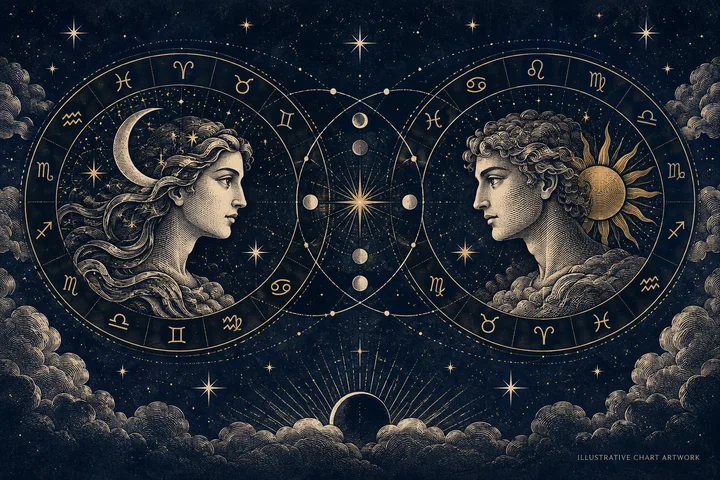
Use the report to ask better questions, not to hand down a sentence. Start with the clearest shared pattern, translate it into an ordinary relationship situation, and ask whether it matches what you both actually experience. Then name one strength to practice, one friction point to watch, and one small agreement to test this week. A synastry report compares chart placements and the relationships between them. It can describe how your Moon, Venus, Mars, or other planets meet. It can’t decide whether either of you should stay, leave, commit, or forgive. Treat the reading as a mirror with vocabulary. The chart gives you a possible pattern. Your conversation gives that pattern a life, a limit, or a useful correction.
What a synastry report can actually tell you
A synastry report compares two charts by placing one person's planets and points against the other person's. In a bi-wheel, the two charts remain distinct. You aren't looking at a third person called the relationship. You're watching two symbolic languages meet. That difference matters. It keeps the report from becoming a judge.
The report can help you describe a pattern of contact. One person's Moon may touch the other person's Venus. One person's Mars may square the other person's Saturn. Mercury may form an aspect to the other person's Moon. Each contact gives you a subject to explore: comfort, affection, desire, timing, speech, restraint, or the way a disagreement gathers heat. Astrology.com describes synastry as layering charts and reading signs, planets, houses, and aspects together. Cafe Astrology likewise advises readers to consider the sign and house placement of each planet, not the aspect in isolation. That is the first useful boundary.
The report can't tell you what either person intends. A Venus-Saturn contact doesn't prove that somebody is withholding love. A Moon-Mars square doesn't prove that every argument will become cruel. The symbols describe a field of experience. You still need the people in the relationship to say what happens there.
This is why the strongest use of synastry is conversational. Read one contact. Put it into plain language. Ask for an example. Listen for the part that fits and the part that doesn't. If the report says a Mercury contact may make problem-solving central, ask, ‘When we disagree, what helps us understand each other?’ If it says a Saturn contact may bring duty or pressure, ask, ‘Which responsibility feels chosen, and which one feels imposed?’
The report becomes more accurate in practice when it creates better observation. You may discover that a supposedly easy contact is so familiar that you take it for granted. You may discover that a tense contact names a real difference but also gives you a way to work with it. You may discover that the pattern belongs more strongly to one person's natal chart than to the bond itself. Those are not failures. They are distinctions.
Before you read, agree on the purpose. Are you trying to understand a repeating argument? Learn how affection lands? Talk about sexual pace? Notice what helps you repair? A clear purpose gives the chart somewhere to go. Without one, the report can become a hunt for the most flattering sentence or the most frightening aspect.
A good opening question is simple: ‘What does this contact invite us to notice?’ Not, ‘Does this mean we're compatible?’ The first question leaves room for evidence. The second asks the chart to replace it. Use synastry to make the conversation more precise, more curious, and more honest. Then let the conversation answer for itself.
Sources: Interaspect, AstroWiki by Astrodienst; What Is a Synastry Chart? Birth Chart Compatibility, Astrology.com; Aspects Between Charts, Cafe Astrology
Read the chart in layers, from broad pattern to close contact
A report gets noisy when every symbol receives equal attention. Start broad. Then narrow. The order below gives you a clean path through the material and stops one dramatic aspect from swallowing the whole reading.
First, look at the known inputs. Which placements are you comparing? If you have sign-only information, you can discuss the sign language of the Moon, Venus, and Mars. You can't responsibly claim an exact conjunction, square, trine, or opposition without degrees. If you have degrees, record the zodiac position for each placement and the calculation method used. This report's comparison can use supplied placements and optional degrees. It does not calculate a natal chart from birth details, and it does not calculate houses. That scope should sit at the front of your discussion, not as a footnote after a dramatic conclusion.
Second, notice the elements and modes. Fire may bring initiative, heat, and direct movement. Earth may seek reliability, texture, and practical proof. Air may need language, space, and exchange. Water may respond through feeling, memory, and atmosphere. Cardinal, fixed, and mutable modes add another layer. Similar elements can make recognition easy. Different elements can create translation work. Neither result is a verdict. It is a clue about what each person may treat as obvious.
Third, read the planets. The Moon describes instinctive needs, comfort, and emotional rhythm. Venus speaks to attraction, pleasure, values, and ways of giving and receiving affection. Mars shows desire, pursuit, anger, heat, and how a person takes action. Mercury describes speech, listening, naming, planning, and the habits that shape daily problem-solving. Saturn adds boundaries, time, duties, fear, and endurance. The Sun brings identity and vitality. Jupiter expands. Outer planets can deepen, unsettle, idealize, or transform a contact, but they need careful context.
Fourth, read the aspect. A conjunction blends and concentrates. A trine often lets two functions move with ease. A sextile offers an opening that grows through use. A square creates friction and demands adjustment. An opposition brings polarity, projection, and a need to hold two ends of a spectrum. Astrology.com identifies conjunction, opposition, sextile, square, and trine as the five major aspects and describes them as different forms of interaction. The aspect tells you how the planets meet. The planets tell you what is meeting.
Fifth, check the orb. The orb is the distance from exactness. A tighter aspect usually deserves more weight than a wide one, especially in a crowded synastry chart. Astrodienst's partner-chart guidance uses a smaller synastry orb than a natal orb because two charts create twice as many possible contacts. This report uses a stated six-degree orb for selected major aspects when degrees are supplied. A contact outside that scope isn't a secret master key. Leave it out of the ranked reading or label it as a looser possibility.
Sixth, return to the natal charts. Synastry doesn't erase what each planet means in its own chart. Cafe Astrology notes that each person may take on the role of the planet involved in a particular interaspect, and that the sign and house placements change how the interaction plays out. A Venus-Saturn contact in one pair won't feel identical to the same contact in another pair because the natal condition, signs, houses, and surrounding aspects differ.
That sequence gives you a disciplined conversation. Start with what you know. Move to what the symbols suggest. Rank the closest and most relevant contacts. Then ask what the pattern looks like on an ordinary Tuesday. The report should get more human as you read it, not more absolute.
It also helps to separate three kinds of sentences in your notes. A technical sentence reports an input: ‘Venus is in Libra at 14 degrees in the supplied data.’ An interpretive sentence gives the astrological meaning: ‘This may make balance, reciprocity, and social grace important in affection.’ A practical sentence brings it into life: ‘Ask whether each person feels the effort is shared when plans change.’ Don't blur them. When you know which kind of sentence you are reading, you can tell what is fixed, what is symbolic, and what is ready to test.
A report may also show a contact from your planet to your partner's planet, or the reverse. Read both directions. If your Moon contacts his Venus, your emotional needs meet his style of affection. His Venus also meets your emotional world. The emphasis may not feel identical, because each person brings a different natal condition and different habits to the exchange. Write two questions when the contact matters: ‘How do I experience this?’ and ‘How might you experience this when I bring it?’
Don't confuse a chart layer with a relationship label. A sign comparison describes tone. An aspect describes interaction. A house placement, when reliable and intentionally calculated, describes where the interaction may become visible. A natal placement describes an individual pattern. A transit describes a time-sensitive activation. This article stays with supplied sign placements, optional degrees, and selected major synastry aspects. That narrower frame is useful because it tells you what kind of question the report can help you ask.
Sources: What Is a Synastry Chart? Birth Chart Compatibility, Astrology.com; Aspects Between Charts, Cafe Astrology; Astrology Aspect Symbols and Meaning, Astrology.com
Rank the contacts, then test one in real life
The report becomes a conversation prompt when you rank its material. You don't need a compatibility percentage. You need a reason to start here rather than there.
Rank one: the closest major contact that matches the question you brought. If you're trying to understand why reassurance matters so much, a close Moon-Venus, Moon-Saturn, Sun-Moon, or Moon-Mercury contact may be more useful than a distant minor aspect. If you're discussing desire or conflict, begin with Venus-Mars, Mars-Moon, Mars-Mercury, or Mars-Saturn when the data supports it. The planet pair supplies the subject. The aspect supplies the style of contact. The orb supplies confidence about its prominence.
Rank two: a second contact that modifies the first. A Moon-Venus contact may describe warmth, but a close Mercury-Saturn square may describe why warmth doesn't always become easy speech. A Venus-Mars trine may describe attraction, while a Saturn contact may describe the pace at which trust becomes dependable. Read the modifier next. It keeps the article from selling one beautiful symbol as the whole bond.
Rank three: the lived pattern you can observe. This rank isn't another planetary signature. It's the check that makes the reading useful. Does the pair already show the pattern? Does it appear only under stress? Does one person experience it as closeness while the other experiences it as pressure? What does each person do next? Synastry can show a strong theme without showing equal investment. Even a compelling contact has to meet behavior.
Then sort the language into three boxes. The first is ‘we recognize this.’ The second is ‘we sometimes do this.’ The third is ‘this doesn't describe us.’ Keep all three. The first gives you a shared strength. The second gives you something to practice. The third protects the reading from becoming a script you feel obliged to perform.
A ranking also solves a common problem: the report's order may not be your order. A long list can make every conjunction feel urgent. It isn't. A chart with many contacts needs an editorial center. What question brought you here? Which contact speaks most directly to it? Which other contact changes the meaning? Which piece of real life can test the reading? Put those in front.
Here's a compact worksheet you can use together. Write the contact in one line. Under it, write the plain-language theme. Then add one example each: when it helps, when it strains, and what would make it healthier. End with a question for your partner. For example: ‘Venus trine Moon. Affection may land naturally. We show care through food and small acts, but we avoid saying when we need comfort. What kind of reassurance feels good without feeling managed?’
Notice what happened. The aspect didn't issue a conclusion. It gave you a subject, an example, a tension, and a question. That's the report doing its best work.
The same method works when the contact is less romantic on the surface. Imagine Maria and Daniel comparing supplied Moon, Venus, and Mars placements. Their report shows a close Venus-Mars square within the six-degree scope. We aren't calculating their charts here, and we aren't assigning them invented signs or degrees. The point is the method.
A Venus-Mars contact puts attraction, pleasure, pursuit, desire, anger, and timing on the table. The square adds friction. That doesn't mean the chemistry is bad. It means the two functions may want different things at the same moment, or may express desire in ways that don't automatically translate. One person may move toward direct contact. The other may need a softer approach. One may read teasing as invitation. The other may hear pressure. The report gives a possible pattern, not a private confession.
Maria and Daniel begin with recognition. They each write down one moment when the contact felt alive. Maria says she feels wanted when Daniel takes initiative. Daniel says he feels close when Maria responds with visible warmth. Then they name the edge. Maria feels rejected when Daniel waits for a perfect signal. Daniel feels pushed when Maria turns a quiet evening into a test of desire. The same Venus-Mars square now has two sides. It isn't simply ‘passion.’ It's a difference in how desire starts and how reassurance is requested.
The next question is not ‘Who is right?’ It is ‘What would make the difference easier to read?’ They choose a small experiment. For one week, Daniel will make a clear invitation without assuming the answer. Maria will answer directly instead of making him decode a mood. If either person says no, the other will not treat it as a judgment on the relationship. They will talk about what helped after the week ends. That experiment respects both planets. Venus gets care, pleasure, and value. Mars gets direct movement and room to act. The square remains. They haven't wished it away. They've given it a better channel.
Now add a modifier. Suppose their supplied placements also show a supportive Mercury contact. The conversation may become easier when they say the difficult thing plainly. If the report instead shows a tense Mercury contact, the same Venus-Mars theme may need written invitations, slower timing, or a pause before interpreting tone. A second contact changes the method, not the dignity of either person. Finally, they ask what the chart does not answer. Are they both willing to experiment? Can they respect a no? Does the pattern improve when they speak, or does one person keep using astrology to explain away hurt? These questions belong to the relationship. The report helps them arrive with better words.
This is the central move: translate a symbol into a behavior you can see, then into a question you can answer together. If the example doesn't fit, change the interpretation. The chart is not offended by honest observation. A good report leaves you with more agency than you had before reading it.
Consider an example with incomplete data. You know that one person's Venus is in Taurus and the other's Moon is in Virgo, but you don't have exact degrees. You can explore the earth-sign connection as a possible shared preference for steadiness, practical care, and tangible proof. You cannot promote it to a precise trine or conjunction. The conversation might ask, ‘Which ordinary acts make you feel secure?’ That question remains useful even when the missing degrees stay missing.
Now imagine that exact degrees reveal no close major aspect between those placements, while a different Moon-Mercury square falls within six degrees. The sign story still offers background, but the Moon-Mercury contact may deserve the first conversation if the couple is struggling to put feelings into words. This is what ranking prevents. It keeps a pleasant broad resemblance from outranking a closer contact that matches the actual concern.
You can also compare the report's headline with its evidence. If the headline says ‘deep emotional understanding’ but the listed input is only that two planets share an element, lower the claim. If it calls a six-degree square ‘exact,’ correct the language. If it treats a declination parallel as though it were a longitude trine, separate the layers. Technical care is part of kindness. It stops the reader from carrying an exaggerated story into a vulnerable conversation.
Sources: Interaspect, AstroWiki by Astrodienst; What Is a Synastry Chart? Birth Chart Compatibility, Astrology.com; Aspects Between Charts, Cafe Astrology
Use Moon, Venus, Mars, and Saturn to choose the question
You don't need to read every planet before you can have a useful talk. Begin with the planet pair that matches the concern in front of you. This keeps the report grounded and gives each section a job.
When the Moon leads, ask about safety and recovery. What helps each of you settle after a hard day? How do you show that you need closeness, food, quiet, touch, or time alone? A Sun-Moon contact may feel like recognition between identity and emotional life. A Moon-Saturn contact may raise questions about support, duty, fear, or the feeling that one person's needs carry more weight. Don't reduce either one to good or bad. Ask how care is offered and how it is received.
When Venus leads, ask about value and affection. What counts as tenderness to each person? Which gestures feel generous, and which feel performative? How do you handle money, beauty, pleasure, loyalty, or public signs of commitment? A Moon-Venus contact may make comfort and affection easier to notice. A Venus-Saturn contact may ask for patience and clear agreements around time, standards, and responsibility. The contact can become a practice rather than a label.
When Mars leads, ask about initiative and heat. How does each person pursue what they want? How do you say no? What happens when desire, irritation, or urgency rises? Venus-Mars contacts often put attraction and difference in the same room. Mars-Mercury contacts can make words feel active, sharp, playful, or combative. Mars-Saturn contacts may show a clash between speed and restraint. The useful question is not whether the contact guarantees passion. It is how the two of you direct the force it describes.
When Saturn leads, ask about structure. What are you building? Which duties have you chosen? Where does one person feel evaluated, delayed, or responsible for holding everything together? Saturn can bind a pair through commitment, but it can also make love feel like a task when its weight goes unnamed. A conversation can separate devotion from obligation. That distinction matters.
Mercury deserves a place in every practical reading, even when it isn't your romantic headline. The way you explain a need, make a plan, repair a misunderstanding, or disagree about a detail will shape the rest of the chart. Astrology.com includes Mercury contacts among the key synastry considerations because communication and daily organization affect how partners move through difficulty. Ask for an example, not a personality summary. ‘How do we plan?’ is better than ‘Are we good communicators?’
The Sun can show where identity and vitality meet. Jupiter can show where encouragement, confidence, and excess enter. Outer planets can describe a more generational or transformative layer, but don't let them erase the personal planets that appear in your daily exchanges. The strongest reading usually has a center of gravity.
Choose one planet pair. Ask one question. Listen for a real scene. Then decide whether you need another layer. That's enough for one conversation. You can always return to the report later.
A useful way to choose the pair is to start with the part of the relationship that has a decision attached to it. If you are deciding how to handle emotional distance, begin with the Moon. If you are deciding how to ask for affection, begin with Venus. If you are deciding how to approach conflict or physical closeness, begin with Mars. If you are deciding how to make a promise sustainable, bring in Saturn. The decision keeps the astrology from floating above your life.
You can make the prompt gentler by asking permission before you interpret. ‘I found a Moon-Saturn contact. Would you be willing to explore whether it matches how we handle support?’ That wording matters. It gives your partner a place in the reading instead of placing them inside it. If they say the description feels wrong, ask what part is wrong. Perhaps the theme appears in another area. Perhaps it belongs to your own chart. Perhaps it simply isn't present. Curiosity keeps the report from becoming a performance.
After the conversation, write down the exact phrase that helped. It might be ‘I need comfort before solutions,’ ‘I want a clear invitation,’ or ‘I can take responsibility for this task, but not for your mood.’ Those phrases are more valuable than a string of flattering keywords. They turn a symbolic reading into shared vocabulary you can use again when the same planets seem to come alive.

Sources: Interaspect, AstroWiki by Astrodienst; What Is a Synastry Chart? Birth Chart Compatibility, Astrology.com; Aspects Between Charts, Cafe Astrology
Know what degrees, orbs, and missing data change
Precision doesn't make a synastry report colder. It tells you how much weight to give each statement. Start by separating sign-only reading from degree-based reading.
With sign-only placements, you can compare elements, modes, and broad sign relationships. You can say that two placements share an element, or that they sit in signs traditionally associated with a certain relationship. You shouldn't call the pair conjunct, square, trine, sextile, or opposed unless the degrees support that aspect. Same-sign placements may be near each other, or they may be far apart. The sign gives a field. The degree tells you whether the planets make a close geometric contact.
With degrees, calculate the angular distance between the two positions and identify the nearest major aspect. Then calculate the orb, the distance from exactness. A conjunction is near 0 degrees, a sextile near 60, a square near 90, a trine near 120, and an opposition near 180. This report's selected major-aspect scope uses a six-degree orb. State that scope plainly. It makes your ranking reproducible.
Tighter doesn't mean automatically more pleasant. It means the contact is usually more prominent in the reading. A close square can demand attention. A wide trine may be a softer background ease. A close conjunction can blend two functions so thoroughly that the pair has trouble separating them. Read the aspect's quality and the planets involved before you decide how it may feel.
Astrodienst's partner-chart FAQ explains why synastry often uses narrower orbs than natal work: two charts create twice the number of possible aspects, so a wide net can make the picture confusing. Its guidance also distinguishes aspects drawn in the bi-wheel from those shown in additional tables. The practical lesson is simple. Know the settings behind the report. A list without its orb rules is missing part of its method.
Birth-time limits matter too. If a birth time is unknown or rounded, house placements and angles may be uncertain. This report doesn't calculate houses from birth details. If the supplied placement itself is uncertain, mark it as uncertain. Don't build a confident conclusion on an unstable input. If one person's degrees are precise and the other's are rounded, rank only the contacts that survive the stated range, then say which interpretation could change.
Missing data doesn't make the conversation useless. It changes the question. Instead of asking, ‘What does your seventh house say about us?’ ask, ‘What do we observe when we make promises?’ Instead of claiming an exact Moon aspect, ask, ‘How do we each seek comfort?’ You can use the known Moon, Venus, and Mars signs as prompts while leaving uncalculated details out.
Be especially careful with extra points, minor aspects, declinations, nodes, and asteroids. They may add texture when the method and data support them, but they shouldn't crowd out a close major contact. Cafe Astrology treats declination parallels and contraparallels as a separate dimension, often with a one-degree orb. That is a different coordinate system and a different setting. Don't blend it casually into a six-degree longitude ranking.
Precision gives you a better sentence: ‘This close Venus-Mars square is one of the clearest supplied contacts within the six-degree scope, so let's see whether it describes how we start and handle desire.’ That sentence is strong. It is also honest about what the chart can support.
Sources: Interaspect, AstroWiki by Astrodienst; Aspects Between Charts, Cafe Astrology; Astrology Aspect Symbols and Meaning, Astrology.com
The strongest exception: a vivid contact may not be the main story
Here is the exception that saves many readings from overstatement: the most vivid synastry contact may not be the most important relationship theme. A contact can be close, magnetic, and easy to recognize while another pattern quietly shapes the bond day after day.
A Venus-Mars conjunction may describe immediate chemistry. A close Moon-Saturn contact may describe who feels responsible for emotional stability. A dazzling Uranus contact may describe excitement and disruption. A Mercury-Saturn pattern may determine whether the couple can discuss the disruption without shutting down. If you rank by drama alone, you may mistake the spark for the structure.
The natal chart is another reason to slow down. The same synastry contact can activate a personal pattern that already exists. Someone with a natal Saturn-Moon story may feel a partner's Saturn contact with unusual weight. Someone with a well-supported natal Venus may experience a difficult Venus contact as creative tension rather than rejection. Cafe Astrology's interaspect guidance stresses that the sign and house placements of the planets change the way a contact is expressed. Synastry is relational, but it is never context-free.
A second exception concerns mutuality. The planet person and the house or point person may experience different sides of a contact. Even when the aspect is shared, the roles can feel uneven. One person may feel seen while the other feels managed. One may feel pursued while the other feels rushed. Write both sides into the reading. Never turn one person's symbolism into proof of the other's intention.
A third exception is simple life. A couple may have an elegant Moon-Venus connection and still be exhausted, grieving, overworked, or facing a practical problem that no chart contact can solve on its own. A tense aspect may become manageable when the pair has time, privacy, and a fair division of effort. The sky doesn't remove circumstance. It can help you name the kind of care the circumstance asks for.
Use a three-part test before you promote any contact to the headline. Is it technically supported by the supplied inputs and orb? Does it match a repeated lived pattern? Does it help the couple choose a better conversation or action? If it fails one test, lower its rank. If it fails two, leave it out of the conclusion.
This is the contrarian claim of the whole method: a synastry report is most useful when you allow it to be wrong in a specific way. If a contact doesn't fit, don't force a symbolic explanation until it does. Ask what the report may be missing. Maybe the orb is too wide. Maybe the natal context changes the expression. Maybe the pattern belongs to one person alone. Maybe the report has simply pointed you toward a question that needs a different answer.
A verdict needs certainty. A conversation can use a strong possibility. Keep the possibility alive long enough to test it, then let what you learn refine the reading.
Sources: Interaspect, AstroWiki by Astrodienst; What Is a Synastry Chart? Birth Chart Compatibility, Astrology.com; Aspects Between Charts, Cafe Astrology
End with one conversation and one small experiment
Don't end your reading with ‘the charts are complicated.’ That's true, but it doesn't help. End with a question you can ask tonight and a small change you can observe this week.
First, name the central contact in ordinary language. ‘Our Moon-Venus contact may make care easy to give, but we still need to say when care is wanted.’ Or, ‘Our Mars-Saturn contact may put speed and caution in the same room. Let's notice what happens when one of us wants an answer now.’ Keep the sentence open. Use may, can, or seems to when the evidence is interpretive. Conviction doesn't require pretending a symbol is a command.
Second, ask for two examples. ‘When did this pattern help us?’ and ‘When did it make things harder?’ Each person answers without correcting the other. The goal isn't agreement about the astrology. The goal is a shared picture of the experience.
Third, choose one question that turns the pattern toward care. Here are a few useful forms: ‘What would reassurance look like in a form you can actually receive?’ ‘How can we make a direct request without turning the answer into a test?’ ‘Which responsibility do we need to name before it becomes resentment?’ ‘What pace lets both of us stay present?’ ‘What does repair require after this pattern shows up?’
Fourth, design a small experiment. Keep it visible and limited. Try a weekly check-in, a clear invitation, a written plan, a pause before replying, a division of one task, or a new way to ask for touch. Pick something you can observe. Avoid grand promises. The purpose is to see whether a different choice changes the pattern.
Fifth, review the result without using astrology as a prosecution. What happened? What felt easier? What still hurt? Which part of the original interpretation needs revision? If the experiment works, keep the practice. If it fails, learn why. Maybe the request was too vague. Maybe the timing was wrong. Maybe the deeper issue needs a more direct conversation about trust, boundaries, or consent.
If you want a guided comparison, the Synastry Comparison Report can organize supplied Moon, Venus, and Mars signs, optional degrees, and selected major aspects within a stated six-degree orb. Use it as a shared page to mark what you recognize and what you want to discuss. It doesn't calculate a natal chart from birth details, calculate houses, or decide whether the relationship will succeed. That limit protects the useful part of the work: you and your partner remain the people making meaning and making choices.
So ask one question tonight: ‘Which pattern in this report do we want to understand together, and what would a kinder response look like the next time it appears?’ Then listen. Let the answer lead.
Sources: Interaspect, AstroWiki by Astrodienst; What Is a Synastry Chart? Birth Chart Compatibility, Astrology.com; Aspects Between Charts, Cafe Astrology
A little more clarity
Can a synastry report tell me whether we should stay together?
No. A synastry report can describe symbolic patterns between supplied chart placements, including areas of ease, attraction, friction, or responsibility. Use those patterns to ask better questions and choose small practices. It can't decide whether you should stay, leave, commit, or forgive. Look at the chart, then look at consent, behavior, repair, and the choices you make together.
Sources & further reading
- Interaspect, AstroWiki by Astrodienst
Defines interaspects and synastry, and explains why narrower orbs help keep two-chart readings usable.
- What Is a Synastry Chart? Birth Chart Compatibility, Astrology.com
Supports the layered bi-wheel method and the roles of signs, planets, houses, and aspects in synastry.
- Aspects Between Charts, Cafe Astrology
Supports reading planet roles, sign and house context, and prioritizing relevant inner-planet interaspects.
- Astrology Aspect Symbols and Meaning, Astrology.com
Supports the plain definitions of conjunction, opposition, sextile, square, and trine used in the guide.
- Partner Horoscopes FAQ, Astro.com
Supports the narrower synastry-orb setting and distinguishes synastry from composite and Davison charts.
- Declinations in Synastry, Cafe Astrology
Supports treating parallels and contraparallels as a separate declination layer with its own orb convention.
Synastry Comparison Report
Enter known placements for two people. Get an input-by-input comparison, selected aspect calculations and a clear record of what remains uncertain.
Compare our placements