The report shouldn't decide what the text meant
A short message can change the temperature of a whole evening. “Fine.” “Do what you want.” A reply that arrives three hours later. You read it again, hear a tone that may not be there, and start building a case. By the time you talk, the original message has become a story about care, respect, or commitment.
The tempting move is to open a synastry report first and ask it to settle the story. Was that coldness her Moon? Was his sharp reply Mars? Does a difficult contact explain why one of you always feels misunderstood? The report can help you ask better questions. It can't recover an intention that neither of you has named, and it can't turn a guess about a text into a fact.
So use the report in a particular order. Talk about the event while it is still concrete. Say what you read, what you felt, and what you assumed. Let your partner answer. Only then compare the chart placements as a way to describe the recurring interaction. This keeps the chart in its proper role. It gives shape to a pattern. It doesn't act as a witness in the argument.
That distinction is the governing judgment for this kind of reading: synastry is most useful after a misunderstanding when it helps a couple name the difference between emotional need, style of affection, and force of reaction. It is least useful when someone uses a planet as a verdict. “Your Mars made you do it” closes the door. “When pressure rises, I experience your Mars style as direct, while my Moon needs more time” leaves room for repair.
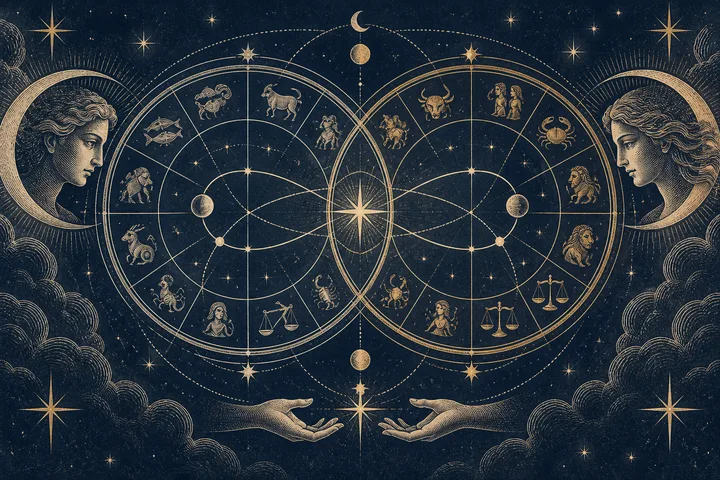
This is also why a report should not be treated as a relationship score. Traditional chart comparison looks at the way two nativities interact through aspects and planetary condition. Astrodienst describes synastry as a comparison of horoscopes that reveals interchart contacts, while Skyscript places the method inside the older practice of judging how two charts fit together. Both descriptions point to relationship dynamics, not a courtroom ruling about a single exchange. [Read the site's synastry hub](/compatibility/synastry) when you want the wider method before returning to the message in front of you.
A useful first conversation can be almost boring. That is a compliment. Each person reads the message aloud, explains the meaning they intended or received, and names the moment the exchange began to feel unsafe or lonely. If the two accounts differ, leave the difference visible. You don't have to settle every detail before you can understand the pattern. The report works better when it sits beside two honest accounts instead of replacing either one.
You can also decide what kind of answer you want before opening the chart. Are you trying to understand why the exchange escalated? Are you trying to choose a better pause? Are you trying to learn how your partner recognizes care? Those are different questions. A Moon reading may serve the first and third. A Mars reading may serve the second. Naming the question prevents the report from becoming a hunt for whichever aspect makes one person look correct.
If only one partner wants to use astrology, don't make participation a test of love. Share the interpretation as your own reflection and ask permission before applying it to the other person. “I noticed this in my response. Would you be willing to hear the question it raises?” keeps choice in the room. The report can support mutual curiosity, but mutual curiosity cannot be forced.
That permission can be very specific. Ask before sharing the partner's placement, before reading a section aloud, and before returning to the topic after the first conversation. Consent makes the report collaborative. It also gives you a useful first answer: are both people curious about the pattern, or is one person trying to win a more elegant argument? If the second motive is present, put the report away and stay with the exchange.
Use the synastry report after you have talked about what happened, not before. First agree on the observable facts: the message, the reply, the silence, and the repair you each need. Then use the report as a shared language for the layer underneath the exchange. Moon placements can describe how each person seeks reassurance. Venus can show how care and goodwill are expressed. Mars can show how each person pushes, protects, or reacts under heat. Aspects and their degrees help you rank which contacts deserve attention, but they don't tell you who was right, what your partner intended, or whether the relationship will work. Compare the relevant supplied placements, note the strongest contact within the stated six-degree orb, and turn it into one honest question: “What did you need from me in that moment?” A useful report opens a conversation. It never replaces one. Keep the first reading short enough that both partners can remember it, and return to the rest only after the new agreement has had a chance to work. The goal is shared understanding, followed by a choice you can both observe in the next exchange. Let the next conversation, not the most dramatic aspect, show whether the reading helped.
Sources: Partner horoscopes, Astro-Dienst FAQ; Aspects Between Charts, Cafe Astrology; Synastry, Skyscript Glossary
Why text messages make chart patterns feel louder
Text strips away the very things that help people repair a small rupture. You can't hear a pause. You can't see whether a face softens after a hard sentence. You may not know if “I need space” means an hour, a night, or the end of the conversation. The screen gives you words, but it asks you to supply the music.
That gap matters before astrology enters the room. A message can be ambiguous because the sender wrote quickly, because the reader was already worried, or because the couple has never agreed on how to pause a difficult conversation. A chart may describe why one person reaches for reassurance while the other reaches for distance. It does not prove which explanation caused this particular message.
Start with a clean reconstruction. Put the exact exchange in front of you, including the message that began the trouble. Mark the point where each of you stopped answering the words and started answering the meaning you assigned to them. Then ask four plain questions. What did you intend? What did I hear? What did you need next? What would have helped you stay present? The questions sound simple. That is their strength.
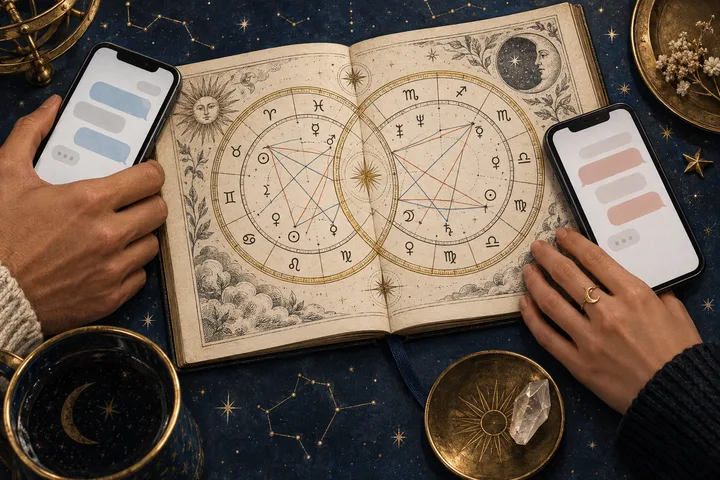
Consider an example. Maria texts, “Can we talk tonight?” Alex answers, “If you want.” Maria hears reluctance. Alex meant, “I can make time if this matters to you.” Neither message carries enough tone to protect the meaning. If their report shows a Moon contact to Mars, the astrology may give them a language for why Maria's emotional alarm meets Alex's quick, action-first response. But the repair still needs a sentence such as, “When you said ‘if you want,’ I heard that you didn't want to talk. Did you mean that?”
The chart becomes helpful when it helps them notice the sequence rather than assign blame. Maria may need to ask directly for reassurance instead of testing it through a vague invitation. Alex may need to answer the emotional question inside the practical one. The pattern is not “Maria is needy” or “Alex is uncaring.” It is a loop. One person reaches indirectly, the other answers literally, and both leave the exchange more alone than before.
The best time to compare placements is therefore after both people can describe the message without fighting over motive. If either partner is still collecting proof, wait. A synastry report should make the conversation more precise, not give a polished vocabulary to an accusation. The question is not, “Which planet caused this?” It is, “Which part of our way of meeting pressure needs a clearer agreement?”
The medium can also reveal a real difference in preference. Some couples use text to soften an approach before speaking. Others use it to solve logistics and save emotional work for a call or a room where they can see one another. Neither preference is automatically more loving. Trouble starts when one person treats the preferred channel as obvious and the other treats the mismatch as evidence of indifference. Say the preference out loud.
Try a message that carries its own context: “I want to talk about last night. I care about us, and I don't need an answer this minute. Can we call at eight?” It gives the Moon something steady, Venus a clear sign of regard, and Mars a defined next action. The chart may help you understand why that structure works for your pair. The structure itself comes from the two of you.
Use a simple channel test. Stay in text when the issue is logistical, both people can answer without guessing at tone, and the next step is clear. Move to a call or an in-person talk when the same sentence keeps producing new meanings, either person is defending an imagined tone, or the repair needs warmth that text cannot carry. The chart may help explain why one person prefers distance and the other prefers immediacy. It cannot choose the channel for you.
If you do stay in messages, slow the exchange down: one point at a time, no disappearing as punishment, and no demand that a tired person answer immediately. Agree on what “later” means. Notice whether the repair makes the question easier to answer or whether either person keeps returning to the original wording as if a perfect interpretation would remove all risk. These observations tell you whether the problem was the channel, the pattern, or both.
Sources: Partner horoscopes, Astro-Dienst FAQ; Synastry: The Astrology of Relationships, Cafe Astrology
Know exactly what your synastry report can compare
A good reading begins with honest inputs. This report uses the placements you supply, especially the Moon, Venus, and Mars signs, with optional degrees. It can compare those placements and identify selected major aspects using a six-degree orb. An orb is the distance, measured in degrees, between an exact aspect and the actual positions being compared. A smaller orb usually gives a tighter contact to discuss first.
The report does not calculate a natal chart from birth details. It does not create missing planetary positions, calculate houses, or produce a hidden compatibility percentage. If you know only that one person has Venus in Libra and the other has Mars in Aries, you can discuss the sign contrast. If you also know the degrees, you can ask whether those planets form a major aspect within the report's six-degree scope. If the degrees are missing, keep the interpretation at the sign level and say so in your own notes.
This limit is useful. It stops a couple from treating an incomplete chart as a complete biography. Astrodienst notes that synastry charts are built from two horoscopes and that aspect tables show the contacts between them. Its partner-horoscope guidance also explains that a synastry display may use narrower orbs than a natal chart because two charts create many more possible contacts. Your report states its own working rule plainly: selected major aspects, six degrees, supplied placements.
The basic vocabulary has three jobs. The Moon describes the way a person receives experience, seeks comfort, and reacts from feeling. Venus describes attraction, affection, pleasure, and the style through which someone gives or recognizes value. Mars describes assertion, pursuit, heat, and the way energy moves toward a want or a problem. These are not sealed personality boxes. They are three lenses, and a message misunderstanding may activate one more strongly than the others.
Degrees help with rank. Imagine Maria's Moon at 12 degrees Taurus and Alex's Mars at 14 degrees Scorpio, using supplied example data only. The opposition is two degrees, so it deserves attention before a loose five-degree sextile elsewhere in the comparison. The example doesn't predict their exchange. It shows how to decide which contact to discuss first. Lead with the tight contact, then check whether the lived pattern supports the interpretation.
If you don't have degrees, don't invent them. Write “Moon-Mars sign comparison” rather than “exact Moon-Mars opposition.” If one Moon placement is uncertain, leave that thread open. A report that names what it knows and what it doesn't know gives the couple a cleaner conversation. Precision is not a cold restriction here. It is what keeps the reading kind.
Keep the source of each input visible in your notes. You might record “her supplied Moon sign,” “his supplied Mars sign,” and “degrees provided” before writing an interpretation. That small habit prevents a sign description from quietly turning into a claim about a whole person. It also makes it easier to revise the reading when better information arrives.
Aspect language needs the same care. A conjunction joins two placements in the same area of the zodiac. A square creates a ninety-degree tension. An opposition places two points across the chart. Trines and sextiles describe flowing relationships. These words describe geometry and interaction. They don't rank human worth. The couple's lived experience tells you how the contact is actually being carried.
Keep the report's scope beside the interpretation. A sign tells you the style of a placement. An aspect tells you how two placements meet. A degree tells you how close that meeting is. None of those pieces, by themselves, describes the entire relationship. If a conclusion needs a house, an angle, or a planet the report did not calculate, mark it as outside this reading instead of quietly filling in the missing layer.
A narrow question makes missing information less disruptive. If you are asking why one person needed an immediate answer, supplied Mars signs may offer a starting point. If you are asking why reassurance failed to land, supplied Moon and Venus signs may offer more. Don't ask the chart to answer a question its inputs cannot support.

Sources: Partner horoscopes, Astro-Dienst FAQ; Aspects Between Charts, Cafe Astrology; Synastry, Skyscript Glossary
Read Moon, Venus, and Mars in that order
After a text misunderstanding, couples often jump to Mars because the exchange felt sharp. That is understandable. It is also incomplete. Read the layers in a steady order: Moon first, Venus second, Mars third. Then read the aspects and degrees that connect them. This sequence moves from what felt vulnerable, to what felt valued, to how each person acted when the pressure rose.
Start with the Moon. Ask, “What did each of us need to feel emotionally safe enough to keep talking?” A Moon-to-Moon contact may show a familiar emotional rhythm. A Moon-to-Venus contact can describe tenderness, comfort, and an instinct to soothe, though the Venus person may sometimes smooth over a problem that the Moon person wants addressed. Cafe Astrology's synastry guide treats Moon-Venus contacts as a source of harmony while also warning that charm can gloss over real hurt. That is a useful exception to remember.
Next, read Venus. Ask, “What did each of us count as care in this exchange?” One person may value a warm paragraph. Another may see a fast practical answer as love. A Venus sign comparison can show different tastes in affection, and a Venus contact may show why the couple keeps reaching for one another even when their styles clash. But affection doesn't erase a missed need. If Maria wants a direct “I want to talk,” Alex's offer to solve the schedule may be caring and still fail to land as care.
Then read Mars. Ask, “How did each of us move when the conversation became uncomfortable?” Mars can show initiative, anger, pursuit, defense, and the urge to settle a problem now. Cafe Astrology describes difficult Mars-Mercury contacts as conversations that can turn quickly into arguments, and its Moon-Mars material connects hard contacts with instinctive reactions, defensiveness, and hurt feelings. In this report's core scope, you may not have Mercury included as a supplied layer. You can still use Mars to examine the speed and force of the response without pretending it explains every word.
Now rank the contacts. Give first place to the tightest major aspect involving the layer that matches the event. Give second place to the next tight contact that either supports or complicates the first reading. Give third place to the sign contrast that describes the different need or style. Do not list every contact just because the report displays it. A long inventory can make a couple feel informed while leaving the actual misunderstanding untouched.
Imagine Maria's Moon in Taurus, Venus in Cancer, and Mars in Libra. Imagine Alex's Moon in Scorpio, Venus in Gemini, and Mars in Aries. These are illustrative supplied placements, not a calculated chart. Maria may want steadiness and a clear emotional signal. Alex may move toward a quick answer and then feel trapped by a long emotional exchange. Their Moon signs suggest a deep difference in how safety is felt; their Venus signs suggest different ways of showing warmth; their Mars signs suggest different speeds in conflict. The useful question is not which person is more compatible. It is whether they can agree that a pause will include a return time and that reassurance will use words both can recognize.
A good interpretation ends each layer with a behavior. Moon becomes a request for reassurance. Venus becomes a concrete sign of appreciation. Mars becomes a rule for how to pause, answer, or restart. The chart gives the language. The couple supplies the practice.
The direction of a contact can matter in the reading, even when both people feel it. If Alex's Mars contacts Maria's Moon, Maria may experience Alex's way of acting as the activating force while Alex experiences Maria's response as emotionally powerful. Don't turn that into a fixed role. Reverse the lens and ask what each person is learning about the other. The Moon person isn't always passive, and the Mars person isn't always the aggressor.
Sign element can add a second layer when degrees are absent. Fire may move by declaration and immediate action. Earth may look for proof, timing, and consistency. Air may need words, options, and room to think. Water may track tone, trust, and emotional undercurrents. These are broad sign principles, not substitutes for the full chart. Use them to form a question, then let the person's answer correct the shorthand.
Make the ranking visible on paper. Under Moon, write the need. Under Venus, write the care that would land. Under Mars, write the response that tends to arrive under pressure. Then add a fourth line: the agreement. If the need says “reassurance,” the care says “give space,” and the response says “push for an answer,” the agreement might say, “Name the pause and give a return time.” That last line turns a symbolic pattern into a behavior you can observe.
Use a three-question check on each contact: What does this placement help me notice? What does it tempt me to assume? What question would let my partner correct me? For the example, a Moon-Mars contact may help you notice the speed from hurt to action, tempt you to assume bad intent, and lead to the question, “When I go quiet, does my pause feel like rejection or relief?” The third question is the safeguard. It keeps interpretation open without making it vague.
Read for reciprocity, too. If one person's Moon need is always translated while the other person's Mars reaction is always excused, the method has become unequal. Each person should name a need, a caring response, and a pressure response. Synastry is a comparison, so the reading should compare both directions.
Sources: Synastry: The Astrology of Relationships, Cafe Astrology; Synastry Moon-Mars Aspects, Cafe Astrology
The strongest contact still has a meaningful exception
A tight aspect deserves attention. It does not deserve unlimited authority. Astrologers use orbs and aspect type to judge emphasis, yet emphasis is not the same as destiny. A close Moon-Mars contact may describe a fast emotional charge. A close Venus-Mars contact may describe attraction, pursuit, and friction. A harmonious contact may make warmth easier. None of these contacts can tell you whether a partner will take responsibility after causing harm.
This is the exception that protects the whole reading: repeated conduct outranks an attractive interpretation. If someone ignores a stated boundary, threatens you, mocks your vulnerability, or uses the report to make you doubt what happened, stop the chart discussion. You don't need a synastry explanation to ask for respect. Astrology can help you reflect on a relationship pattern, but it must not become a reason to tolerate behavior that leaves you afraid or controlled.
There is a gentler version of the same exception. A single awkward text may be a bad hour, not a relationship pattern. A couple who usually repairs well may not need a grand theory for one clipped reply. Before you build a chart narrative, check frequency, context, and repair. Has this happened once or every week? Did the person clarify without being pushed? Did the apology include responsibility? Did the next conversation change anything? These questions keep the reading close to life.
Astrological tradition itself gives room for mixed testimony. Skyscript's account of chart comparison notes that harmonious contacts can support agreement while difficult contacts can create friction that asks both people to invest energy. Cafe Astrology makes a similar distinction across its synastry material: a difficult contact can bring attraction and conflict, and a pleasant contact can coexist with disagreements. The chart is a field of tendencies and exchanges. It isn't a single verdict stamped over every event.
So treat the strongest contact as a hypothesis to test gently. Say, “This Moon-Mars contact may fit the way we move from hurt to action. Do you recognize that?” Let the other person disagree. If the pattern doesn't fit, drop it. A report that survives a partner's honest correction becomes more useful. One that demands belief has stopped serving the relationship.
The same rule applies when the report looks beautiful. A soft Moon-Venus contact may describe ease and tenderness, but it doesn't excuse a partner who repeatedly withholds appreciation. A compelling Venus-Mars contact may describe chemistry, but it doesn't answer whether the couple handles conflict well. Rank the lived evidence first, then use the chart to understand how the two of you might make a better choice inside it.
A chart can also hold a contradiction without needing to be rescued. One contact may make affection easy while another makes timing difficult. One person may feel deeply recognized in person and poorly understood by text. One week may show a familiar loop, while the next shows a new response. Don't force every detail into one theme. Rank the strongest pattern, name what doesn't fit, and keep the interpretation open enough to learn.
When the couple disagrees about the report, the disagreement itself can become information. Ask which phrase feels unfair, what behavior it overlooks, and what wording would describe the experience more accurately. If one partner says, “That isn't how I act,” believe that correction enough to investigate. A reading should be a meeting place. It should not require either person to surrender their own account.
You can end the review with a simple test: what would look different next time if this interpretation were useful? If the answer is nothing, the interpretation is decorative. If the answer is clear, such as naming a return time or asking whether comfort is wanted, you have found a living use for it. The strongest contact earns its place by changing attention and behavior.
This test also keeps hope honest. A couple may discover that the chart describes real chemistry and a stubborn conflict loop at the same time. That is not a failure of the reading. It is a more complete picture. The decision is whether both people can work with the loop, whether each person accepts the work, and whether the changes show up outside the report.
A meaningful exception can be positive as well. You may expect a tense contact to describe every conversation, then discover that it appears only when one person is exhausted or communicating by text. The contact still offers a clue, but context tells you when the clue becomes active. Good astrology gets more precise as it meets real life.
Sometimes the leading contact fits the emotional charge but not the wording. That doesn't make the reading useless. It tells you to separate the layers. The Moon-Mars pattern may describe why the exchange felt urgent, while the actual misunderstanding came from an unclear sentence or an old agreement about response times. Record both findings. One belongs to the chart comparison; the other belongs to the couple's communication history. Then choose the repair at the level where the problem occurred. If the feeling was real but the message was vague, ask for clearer language. If the language was clear but the reaction became sharp, make a pause agreement. If both happened, handle the sentence first and the pattern second. This is how a report stays precise without becoming narrow: it can name the atmosphere while the couple identifies the event. A reading becomes trustworthy when it leaves room for the lived details that first brought you to the chart. That keeps symbolism in conversation with timing, tone, memory, and the words that were actually exchanged.
Sources: Aspects Between Charts, Cafe Astrology; Synastry, Skyscript Glossary; Synastry: The Astrology of Relationships, Cafe Astrology
Turn the reading into one better conversation
Don't bring the whole report into the next argument. Bring one pattern and one question. The aim is not to prove that the chart was right. The aim is to make the next exchange safer, clearer, and easier to repair.
Begin with the facts. “When I asked if we could talk, you replied ‘if you want,’ and we didn't speak until the next afternoon.” Then name your experience without turning it into a charge. “I heard reluctance, so I pulled back.” Ask for the missing meaning. “Were you unsure about talking, or were you trying to give me room?” Wait for the answer. Don't fill the silence with your interpretation.
After that, offer the chart as a shared lens. “Our Moon comparison makes me think we may seek safety differently. I look for a clear sign that we're still connected. You may try to reduce pressure by giving me options. Does that fit?” This wording matters. It says “may,” it names the actual behavior, and it gives the other person a real chance to correct the reading.
Choose one agreement that follows from the conversation. You might agree that a pause includes a return time. You might agree that “fine” is too unclear for a hard subject and must be followed by a direct sentence. You might agree that either person can ask, “Do you want comfort, a solution, or time?” Make it small enough to use when both of you are tired. A perfect insight that nobody can remember won't repair the next message.
Then revisit the pattern once, later, when the temperature has dropped. Did the agreement help? Did one person still have to chase the conversation? Did the other person feel cornered by the new rule? This second look lets the chart become a living reference instead of a label. If the interpretation keeps matching the behavior and the agreement creates more room, keep it. If it doesn't, revise it.
Your report can support that process with supplied Moon, Venus, and Mars placements, optional degrees, and selected major aspects within its six-degree orb. It won't calculate missing birth data or decide the relationship for you. That boundary is exactly what makes the next step yours. [Compare our placements](/compatibility-test) and use the result to prepare a question you can both answer, not a case one of you must lose.
The next message can be different without being elaborate. “I think we read that exchange differently. I want to understand your meaning before I explain mine. Can we talk at seven?” Write the agreement in words you would actually send. “Please tell me when you'll come back to this conversation” is better than “honor our communication needs.” “Please answer the feeling before the logistics” is better than “be more Venusian.” Plain language survives stress, and it makes the chart's insight answerable to real life.
Don't finish every layer in one sitting. If the Moon question opens a tender conversation, stay there. Venus and Mars can wait. If the Mars pattern is urgent, make the pause agreement first and return to affection later. A good reading follows the relationship's need instead of demanding that every symbol receive equal time.
Review the agreement after the next similar exchange, not after every text. Ask three things: Did both people remember it? Did it reduce guessing? Did each person carry part of the repair? If the answer is yes, keep the practice and let the chart recede into the background. If the answer is no, revise the agreement before revising the entire interpretation. A report earns its place when it changes the quality of the question and the behavior that follows.
The chart offers a pattern, the person offers a correction, and the next choice shows whether the insight has taken root. Start with what happened. Ask what was meant. Compare only what your inputs support. Then choose the smallest act that gives the next conversation a better chance. Return to the report with new observations, not a demand for certainty. A contact may look different once the couple learns to pause, reassure, and come back. That change doesn't cancel the chart. It shows the chart being lived with more skill.
Sources: Partner horoscopes, Astro-Dienst FAQ; Synastry: The Astrology of Relationships, Cafe Astrology; Synastry Moon-Mars Aspects, Cafe Astrology
A little more clarity
Should we compare our synastry before or after we talk about the misunderstanding?
Talk about the misunderstanding first. Agree on what was said, what each person heard, and what repair is needed. Then use the report to explore the pattern underneath the exchange. Comparing placements too early can turn an interpretation into evidence against your partner. Comparing them after a real conversation can give you a shared language for Moon needs, Venus values, and Mars reactions. Keep the result narrow: choose one relevant contact, ask whether it fits, and turn the insight into one practical agreement.
Sources & further reading
- Partner horoscopes, Astro-Dienst FAQ
Supports synastry chart comparison and the use of narrower aspect orbs when drawing contacts between two charts in a partner horoscope.
- Aspects Between Charts, Cafe Astrology
Supports reading interchart aspects by planet roles, sign context, and inner-planet emphasis instead of treating one contact as a complete relationship verdict.
- Synastry, Skyscript Glossary
Supports the historical chart-comparison method and the view that aspects describe interaction while planetary condition describes the quality of that exchange between the people involved.
- Synastry: The Astrology of Relationships, Cafe Astrology
Supports Moon, Venus, and Mars interpretive themes, including affection, attraction, assertion, emotional needs, and friction in synastry across several interchart contacts.
- Synastry Moon-Mars Aspects, Cafe Astrology
Supports the reading of Moon-Mars contacts as emotionally charged, reactive, attractive, instinctive, and potentially volatile during intense relationship exchanges and conflict recovery.
Synastry Comparison Report
Enter known placements for two people. Get an input-by-input comparison, selected aspect calculations and a clear record of what remains uncertain.
Compare our placements