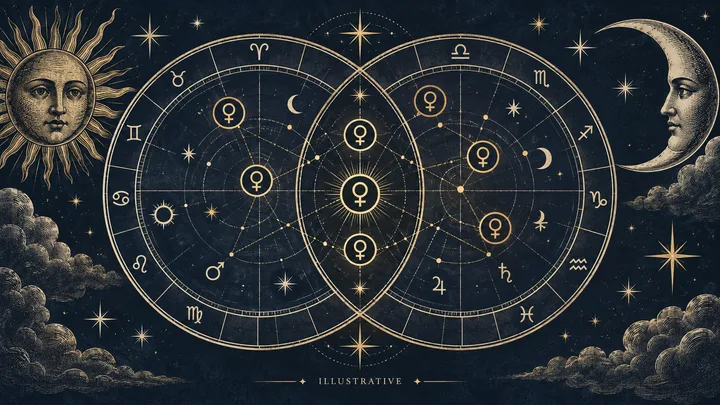
Repetition means emphasis, not a verdict
A synastry chart can look noisy. Two charts create a web of contacts, and a report may print every conjunction, square, trine, opposition, and minor angle it finds. Then you notice the same planet appearing again and again. Venus touches the Moon. Venus touches Mars. Venus touches Saturn. The question arrives quickly: does this mean Venus is the relationship’s main story?
Yes, often. Repetition is one of astrology’s clearest ways to show emphasis. When several independent contacts return to the same planet or planetary pair, the chart keeps directing your attention to one function of relationship. The Moon may keep describing safety and emotional timing. Venus may keep describing affection, attraction, taste, and the values you bring into love. Mars may keep describing pursuit, desire, heat, anger, and the way you act under pressure. Saturn may keep asking what can be built, carried, delayed, or made dependable.
But emphasis isn’t the same as a sentence handed down about the couple. A repeated theme tells you where the bond concentrates energy. It doesn’t tell you that the relationship must last, end, marry, or become a particular kind of story. Synastry describes how two charts meet. Your choices give that meeting its form.
This distinction matters because repetition can feel dramatic. A reader sees five Venus contacts and assumes five separate confirmations of love. They may be five views of one question. If three are wide outer-planet contacts, they may add atmosphere without carrying the central weight. If two are close contacts to personal planets and one is a sign echo, the reading is stronger, but still more focused than cumulative. The chart is underlining a word. It isn’t multiplying a guarantee.
Astrodienst’s synastry guidance begins with a similar discipline: understand each person’s horoscope as a whole before interpreting the exchange between charts. That keeps you from treating one cross-chart pattern as the entire person. Cafe Astrology likewise places planet meanings before the sign comparison and then asks which planets or angles receive the contact. Together, those methods support a simple starting rule: identify the repeated function, then return to the actual people.
The first useful question is therefore not, ‘How many aspects do we have?’ Ask, ‘What keeps happening between us?’ Does one person seek reassurance while the other tries to solve the feeling? Do affection and desire arrive together, or does one person move forward while the other hesitates? Does commitment create safety, pressure, or both? The repeated planet theme becomes meaningful when it names a pattern you can recognize in ordinary life.
Sources: Synastry | Astrodienst Astrowiki; Synastry | Cafe Astrology; Synastry Aspects: Meanings, Orbs & Compatibility Guide
What counts as a repeated theme in synastry?
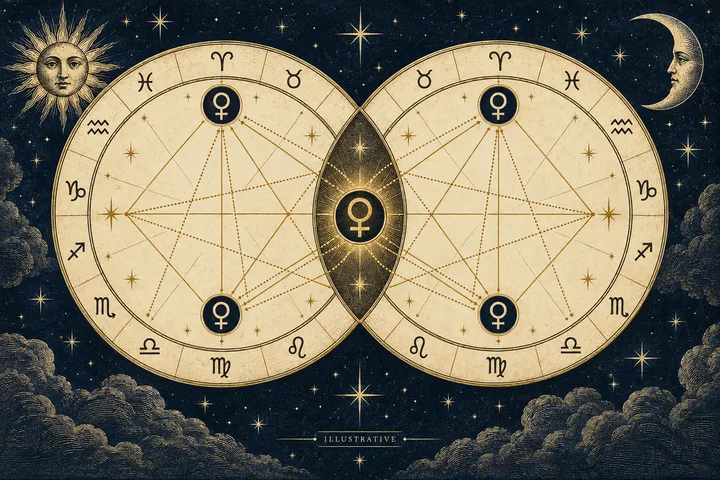
Not every repeated symbol belongs in the same pile. Before you interpret a theme, sort the chart into four layers: the planet, the planet pair, the aspect, and the orb. These layers answer different questions. The planet says what part of life is involved. The pair says how two functions meet. The aspect says whether the exchange flows, fuses, pulls, or rubs. The orb says how loudly the aspect speaks.
Start with the planet. A repeated Moon emphasis isn’t interchangeable with a repeated Mars emphasis. Moon contacts often bring emotional memory, comfort, habit, and the need to feel received. Venus contacts bring attraction, pleasure, affection, and shared values. Mars contacts bring initiative, sexuality, competition, irritation, and repair after heat. Mercury contacts return you to language, timing, questions, and the way each person makes meaning. Saturn contacts bring structure, responsibility, endurance, fear of loss, and the work of staying present when love becomes practical.
Then look for a repeated pair. Moon-Venus contacts repeat a meeting between feeling and affection. Venus-Mars contacts repeat the meeting between attraction and pursuit. Sun-Moon contacts repeat identity meeting emotional response. Mercury-Mars contacts can repeat the link between words and assertion, so a couple may debate with unusual speed or turn conversation into a contest before either person notices. The pair gives the theme a sharper shape than a planet counted by itself.
Next, group by aspect quality. Three Venus contacts are not one single message if one is a trine, one is a square, and one is an opposition. They all involve Venus, but they may describe ease, friction, and polarity in different ways. Repetition can mean that Venus matters. The aspects tell you how Venus matters. A cluster of harmonious contacts may make affection easy to offer. A cluster of hard contacts may make affection urgent, defended, or easily misunderstood. A mixed cluster often gives the most useful reading because it shows both the gift and the work.
Finally, check the orb. An orb is the distance between an exact aspect and the actual positions of the two planets. A contact at 0° is exact. A contact at 5° is wider. Astrological practice varies, but synastry readers commonly tighten the working range because two charts generate so many possible lines. The current sources reviewed here all place weight on closeness, with extra room often given to the Sun and Moon. This article uses the report’s stated six-degree major-aspect scope as a practical boundary, not as a claim that every astrologer uses one universal number.
A repeated theme is strongest when the same subject appears through more than one layer. For example, a close Moon-Venus trine, a close Moon-Saturn square, and both people’s known Moon signs emphasizing security would make emotional safety a serious interpretive thread. A dozen loose aspects to Neptune alone would not automatically outrank it. Repetition is about resonance, not arithmetic.
Sources: Synastry | Astrodienst Astrowiki; Synastry | Cafe Astrology; Synastry Aspects: Meanings, Orbs & Compatibility Guide
Read the strongest contact before the whole pattern
The fastest way to misread repetition is to count first. Don’t. Rank first. A chart with twelve contacts may contain one close Moon-Venus conjunction, two moderate Mercury contacts, and nine wide aspects involving slow planets. Those are not twelve equal votes. The close personal-planet contact should lead the reading, and the wider contacts should support it only if they describe the same experience.
A practical ranking starts with the personal planets and luminaries: Sun, Moon, Mercury, Venus, and Mars. These planets move through daily life. They describe identity, emotion, speech, affection, desire, and action. Saturn comes next because it gives the pattern weight over time. It can show duty and endurance, but it can also show inhibition, fear, or a teacher-and-student dynamic. Uranus, Neptune, and Pluto can matter deeply, especially when they contact personal planets or angles, yet their slow movement means many people of a similar age share some of those contacts. Treat them as context until the personal story is clear.
Within the aspect list, begin with conjunctions, oppositions, and squares, then consider trines and sextiles. This isn’t a moral ranking. A square isn’t worse than a trine. It creates a different kind of work. A conjunction fuses the functions. An opposition makes the other person a vivid mirror. A square creates pressure that demands action. A trine offers natural flow. A sextile offers an opening that becomes useful when both people choose it.
The exactness of a contact can change its rank. Imagine a report with these supplied placements: her Venus at 14° Taurus and his Mars at 15° Taurus, a 1° conjunction; her Moon at 2° Libra and his Saturn at 7° Cancer, a 5° square by sign geometry; and several outer-planet aspects at 5° or 6°. The Venus-Mars contact should be read first because it joins personal planets closely. It may describe immediate attraction, physical awareness, and the way desire gets expressed. The Moon-Saturn contact deserves attention next because it can describe emotional seriousness or restraint, but its wider orb makes it a quieter influence in this example. The outer-planet contacts may color the atmosphere. They don’t get to rewrite the headline.
Tarot by Hand’s current guide makes the same quality-over-quantity point in plain terms: lead with the tightest contacts involving the Sun, Moon, Venus, Mars, the Ascendant, or Saturn. Wanga’s guide also warns that a long list of loose contacts usually carries less weight than one close personal-planet contact. Those sources are useful because they protect repetition from becoming numerology in disguise.
Your working table can be very small. Write the five closest relevant contacts. Note the planets, aspect, orb, and direction of the contact. Then mark which ones describe the same subject. If only one or two lines fit the theme, call it a supporting motif. If three close contacts converge on the same personal function, call it a leading theme. The label should help you read. It shouldn’t impress you.
Sources: Synastry | Cafe Astrology; Synastry Aspects: Meanings, Orbs & Compatibility Guide; Synastry Orbs: Which Aspects Actually Matter
A worked example: when Moon, Venus, and Mars repeat one story
Consider an example. Maria and Daniel are comparing supplied placements only. No birth times are being used here, so this example does not interpret houses or angles. The point is to show the reading sequence, not to present a calculated chart.
Their strongest contacts are these: Maria’s Moon in Cancer is conjunct Daniel’s Venus in Cancer within 2°. Maria’s Venus in Gemini squares Daniel’s Mars in Virgo within 3°. Maria’s Mars in Virgo is conjunct Daniel’s Moon in Virgo within 1°. Daniel’s Saturn in Pisces squares Maria’s Venus in Gemini within 5°. The signs and degrees are part of the imagined example. They let us see how the layers work together.
The first contact, Moon conjunct Venus, links Maria’s emotional nature with Daniel’s style of affection. It can feel tender and familiar. Maria may feel that Daniel understands what comforts her. Daniel may respond to her moods with warmth, or may idealize the way she receives care. The conjunction doesn’t promise perfect emotional timing. It concentrates the exchange. What one person feels, the other person’s Venus is likely to notice and answer.
The second and third contacts pull Mars into the story. Maria’s Venus square Daniel’s Mars can create attraction with friction. Daniel may pursue directly while Maria wants conversation, variety, or a lighter entry into intimacy. Maria’s Mars conjunct Daniel’s Moon adds another layer: her action can stir his feelings immediately. A practical decision, a sharp tone, or a sudden plan may land on Daniel’s nervous system before he has words for it. The relationship may move quickly from desire to reaction.
Now the repetition becomes visible. Moon, Venus, and Mars keep meeting. The central theme is not simply romance. It is the speed at which affection, feeling, and action trigger one another. Tenderness can become desire. Desire can become impatience. Impatience can hurt the Moon. Then Venus tries to restore closeness, perhaps before the original feeling has been fully heard.
Saturn adds the strongest exception to an easy reading. Its wider square to Maria’s Venus may make affection feel subject to rules, timing, distance, or proof. It can steady the relationship if both people accept responsibility for the bond. It can also make Maria feel judged, or make Daniel treat love as a duty he must manage correctly. Because the orb is wider than the personal contacts, I wouldn’t make Saturn the opening claim. I would use it as the condition that tests the Moon-Venus-Mars pattern over time.
The decision guide follows from the interpretation. When they feel close, do they let tenderness lead, or do they rush into action? When one person feels hurt, can the other pause before explaining, pursuing, or fixing? If the answer is yes, the repeated theme becomes a source of intimacy and aliveness. If the answer is no, the same pattern may keep producing a loop. The chart doesn’t choose between those expressions. It shows where the choice will matter most.
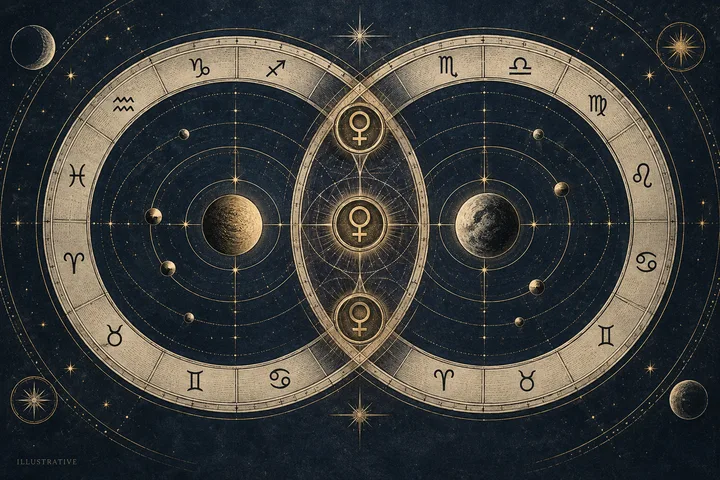
When a synastry chart repeats the same planet theme, astrology treats that repetition as emphasis. Several contacts may keep bringing the same subject into the relationship: Moon contacts can repeat emotional needs, Venus contacts can repeat affection and values, Mars contacts can repeat desire and conflict, while Saturn contacts can repeat duty and limits. But don’t count every line as equal. First check which planets are involved, then the aspect, then the orb. A close personal-planet contact usually speaks louder than several wide contacts, and repeated hard aspects describe a recurring pressure rather than a guaranteed failure. Read the pattern against what you actually experience. If the chart keeps pointing to Venus and Mars, ask where attraction becomes pursuit, hesitation, or argument. If Saturn repeats, ask what commitment requires. The useful conclusion is a focused conversation or decision, not a score. This article shows how to make that reading step by step.
How the same planet changes meaning across aspects
A repeated planet theme becomes useful only when you preserve its differences. If Venus appears in three contacts, don’t flatten them into ‘love.’ Ask what kind of Venus is speaking each time. Venus with the Moon concerns affection meeting need. Venus with Mars concerns attraction meeting pursuit. Venus with Saturn concerns pleasure meeting structure, restraint, or durability. The planet repeats. The conversation changes.
The aspect supplies the verb. A Venus conjunction says the two functions blend. A Venus trine says they can flow without much translation. A Venus sextile says the connection is available when both people act on it. A Venus square says the functions want different things at the same moment. A Venus opposition says each person may carry one side of a polarity and experience the other as compelling, difficult, or both.
Suppose a chart repeats Saturn. Saturn trine Venus may support loyalty through steady acts, shared standards, and patience. Saturn square Moon may bring emotional caution, fear of disappointing the other, or the need to build trust slowly. Saturn conjunct Mars may give shared stamina and a strong capacity to work together, but it can also make one person feel blocked when the other sets the pace. Calling all three ‘commitment’ loses the actual reading. The repeated theme is structure. Its expressions range from shelter to pressure.
The same rule applies to Mars. Mars trine Venus can make desire easy to express. Mars square Mercury can turn a small disagreement into a fast exchange of claims and counterclaims. Mars opposite Moon can pull action and feeling into a seesaw, especially when one person wants to move and the other needs time to settle. A Mars-heavy chart isn’t automatically sexual, angry, or doomed. It is activated. You must ask where the activation goes.
Signs add the style of expression. Fire signs may make the theme direct, quick, and visible. Earth signs may make it practical, physical, and tied to reliability. Air signs may carry it through language, ideas, and social movement. Water signs may make it private, protective, and emotionally porous. These are interpretive lenses, not replacement facts. If the planet and aspect say there is friction but the signs show different tempos, the useful question is how the friction gets translated.
Cafe Astrology’s planet-pair material helps here because it treats Venus-Moon, Venus-Mercury, Venus-Sun, and Venus-Mars as distinct exchanges rather than one general compatibility label. Celestia’s aspect guide similarly describes conjunction, sextile, square, trine, opposition, and quincunx as different qualities of contact. Use that vocabulary to keep the pattern precise. Repetition should make the reading narrower and clearer, not broader and blurrier.
Sources: Synastry | Cafe Astrology; Synastry Aspects: Meanings, Orbs & Compatibility Guide; Synastry Orbs: Which Aspects Actually Matter
When repetition is real, and when it is only a crowded list
A long aspect list can create a false sense of importance. Repetition is real when several contacts converge on one subject and survive a reasonable ranking process. It is only a crowded list when the contacts are wide, weak, unrelated, or generated by a setting that includes every possible angle.
Check the source data first. If the placements are rounded, the apparent orb may be uncertain. If you know signs but not exact degrees, you can discuss sign-based themes and some broad relationships, but you shouldn’t present a close conjunction or square as settled. If the report uses different aspect settings for the two charts, the count itself becomes unreliable. A clean reading needs one consistent list and one stated orb policy.
Then remove duplicates. A report may print Maria’s Venus square Daniel’s Mars and Daniel’s Mars square Maria’s Venus as two rows. They describe one cross-chart contact viewed from opposite directions. Don’t count that twice. Likewise, a sign pattern and the aspect created by that same pair may be related evidence, not two independent confirmations. Name the relationship once, then explain how the sign modifies it.
Next, separate personal contacts from generational ones. If both people have Pluto in the same generation sign, Pluto may appear repeatedly because the charts share an age-based background. That doesn’t make the contact meaningless. It does mean you should ask whether Pluto also touches a personal planet, angle, or chart ruler. Without that bridge, the outer planet is better treated as a background tone than the main cause of the relationship’s daily drama.
Finally, compare the pattern with the lived situation. This is where a repeated theme either becomes a reading or falls away. If the chart appears Venus-heavy but the couple’s real question concerns distance, promises, and waiting, Saturn may be the more useful lens even with fewer contacts. If the report shows Mars contacts and the couple never experiences conflict or pursuit as central, revisit the orbs, the data, and the interpretation before forcing the symbolism.
The strongest exception is a single exact contact that changes the whole picture. One close Sun-Moon, Venus-Mars, Moon-Saturn, or planet-angle contact can matter more than several loose echoes. Quality beats quantity. A repeated theme is a reason to look harder, not permission to ignore strength, context, or the people in front of you.
Sources: Synastry | Astrodienst Astrowiki; Synastry Aspects: Meanings, Orbs & Compatibility Guide; Synastry Orbs: Which Aspects Actually Matter
Turn the repeated theme into a useful couple conversation
Astrology earns its place in a relationship conversation when it gives you better questions. Don’t turn either person into a fixed role such as ‘the Saturn person.’ Name the ordinary subject instead: what helps you settle, what makes affection feel sincere, how desire or anger begins, or which promises have become heavy. Then let the aspect shape the question. A square needs an action plan, a conjunction needs room for separate needs, an opposition needs translation, and a trine needs conscious appreciation.
Return to the imagined example. Maria and Daniel don’t need to decide that their Moon-Venus-Mars pattern is good or bad. They need to ask whether Daniel can name hurt before Maria changes the subject or takes action, whether Maria can ask for a slower pace without making Daniel guess whether affection remains, and whether Saturn’s pressure can become one clear promise instead of vague reassurance. Those are observable tests.
Write down four lines: the repeated theme, the behavior it seems to describe, the strongest exception, and one action to try. In the supplied Synastry Comparison Report, you can compare Moon, Venus, and Mars signs, add optional degrees, and review selected major aspects within the stated six-degree orb. The report doesn’t calculate a natal chart from birth details or houses, so missing degree or house information stays missing. That boundary keeps the reading tied to the placements you actually supplied.
A useful final sentence might be, ‘Our close Moon and Venus contacts make reassurance important, but the Mars contact makes us act before we listen.’ It names the theme, ranks the tension, and points to a decision. If the repeated symbolism matches the behavior, keep working with it. If the behavior doesn’t appear, check the data and lower the claim. The chart should sharpen the conversation, not replace it.
Start with that conversation. Choose one small change, make the strongest exception visible, and decide when you’ll revisit what happened. That is enough for a serious synastry reading.
Sources: Synastry | Astrodienst Astrowiki; Synastry | Cafe Astrology; Synastry Aspects: Meanings, Orbs & Compatibility Guide; Synastry Orbs: Which Aspects Actually Matter
A little more clarity
Does having many synastry aspects mean the relationship is stronger?
No. A high aspect count may simply reflect wide or minor contacts, and one cross-chart contact may appear twice in reverse order. Rank the aspects by planets, aspect type, and orb. A close contact involving the Sun, Moon, Venus, Mars, or Saturn usually deserves more attention than several loose outer-planet contacts. Many contacts can make a relationship feel busy, but strength comes from the quality and relevance of the pattern, not the total number of lines.
Can a repeated difficult aspect be helpful in synastry?
Yes. Repeated squares or oppositions show sustained friction, but friction can become energy, honesty, and growth when both people know how to work with it. The same pattern can become exhausting when it turns into a fixed fight. Read the planets involved and ask what behavior would give the tension a constructive outlet. A repeated hard aspect describes important work. It doesn’t decide the result for you.
Sources & further reading
- Synastry | Astrodienst Astrowiki
Synastry compares two or more horoscopes, and each natal chart should be understood before the inter-chart contacts are carefully interpreted.
- Synastry | Cafe Astrology
Venus, Moon, and Mars have distinct relationship functions in synastry, and different planet pairs change the meaning of attraction, tenderness, and conflict.
- Synastry Aspects: Meanings, Orbs & Compatibility Guide
Major aspects have different angular qualities, tighter orbs speak more loudly, and personal-planet contacts should be ranked before wide outer-planet contacts.
- Synastry Orbs: Which Aspects Actually Matter
Synastry reading benefits from tighter working orbs, priority for personal planets and Saturn, and quality over a high count of loose contacts.
- Synastry Aspects Explained: The Complete Guide
Conjunctions, sextiles, squares, trines, oppositions, and quincunxes describe different forms of energy exchange, while repeated aspects can point to a central relationship dynamic.
Synastry Comparison Report
Enter known placements for two people. Get an input-by-input comparison, selected aspect calculations and a clear record of what remains uncertain.
Compare our placements