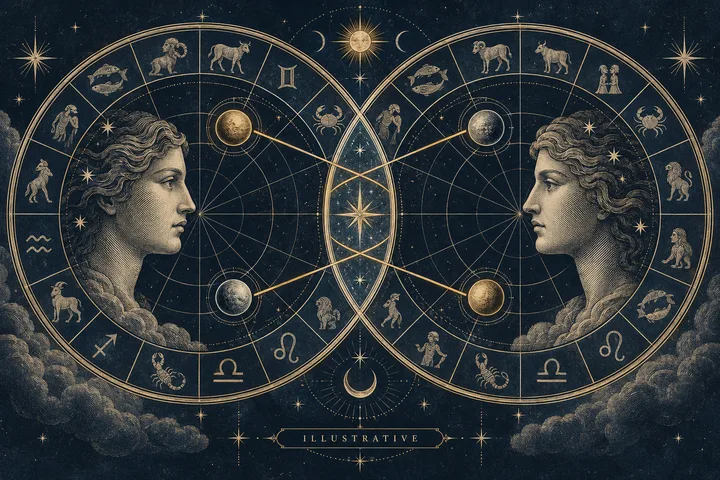
What can a report explain when the pattern is reciprocal but conflicting?
A reciprocal conflict can point to a relationship theme that appears more than once in a cross-chart comparison. Check whether the report describes one aspect from both viewpoints or lists two contacts, one in each direction. AstroScroll's “Synastry Aspects Explained: Reading Two Charts” reads a link through its planets, angle and closeness. Describing one link from both sides doesn't create a second contact. Consider an illustrative Venus–Mars pattern. One Venus square a partner's Mars can symbolize friction around affection, desire or approach. A separate reversed Venus–Mars square repeats the planet pairing with roles changed. Cafe Astrology's “Synastry in More Detail” says each person can take on the role of the planet they contribute, and sign context changes its expression. Recurrence makes a theme worth examining; it doesn't make the experiences equal or harmonious. The report compares supplied Moon, Venus and Mars signs; supplied degrees allow selected major-aspect checks within its six-degree orb. It doesn't calculate natal placements from birth details. Read each contact by ownership, sign, angle and orb, then ask how the theme shows up between you. The comparison can clarify chart structure. It can't tell you what either person feels or what the relationship will become.
A reciprocal conflict can describe one cross-chart aspect viewed from both sides or two distinct contacts with reversed planet roles. Count the links first, then read each by planet ownership, sign, aspect and, when degrees are supplied, orb. Repetition can make a theme worth exploring; it doesn’t establish equal experience, harmony or an outcome.
Sources: Synastry Aspects Explained: Reading Two Charts; Synastry in More Detail
What does reciprocal mean: one contact or two?
When a synastry report calls a contact reciprocal, first ask whether it means one aspect viewed from two sides or two separate aspects in opposite directions. They are different patterns. One interchart aspect links a planet in one chart with a planet in the other. You can describe the exchange from either person's side, but changing the viewpoint doesn't create another link. A mirrored pair requires a second listed aspect, with the planet owners reversed. | Pattern | What the chart comparison contains | What you can conclude | |---|---|---| | One contact | A's Venus square B's Mars | One Venus–Mars contact, describable from both participants' sides | | Mirrored pair | A's Venus square B's Mars, plus B's Venus square A's Mars | Two distinct Venus–Mars contacts, with the roles reversed | The table counts aspect links, not people. In both rows, two people take part. Only the second row contains two cross-chart geometries. If a report gives one aspect and then explains how it may feel for each person, those two explanations are perspectives on the same contact. If it lists a second aspect with the owners reversed, that is a repeated planet pair in a separate link. Keep the labels A and B beside each planet as you read; otherwise a mirrored pattern can look like a duplicate when it is actually another exchange. AstroScroll's “Synastry Aspects Explained: Reading Two Charts” defines an aspect as an angle between planets in different charts and treats direction and repetition as separate considerations. It notes that A's Saturn contacting B's Moon differs from B's Saturn contacting A's Moon. That distinction helps here: a contact carries the roles of the planets each person contributes. Cafe Astrology's “Synastry in More Detail” likewise says each person whose planet is involved takes on that planet's role in the interaction. They describe chart roles, not proven daily behavior. Astrologers sometimes use “reciprocal” or “double whammy” as shorthand for a theme that appears in both directions. The shorthand helps once entries are clear, but doesn't prove equal experience, intensity, harmony, or outcome. Two Venus–Mars links may have different signs or aspects, so the theme needn't have the same tone in both directions. For this report, the comparison is limited to Moon, Venus and Mars signs you supply. When you also provide degrees, it checks selected major aspects within its six-degree orb. Tie “reciprocal” to the supplied entries and, for calculated aspects, available degrees. If an interface uses the word but shows no second link, ask whether it means two viewpoints or a separately listed reversed contact before drawing a conclusion. Count first; interpret next.
Sources: Synastry Aspects Explained: Reading Two Charts; Synastry in More Detail
Why does planet ownership change what reciprocity means?
Planet ownership keeps a synastry contact attached to the person whose placement supplies each symbol. In the illustrative contact A's Venus square B's Mars, A contributes Venus and B contributes Mars. The aspect joins those two placements; it does not turn them into interchangeable roles. Cafe Astrology's “Synastry in More Detail” makes this directional point with a Saturn–Sun example: each person whose planet is involved may take up that planet's role in the interaction, while the other person meets that expression through their own planet. Sign context also changes expression. This is one contemporary method, not a rule assigning fixed behavior. For a Venus–Mars contact, Venus offers a symbolic lens on attraction, preference and relating; Mars brings desire, initiative and assertion. These are themes, not biographies. So A's Venus square B's Mars can be read as A's way of relating meeting B's way of pursuing or acting. It does not show that A always waits, that B always initiates, or that either person wants a particular outcome. This stays with symbolic exchange, leaving lived details for the people to describe. That distinction matters when a report calls a pattern reciprocal. A single contact between A's Venus and B's Mars already involves both people, but it remains one cross-chart link. Describing it once from A's Venus side and again from B's Mars side may help explain the exchange, yet it does not create another contact. A mirrored pair is different: A's Venus square B's Mars and B's Venus square A's Mars are two separately identified links. Now both people contribute Venus in one link and Mars in the other. The Venus–Mars topic recurs, but the chart has not established that the two contacts feel equal or produce equal effects. AstroScroll's “Synastry Aspects Explained: Reading Two Charts” likewise treats direction as meaningful: its example distinguishes one person's Saturn contacting the other's Moon from the reverse arrangement. It treats synastry aspects as exchanges, not standalone traits. Applied here, keeping the letters beside each planet prevents a summary from erasing who contributes what. Write the contacts out in full before interpreting them. “Venus–Mars repeats” is a useful shorthand only after you have preserved A Venus–B Mars and B Venus–A Mars separately. The practical question is therefore not “Who is the Venus person?” as if that label settles a person's nature. Ask instead what kind of invitation, preference or approach the chart symbolism brings into contact, and how the other placement changes the question. Then, if the comparison shows a second reversed link, ask whether the same topic appears under different roles. This gives a couple a precise prompt about invitation and response, without claiming who feels more, who initiates in daily life, or what the relationship should become. The chart can organize the question; the people supply the answer through what they say and do.
Sources: Synastry in More Detail; Synastry Aspects Explained: Reading Two Charts
What does the aspect angle add after the planets are named?
The angle changes the tone of a contact, even when the same two planets remain involved. A Venus–Mars square and a Venus–Mars trine both bring Venus and Mars into the comparison, but they are read through different geometries. In the usual modern shorthand, a square raises friction or a need to adjust; a trine suggests flow or ease. They describe an interpretive starting point, not what either person feels or what the relationship will become. Astro Ásoma’s “Synastry Aspects Explained” names the five major angles: conjunction at 0 degrees, sextile at 60, square at 90, trine at 120, and opposition at 180. The angle describes the connection’s mode, while the planets identify the functions involved. AstroScroll’s “Synastry Aspects: How Two Charts Talk to Each Other” makes the same useful distinction: the planet pair names the topic, and the angle sets its tone. Read them together: “Venus–Mars” alone doesn’t tell you whether the exchange is easy, effortful, or polarized. Take the same Venus–Mars pair under two different angles. Cafe Astrology’s “Synastry: Venus-Mars Aspects Between Two Charts” presents a square as a possible mix of attraction and mistimed approaches: one person’s directness may feel too strong to the other. Its trine interpretation, by contrast, describes an easier exchange between affection and desire. These are possibilities, not promises. A square doesn’t prove attraction, and a trine doesn’t guarantee ease. The useful comparison is narrower: the pair of planets stays the same, while the aspect changes the symbolic question from “Where might our approaches need adjustment?” to “Where might relating and initiative move with less resistance?” A conjunction adds another distinction. At 0 degrees, two planetary functions meet closely, but that blending isn’t automatically harmonious. Astro Ásoma notes that a conjunction concentrates the pair rather than guaranteeing ease. Don’t sort aspects into good and bad. Name the planets, then describe what the angle commonly adds. This distinction matters when two contacts repeat a theme. A mirrored Venus–Mars pair could contain two squares, two trines, or one of each. If one contact is a square and the other a trine, the comparison holds both effort and ease in the same planetary topic. It doesn’t cancel them into a neutral verdict or make the contacts interchangeable. AstroScroll also distinguishes tense and easy contacts by angle while warning that neither type decides whether a relationship works. Read each listed contact on its own before describing their shared thread. The angle lets you say how astrologers commonly frame the connection between two planetary functions. It cannot establish behavior or an outcome. Keep a mixed pattern mixed, and use it to ask a more precise question: where does this part of relating feel easy, and where does it call for adjustment?
Sources: Synastry Aspects Explained; Synastry Aspects Explained: Reading Two Charts; Synastry: Venus-Mars Aspects Between Two Charts
How should degrees and the report's six-degree orb be used?
Degrees turn a sign-level suggestion into a measured aspect. The orb is the distance between the measured angle and the exact angle named by the aspect. If two planets sit 90 degrees apart, their square is exact; if their separation differs, the gap is the orb. In a reciprocal pattern, each contact has its own geometry. A's Venus square B's Mars and B's Venus square A's Mars may share a theme, but their degrees need not match. The Synastry Comparison Report uses a six-degree boundary for selected major-aspect calculations when you supply degrees. That rule answers one question: does this contact fall within the report's calculation range? Keep eligibility and interpretation separate. A reported aspect qualifies under the tool's method; its orb tells you how close it is to exact. Signs alone cannot confirm a degree-based aspect. They offer a first clue, but planets in the same pair of signs can sit at very different distances from an aspect angle. AstroScroll's “Synastry Aspects Explained: Reading Two Charts” illustrates this: Venus and Mars in Taurus and Virgo are 145 degrees apart, so their sign pairing doesn't make a trine. To verify a square, compare supplied degrees against 90 degrees; don't infer one from sign names. Without both degrees, the report can't confirm the aspect. The six-degree cutoff is a working rule, not a universal decree. In “Estimation of Aspect Orbs by the Computer,” published in Correlation 32(2), 2020, Kyösti Tarvainen reviews estimates and recommendations across astrological applications. For synastry, he notes that astrologers' orb recommendations vary considerably, including for major aspects. The paper doesn't establish one rule for every astrologer, planet pair or purpose. It shows why a report should name its boundary instead of presenting it as the only possible practice. Astro Ásoma's “Synastry Aspects: Angles, Orbs & Meaning” advises recording the chosen rule and orb, while its triage ranges are an editorial method, not a universal standard. First check whether a contact qualifies under the report's six-degree rule; then note whether its orb is tighter or wider than the other listed contact. A closer orb can be described as closer to exact. Don't turn that into a promise of greater attraction, conflict or influence. If a mirrored pair has different orbs, preserve both values. One contact may sit nearer its exact angle while the other still qualifies under the report's boundary. That describes the chart pattern more precisely; it doesn't rank whose feelings are stronger. If a degree is missing, ask for the placement data needed to check it, or keep the comparison at sign level. The useful question is what each verified link contributes to the shared theme.
Sources: Estimation of Aspect Orbs by the Computer; Synastry Aspects Explained; Synastry Aspects Explained: Reading Two Charts
Can tension and attraction belong to the same contact?
Yes. In a Venus–Mars square, astrologers can read attraction and friction together. Cafe Astrology’s “Synastry: Venus-Mars Aspects Between Two Charts” describes romantic attraction alongside feelings that may not be in tune, including different timing and approaches. That combination matters: the square need not erase the Venus–Mars theme, and the planet pair need not erase the square’s challenge. Still, this is a symbolic reading, not a report about what every pair feels. A chart contact can give you a way to frame a question. It cannot answer that question on your partner’s behalf. Venus is associated in this reading with affection, preference and relating; Mars with desire, initiative and assertion. When one person’s Venus squares the other person’s Mars, those themes meet through a tense angle. One possible interpretation is that an invitation, show of affection or preferred pace meets a more direct or forceful style of approach. The friction may concern when or how each person welcomes closeness. This reading does not assign a fixed behavior to either person. It names a symbolic tension to explore, while leaving actual responses to the people involved. There are two easy ways to flatten the contact. A friction-only reading can make the square sound like a warning and overlook the engagement astrologers associate with Venus and Mars. An attraction-only reading can turn a possible theme into a promise, while overlooking the square’s adjustment and timing questions. Cafe Astrology’s interpretation holds both possibilities, but it also makes stronger claims about likely passion, jealousy and lasting feelings. Those claims go beyond what this comparison can establish, so they should not be carried forward as facts about a couple. A more useful reading keeps the two parts in view without pretending they are equal or guaranteed. Attraction may be a question to consider; it is not evidence of mutual attraction, equal intensity or consent. Friction may describe a symbolic difference in approach; it does not establish conflict in daily life or predict that conflict will resolve. Astro Ásoma’s “Synastry Aspects Explained” makes the angle part of a broader reading that includes the planets and their roles. Its explanation of a square as friction or pressure supports treating the angle as a challenge to negotiate, not a complete verdict. For an illustrative example, imagine one person tends to show affection through a gentle invitation while the other favors a quick, direct approach. A Venus–Mars square could offer language for asking whether those styles meet comfortably, clash in timing, or change from one moment to another. The example is a prompt, not a claim about anyone’s chart or relationship. The useful next step is a conversation: “When one of us initiates closeness, what pace feels welcome, and how should we say so?” That answer belongs to the two people, not to the aspect.
Sources: Synastry: Venus-Mars Aspects Between Two Charts; Synastry Aspects Explained
When two contacts repeat a theme, what should be weighed first?
Read each listed contact on its own before describing the repetition. Preserve its direction, planets, signs, aspect and orb; then ask what topic recurs and where the contacts differ. A close contact can be more exact under the chosen orb method, while two links can make a theme recur. Neither closeness nor repetition alone means the two contacts carry equal weight or cancel each other's tension. A useful sequence starts with the chart entries, not the summary label. First, verify that each link is a separate cross-chart aspect and that the necessary placements and degrees are present. AstroScroll's “Synastry Aspects Explained: Reading Two Charts” describes an aspect as a link between planets from different charts, and recommends reading the planets, angle and closeness in turn. Write down who contributes each planet, what signs the report lists, which angle it identifies, and whether an orb is available. If one item is missing, leave that part open instead of filling it in by guesswork. Next, keep the direction intact. In the hypothetical mixed example, A's Venus square B's Mars is one contact; B's Venus trine A's Mars is a second, reversed contact. The repeated Venus–Mars pairing brings a related symbolic topic into focus, but the roles have changed and so has the angle. Cafe Astrology's “Synastry in More Detail” says each person whose planet is involved may take on that planet's role in the interaction, while AstroScroll distinguishes direction and repetition as separate features of a comparison. Read the square and trine separately before naming what they share. Then compare the aspect tone and the available orb under one consistent rule. In this report, selected major aspects use a six-degree orb when degrees are supplied. That threshold tells you whether a contact qualifies for this calculation; it doesn't turn a qualifying contact into a measured level of importance. In “Estimation of Aspect Orbs by the Computer,” published in Correlation 32(2), Kyösti Tarvainen notes that astrologers' synastry orb recommendations vary considerably. Use the report's boundary consistently, and describe one listed contact as closer only when its supplied degrees support that comparison. Finally, synthesize the common thread and name the difference: “This theme appears in both directions, but through different symbolic modes.” Repetition may make a topic stand out to an astrologer, as AstroScroll's guide suggests, yet that is an interpretive ranking choice, not proof of equal experience or arithmetic double strength. The strongest alternative is that a repeated pair deserves extra attention. It may. Still, the square and trine do not cancel each other, and the chart alone cannot establish how either person experiences the exchange. Use the pattern to frame a question about the theme, while keeping each contact's distinct contribution visible.
Sources: Synastry Aspects Explained: Reading Two Charts; Estimation of Aspect Orbs by the Computer; Synastry in More Detail
What can this particular report actually compare?
The Synastry Comparison Report works from placements you already know. You enter each person’s Moon, Venus and Mars signs, then compare those sign-level themes. If you also provide both degrees for a pair of placements, the report calculates their shortest zodiac angle and checks five major aspects within its fixed six-degree orb. That distinction matters when a reciprocal pattern seems tense: signs can describe a shared symbolic topic, while supplied degrees let the report check whether a selected aspect qualifies under its stated rule. The report can organize those inputs and contacts. It cannot supply chart positions you have not entered. The report page, “Synastry Comparison Report,” says sign-level comparisons reveal elemental and modal themes. With both degrees supplied, it checks five major aspects under a six-degree orb. In practice, the first layer compares the signs you provide; the degree-based layer checks the shortest angle between two entered placements against the report’s selected aspects and cutoff. This lets you separate a sign interpretation from a confirmed aspect calculation. Use this input guide before interpreting a listed contact: - **Both signs supplied:** the report can compare sign-level themes. Signs alone don’t confirm a degree-based aspect or its orb. - **Both signs and degrees supplied:** the report can check the shortest zodiac angle for one of its five selected major aspects within six degrees. The result follows this report’s rule. - **A degree is unknown or omitted:** the report lacks the two degree inputs needed to confirm that aspect calculation. Keep the interpretation at the level the supplied information supports. - **Birth details supplied instead of placements:** the report doesn’t calculate natal positions from birth details. It asks for known placements, and the comparison begins with what you enter. - **A question depends on houses:** house calculations are outside this report’s stated comparison. Don’t read a house placement into its result. This boundary tells you what kind of answer the report can give. Sign-level comparison can help name broad themes in emotional rhythms, affection and values, or initiative and desire. A degree-based contact adds a specific geometric relationship between two supplied placements. Neither layer fills in an absent planet, house or natal chart. If a reciprocal conflict appears, check that each contact has the placements and degrees it needs. Keep any unconfirmed link as a question, not a calculated fact. The report offers a focused comparison, not every layer used in a full synastry reading. Bring the signs you know, add degrees only when you have them, and read the output at that level.
Sources: Synastry Comparison Report
What conversation can the comparison help you start?
A chart comparison is most useful here when it helps you ask about a real moment without deciding in advance what that moment means. If the example is a Venus–Mars contact, keep the question close to its symbols: preference and relating meet desire and initiative. That can suggest a topic to explore, such as how one person signals interest. It cannot tell you whether either person felt wanted, pressured, or misunderstood. Ask, then listen to the answer.
Try this: “When one of us initiates closeness or a plan, what pace feels welcome to the other, and how should we say so?” One person may welcome a direct invitation; the other may want more time or a clearer choice. Discover those differences together, rather than assigning traits from a placement. If the conversation reveals a difference, you can agree on a phrase or signal that makes the next invitation easier to answer. If it reveals no such difference, let the lived exchange outweigh an elaborate story about the aspect.
Before you compare, mark whether the report shows one cross-chart contact or two separately listed contacts. Note your Moon, Venus, and Mars signs and whether degrees are available. The Synastry Comparison Report uses supplied placements and, when degrees are provided, checks selected major aspects within its six-degree orb. Its page explains those inputs and calculations. It doesn’t calculate natal placements from birth details or houses, so bring the placements you want compared. Use the result as a prompt for this conversation, not as an answer on your behalf. If you’re ready to compare your supplied placements, [Compare your placements](/compatibility-test).
Sources: Synastry Comparison Report
A little more clarity
Does a reciprocal synastry aspect mean there are two contacts?
Not by itself. One aspect can be described from both participants’ viewpoints and remain one contact. A mirrored pattern requires a second, separately listed cross-chart aspect with the planet owners reversed.
Sources & further reading
- Synastry Aspects Explained: Reading Two Charts
Defines cross-chart aspects and discusses planet roles, direction, angle and orb.
- Synastry in More Detail
Supports the interpretive distinction between each person's contributed planet role and sign context.
- Synastry: Venus-Mars Aspects Between Two Charts
Compares possible Venus–Mars square and trine interpretations, including attraction and differing approaches.
- Estimation of Aspect Orbs by the Computer
Discusses variation in astrologers' synastry orb recommendations; does not establish a universal cutoff.
- Synastry Aspects Explained
Lists major aspect angles and explains that planet pair and angle both shape an interpretation.
- Synastry Comparison Report
Describes the report's supplied placement inputs and selected major-aspect checks with degrees.
Synastry Comparison Report
Enter known placements for two people. Get an input-by-input comparison, selected aspect calculations and a clear record of what remains uncertain.
Compare our placements