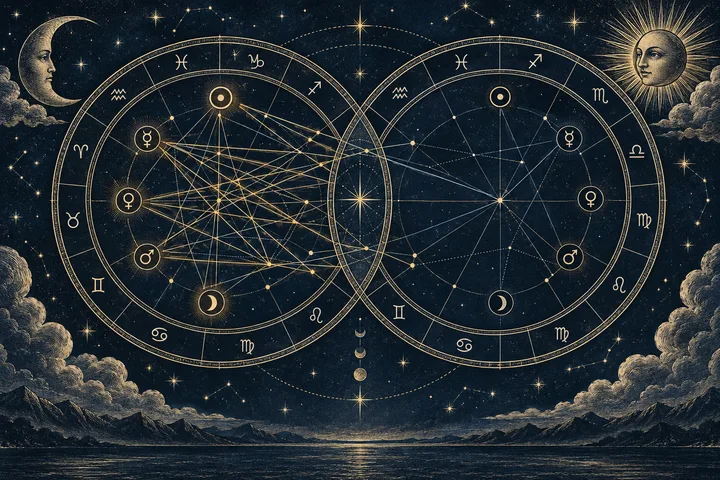
When one person's personal planets receive far more contacts, the relationship often feels more immediate or personally activating for that person. Their Moon, Venus, Mars, Sun, or Mercury becomes a louder meeting point for the other person's chart. That can show where attention, attraction, pressure, comfort, or conflict gathers. It doesn't automatically show who loves more, who has more power, or whether the bond will last. First count only the major aspects you actually trust, using the same six-degree orb throughout. Then rank the tightest contacts and read the receiving planet's sign and house, the aspect's nature, and the other person's planet role. Finally, look for return contacts and for real-life reciprocity. An uneven chart is a map of emphasis. It becomes useful when you ask what the emphasized person experiences and what the other person repeatedly brings into the room.
The short answer: emphasis is not a score
A synastry chart compares two natal charts and shows the aspects formed between them. When one person's Sun, Moon, Mercury, Venus, or Mars is touched many more times than the other's, astrologers usually read that side as more activated. The person's inner life, voice, affection, desire, or sense of self becomes a frequent site of contact. The other person may be the one bringing the stimulation, questions, warmth, pressure, or pursuit. Both roles matter.
The first mistake is to turn the count into a love meter. Five contacts to your Venus don't mean you love five times as much. Three contacts to his Moon don't mean he is secretly more invested. A high count can reflect a tight cluster in one chart, a slow planet crossing several natal placements, or a broad list of aspects that the other chart simply doesn't match. It can also reflect an angle or house emphasis that your chosen chart list leaves out. Numbers describe concentration. They don't settle intention.
The strongest first conclusion is narrower. The relationship is likely to feel more personal, vivid, or demanding through the contacted person's planets. If your Moon receives the contacts, your emotional habits may be stirred. If your Venus receives them, your tastes and way of receiving love may become central. If your Mars receives them, desire, initiative, anger, and boundaries may carry the heat. Read that emphasis as a question about lived experience, then test it against how you actually respond to each other.
For a clean comparison, define your terms before reading. Personal planets are the Sun, Moon, Mercury, Venus, and Mars. A synastry contact is a major angular relationship between two placements, usually a conjunction, opposition, square, trine, or sextile. The planet names the function that meets. The aspect names the way it meets. A six-degree orb means the placements may be up to six degrees from the exact angle and still enter this article's working list. It is a boundary for consistent reading, not a promise that every contact inside it feels identical.
The visible chart can make the imbalance look larger than it is. A biwheel displays two complete horoscopes, so every possible cross-contact competes for attention. One software program may draw fewer lines because it uses a narrower synastry orb. Another may list more aspects in a table than it draws on the wheel. Treat the display as a starting index, not as the interpretation. Check the degrees and keep the same inclusion rule for both people.
It also helps to separate activation from preference. The person whose planet is contacted may feel the meeting in a personal place, but that doesn't tell you whether they want more of it. A Venus person can feel adored and still dislike the values being brought forward. A Moon person can feel deeply recognized and still need distance. Strong contact means the relationship reaches the person. It doesn't dictate the answer they give.
Sources: What’s Your Sign? An Intro to Synastry Charts and Astrological Compatibility; Aspects Between Charts; Synastry
Why the receiving planet matters more than the raw total
An uneven pattern becomes meaningful when you identify which planet is being contacted. A busy Moon often makes the relationship feel emotionally close, intrusive, comforting, or reactive to the Moon person. Their body remembers the other person. Small gestures can land heavily, and ordinary domestic moments may carry more weight than outsiders expect. A busy Venus puts love, attraction, preference, money, beauty, and mutual appreciation on the table. The Venus person may feel especially seen, desired, or asked to define what they value.
A busy Mars moves the story into action. The Mars person may feel pursued, challenged, energized, aroused, irritated, or pushed to make a choice. Mars contacts can animate the bond, but they can also make timing, sex, competition, and anger impossible to ignore. A busy Mercury makes conversation the doorway. You may talk for hours, argue over wording, trade ideas, or keep returning to the same question because the mind has become the relationship's busiest room.
A busy Sun makes identity and recognition central. The Sun person may feel illuminated, judged, encouraged, or made unusually aware of how they show up. A busy personal planet is not automatically the vulnerable one, and the planet person is not automatically the more invested one. For example, Saturn contacting your Sun can make you feel evaluated while the Saturn person supplies structure or restraint. Jupiter contacting your Moon can make the Moon person feel encouraged while Jupiter keeps offering confidence. Name both roles before you rank the meaning.
The pattern also changes when the contacts are spread across several planets instead of gathering around one. Contacts to your Moon, Venus, and Mars can make feeling, affection, and desire move together. You may feel emotionally pulled in, romantically interested, and physically alert at once. Contacts only to Mercury may create a brilliant mental bond that still leaves the emotional and erotic layers quieter. Contacts only to the Sun may make recognition and admiration strong while practical intimacy remains untested. The count matters less than the layer it keeps returning to.
Sources: What’s Your Sign? An Intro to Synastry Charts and Astrological Compatibility; Aspects Between Charts; Synastry
The planet person and the contacted person have different jobs
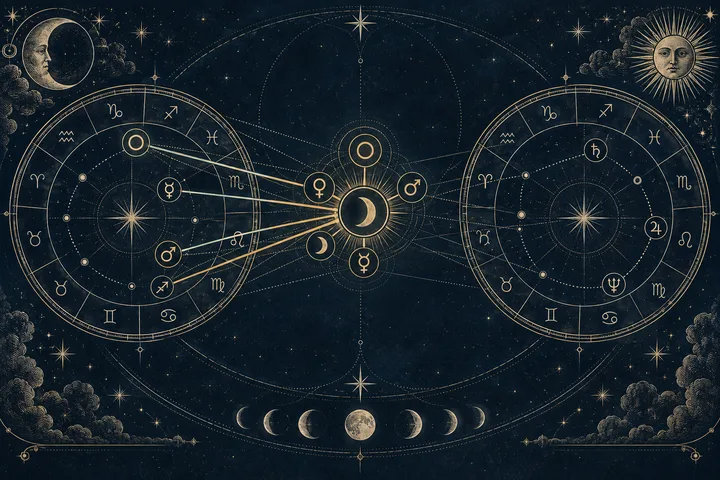
Synastry is relational, so an aspect has two sides. The person whose planet makes the contact often carries, expresses, or triggers that planet's function. The person whose planet receives it experiences that function through a familiar part of their own chart. If her Venus trines his Moon, she may offer affection in a way that soothes him, while he gives that affection an emotional home. If his Mars squares her Venus, he may move directly toward what he wants while she experiences that approach as exciting, intrusive, or both.
This is why the same aspect can sound different when you reverse the sentence. 'Her Saturn squares his Mercury' is not identical to 'his Mercury squares her Saturn.' Her Saturn may set a standard for speech, timing, or seriousness. His Mercury may feel corrected, slowed, or challenged to become more precise. But he also brings the words, questions, and ideas that give her Saturn something to shape. Neither person owns the whole aspect.
Cafe Astrology's synastry guidance makes this planet-role distinction explicit and also asks the reader to include each planet's sign and house. That sequence prevents a common error: assigning a one-way feeling to a two-way exchange. Describe what the planet person does, what the receiving planet person feels, and what behavior follows. Then ask whether the other chart returns the same kind of contact. One person can be more activated without becoming the only actor in the relationship.
A useful sentence pattern is simple: 'His Mars activates her Venus, so his pursuit meets her pleasure and values; the square makes timing and style the point of friction.' Then reverse it: 'Her Venus receives his Mars, so she decides whether his approach feels attractive, rushed, or invasive.' This keeps the reading alive. It also prevents the planet person from becoming a fixed character and the receiving person from becoming a passive screen. Every aspect needs a response, and every response can develop.
Sources: Aspects Between Charts; Synastry
A worked example: her Moon is the crowded room
Imagine Maria and Daniel have supplied their known placements and selected degrees for a comparison. Maria's Moon at 14 degrees Libra receives Daniel's Sun at 15 degrees Libra, Mars at 11 degrees Capricorn, and Saturn at 16 degrees Cancer by major aspect. Maria's Venus and Mars receive no close major aspect from Daniel's personal planets in the chosen six-degree list. Daniel's Moon receives one wide trine from Maria's Mercury. On the page, Maria's personal planets are contacted more often, but her Moon is the clear center of gravity.
The Sun-Moon conjunction gives Daniel's identity a direct path into Maria's emotional world. She may feel that he notices her moods, or that his presence changes the atmosphere before he says much. Her Moon also squares his Mars, so his initiative can wake up irritation, desire, or both. Her Moon squares his Saturn, which can make his caution feel stabilizing one day and withholding the next. These are different aspects, yet they all land on the same lunar function: comfort, response, and the need to feel safe.
The interpretation is not 'Maria cares more.' It is 'Maria's emotional system is the place where Daniel's chart repeatedly arrives.' Daniel may experience the bond through his Sun, Mars, and Saturn roles: he brings presence, pursuit, and limits. Maria may experience it as a constant question about emotional steadiness. If Daniel also has a Venus contact to Maria's Sun, the chart may contain more mutual warmth than the first count suggests. If their daily behavior shows Daniel asking for closeness while dismissing Maria's feelings, the synastry describes the pressure point, not an excuse for it.
This example shows why a tally needs a center. Count the contacts, then group them by receiving planet. Three separate lines to one Moon often tell a more coherent story than three unrelated lines spread across Sun, Mercury, and Mars. The cluster may describe the relationship's main doorway. It may also show where repair matters most. Maria can ask for clearer reassurance and steadier conflict rules. Daniel can learn how his speed, silence, and standards reach her nervous system. The chart becomes useful when both people can name the pattern and choose a better way to carry it.
Now change one input and watch the meaning change. If Maria's Moon were at 20 degrees Libra instead, Daniel's Sun at 15 degrees Libra would remain within a five-degree conjunction. The emotional center would still be that Sun-Moon meeting, though it would be looser and usually ranked below a closer contact. Daniel's Mars and Saturn might still contact the Moon, so the reading would continue to combine recognition, activation, and restraint. The technical emphasis would shift slightly, not disappear. This is why a reader should check the degree difference instead of treating a conjunction as either exact or absent.
Suppose the chart also shows Maria's Venus at 2 degrees Scorpio conjunct Daniel's Pluto at 3 degrees Scorpio, while her Moon remains the busiest personal planet. The Venus-Pluto contact adds magnetism and depth, but it does not cancel the lunar story. Maria may feel Daniel's presence in her emotional body and in her romantic desire, yet those two experiences may ask for different kinds of safety. She may need both tenderness and freedom from pressure. A good reading holds the layers together without forcing them into one word such as intense.
Imagine a second version of the same couple in which Daniel's Sun, Mars, and Saturn contact Maria's Moon, but Maria's Venus squares Daniel's Mars at 1 degree and her Mercury trines his Sun at 2 degrees. The chart is still numerically uneven on Maria's side, yet the relationship has return pathways. Her Venus answers his Mars through attraction and friction. Her Mercury meets his identity through understanding and language. The count remains useful, but it no longer tells a story of one person receiving everything. It tells a story of one person carrying the central emotional impact while both people contribute to desire and recognition.
This is the comparison to make when you read your own chart. Don't ask only, 'Who has more lines?' Ask, 'Which planet is the meeting place, and what does the other person bring there?' Then ask, 'Where does my chart meet theirs in return?' The first question locates the pressure point. The second protects the reading from becoming a portrait of one person acted upon by the other.
Rank the contacts by orb, aspect, and planet weight
Start with exactness. A conjunction at 0 degrees 42 minutes deserves attention before a square at 5 degrees 55 minutes, even though both sit inside the same six-degree rule. The closer the planets are to the exact aspect, the more concentrated the contact usually feels in a focused synastry reading. Don't treat an orb as a volume knob with a precise mathematical output. Use it as a ranking tool. Tight means immediate. Loose means possible, secondary, or easier to miss.
Then rank the aspect. A conjunction fuses the two planetary functions, which can feel intimate and hard to separate. An opposition makes each person aware of the other's side and can produce fascination or resistance. A square creates a live problem that can also keep the bond active. A trine often describes ease, talent, and mutual flow. A sextile can be pleasant but may need choice and effort before its promise becomes visible. A hard aspect isn't a bad aspect, and a soft aspect doesn't remove the need for care.
Finally, rank the planets by the question you are asking. For emotional fit, give the Moon serious attention. For attraction, include Venus and Mars together, not Venus alone. For communication, study Mercury and its links to the Moon, Sun, and Saturn. For recognition and identity, study the Sun. Cafe Astrology specifically recommends close attention to inner-planet interaspects, while its broader synastry guide treats Venus, Mars, Mercury, and Saturn as distinct relationship layers. A clean ranking keeps one dramatic contact from swallowing the whole chart.
You can make the ranking visible with three passes. Pass one keeps only contacts within the chosen orb. Pass two sorts them by exactness, with the closest first. Pass three asks whether the contact repeats a theme already present elsewhere. A 1-degree Moon-Saturn square and a 2-degree Mercury-Saturn square may belong to one story about restraint, timing, and criticism. Treating them as two unrelated warnings exaggerates the count. Treating them as one repeated Saturn theme gives the chart shape.
Applying and separating motion can add another traditional layer when your method includes it. An applying aspect is moving toward exactness; a separating aspect has passed exactness. In a static natal comparison, both can matter, and the exact degree still deserves priority. If you don't have the data or don't use that distinction, leave it out. Consistency beats decorative complexity. A short, reproducible method gives you a reading another astrologer can inspect and understand.
Don't use the sign relationship as a substitute for the degree relationship. Two planets in signs that naturally cooperate may have no major aspect by degree. Two planets in signs that seem awkward may form a close trine across a sign boundary or a close aspect that deserves attention. The exact geometry comes first for a degree-based count. The signs then refine how that geometry speaks. This keeps sign-pair impressions from overruling the actual placements you supplied.
When a person has a stellium, several contacts may appear to be separate when they are really one concentrated natal area. If three of Daniel's planets sit close together and all touch Maria's Moon, the Moon receives a bundle. Read each planet, but also name the bundle's shared theme. A Sun-Mercury-Saturn cluster might bring identity, speech, and standards together. The relationship may feel like a conversation that always carries consequences. That is more precise than calling it simply heavy.
Sources: What’s Your Sign? An Intro to Synastry Charts and Astrological Compatibility; Aspects Between Charts; Synastry; Saturn in Synastry
Signs and houses tell you where the emphasis lives
The planet tells you what is active. The sign tells you the style. A Moon contact in Cancer may seek protection, continuity, and emotional familiarity. The same Moon contact in Aquarius may need space, honesty, and a friendship-like form of care. Venus in Taurus may register affection through steadiness and touch, while Venus in Gemini may look for lively exchange and mental movement. Mars in Aries acts quickly. Mars in Libra weighs the other person's response and may fight for balance. These are interpretive directions, not scripts.
The house tells you where the receiving person feels the contact in life. If Daniel's Venus falls in Maria's fifth house, his affection may animate romance, play, creativity, and the wish to be chosen. If his Saturn falls in her seventh, commitment, agreements, and partnership expectations may become weighty. House overlays require dependable birth times, so don't treat a house placement as firm when the birth time is uncertain. A sign and degree comparison can still be useful without pretending to know every house.
Cafe Astrology notes that the same planet pair can express differently according to sign and house. That point matters especially when one person's planets contact many of the other's. A cluster in the sixth house may turn the relationship into a daily rhythm of help, work, health, and small duties. A cluster in the eighth may bring trust, shared resources, vulnerability, and deep merging to the front. Ask where the contact happens before deciding what the contact means.
The sign can also explain why an aspect feels uneven even when both people participate. A Libra Moon receiving a Capricorn Mars may experience direct action as a challenge to harmony and timing. A Capricorn Mars may experience the same exchange as a practical push to stop discussing and act. Neither description is the whole truth. The sign of each planet, not only the sign of the aspect, tells you what each person brings. The house then shows which life area keeps staging the exchange.
If you only know sign placements, say so in your notes. Same-sign planets may share a field, but sign proximity alone doesn't prove a conjunction, and signs in compatible elements don't prove a trine by degree. If you have degrees but no minutes, preserve the uncertainty near the edge of an orb. If you have a reliable birth time, house overlays can deepen the reading. If you don't, let the planetary aspects carry the weight.
Sources: Aspects Between Charts; Synastry
A lopsided count can still contain mutual impact
Astrological impact isn't measured only by how many planets receive lines. One exact contact can organize a relationship more strongly than several loose ones. A single Venus-Mars conjunction at 1 degree may make attraction unmistakable, while four minor or wide contacts remain background material. A Saturn contact to a personal planet may also become more visible with time, especially once the pair makes a clear commitment. The quality, tightness, and repetition of a theme matter as much as the total.
Look for reciprocity at the level of function. If her Moon receives three of his planets, does one of her planets contact his Sun or Moon? If not, does her Saturn provide the structure that lets his activated planets settle? Does her Mercury make an aspect to his Mars, turning her questions into the place where his action gets tested? Mutuality can appear through different planet pairs. The chart doesn't need to be symmetrical to be shared.
The strongest exception is a real asymmetry in experience. Sometimes one person feels the relationship as a major emotional or erotic event while the other experiences it as pleasant, practical, or intermittent. Astrology can describe why one chart is more exposed, but it cannot replace observation of availability, honesty, and follow-through. Don't use an uneven contact count to overrule the other person's stated boundary. Use it to understand why the connection may feel larger to one person, then bring that knowledge into a direct conversation.
There is another kind of mutuality: one person may receive the contacts while the other supplies the context that makes them workable. Her Moon receives his Mars, but her Venus trines his Moon. Her emotional response is activated by his drive, yet her affection gives his emotional nature a soft place to land. The chart is not balanced line by line. It is balanced by function. Look for the aspect that answers the pressure, not only the aspect that creates it.
This is also where natal condition matters. A person with a natal Moon already joined to Saturn may experience a partner's Saturn contact differently from someone whose Moon is free of that pattern. The synastry contact enters an existing chart. It doesn't arrive on an empty page. Compare the relationship aspect with the person's own natal story when those placements are known, then keep the conclusion modest if they aren't.
Sources: Synastry; Saturn in Synastry
What changes when Saturn or the outer planets join the pattern
If Saturn contacts the already busy personal planets, the emphasis can become serious and durable. Saturn may bring time, responsibility, rules, patience, or fear of loss. The Saturn person can feel responsible for the contacted planet, while the personal-planet person may feel guided, contained, judged, or restricted. Cafe Astrology describes Saturn interaspects as bonds that often unfold in stages. That doesn't make Saturn a promise of permanence. It makes the contact a request for mature handling.
Uranus, Neptune, and Pluto can intensify the meaning without making the relationship one-sided in a simple way. Uranus can awaken freedom, surprise, and instability around the contacted planet. Neptune can idealize, soften, confuse, or spiritualize the contact. Pluto can expose desire, fear, power, and transformation. If several of these planets touch one person's Moon, Venus, or Mars, that person may feel changed by the encounter. The other person still carries the outer-planet role, and the natal condition of both planets changes the story.
Don't let a dramatic outer-planet contact erase the personal planets. The question is still how the relationship moves through feeling, affection, thought, desire, and identity. A Pluto-Venus conjunction may be magnetic, but you still need to see how Mercury handles difficult conversations and how Saturn handles time. A Neptune-Moon contact may feel soulful, but the Moon's sign and the couple's actual pattern of reassurance tell you whether the softness has a reliable container. Rank the lived layer first.
Generational planets can also inflate the appearance of an uneven pattern. Many people born in the same period share outer-planet sign placements, so a sign-based list may suggest a connection that degree-based analysis would not confirm. Keep the outer planets in their proper place. They can describe a compelling background tone or a powerful contact to a personal planet, but they shouldn't crowd out the tighter Sun, Moon, Mercury, Venus, and Mars links that answer how the two people meet day to day.
Saturn deserves special care because a binding contact can feel unequal at first. The Saturn person may appear to set the terms, while the personal-planet person feels watched or tested. Over time, the same contact can become a shared discipline if both people accept responsibility. Or it can harden into criticism if only one person gets to define the rules. The chart shows the material. The couple's conduct shows which expression they are building.
Sources: Aspects Between Charts; Synastry; Saturn in Synastry
How to read an uneven chart without overreading it
Use a simple worksheet. Write both people's Sun, Moon, Mercury, Venus, and Mars signs and degrees. Choose your zodiac system, major aspect list, and six-degree orb before counting. Mark who owns each planet and who receives the contact. Group the results by receiving planet, then by aspect type. Circle contacts within two degrees. Put sign and house notes beside them only when those inputs are dependable. This takes a few minutes and prevents the chart from changing rules halfway through.
Next, write one sentence for each strong cluster. 'His Mars and Saturn repeatedly activate her Moon, so emotional safety becomes the place where pursuit and restraint meet.' That's stronger than 'They have intense synastry.' Add the best expression and the strain. The best expression might be protection, focus, or honest growth. The strain might be pressure, criticism, overreaction, or a fear of losing control. Then name one observable question: Do they repair after conflict? Can she ask for comfort without being mocked? Does he respect a slower pace?
Keep missing information visible. If you know signs but not degrees, you can discuss sign themes and possible same-sign emphasis, but you can't claim a precise conjunction or square. If a birth time is unknown, don't build the conclusion on houses or an angle. The Synastry Comparison Report is designed for supplied Moon, Venus, and Mars placements with optional degrees and selected major-aspect calculations using a six-degree orb. It doesn't calculate natal positions from birth details or promise a relationship outcome. Give the chart the inputs it can honestly carry.
A report can be clear about its boundary and still be rich. With Moon, Venus, and Mars signs, you can compare emotional needs, affection, desire, pacing, and element or modality patterns. With degrees, you can test selected major aspects and rank them by orb. Without birth times, you can leave houses and angles aside. What you should not do is fill a missing placement with a guess. A narrower reading is usually more revealing than a complete-looking one built on invented certainty.
Before you finish, write the strongest supportive expression and the strongest difficult expression. For a Moon cluster, support might be instinctive care and emotional recognition. Difficulty might be reactivity or feeling managed. For a Venus cluster, support might be shared pleasure and attraction. Difficulty might be over-accommodation or value conflict. This paired reading keeps the article from becoming either a promise or a warning. It gives the reader something to notice in both the good days and the tense ones.
Sources: What’s Your Sign? An Intro to Synastry Charts and Astrological Compatibility; Aspects Between Charts; Overview chart types
The practical decision: find the pressure point, then compare behavior
Return to the opening question with a sharper answer. When one person's personal planets are contacted far more often, the chart shows a concentrated field of experience. The receiving person may feel more seen, stirred, desired, challenged, or exposed. The planet person may supply the action that keeps touching that field. The chart is uneven in emphasis, not necessarily in affection, agency, or worth. That's the judgment to keep.
Use the pattern to choose one conversation. If the Moon is crowded, ask what reassurance and space look like during conflict. If Venus is crowded, ask how each person defines care, pleasure, money, and loyalty. If Mars is crowded, talk about pursuit, sex, anger, and the right to slow down. If Mercury is crowded, agree on how you will clarify rather than score points. If Saturn is involved, ask what commitment requires in time and practice. One useful question beats another hour of tallying.
Then compare the answer with the relationship in front of you. Do both people make room? Do they keep promises? Can intensity become tenderness instead of pressure? A busy chart deserves attention, but it doesn't deserve the power to make a choice for you. If you already know the Moon, Venus, and Mars placements, compare them with consistent inputs and optional degrees. The report can help you rank the contacts and name the central pattern. You still decide what the pattern asks of you.
Make the next action small enough to take. Choose the busiest receiving planet, name the likely gift and strain, and ask one question that invites a real answer. 'When you pull away, what kind of reassurance can we both offer?' is better than 'Why is our synastry so intense?' Then watch what happens after the conversation. A chart reading earns its place when it helps you see a pattern early enough to handle it with care.
If the answer feels mutual, use the report to compare the layers rather than hunt for a final label. If the answer feels one-sided, let that fact stay visible. A powerful synastry signature can explain why you remain drawn in, but it cannot turn inconsistency into devotion. The most grounded reading joins astrology to attention: know what is contacted, know who carries which role, and notice whether both people keep choosing the relationship in practice.
You can finish the reading with a three-line note: 'The strongest contact is...' 'It is most likely to show up when...' 'We can handle it by...' For the Maria and Daniel example, the note might name Maria's Moon as the strongest receiving planet, conflict and uncertainty as the moments when the pattern rises, and explicit reassurance plus respectful pacing as the useful response. That is a decision guide. It gives the symbolism a place in ordinary life.
The final question is not whether the chart is balanced in appearance. It is whether the relationship can hold the places where it is unbalanced. Some pairs need more reassurance. Some need more room. Some need clear limits around pursuit, criticism, money, or private time. The synastry pattern can show where to begin. Mutual care is shown by what both people do with that knowledge.
Sources: What’s Your Sign? An Intro to Synastry Charts and Astrological Compatibility; Aspects Between Charts; Synastry
A little more clarity
Does the person with more synastry contacts feel the relationship more strongly?
Often, that person feels more personally activated, especially when the tightest contacts reach the Moon, Venus, Mars, or Sun. But a contact count can't prove stronger love or greater commitment. A single exact aspect can matter more than several loose ones, and the planet person may be the one creating the strongest movement. Read the receiving planet, orb, aspect, sign, and house, then compare the pattern with real behavior.
What should I count first in an uneven synastry chart?
Count major aspects between the Sun, Moon, Mercury, Venus, and Mars using one consistent orb. This guide uses six degrees and ranks tighter contacts first. Group the results by receiving planet, because three contacts to one Moon can form a clearer emotional story than three unrelated contacts. After that, add Saturn and the outer planets, then check signs and dependable house placements. Don't count invented degrees or treat missing birth information as exact.
Sources & further reading
- What’s Your Sign? An Intro to Synastry Charts and Astrological Compatibility
Supports personal-planet meanings, major synastry contacts, and the usual relationship role of degree-based orbs.
- Aspects Between Charts
Supports reading planet roles, sign and house context, and prioritizing inner-planet interaspects in synastry.
- Synastry
Supports the distinction between Venus attraction, Mars desire, Mercury exchange, aspect types, and Saturn glue.
- Overview chart types
Supports the technical description of a synastry chart as two horoscopes with inter-chart aspects and data tables.
- The Classical Origin and Traditional Use of Aspects
Supports the definitions of aspect geometry, applying and separating aspects, exactness, and the historical use of orbs.
- Saturn in Synastry
Supports the staged, binding, responsible, and sometimes restrictive expression of Saturn to personal planets.
Synastry Comparison Report
Enter known placements for two people. Get an input-by-input comparison, selected aspect calculations and a clear record of what remains uncertain.
Compare our placements