Imagine a bond that keeps returning to the same argument
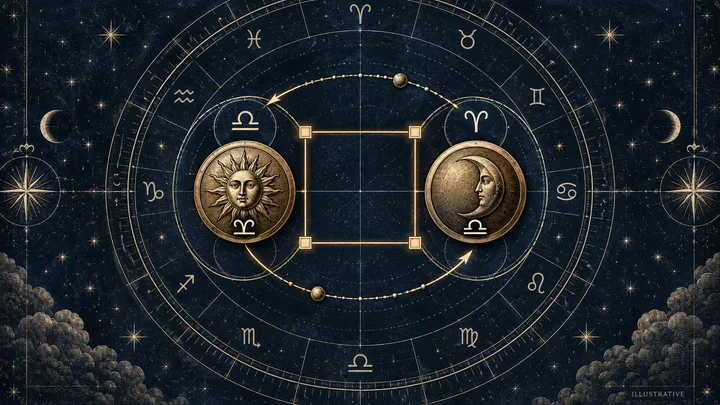
Imagine Maria has Venus at 12 degrees Capricorn and Daniel has Saturn at 12 degrees Libra. They keep circling the same question: how much reassurance is enough, and how much proof is fair to ask for? Venus is in Capricorn, Saturn's domicile. Saturn is in Libra, Venus's domicile. The planets exchange domiciles, so this is mutual reception by domicile. They are also exactly 90 degrees apart. That is a square.
This is a clearly illustrative case, not a supplied personal chart. It separates two astrological layers. Reception describes the rulership bond between the planets. The square describes the angle at which they meet. One can provide a route into the other's concerns while the other keeps the contact tense. The first changes the resources available. The second changes the work required.
That answers the real question. If the planets are linked, why doesn't the connection feel easy? Because recognition and ease aren't the same thing. Venus still seeks affection and value. Saturn still tests time, responsibility, limits, and proof. Their exchange can make those subjects relevant to one another. The square can make the translation hard.
Read this pattern as workable tension, not hidden harmony. A reception may show potential for access or cooperation. It doesn't certify attraction, reciprocity, safety, or good conduct. Those belong to the people and the wider comparison.
Sources: Mutual Reception, Astrodienst Astrowiki; Reception, Astrodienst Astrowiki; Square, Astrodienst Astrowiki
Check the signs before you name the pattern
Write down planet A, its sign, and its degree. Do the same for planet B. Then identify the rulership system. In the traditional domicile example above, Saturn rules Capricorn and Venus rules Libra. Venus in Capricorn and Saturn in Libra therefore form a two-way domicile exchange. This is the worked reception in this guide. Not every pair of planets can create it. The signs have to be ruled by one another's planets.
Don't stretch 'in each other's signs' to mean that the planets have moved into one another's bodies or that the people understand each other equally. Reception is a symbolic relationship of rulership. Traditional astrology also discusses reception through exaltation, triplicity, term, and face, but those forms differ in strength and meaning. Name the dignity you are using.
Next, calculate the angular distance. A square is 90 degrees. At 12 degrees Capricorn and 12 degrees Libra, the distance is exact. If Saturn moved to 18 degrees Libra, the sign exchange would remain, but the square would be six degrees wide. If Saturn moved to 12 degrees Taurus, the exchange would remain while the contact would become a trine. Sign relationship and degree geometry are related, but they are not interchangeable.
A sign-only comparison cannot settle exactness. If you know the degrees, measure the aspect. If you don't, keep the reading at the sign and rulership level. The Synastry Comparison Report can organize supplied Moon, Venus, and Mars signs and optional degrees. It doesn't calculate natal positions, houses, or a complete chart from birth details.
When two synastry planets occupy one another's ruling signs and also form a square, read the reception as a possible resource and the square as the main point of friction. The exchange links the planets through rulership. The square puts them 90 degrees apart, so the link may require adjustment instead of offering ease. It doesn't cancel the square, prove mutual interest, or predict equal effort. First confirm the actual sign rulers. Then measure the supplied degrees and apply the chosen orb. After that, read the two planets, their natal condition if known, and the other contacts that repeat or soften the pattern. The useful next step is a specific conversation about the behavior the symbolism brings into view.
Sources: Mutual Reception, Astrodienst Astrowiki; Square, Astrodienst Astrowiki; Interaspect, Astrodienst Astrowiki
Let the square lead, then let reception modify it
A square is an aspect of pressure. Astrodienst defines it as a 90-degree relationship and describes its potential for conflict, inhibition, and constructive effort. In synastry, that pressure belongs to the contact between two charts. It can show where one person's planetary function presses against the other's way of acting, feeling, thinking, or deciding.
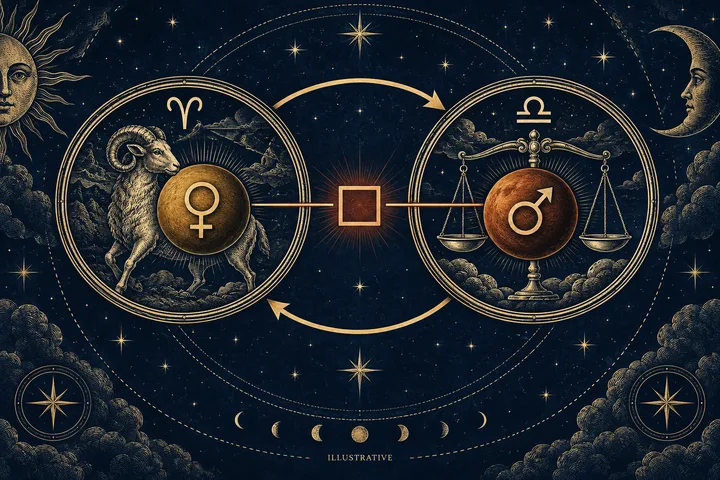
Reception asks a different question: is there a symbolic route by which each planet can draw on the other? Astrodienst describes mutual reception as two planets occupying one another's domicile signs and notes that the exchange can strengthen them, unless one or both planets are weakened. That is why reception can matter in a hard contact. It may offer a resource. It doesn't turn the hard contact into a soft one.
For Venus and Saturn, the resource might involve loyalty, value, standards, or lasting form. The friction might involve warmth and proof, pleasure and duty, or reassurance and restraint. Those are interpretive possibilities, not reports of what either person intends. The chart supplies the symbolic comparison. The couple supplies the facts.
Mutual reception isn't automatically helpful just because it sounds reciprocal. If both planets are in signs of detriment or fall, traditional sources treat the advantage as weakened. A planet's natal condition matters too. Without complete natal information, keep that point as a question rather than a conclusion.
Rank the layers in this order: establish the exchange, give the exact square its weight, interpret the two planets, then look for repeated contacts. Reception is the modifier. The square is the task.
Sources: Mutual Reception, Astrodienst Astrowiki; Reception, Astrodienst Astrowiki; Square, Astrodienst Astrowiki
Use degrees and orbs to decide how loudly the contact speaks
Exactness changes emphasis. A square at 0 degrees 40 minutes deserves more attention than one at 5 degrees 50 minutes, even when both fall inside a six-degree working orb. The tighter contact is harder to miss. The wider one may still describe a theme, but it should not outrank a closer personal-planet contact without support.
Astrodienst recommends smaller orbs in synastry because comparing two charts quickly doubles the number of possible contacts. That is a useful rule. A crowded aspect list can make every symbol sound decisive. A stated orb lets you decide what leads and what remains background.
For this report scope, use the supplied placements and a six-degree orb for selected major aspects. If Venus is at 9 degrees Capricorn and Saturn is at 14 degrees Libra, the five-degree distance supports a square reading. If one degree is rounded or missing, say so. A rounded Moon position can change the result near a boundary.
The strongest exception is a wide, isolated square near the edge of the orb. It may not describe the central relationship pattern. The reverse matters too: a tight square can lead even when reception is absent. Never use mutual reception as a rescue word. Geometry comes first.
Then look for repetition. Does another contact connect Mercury with the Moon, giving the pair a language for repair? Does Saturn repeat the theme of duty? A soft aspect doesn't erase a square, and a second hard aspect doesn't doom a bond. It tells you whether the same question keeps returning.
Sources: Square, Astrodienst Astrowiki; Interaspect, Astrodienst Astrowiki
Read the planet pair without turning it into a verdict
The planets tell you what kind of adjustment the square asks for. Venus-Saturn can bring affection and responsibility into one negotiation. Venus-Mars can put desire, pace, initiative, and values in the same room. Moon-Mars can press emotional safety against action. Mercury-Mars can sharpen the exchange between words and assertion. These examples help you choose a question. They don't prove a motive or predict an outcome.
Be careful with the framework. The precise domicile mutual-reception example here is Venus in Capricorn with Saturn in Libra. A Moon-Mars, Venus-Mars, or Mercury-Mars square may show how different planet meanings change the conversation, but those pairs do not automatically form the same two-way domicile exchange. Don't place every planet pair under the Venus-Saturn label.
Sign mode gives another clue. A cardinal square may argue over who begins or sets the pace. A fixed square may hold steady while making compromise difficult. A mutable square may keep revising the plan. Fire may move fast, water may protect, earth may stabilize, and air may analyze or connect. Use these as prompts, then return to the actual planets and degrees.
The behavioral test is small. Ask what the contact seems to make difficult, what each person needs in that moment, and what response would reduce the friction without erasing either need. If the chart suggests Venus seeking warmth while Saturn asks for proof, watch the exchange. Does one person answer a request with a condition? Does the other treat a limit as rejection? Behavior tests the interpretation.
A difficult aspect can describe a real point of attraction, pressure, or learning. It cannot tell you that someone will stay, change, commit, or treat you well. Those are decisions made through time and conduct.
Sources: Mutual Reception, Astrodienst Astrowiki; Square, Astrodienst Astrowiki
Turn the interpretation into one clear conversation
Begin with a recent scene, not a theory. You might say, 'When I asked for reassurance, your answer became a list of conditions,' or, 'When you asked for a plan, I heard pressure and pulled away.' Describe the action before naming Venus and Saturn. That order keeps the chart from becoming a verdict about another person's inner life.
Then use the symbolism as a shared question: 'Could this be our Venus-Saturn square? My need for warmth seems to press on your need for proof. What did each of us need in that moment?' Ask what each person wanted, what each thought the action meant, and what a useful response would have looked like. A planet can suggest the subject. Only a conversation can establish the lived meaning.
If you have degrees, include them plainly. 'Your Saturn is 14 degrees Libra and my Venus is 9 degrees Capricorn. In the supplied positions, that's a five-degree square.' If you have signs only, keep the reading at that level. You don't need to abandon the symbolism. You need to avoid claiming precision the inputs don't support.
Choose one agreement that gives the square a job. The person asking for clarity will receive a direct answer before the wider explanation. The person needing time will name when the conversation will resume. Neither person will call a difference in pace proof of indifference without asking a clean question first.
The Synastry Comparison Report fits when you already know the placements. It can organize supplied Moon, Venus, and Mars signs, use optional degrees, and select major aspects with a stated six-degree orb. It won't calculate a natal chart from birth details, determine houses, or turn a hard contact into a compatibility score. Compare our placements when you want a focused record of the technical pattern.
End with this question: 'Where do we recognize each other's needs, and what do we keep making harder than it needs to be?' Then look for an action, not a more elaborate explanation. A mutual-reception square becomes useful when both people can name the tension and share the work of responding to it.
Sources: Mutual Reception, Astrodienst Astrowiki; Reception, Astrodienst Astrowiki; Square, Astrodienst Astrowiki
A little more clarity
Does mutual reception cancel a square in synastry?
No. Mutual reception describes a rulership exchange, while the square describes a 90-degree contact and its pressure. Read reception as a possible resource for access or cooperation, not as proof of attraction, equal investment, or easy compatibility. The tighter the square and the more it repeats elsewhere, the more directly you should address its friction.
Can any two synastry planets be in mutual reception and square?
No. For the domicile example used here, each planet must occupy a sign ruled by the other. Venus in Capricorn and Saturn in Libra meet that condition because Saturn rules Capricorn and Venus rules Libra. Other planet pairs may form squares without forming this mutual domicile exchange. Check the rulers, degrees, and chosen orb first.
Sources & further reading
- Mutual Reception, Astrodienst Astrowiki
Defines mutual reception as two planets occupying one another's domicile signs and describes its possible strengthening effect and limits.
- Reception, Astrodienst Astrowiki
Explains reception as a relationship of acceptance or attention and distinguishes mutual domicile reception from other dignities.
- Square, Astrodienst Astrowiki
Defines the square as a 90-degree aspect associated with pressure, conflict, and constructive effort.
- Interaspect, Astrodienst Astrowiki
Defines interaspects in synastry and recommends smaller orbs because comparing two charts creates many possible contacts.
Synastry Comparison Report
Enter known placements for two people. Get an input-by-input comparison, selected aspect calculations and a clear record of what remains uncertain.
Compare our placements