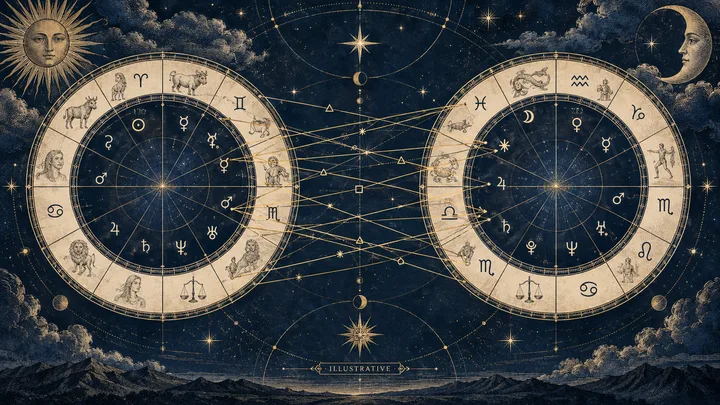
Imagine the crowded chart and the quiet question beneath it
Imagine Maria and Theo opening a synastry report after several promising dates. The wheel is busy. Lines cross the center. The list includes squares, trines, sextiles, and contacts to slow planets. Yet neither person feels the immediate warmth they expected from such a dramatic picture. Maria asks the useful question: does the chart show a personal bond, or only a strong atmosphere around the connection?
There are two plausible readings. The relationship may carry shared ideals, fascination, growth, or pressure without a close link between the planets that speak most directly to comfort, affection, thought, and desire. Or the report may treat every visible line as equal evidence. It shouldn’t. A crowded chart isn’t automatically an intimate chart.
Synastry describes an exchange between chart factors. It doesn’t decide whether two people should date or stay together. A chart can show tenderness without ease, attraction without steadiness, or inspiration without a practical plan. Your task is to identify the exchange that deserves attention and bring it back to a real interaction.
Start with a clean inventory. Which placements were supplied? Which include degrees? Which contacts are major, close, and readable? Which depend on an uncertain birth time? That first pass often changes the story. The page may look full, but the interpretation may need only two or three leading contacts and one supporting pattern.
Sources: Aspects Between Charts; Synastry: Love and Relationship Astrology; What’s Your Sign? An Intro to Synastry Charts and Astrological Compatibility
Check the angle, orb, and sign before you trust a line
An aspect is an angular relationship between two chart factors. A conjunction is near 0 degrees, an opposition near 180 degrees, a square near 90 degrees, a trine near 120 degrees, and a sextile near 60 degrees. The orb is the distance between the exact angle and the positions being compared. The smaller the orb, the more tightly the two factors speak within the chosen method.
This article uses a six-degree orb for selected major aspects when reliable degrees are available. That gives the reading a clear boundary. It isn’t a universal rule for every astrological school. If a report uses a wider orb, record its setting instead of mixing its list with a six-degree list.
Write down the planet pair, aspect, orb, and input quality. Don’t let the thickness of a line decide importance. Don’t let a software heading turn a wide contact into a close one. When degrees aren’t supplied, compare the known signs and describe sign-based affinity. Leave exact aspect claims open.
Signs add style to an aspect. A close contact across a sign boundary may express two different modes at once, while the same-sign version may feel more familiar. A fixed-sign square may hold a position; a mutable-sign square may keep changing the terms. The angle tells you how the planets meet. The signs tell you how each one acts.
For a placement-only comparison, the method stops where the data stops. Don’t add houses, angles, or a calculated Moon degree unless the required birth information and placements were supplied. Precision makes the reading stronger because it tells you which layer you’re actually reading.
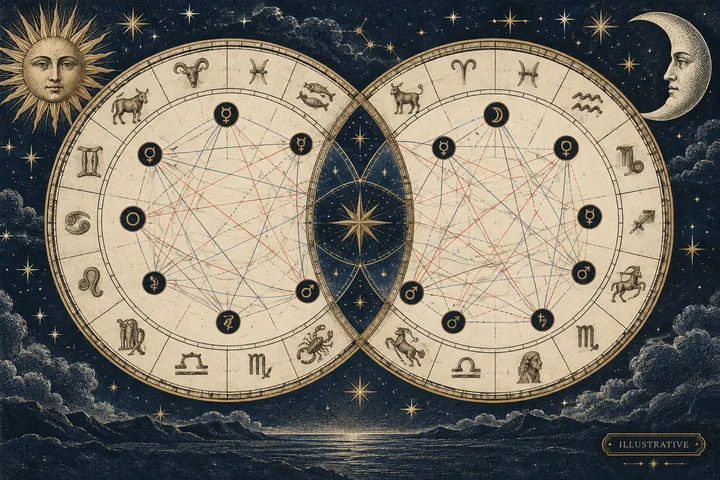
Read the chart by hierarchy, not by count. A long aspect list can describe a vivid atmosphere while saying less about daily affection, emotional ease, desire, or recognition than one close personal-planet contact. Check the supplied degrees, aspect type, and orb first. Then rank the Sun, Moon, Mercury, Venus, Mars, and reliable angles ahead of wide contacts between slower planets. Group aspects that repeat one theme instead of counting each line as a separate vote. If no close personal contact survives, say what remains: shared ideals, pressure, fascination, or a generational tone. In this placement-only report, compare the supplied Moon, Venus, and Mars signs and optional degrees, then use a six-degree orb for selected major aspects. Choose the strongest supported theme, name the behavior it could describe, and ask whether you can see it in ordinary life.
Sources: Aspects Between Charts; What’s Your Sign? An Intro to Synastry Charts and Astrological Compatibility
Give the personal planets first claim on meaning
Personal planets deserve the first look because they describe familiar relationship functions. The Sun shows vitality and self-expression. The Moon speaks to comfort, instinct, and emotional rhythm. Mercury carries speech and understanding. Venus describes affection, pleasure, taste, and values. Mars shows desire, initiative, heat, anger, and the way a person moves toward what they want.
That priority doesn’t mean every personal-planet contact feels easy. A close Moon-Mars square can bring heat and quick irritation. Mercury-Saturn can make conversation careful or weighted with correction. Venus-Uranus can wake attraction while making the rhythm less predictable. Personal means immediate and recognizable, not automatically soft.
Cafe Astrology’s interchart guidance gives inner-planet interaspects extra attention and asks readers to consider the signs and houses in which those planets sit. Its synastry overview gives Venus, Moon, Mars, Jupiter, and the outer planets different jobs. Astrology.com likewise presents close Sun-Moon, Moon-Venus, and Venus-Mars contacts as useful relationship layers. The point is relevance, not a compatibility score.
If a report contains many Jupiter or Neptune contacts but no close Moon, Venus, or Mars contact, don’t turn the outer pattern into proof of personal chemistry. Read it as context. Then ask what the couple experiences when they seek reassurance, show affection, disagree, or make plans.
Sources: Aspects Between Charts; Synastry: Love and Relationship Astrology; What’s Your Sign? An Intro to Synastry Charts and Astrological Compatibility
Read outer planets as atmosphere, pressure, or change
Slow planets can matter deeply. Saturn may bring duty, limits, endurance, or judgment. Uranus can open a new way of relating and disrupt an old rhythm. Neptune can bring longing, spiritual feeling, imagination, and projection. Pluto can intensify attachment and expose power questions. These are not empty contacts. They simply do different work from a close Moon-Venus or Venus-Mars exchange.
The distinction sharpens when two people share a slow planet by generation. A contact between their outer planets may describe a common era as much as a personal bond. An outer planet touching one person’s Venus, Moon, Sun, or Mars is more individual, especially when the orb is close and the planet roles are clear. Even then, Neptune can inspire and blur, while Saturn can steady and weigh.
Consider an example with no personal chart data attached. A report shows several wide contacts involving Jupiter and Neptune, while its close personal-planet section is empty. The best reading is not ‘nothing is here.’ It is ‘the chart’s strongest visible material concerns hope, imagination, growth, or shared meaning; the evidence for everyday chemistry is lighter.’
Ask what the outer pattern changes. Does it make dates feel imaginative? Does it encourage a large future before the pair has made small plans? Does responsibility draw the couple closer, or make one person feel assessed? Those questions translate atmosphere into life without pretending that an outer-planet signature guarantees an outcome.
Sources: Aspects Between Charts; Synastry: Love and Relationship Astrology
Rank the pattern once instead of counting every line
A busy report often says the same thing several times. Three Jupiter contacts may all support warmth, generosity, and encouragement. Several Neptune contacts may circle imagination or uncertainty. Group the shared theme before you decide how much weight it carries. Repetition can strengthen a story, but it isn’t three separate votes.
Use this order. First, remove contacts outside the stated orb or mark them as background. Second, place close personal-planet and reliable angle contacts ahead of wider generational contacts. Third, group repeated themes. Fourth, translate the leading contact into one ordinary behavior. A symbol that never reaches a recognizable moment is still too broad.
The aspect type shapes the question. Conjunctions combine forcefully. Oppositions pull two poles into awareness. Trines and sextiles can bring ease. Squares create friction that asks for movement. None is a moral grade. Ease can become passive. Friction can become a practice. The planet pair tells you what is meeting; the aspect tells you how.
Here’s a safe worksheet for Maria and Theo. They can list the closest contact their report actually supplies, note whether it involves a personal planet or angle, write the narrow behavior it might describe, and add one supporting theme. If the report only provides signs, they can write ‘sign comparison’ in the data column and leave the degree column blank. The worksheet stays useful because it never pretends to be a calculation.
Suppose the leading contact concerns Mercury and Saturn. Ask, ‘When one of us speaks carefully, does the other hear care, distance, or criticism?’ If it concerns Venus and Neptune, ask, ‘Which hopes about us have we confirmed, and which are we carrying alone?’ The chart gives the language. The couple supplies the example.
Sources: Aspects Between Charts; Synastry: Love and Relationship Astrology; Declinations in Synastry: Astrology of Relationships
Separate an absent contact from a missing one
An absent contact and a missing contact are different. An absent contact means the supplied positions don’t meet within the chosen aspect set and orb. A missing contact means a needed degree, planet, angle, or birth time was never supplied or can’t be trusted. The first is part of the chart pattern. The second is a boundary around what you can claim.
This matters most with the Moon and angles. A changing Moon degree can alter an aspect, and an uncertain birth time can shift the Ascendant and house cusps. If the report gives a Moon sign but not a reliable degree, compare the sign. Don’t call a Moon aspect exact. If it gives no dependable birth time, don’t build a house-overlay or angle interpretation to rescue a thin personal layer.
Declination can offer a separate secondary technique. Parallel and contraparallel contacts compare north-south positions rather than zodiacal longitude. Cafe Astrology describes a typical one-degree orb for that work. Use it only when the declinations are supplied and the report names the method.
The strongest exception is a close, reliable angle contact. A partner’s planet near an Ascendant or Descendant can feel immediate even when usual personal-planet contacts are sparse. But that exception depends on dependable angle data. If the input is uncertain, label the angle a possibility and keep the main reading with the placements you can verify.
If two websites produce different lists, compare their rules before their meanings. Match the zodiac, planet set, aspect set, house system, and orb. Then see what survives. A shorter list made under known rules is more useful than a longer list assembled from settings you can’t reproduce.
Sources: Aspects Between Charts; Synastry: Love and Relationship Astrology; Declinations in Synastry: Astrology of Relationships
Turn the leading symbol into a decision you can observe
A synastry reading earns its place when it improves a conversation. Don’t stop at ‘Neptune means confusion’ or ‘Mars means chemistry.’ Ask what the planet does between these two people. Venus may raise a question about affection and values. Mars may raise one about initiative, anger, or desire. Mercury may point to how meaning travels. Saturn may ask what time and responsibility do to the bond.
When there are no close personal-planet contacts, choose a modest decision. Do you need to find out whether warmth appears in ordinary routines? Do you need to turn shared inspiration into a specific plan? Do you need to slow down before a beautiful possibility becomes a promise? The chart won’t choose for you. It can help you choose what to notice.
Imagine Maria asking Theo for a plan and hearing a list of limits. Imagine Theo hearing Maria describe a possibility and assuming she has made a promise. These are illustrative scenes, not supplied chart facts. If a Saturn or Neptune theme is relevant to their actual report, the couple can test it with a clear question and a recent example. If the behavior isn’t there, they can lower that theme’s rank.
End with three notes: the strongest contact within the stated method, the behavior that would make it visible, and the question you’ll ask next. Keep the verified close material in front, let the wider pattern support it, and allow daily interaction to refine the interpretation. Then decide what to observe and when you’ll revisit the question.
Sources: Aspects Between Charts; Synastry: Love and Relationship Astrology; What’s Your Sign? An Intro to Synastry Charts and Astrological Compatibility
A little more clarity
Can many wide synastry aspects outweigh one close personal-planet aspect?
Don’t count them as equal votes. Start with the close major contact, especially one involving the Sun, Moon, Mercury, Venus, Mars, or a reliable angle. Then group wider contacts by theme. Several lines can support a pattern, but they shouldn’t bury the most exact personal exchange. Rank by orb, planet relevance, repetition, and recognizable behavior.
What can I compare when I have signs but no exact degrees?
Compare the supplied sign placements and describe elements, modalities, and the relationship roles of known Moon, Venus, and Mars signs. Don’t call an aspect exact, calculate houses, or claim an angle contact without the needed data. If reliable degrees arrive later, rerun the major-aspect comparison using the same orb and planet set.
Sources & further reading
- Aspects Between Charts
Supports considering planet roles, signs and houses, and giving inner-planet interaspects closer attention.
- Synastry: Love and Relationship Astrology
Supports distinct relationship meanings for Venus, Moon, Mars, Jupiter, Saturn, Uranus, Neptune, and Pluto contacts.
- What’s Your Sign? An Intro to Synastry Charts and Astrological Compatibility
Supports using tighter orbs and reading familiar Sun-Moon, Moon-Venus, and Venus-Mars synastry layers.
- Declinations in Synastry: Astrology of Relationships
Supports treating parallels and contraparallels as a separate secondary synastry technique.
Synastry Comparison Report
Enter known placements for two people. Get an input-by-input comparison, selected aspect calculations and a clear record of what remains uncertain.
Compare our placements