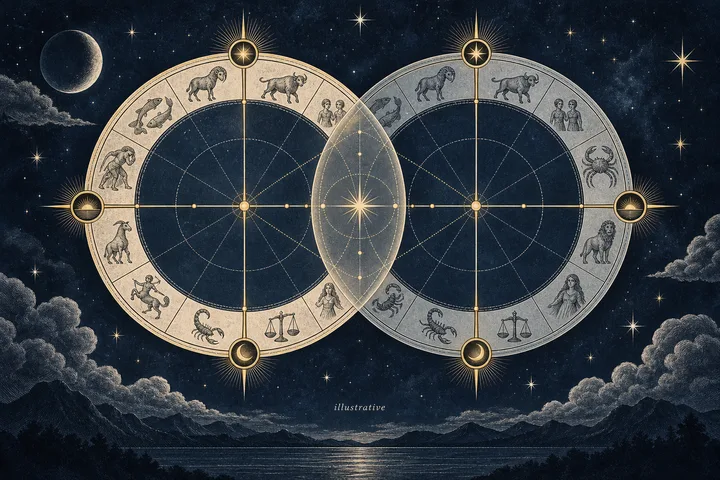
Yes. You can use the four angles in synastry without every house cusp, provided the angle signs and degrees are supplied and the birth time behind them is trustworthy. Treat the Ascendant, Descendant, Midheaven, and IC as sensitive points. Compare them with the other person's planets or angles, rank close major contacts within a six-degree orb, and read each point through its opposite axis. That gives you a useful first layer: how someone meets you, partners with you, supports your public direction, or enters your private foundations. It doesn't give you a license to name an uncertain house overlay. Record the data, check the degree arithmetic, then turn the strongest contacts into questions about attraction, home, work, and partnership. Add houses only after the report identifies its house system and provides the cusps that system needs.
The four angles are a cross, not four extra cusps
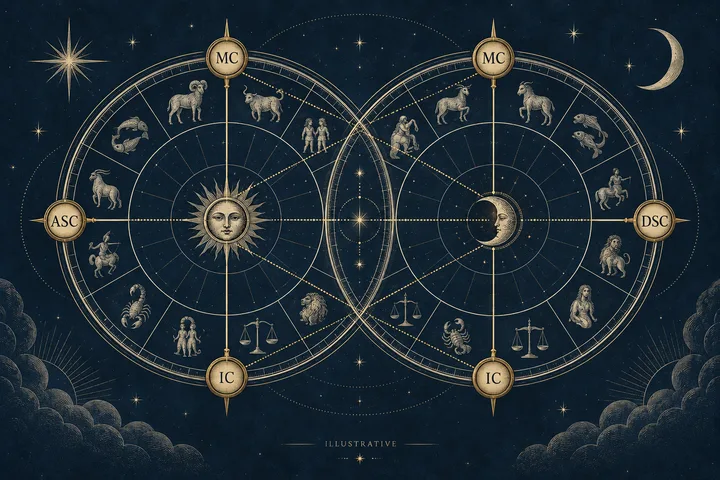
The four angles are the chart's main cross. The Ascendant, or ASC, is where the zodiac rises in the east. The Descendant, or DSC, sits directly opposite it in the west. The Midheaven, or MC, is the meridian's high point. The Imum Coeli, or IC, is opposite the MC. The horizon makes the ASC-DSC axis. The meridian makes the MC-IC axis.
That geometry gives each angle a distinct doorway into synastry. The ASC describes how a person enters life and meets the world. The DSC describes the field of partnership and direct encounter. The MC brings public direction, reputation, responsibility, and long-term aims into view. The IC points toward roots, home, family ground, and private security. AstroAk's reference describes the same four-part skeleton and links the angles to exact birth time and place.
A partner's planet touching one of these points can make a theme immediate. Venus near your ASC may make liking visible in the first exchange. Mars near your DSC may sharpen desire or disagreement. The Moon near your IC may create a private, familiar feeling. The Sun near your MC may connect the relationship with your public direction. These are interpretive starting points. The planet, its sign, the aspect, and the rest of the comparison decide how far the reading can go.
Begin with the point and its axis. Ask what becomes more noticeable at that doorway, then ask what the opposite end needs. A planet on the ASC also speaks to the DSC. A planet on the MC also raises the question of the IC. This keeps the reading relational. You aren't collecting four dramatic labels. You're watching how self and other, public life and private life, answer one another.
Sources: AstroAk: The Four Angles: Ascendant, Descendant, Midheaven and IC; Cafe Astrology: Astrological Houses: Divisions
What missing cusps change, and what they don't
House cusps and angle degrees belong to related parts of the chart, but they aren't interchangeable. In quadrant systems, the angles commonly begin the first, fourth, seventh, and tenth houses. In whole-sign houses, the first house is the entire sign containing the ASC, and the MC can fall inside the ninth, tenth, or eleventh house instead of starting the tenth. Equal houses also begin from the ASC degree and don't necessarily place the MC on the tenth cusp. Kerykeion lays out these differences in its technical house-system guide; Cafe Astrology makes the same practical point about the four angles and house beginnings.
So separate the claims. 'Her Venus is four degrees from his DSC' is an angular contact. 'Her Venus is in his seventh house' is a house overlay. The first uses the supplied degree relationship. The second depends on the house method, the full cusp structure, and reliable chart inputs. If the report gives the angle but hides the intermediate cusps, you can still read the first claim. Don't silently promote it into the second.
This distinction also helps when two reports disagree. A whole-sign report and a Placidus report may give different house placements while retaining the same ASC, DSC, MC, and IC degrees. Compare the shared geometry first. Then name the house-system difference as a separate interpretive layer. If the angle degree itself changes, stop and investigate the birth time, time zone, location, zodiac, or settings before ranking the contact.
Use three labels in your notes. Call it an angle contact when the degrees support the relationship. Call it an axis theme when you are reading the paired points. Call it a house overlay only when the method and cusp data support that statement. The vocabulary is simple, but it prevents a partial report from carrying a larger claim than its data can hold.
Sources: Kerykeion: House Systems: Mathematical Foundations and Cusp Calculation; Cafe Astrology: Astrological Houses: Divisions
How to rank contacts on the ASC and DSC
Read the horizon axis as the pattern of meeting. The ASC is the threshold of self-presentation and immediate response. The DSC is the threshold of partnership, projection, and direct engagement. When another person's planet contacts your ASC, their planet enters the way you move through the world. When it contacts your DSC, that planet becomes especially present in how you experience the other person and the relationship itself.
Start with the closest major aspect. A conjunction is usually the clearest activation because the planet and angle occupy the same degree neighborhood. An opposition can be just as important because it reaches the opposite end of the same axis. Squares create friction that demands a response. Trines and sextiles can help the planet flow into the angle person's life. For this guide, use a six-degree orb for selected major aspects, and give the smallest orbs the most weight.
Then identify the planet. The Sun can make the connection feel visible and defining. The Moon brings instinct, comfort, and changing moods. Mercury puts words and interpretation at the threshold. Venus brings liking, pleasure, and attraction. Mars brings initiative, heat, and sometimes impatience. Jupiter enlarges confidence or expectation. Saturn adds seriousness, duty, patience, or weight. Slow planets matter, but a close personal-planet contact usually gives the cleaner first sentence.
Add the sign last, not first. Venus on a Taurus ASC may express through steadiness, touch, and practical pleasure. Venus on an Aquarius ASC may express through friendship, room to breathe, and attraction to difference. The sign shapes the expression; it doesn't replace the degree contact. A sign-only resemblance can open a question, but it belongs below a supported aspect in the ranking.
Finally, split the experience between the angle person and the planet person. If her Moon is conjunct his ASC, he may feel her emotional rhythm close to his body and manner, while she may feel that her feelings reach him directly. If his Mars is conjunct her DSC, she may experience his initiative as central to partnership, while he may act out Mars through pursuit, challenge, or desire. Neither role proves intent. It gives both people language for what they notice.
Sources: AstroAk: The Four Angles: Ascendant, Descendant, Midheaven and IC; Cafe Astrology: Astrological Houses: Divisions
What the MC and IC add to the relationship picture
The MC-IC axis changes the question from 'How do we meet?' to 'What does this bond touch in the life we are building?' The MC is the public angle. It speaks to visible aims, reputation, responsibility, and the direction a person wants to take. Cafe Astrology describes it as a point tied to public standing, long-term goals, and the work a person becomes known for. The IC is the private pole: home, family ground, memory, and the base from which someone can act.
A partner's Sun near your MC may make you feel seen in your direction. Jupiter may encourage growth. Saturn may bring accountability or pressure. Venus may make public cooperation feel natural. None of these contacts promises a career result. They show where the partner's presence meets your public axis, and that meeting can become support, competition, admiration, or a demand for clearer priorities.
The IC carries a quieter charge. A close Moon-IC contact can feel intimate before either person can explain why. You may fall into domestic rhythms quickly, share a strong private language, or touch family patterns that need care. Saturn near the IC may ask whether you can build dependable shelter without turning love into duty. Uranus may ask for a home life with more freedom and flexibility than either person expected.
Read both ends together. If her Venus touches his MC while his Mars touches her IC, one person may experience the bond through public encouragement while the other feels it through private desire, domestic pressure, or the need for safety. That isn't a measure of who cares more. It shows where each person notices the relationship first. The useful questions are concrete: How do we support each other's work? What must stay private? What kind of home rhythm helps both of us feel steady?
Don't force a parent story every time the IC appears, or a status story every time the MC appears. Let the planet and the lived pattern narrow the meaning. A chart contact becomes useful when it helps you name a real decision about visibility, belonging, time, or support.
Sources: Cafe Astrology: Astrological Houses: Divisions; Cafe Astrology: Midheaven in Astrology
A worked example when the house list is incomplete
Imagine Maria and Daniel comparing a report that supplies the four angles and the degrees of their Sun, Moon, Venus, and Mars, but not every house cusp. The report uses a six-degree orb for selected major aspects. Maria's ASC is 18° Libra, her MC is 7° Cancer, her DSC is 18° Aries, and her IC is 7° Capricorn. Daniel's Venus is 20° Libra, his Mars is 6° Cancer, and his Moon is 15° Aries. These positions are supplied for method. They are not a calculated personal chart.
Do the arithmetic before interpreting. Daniel's Venus is 2° from Maria's ASC, so it qualifies as a close conjunction. His Mars is 1° from her MC, another close conjunction. His Moon is 3° from her DSC. The three contacts don't say the same thing. Venus-ASC can describe immediate liking and pleasure in Maria's manner. Mars-MC can bring drive, challenge, or action into her public direction. Moon-DSC can make Daniel's emotional responses especially present in Maria's partnership field.
Now group them by axis. Venus on the Libra side of Maria's ASC and Moon near her Aries DSC activate the horizon line. The pair can ask how easy attraction becomes direct partnership, and whether warmth and emotional immediacy leave enough room for clear boundaries. Mars near the Cancer MC activates the meridian. The opposite Capricorn IC brings private structure into the question: whose work takes priority, what support looks like at home, and how the pair protects rest while pursuing visible aims.
The missing house list doesn't stop those readings. It does stop a stronger claim such as 'Daniel's Venus is in Maria's seventh house' or 'his Mars is in her fourth house.' Those statements need the named house method and relevant cusp data. Keep the supported contact. Leave the unsupported overlay out.
Reverse the comparison. Synastry isn't only what Daniel's planets do to Maria's angles. Check Maria's planets against Daniel's ASC, DSC, MC, and IC as well. If Maria's Mercury touches his DSC, communication becomes part of the mutual story. If no close reciprocal contact appears, say the pattern is asymmetrical. That doesn't make it meaningless. It tells you where each person may feel the activation most strongly.
Turn the three contacts into actions rather than a verdict. Maria and Daniel might name one public support they need, one private boundary, and one way to pause before a mood becomes an accusation. The chart has done enough when the symbols sharpen a conversation. It doesn't need to decide the relationship for them.
The exception, the order of operations, and the decision
The strongest exception is an uncertain birth time. The angles depend on the local horizon and meridian, so a time error can move an angle by several degrees or shift its sign. AstroAk notes that the zodiac moves past the horizon quickly and that even a modest time error can affect the ASC, MC, and house framework. If the time is uncertain, mark the angle layer provisional. Give stable, supplied planetary placements more weight until the time is confirmed.
If you know only the angle signs, stay at sign level. Libra rising beside a partner's Venus in Libra can suggest ease around style or social manner. It isn't proof of a Venus-ASC conjunction. Degree contact is specific. Sign resonance is broad. Keep them in different ranks.
Use this order: record each angle's sign and degree; record the other person's planet and angle degrees; note the zodiac, house method, time zone, and birth-time quality when supplied; check planet-to-angle contacts; check angle-to-angle contacts; group the results by ASC-DSC or MC-IC axis; interpret the planet through its sign; then compare the reading with what you actually observe. Add house overlays last.
Rank only the contacts that survive that check. A one-degree personal-planet conjunction leads. A five-degree sextile can support it. A sign-only resemblance stays in the background. If several contacts repeat one theme, name it once and give its clearest expression. Repetition doesn't make a pattern stronger. Clarity does.
The next step is practical. Write the three closest supported angle contacts in a small table. For each one, add the point, planet, separation, aspect, axis, and one observable question. 'How do we welcome each other?' belongs beside Venus-ASC. 'How do we handle competing goals?' belongs beside Mars-MC. 'What helps emotion become partnership rather than reaction?' belongs beside Moon-DSC. Then watch what happens in ordinary life.
If you want a fuller comparison, confirm the birth times, use one stated zodiac and house method, and add exact degrees. A supplied-placement report can compare Moon, Venus, Mars, optional degrees, selected major aspects, and supplied angles. It can't infer a missing birth time or calculate houses that weren't provided. That scope is enough for a precise angle reading, as long as you let the evidence set the rank.
Sources: AstroAk: The Four Angles: Ascendant, Descendant, Midheaven and IC; Kerykeion: House Systems: Mathematical Foundations and Cusp Calculation
A little more clarity
Can I read synastry angles if I know only the signs, not the degrees?
Yes, but keep it at sign level. You can discuss the tone of a planet meeting an angle sign and its opposite axis, but you can't call the contact a conjunction, opposition, square, trine, or sextile without degrees. Treat sign resonance as a broad clue and rank supported degree contacts above it.
Does a planet on the MC always sit in the tenth house in synastry?
No. In many quadrant systems the MC begins the tenth house, but whole-sign and equal-house methods can place the MC inside another house. Read the planet's contact to the MC first. Add a tenth-house overlay only when the report names the house system and supplies the data needed for that placement.
Sources & further reading
- AstroAk: The Four Angles: Ascendant, Descendant, Midheaven and IC
Supports the horizon and meridian axes, angle meanings, and the effect of uncertain birth time on angle degrees.
- Kerykeion: House Systems: Mathematical Foundations and Cusp Calculation
Supports the distinction between whole-sign, equal, and quadrant houses and the MC's status as a sensitive point.
- Cafe Astrology: Astrological Houses: Divisions
Supports common ASC, IC, DSC, and MC house associations and the fact that house systems do not all place them identically.
- Cafe Astrology: Midheaven in Astrology
Supports the MC as an angle associated with public direction, reputation, responsibility, and long-term goals.
Synastry Comparison Report
Enter known placements for two people. Get an input-by-input comparison, selected aspect calculations and a clear record of what remains uncertain.
Compare our placements