A conjunction joins the planets, not their goals
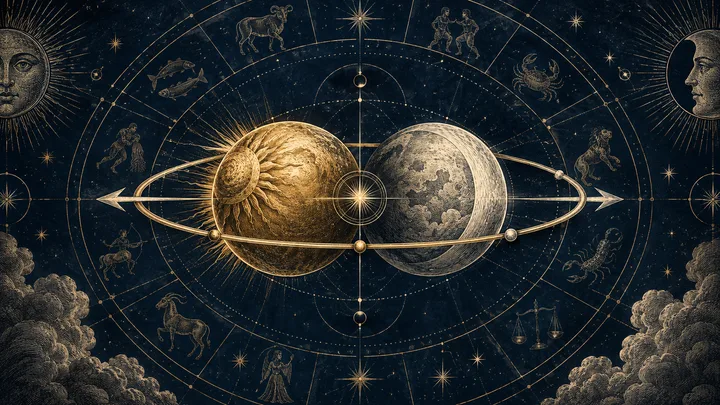
The simplest mistake is also the most tempting one: two planets sit together, so they must want the same thing. They don't. A conjunction puts the functions in the same room. It doesn't make them identical.
Astrodienst describes the conjunction as a close bond in which both energies interpenetrate. In synastry, your planet activates your partner's planet, and your partner's planet activates yours. Venus may want agreement while Mars wants a direct answer. The Moon may seek reassurance while Mercury reaches for an explanation. A conjunction adds repeated activation. It concentrates a theme until the couple can see it, use it or keep colliding with it. It doesn't add a compatibility grade.
A synastry conjunction adds concentration, not sameness. Two planetary functions meet in one shared field, so they keep activating one another. That can feel intimate and immediate. It still doesn't mean they want the same result. Moon conjunct Venus may join emotional comfort with affection, while Venus conjunct Mars may join attraction with pursuit. Read the planets first, then the signs, then the degrees and orb. Check each planet in its own natal chart before deciding how the contact behaves between you. The useful question isn't whether the conjunction is good. It's what the two of you repeatedly bring together, where your aims split, and what practice gives both functions room.
Sources: Conjunction - Astrodienst Astrowiki; Synastry - Astrodienst Astrowiki
Why a conjunction feels immediate
Synastry compares two horoscopes by placing the planets of one person against the chart of the other. Astrodienst calls the resulting links interaspects. A conjunction has very little symbolic distance, so one person's planet can touch a sensitive place in the other's chart without much translation.
That closeness can feel like recognition. It can also feel irritating because it lands fast. Degree closeness increases the concentration, but immediacy isn't total importance. Read each natal chart as a whole before treating the partner as the source of a feeling. The relationship is a meeting between two complete charts, not one aspect floating by itself.
Sources: Synastry - Astrodienst Astrowiki; Interaspect - Astrodienst Astrowiki; Aspect - Astrodienst Astrowiki
Start with the planet pair
Don't begin with the word romance. Begin with the jobs. Moon conjunct Venus joins emotional response with affection. The Moon may want dependable reassurance while Venus keeps the atmosphere pleasant. When a difficult feeling appears, Venus may smooth it over and the Moon may need it named.
Venus conjunct Mars joins attraction with initiative. Venus may want courtship and a graceful pace. Mars may prefer a clear signal and a direct move. Moon conjunct Saturn places feeling beside responsibility. These are starting points, not fixed roles. Both people can repeat the pattern, interrupt it or give it a better form.
Sources: Conjunction - Astrodienst Astrowiki; Synastry - Astrodienst Astrowiki; Relationship Astrology - An Intro Course with Kelly Surtees
The sign gives the shared field a style
Once you know the planet pair, read the sign. The sign shows the manner, pace and instinct the two functions use to reach their aims. It doesn't replace the conjunction. It gives the meeting a setting.
Imagine Maria's Moon at 14 degrees Taurus joined her partner's Venus at 16 degrees Taurus. Their two-degree contact may build comfort through touch, loyalty and steady routines. Move the same pair to Gemini and the Moon may process feeling through questions while Venus shows affection through wit and variety. A late Leo Moon and an early Virgo Venus can form a close contact across a sign boundary, but warmth and usefulness still ask for translation.
Sources: Conjunction - Astrodienst Astrowiki; Interaspect - Astrodienst Astrowiki
Degrees and orb tell you how much weight to give it
A sign match isn't the same as a close conjunction. An aspect is measured by degree, and an orb is the allowed distance from exactness. Astrodienst notes that synastry often calls for a smaller orb because comparing two charts creates many possible interaspects.
For this focused comparison, use a six-degree orb for supplied Moon, Venus and Mars placements. A Moon at 12 degrees Leo and Venus at 15 degrees Leo have a three-degree conjunction. A Moon at 28 degrees Leo and Venus at 2 degrees Virgo have a four-degree conjunction across the sign boundary. Within one degree gets first attention, one to three is tight, and three to six is usable. If degrees are missing, compare the signs but don't call the contact exact, calculate houses or fill in absent positions.
Sources: Interaspect - Astrodienst Astrowiki; Aspect - Astrodienst Astrowiki; Synastry - Astrodienst Astrowiki
A worked comparison shows what changes
Consider an example. Lena's Moon is at 8 degrees Virgo. Daniel's Venus is at 11 degrees Virgo. Their three-degree contact brings feeling, affection and daily care into one field. Lena may want attentive care. Daniel may believe he is loving when he offers a useful fix. If Lena wants sympathy and Daniel gives edits, the conjunction hasn't failed. It has shown its split. Their first practice is to ask whether comfort, help or space is wanted.
Now change only the planet pair. Lena's Venus is at 8 degrees Virgo and Daniel's Mars is at 11 degrees Virgo. Venus-Mars still joins attraction and action, but Virgo makes desire selective. Venus may want a graceful gesture while Mars moves toward what works. Same sign. Same closeness. Different work. Moon-Venus asks how feeling and affection recognize each other. Venus-Mars asks how attraction and initiative coordinate.
Sources: Conjunction - Astrodienst Astrowiki; Synastry - Astrodienst Astrowiki; Relationship Astrology - An Intro Course with Kelly Surtees
The strongest exception: similar planets can still clash
It would be too neat to say that different planets create friction while similar planets create ease. Moon conjunct Moon can feel familiar, but both people may need comfort at the same moment. Venus conjunct Venus can share taste, yet both may wait to be pursued. Mars conjunct Mars can bring heat, then turn a disagreement into a contest of speed.
The reverse matters too. Moon conjunct Saturn can become a dependable container when Saturn offers steadiness without condescension. The natal condition is the hinge. If Saturn works as trusted structure in one chart, a partner's Moon may experience shelter. If Saturn carries fear, the same contact may feel like surveillance. Planet similarity raises recognition, not cooperation. Planet difference raises translation, not conflict.
Sources: Conjunction - Astrodienst Astrowiki; Synastry - Astrodienst Astrowiki; Synastry: The Astrology of Relationships
Turn the symbolism into one honest conversation
A conjunction earns its place when it helps you notice a repeatable exchange. Start with behavior, not a label: ‘When I ask for reassurance, you explain the facts.’ Then name the two planetary jobs. With Moon-Venus, ask whether the moment calls for comfort, appreciation or agreement. With Venus-Mars, ask whether initiative feels welcome and what pace feels good.
Add the sign as a style guide. An earth contact may need a routine. An air contact may need clearer words. A water contact may need time. A fire contact may need one direct next action. Choose one practice. Ask before offering advice, or agree that desire can be named without pressure and declined without punishment. Bring one known conjunction to one real conversation. Name both wishes. Watch what the two of you do with the shared field.
If you want the comparison organized, the Synastry Comparison Report uses the Moon, Venus and Mars placements you supply, with optional degrees, and applies a stated six-degree orb to selected major aspects. It can compare the contact you already know. It doesn't calculate a natal chart from birth details or add houses that weren't supplied. That keeps the question focused: what do these placements bring together, and what does the pair need to practice?
Keep the experiment small. Notice one exchange this week and write down what each person seemed to want before you explain it with astrology. Try the new response once, then ask what changed. Did the Moon receive warmth? Did Venus feel appreciated? Did Mars receive a clear welcome? If the answer is no, the contact has given you better information, not a bad omen or a final answer. Adjust the practice or return to the natal chart. Let the symbol sharpen observation. That pause protects both people from turning a chart into an accusation or a promise. It should help you speak sooner and more honestly, not make you surrender your judgment right now.
Sources: Synastry - Astrodienst Astrowiki; Interaspect - Astrodienst Astrowiki; Synastry: The Astrology of Relationships
A little more clarity
Is a synastry conjunction always positive?
No. A conjunction is concentrated, not automatically easy. Similar planets may recognize each other and still compete for the same role. Different planets may need translation and still cooperate well. Read the planet pair, sign, degree, natal condition and surrounding contacts before ranking it.
What orb should I use for a conjunction in synastry?
For a focused Moon, Venus and Mars comparison, use a six-degree orb and state it clearly. Give the most weight to contacts within one degree, then one to three degrees, then three to six degrees. If the planets share a sign without a close degree contact, describe a shared field rather than an exact conjunction.
What is the difference between Moon-Venus and Venus-Mars conjunctions?
Moon-Venus joins emotional need with affection, so the central question is how care is offered and received. Venus-Mars joins attraction with action, so the central question is how desire, initiative and pace are coordinated. Both can feel magnetic, but they ask for different relationship skills.
Can a conjunction tell me whether the relationship will last?
A conjunction can show a strong recurring dynamic, but it can't decide the relationship's future. Read both natal charts and the wider synastry, then watch how the two people handle the contact. The chart can show where attention belongs. The couple decides what they build there.
Sources & further reading
- Conjunction - Astrodienst Astrowiki
Supports conjunction as a close bond whose expression depends on planetary energies, sign, house and other chart factors.
- Synastry - Astrodienst Astrowiki
Supports synastry as a comparison of two horoscopes through interaspects and reciprocal planetary placement.
- Interaspect - Astrodienst Astrowiki
Supports using a smaller orb in synastry because doubled chart factors create many possible interaspects.
- Aspect - Astrodienst Astrowiki
Supports the conjunction as a zero-degree major aspect and explains how planetary nature shapes an aspect.
- Relationship Astrology - An Intro Course with Kelly Surtees
Supports studying emotional, physical and practical connection through planetary interactions between two charts.
- Synastry: The Astrology of Relationships
Supports reading synastry as relationship dynamics and separating astrological description from how people resolve a pattern.
Synastry Comparison Report
Enter known placements for two people. Get an input-by-input comparison, selected aspect calculations and a clear record of what remains uncertain.
Compare our placements