
Bring both people's Moon, Venus, and Mars signs first. Add every degree you truly have, plus the zodiac system, minutes, source report, and any note about rounding. A degree from one chart is useful for organizing the comparison, but it can't confirm an interchart aspect until the paired position is also precise. Your first job isn't to hunt for a dramatic contact. It's to make a clean intake sheet that separates supplied facts from questions still open. Mark each entry exact, rounded, sign-only, or unknown. Then choose the one relationship question you want the comparison to answer. The Synastry Comparison Report uses supplied placements and optional degrees, a declared six-degree working orb for selected major aspects, and no invented houses or birth-chart calculations. Bring the data you know. Label the gaps. Decide which missing number is worth requesting.
Build the packet before you read the chart
When one person has a detailed report and the other has a list of signs, the temptation is to start interpreting the detailed chart. Pause. The most useful thing you can bring is a shared packet that lets both charts enter on equal terms.
Start a two-column note, one column for each person. For every placement, write the planet, sign, degree, minutes, zodiac system, and source. If a report says Venus 14 degrees Taurus, keep the minutes if they appear. If it says only Taurus, write sign-only. If two records disagree, write both versions and flag the conflict. Don't quietly choose the one that produces the prettier reading.
Add the question at the top. Are you comparing emotional ease, affection, desire, communication, or the way you handle pressure? A synastry report can contain many contacts. Your question tells you which ones deserve the first look. A clean packet turns a pile of placements into a decision about what to investigate.
Sources: Aspect, Astrodienst Astrowiki; Orb, Astrodienst Astrowiki
Settle the reference frame first
Before you compare a single degree, check that both records speak the same astrological language. Write down whether each uses the tropical or sidereal zodiac. Both divide the zodiac into twelve thirty-degree signs, but they anchor those signs differently. A change of reference frame can move a planet into another sign and change the degrees you are comparing.
Record the date and time shown, the location, and whether the output is a natal chart or a placement list. If you have only supplied placements, you can compare those placements. You can't responsibly add houses, angles, or a rising sign that the packet doesn't contain.
This isn't clerical fussiness. It prevents a false disagreement. Two reports can display different signs because they use different zodiac settings, or different degrees because one rounds while the other keeps minutes. Resolve the frame before asking what the contact means.
Sources: Orb, Astrodienst Astrowiki; Interaspect, Astrodienst Astrowiki
Bring the placements that answer the first question
For most relationship questions, bring the Moon, Venus, and Mars for both people. The Moon gives you the emotional and daily-life layer. Venus shows attraction, taste, affection, and values. Mars brings desire, initiative, heat, and the way each person moves through friction. These aren't a complete relationship story. They're a focused beginning.
Add the Sun when recognition, confidence, or the meeting of identities matters. Add Mercury when the question is how you talk, listen, explain, or misunderstand one another. Add Saturn when time, duty, boundaries, or staying power sits at the heart of the question. Bring the placements that serve the question instead of exporting every point a calculator can display.
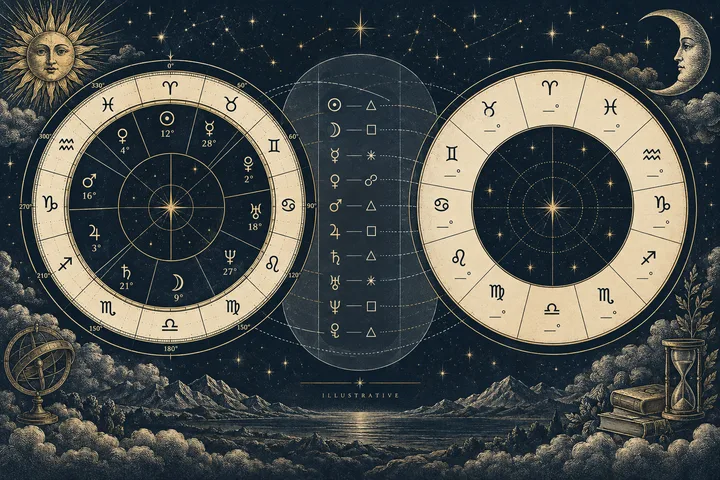
Keep the direction of each cross-pair visible. Your Venus to his Mars is a different interpretive sentence from his Venus to your Mars. A synastry contact gives each planet a role in the exchange, so a worksheet that collapses both directions into chemistry loses useful detail.
Sources: Interaspect, Astrodienst Astrowiki; Aspects Between Charts, Cafe Astrology
Separate exact data from useful leads
Use four labels in your intake sheet: exact, rounded, sign-only, and unknown. They tell you what kind of statement you can make next.
Exact means both paired positions are supplied closely enough to measure the angle you are studying. Rounded means the report has shortened a degree, such as 12 degrees instead of 12 degrees 41 minutes. Rounded data can still be useful, but don't present a borderline contact as more precise than the record allows. Sign-only gives you a sign relationship and a lead. Unknown means the packet can't answer that part yet.
A known degree on one side doesn't establish a precise aspect. Your Moon at 27 degrees Libra and the other person's Moon listed only as Libra may suggest a same-sign connection, but the second degree controls the distance and priority. Write possible same-sign contact, pending the other degree. Don't write Moon conjunct Moon.
Keep the raw entry beside your interpretation. Record whether the number came from a chart wheel, an aspect table, an exported list, or a message from the other person. This makes the comparison reproducible and gives you somewhere to return when two reports disagree.
Sources: Aspect, Astrodienst Astrowiki; Orb, Astrodienst Astrowiki
Choose an orb policy before ranking contacts
An orb is the distance allowed from an exact aspect. It's part of your method, not a secret quality score. Astrologers vary in the ranges they use, and interchart work can become noisy because two charts create many possible contacts. State the rule before you decide what counts.
For this report, use a six-degree working orb for selected major aspects: conjunction, sextile, square, trine, and opposition. Apply it only when both planet positions are known. A four-degree conjunction belongs in the measured column. A sign-only pairing belongs in the possible column, even if the signs make a conjunction seem likely.
Then rank by more than admission. A one-degree contact sits closer to exact than a six-degree contact. A close Moon-Mercury contact may answer a question about feeling understood better than a closer Venus-Jupiter contact. First check the angle. Then check the planets and signs. Finally ask whether the contact speaks to the question that brought you there.
A declared orb keeps your report calm. It stops a long list of wide contacts from pretending to be a verdict, and it tells you exactly what additional degree would change the reading.
Sources: Aspect, Astrodienst Astrowiki; Interaspect, Astrodienst Astrowiki
A worked intake example with one detailed record
Consider an example. Maria brings a report with degrees: Moon 12 degrees Virgo, Venus 14 degrees Taurus, Mars 22 degrees Cancer, Sun 3 degrees Gemini, and Mercury 18 degrees Gemini. Daniel brings a placement list: Moon Virgo, Venus Taurus, Mars Leo, Sun Gemini, and Mercury Cancer. His list has no degrees.
The packet answers one question: which placements are available for a first sign-level comparison. It doesn't answer which paired planets form major aspects. Maria's degrees are not wasted. They show which of Daniel's missing numbers would be most useful to request, and they reveal whether a placement sits near a sign boundary where a later degree could change the language.
If the question is emotional comfort, request Daniel's Moon degree first. If it's attraction and pace, request Venus and Mars degrees first. If it's communication, request Mercury degrees. This is a better intake decision than asking for a complete export without knowing what the comparison needs.
Now imagine Daniel supplies Venus 19 degrees Taurus and Moon 8 degrees Virgo. Those pairs can be measured under the declared orb. His Mars remains sign-only, so Maria's Mars at 22 degrees Cancer can't be used to name a precise Mars contact with it. The packet has become more useful in one layer, not magically complete in every layer.
Imagine instead that Daniel reports Venus 28 degrees Taurus. The shared sign remains an interpretive layer, but the degree distance changes the aspect question. Preserve the number and its source. Don't choose the result that sounds more romantic.
The example doesn't invent birth times, houses, percentages, or outcomes. It shows what to bring and what the next request should accomplish.

Check the sign boundary before you call a contact clean
The strongest exception appears near the end or beginning of a sign. A planet at 29 degrees Aries and another at 2 degrees Taurus are three degrees apart around the zodiac, so the angle may fall within a conjunction orb. But the planets speak through Aries and Taurus, not through one shared sign.
Astrologers call this an out-of-sign or dissociate aspect. The angle and the sign story deserve separate sentences. The contact may be close, yet it may not feel like a seamless blend. One person can move quickly and directly while the other seeks steadiness and proof. The exact expression belongs to the planets and signs involved.
If your Venus is at 29 degrees Virgo and the other person's Mars is listed only as Libra, ask for the Mars degree before choosing between a close conjunction across the boundary and a wider separation. The missing number can change both the geometric label and the way the signs modify it.
Name the layers plainly: close angle, different signs, interpretation held open until the second position is checked. That's stronger than calling the contact seamless or dismissing it entirely.
Sources: Aspect, Astrodienst Astrowiki; Orb, Astrodienst Astrowiki
Finish with one question and one next request
Once the packet is clean, choose the first useful question. For Moon contacts, ask what helps each person feel cared for on an ordinary day. For Venus, ask what each person counts as affection and what feels like pressure. For Mars, ask how each person starts, disagrees, and returns to warmth. The chart gives the pattern a name. Your conversation shows how it lives.
Ask for a missing degree when it could change the aspect label, the closeness ranking, or the answer to your first question. Don't delay the whole comparison for a detail that won't alter that first pass. Sign themes can be read as sign themes. A precise aspect can wait until it has two precise positions.
The Synastry Comparison Report is built for this focused packet. Bring the Moon, Venus, and Mars signs for both people, add the optional degrees you have, and keep missing entries visible. The report compares supplied placements and selected major contacts within a six-degree working orb. It doesn't calculate a natal chart from birth details, add houses, or fill gaps for you.
Start the conversation like this: I have both sign sets and some degrees. Which question should we answer first, and which missing number could change it? That's the right handoff from chart data to shared understanding.
Sources: Interaspect, Astrodienst Astrowiki; Aspects Between Charts, Cafe Astrology
A little more clarity
What should I send if only one person has exact degrees?
Send both people's Moon, Venus, and Mars signs, every known degree and minute, the zodiac system, the source report, and notes about rounding or conflicting records. Label the other entries sign-only or unknown. One-sided degrees help organize the request, but they don't confirm a paired aspect.
Do I need birth times for a placement-only synastry comparison?
You need the placements you intend to compare, not an invented set of houses or angles. Preserve supplied time and chart-setting information as source data. The Synastry Comparison Report uses supplied placements and optional degrees; it doesn't calculate missing natal positions or houses.
How should I handle a rounded degree?
Keep the rounded value, mark it rounded, and be careful with contacts near the edge of your chosen orb. A rounded position may be enough for a clear, close aspect, but it shouldn't be presented as minute-level precision. Keep the original report so the number can be checked later.
When is it worth asking for the missing degree?
Ask when the number could change the aspect label, the closeness ranking, or the answer to your first relationship question. Prioritize the Moon for emotional questions, Venus and Mars for attraction or pace, Mercury for communication, and Saturn when commitment or limits are central.
Sources & further reading
- Aspect, Astrodienst Astrowiki
Defines aspects as angular relationships and explains major aspect angles and the role of an orb.
- Orb, Astrodienst Astrowiki
Explains that orb practice varies by aspect and that close sign-boundary contacts need separate treatment.
- Interaspect, Astrodienst Astrowiki
Supports a smaller, declared orb in interchart work because two charts create many possible contacts.
- Aspects Between Charts, Cafe Astrology
Explains that each planet carries a role in an interchart exchange and signs modify the contact's expression.
Synastry Comparison Report
Enter known placements for two people. Get an input-by-input comparison, selected aspect calculations and a clear record of what remains uncertain.
Compare our placements