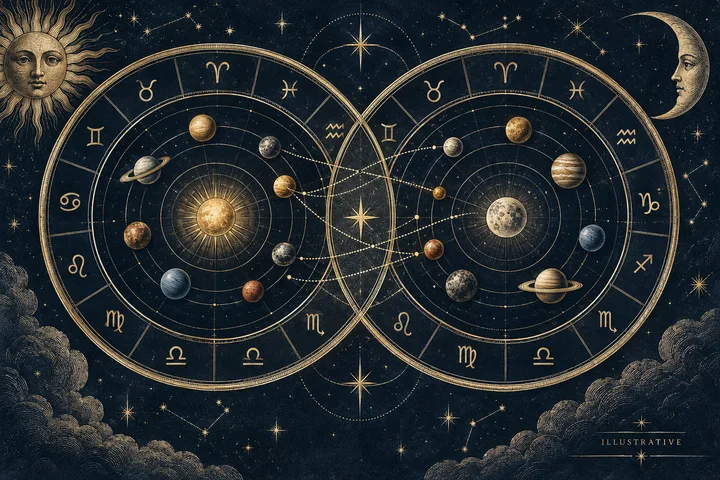
A synastry chart shows where two people’s planetary functions meet. Each planet brings a function to the exchange, the aspect describes how those functions connect, and signs color their expression. House overlays can add the life area where a planet may be felt, when reliable birth-time data supports them. Read these as related layers, not fixed identities or a relationship verdict.
What does a synastry chart actually show?
A synastry chart compares two people's chart placements to show where their planetary functions meet. Each planet describes a function in the exchange; an aspect describes how two functions contact one another. A house overlay adds another question: where in one person's chart might the other person's planet be felt? These are connected layers, but they don't do the same job. Together, they offer a way to read an interaction, not a score or a fixed cast list. In “What is a synastry chart, exactly?”, Sona describes two charts read against each other, with planet-to-planet aspects and planet-to-house overlays as distinct mechanics. That distinction matters. A contact between two planets gives you a shared aspect to interpret. An overlay places one person's planet in a house of the other person's chart, adding a life-area setting to the reading. Neither layer turns a person into one planetary label. Cafe Astrology's “Aspects Between Charts” makes the role idea concrete: in a Saturn–Sun contact, one person brings Saturn's function while the other brings the Sun's. The chart reader can then ask how those functions meet, and how the people might experience the exchange. Signs can refine the expression; house overlays can add context when the chart supports them. Start with the contact, name both planetary functions, then add the other layers carefully.
Sources: What is a synastry chart, exactly?; Aspects Between Charts
What role does each planet bring to a contact?
Each planet names a function in the exchange, not a whole person. In a synastry contact, one person's planet meets another person's planet, so start by asking what each function contributes to this particular interaction. The Moon can describe emotional needs and the search for security; Mercury, how someone thinks, speaks, and makes meaning; Venus, affection, attraction, and values; Mars, initiative, assertion, and desire. The Sun can describe a person's central vitality and self-expression. Saturn brings boundaries, responsibility, and structure. These are working symbols, not labels that capture everything either person is. The page “Aspects Between Charts” at Cafe Astrology models this role-based reading through a Saturn-to-Sun contact: it asks the reader to consider the person carrying Saturn and the person carrying the Sun, then refine the interpretation with each planet's sign and house. Kerykeion's “Synastry Introduction” likewise treats an inter-chart aspect as a meeting between distinct planetary lenses. Together, these guides support a practical distinction: the planet names the function a person brings to the contact, while the contact describes the shared exchange. Neither role tells you what someone secretly intends or how they will always behave. Try a simple two-column note for one scene you recognize. **Planet / function:** What does my placement bring here? **Contribution in this scene:** What might that function look like in the moment? Repeat for the other person's planet. For instance, if you are examining a Moon–Mars contact, note “Moon / feeling and security” beside “Mars / initiative and desire,” then ask how those functions actually meet in the interaction. This is a prompt, not a claim that the Moon person is always sensitive or the Mars person always acts first. Keep the scene small. “How do we handle a change of plans?” gives the symbols something concrete to illuminate; “Who are we as partners?” asks a single contact to carry too much. A planet can play a different part in another exchange, and the same person brings many functions to a relationship. Name the contribution, check whether it fits the moment, and leave room for the person to tell you what the moment felt like.
Sources: Aspects Between Charts; Synastry Introduction
How can one contact give each person a different role?
In a cross-chart contact, each person brings the function of the planet they carry. If one person’s Moon forms an aspect to the other person’s Mars, the Moon describes feeling, instinct, and a need for emotional security; Mars describes initiative, desire, and the urge to act. The aspect remains one shared geometry between the placements, not a second, reversed aspect. In “Aspects Between Charts,” Cafe Astrology describes each participant through the planet involved in that particular interaction. Kerykeion’s “Introduction to Synastry” likewise calls an inter-aspect two-way, while noting that each person experiences it through a different planetary lens. That difference matters. “Two-way” doesn’t mean both people feel the same thing, react at the same speed, or take turns in a neat pattern. It means the contact links both placements, and a useful reading asks what each function contributes. In a Moon–Mars contact, one person may notice that a quick move or blunt response stirs a strong feeling; the other may experience the same moment as an attempt to get something started or address a problem. The Moon person isn’t automatically passive, and the Mars person isn’t always forceful. To read the exchange, ask three questions in order: What does my planet bring to this moment? How does it meet the other person’s planet? What might each of us notice when this pattern appears? If the aspect is Moon to Mars, that might mean naming the feeling or need on one side and the impulse or action on the other, then checking those words against an actual interaction. Kerykeion’s introduction emphasizes that the wider pattern and each natal chart shape how an aspect is expressed; the contact alone doesn’t define a relationship. Let both people refine it through their own words and responses. When the same planet meets itself, such as Moon–Moon or Mars–Mars, don’t force a contrast that isn’t there. Both people bring the same planetary function, though signs and natal charts can make their expressions different. The question shifts from “Who is the Moon, and who is Mars?” to “How do our emotional needs meet?” or “How do our ways of acting reinforce or interrupt each other?” Cafe Astrology’s discussion of house overlays distinguishes planet-to-planet aspect roles from the less straightforward roles in overlays. So name the functions the aspect connects, then let the people and their wider charts supply nuance.
Sources: Aspects Between Charts; Synastry Introduction; Synastry: Planet Overlays in Houses
What does the aspect add to the role reading?
The aspect gives a planet pair its connecting verb. It shows how two functions meet: blending, flowing, creating pressure, or facing one another. In synastry, that verb belongs to one shared contact between two charts. It doesn't assign fixed identities or decide the relationship's quality. A conjunction brings functions into a shared channel. They may feel closely linked, supporting cooperation or intensifying a difference. A square adds pressure: the functions may ask for movement at once, or approach a moment in ways that don't immediately fit. Friction can demand attention or prompt effort. An opposition makes contrast visible. Each function may pull toward a different end of an axis, so the useful question is how both sides can have room. These are textures, not outcomes. Astrology.ac's “Aspects” describes conjunctions as capable of cooperation or competition, squares as pressure that can build skill, and oppositions as contrasts to integrate. A trine suggests easier flow between functions; a sextile suggests an opening that can be used. Ease can help people coordinate, but a familiar strength can go unexamined. Pressure can expose a difference that invites effort, though it can also remain difficult. “Introduction to Synastry” describes every aspect as carrying both resources and growth edges, and says no type is inherently better or worse. Consider a hypothetical Moon–Mars contact. The Moon's feeling and security function meets Mars's action and assertion function. In a flowing aspect, a need and response might coordinate readily. In a square, timing may come into focus: one person may want acknowledgment before action, while the other moves quickly to address the moment. This isn't a prediction. Check whether the reading fits a recurring scene. Keep angle type separate from exactness. The aspect name describes the angular relationship; the orb measures distance from its exact angle. Astrology.ac's “Aspects” defines orb this way and notes that its limits are one published method, not a universal rule. “Square” doesn't mean close, and “trine” doesn't mean effortless in every moment. Degrees can refine a reading under a chosen method, but don't replace interpretation. Name both planets, then their aspect. Ask what each function brings and what the angle suggests about their meeting. A conjunction may concentrate; a square may press; an opposition may contrast; a trine may ease; a sextile may open a path. Test that language against the interaction. A Moon–Mars square doesn't prove conflict, just as a trine doesn't promise perfect coordination. It gives you a sharper question: where do feeling and action support each other, and where might their timing need attention?
Sources: Aspects; Synastry Introduction; Aspects
How do signs change the way a planetary role is expressed?
A planet names the function; its sign describes a style for expressing it. In a synastry contact, keep those jobs separate. First ask what each planet brings to the exchange. Then ask how each sign may color that function. Cafe Astrology's “Aspects Between Charts” makes the same distinction when it says to consider the signs of both planets: a Sun-Saturn contact expressed through Scorpio placements would read differently from the same pairing in Sagittarius. The planet pair remains the same, but the style changes.
Consider an imagined example. Suppose one person has Venus in Aries and another has Venus in Taurus. As an interpretive illustration, the first placement might describe affection expressed more directly, while the second might favor a steadier pace and tangible signs of care. These are possible styles, not scripts. They don't define either person's behavior, and they don't assign one person the role of pursuer or the other the role of receiver. The useful question is narrower: if a specific Venus contact exists, how might each person's way of expressing affection meet the other's way of valuing or receiving it?
That last condition matters. A sign pairing alone doesn't establish a cross-chart aspect. An aspect depends on the angular distance between two placements; Sona's “What is a synastry chart, exactly?” defines it in those terms and distinguishes that geometry from comparing signs. Without degrees, two known signs can support a sign-level reading, but they can't show whether the planets form a close conjunction, square, trine, or another exact contact. Nor can signs alone show which interaction matters most in a couple's life.
Use signs as modifiers, then stop where the available information stops. If you know the planets and signs but not degrees, describe the functions and possible styles without naming an exact aspect. If degrees are available, identify the contact first, then let each sign refine the interpretation. This keeps the reading specific without asking a sign pair to answer a question it can't settle.
Sources: Aspects Between Charts; What is a synastry chart, exactly?
What changes when a planet falls in the other person's house?
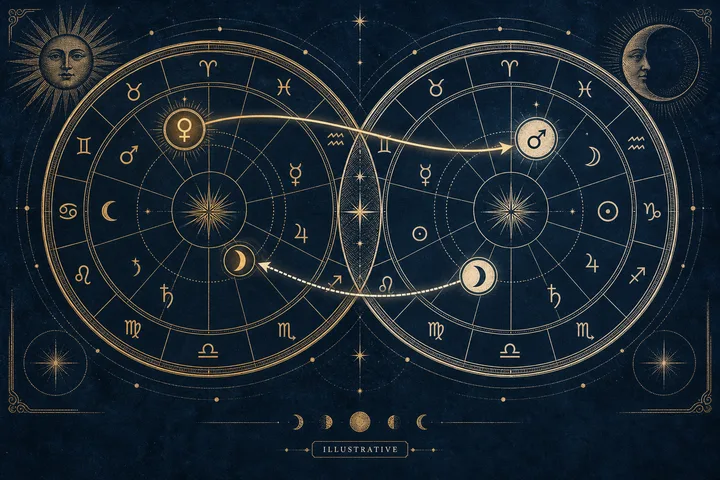
A house overlay adds a where to the role reading. It asks which area of one person's life may become more noticeable when the other person's planet enters that part of the chart. “Romantic Compatibility Synastry House Overlays” describes overlays as a way to consider where interaction is concentrated, and shows the comparison in both directions. Your Mercury in my sixth house and my Mercury in your sixth house are separate placements; one does not tell us what the reverse overlay must be. The planet brings its function, while the house gives that function a setting. “Synastry: Planet Overlays in Houses” uses a partner's Mercury in the sixth house to illustrate conversation turning toward routines and daily organization. Mercury supplies talking and thinking; the sixth-house context brings attention to everyday arrangements. This doesn't mean one person will manage the other's schedule, or that either person must enjoy these conversations. The pattern might feel engaging, irritating, or different at different times. An overlay offers a lens for noticing a theme, not a script for behavior. The overlay can be reciprocal without assigning one fixed role to each person. The planet person brings a planetary function into the house person's chart; the house person's concerns shape the setting in which that function is encountered. “Synastry: Planet Overlays in Houses” cautions that overlay roles are less straightforward than roles in a planet-to-planet aspect. Don't force a simple giver-and-receiver story onto every house placement. To read an overlay, name the planet and its function, then the house topic, and ask whether the combination describes a recurring interaction. A Mercury overlay might point toward everyday talk; it cannot tell you whether a partner is attentive, controlling, or compatible. Those judgments require what the people actually say and do. House placement depends on chart information that supports it. “Romantic Compatibility Synastry House Overlays” notes that uncertain birth times limit this part of a reading. Without reliable birth-time information and a chosen house system, leave the overlay unassigned. You can still compare known planetary signs or a degree-based aspect when those inputs are available, but don't fill the missing house with a guess. An overlay adds context about where a planetary exchange may be felt, provided the chart data supports it.
Sources: Romantic Compatibility Synastry House Overlays; Synastry: Planet Overlays in Houses; What is a synastry chart, exactly?
Why isn't sign compatibility enough to assign roles?
Sign compatibility can describe a style, but it cannot by itself tell you what role each person’s planets play in a particular exchange. Identify known placements, check for a cross-chart aspect, then use signs to color the contact. Add overlays only when chart data supports them. These layers answer different questions: how a placement expresses itself, how two planetary functions meet, and where that meeting may be felt. A sign-only comparison may suggest how Venus expresses affection or Mars initiative. But signs alone don’t establish the exact angular distance between two planets. “Aspects are angles. Interpretation starts after the math” explains that aspects measure distance between chart points; its synastry section defines the contact as one person’s planet compared with another’s. Without degrees, signs cannot verify an exact aspect or its closeness. Don’t turn a broad style description into a precise role claim. A degree-based inter-chart aspect answers a more focused question. It identifies a contact between planetary functions, then gives you a shared dynamic to interpret. Cafe Astrology’s “Aspects Between Charts” recommends reading each participant through the planet they bring to that interaction, while considering the planets’ signs and houses. Name both functions, verify the angle if degrees are available, interpret the aspect, then use signs to describe style. The aspect is one geometry shared by both charts; the roles differ because each person carries a different planet in that contact. A house overlay adds context, not a substitute role system. Sona’s “What is a synastry chart, exactly?” distinguishes planet-to-planet aspects from planets falling in another person’s houses. An overlay suggests where a planet’s function may be noticed, but doesn’t prove one person always acts while the other receives. Houses also depend on birth-time chart data. If birth time is uncertain, leave overlays out. Use the layers in order, not as rival compatibility tests. Signs describe expression. Aspects show contact and make a role reading more specific. Eligible house overlays add a possible setting. None ranks either partner or decides the relationship. With signs alone, stay at the level of style; with degrees, check the contact before naming roles. That keeps the reading faithful to its inputs.
Sources: What is a synastry chart, exactly?; Aspects; Aspects Between Charts
When do degrees, orbs, and birth times change what you can say?
Degrees change a role reading by showing whether two placements form a named aspect and how close they come to its exact angle. If you know only the signs, you can describe each planet's sign style, but you cannot claim a precise angle or orb from those labels alone. The distinction matters: an interpretation can be thoughtful and useful while still being limited to the information you have. In “Aspects are angles. Interpretation starts after the math,” Astrology.ac defines an aspect by the angular distance between two planets. It defines the orb as the distance from the exact target angle. A contact near its exact angle has a smaller orb; a contact farther away has a larger one. The page treats exactness as a question of emphasis, separate from whether the contact is easy or difficult. The aspect label and the orb answer related but distinct questions. A square remains a square whether its orb is narrow or wide under the method being used; the orb tells you how close the measured separation is to 90 degrees. Astrology.ac’s own examples and limits belong to its published calculation method. They are not a universal rule for every astrologer or chart reading. Methods can set different limits, so name the one being used. When both people’s degrees are known, compare the positions by their shortest zodiac angle, then check whether that separation falls within the orb policy you have chosen. The Synastry Comparison Report page describes this scope directly: it accepts supplied Moon, Venus, and Mars signs, with optional degrees, and checks five major aspects within its stated six-degree orb when both degrees are entered. That six-degree rule belongs to this report’s selected calculations. It is not a universal boundary. If degrees are missing, stay with what the input supports. You can compare known signs and discuss how each placement may express its planetary function. A sign pair may suggest a shared element or mode; that is a sign-level comparison, not a measured aspect. Birth time affects a different layer. House overlays place one person’s planets into the houses of the other person’s chart, so the chart needs a reliable time for the house structure being used. Cafe Astrology’s “Romantic Compatibility Synastry House Overlays” describes overlays as showing areas of life where an interaction may be concentrated, and presents the two directions separately. If either relevant birth time is uncertain, leave house and angle claims out rather than assigning a life area from incomplete chart data. That does not make the rest of the comparison unusable. Known placements still let you discuss sign style, and known degrees can support a selected aspect check. The report page says it begins with the placements entered, compares Moon, Venus, and Mars, and records what remains uncertain. It does not calculate natal charts from birth details or provide house overlays. So the practical choice is simple: use supplied signs for sign-level interpretation; use supplied degrees for the report’s selected major-aspect calculations under its stated six-degree orb; reserve house overlays for a chart with reliable birth-time data. Leaving that layer open is part of a careful reading, not a failure to finish the comparison.
Sources: Aspects; Romantic Compatibility Synastry House Overlays; Synastry Comparison Report
How can you test a role interpretation against a real interaction?
Take one repeated moment and ask whether the proposed planetary roles describe what each person brings and receives. A Moon–Mars contact can frame one person seeking acknowledgment while the other moves to action. Treat this as a question, not a claim about hidden motives. Imagine one person says, “I needed you to listen first,” while the other says, “I thought fixing the problem was how I could help.” Moon names the feeling or security sought; Mars names the impulse to act. These are roles in this contact, not identities or proof of intent. Next, add the aspect only if the placements support one. It describes the shared geometry and gives the exchange a quality to consider. A flowing contact might suggest that feeling and action can cooperate readily; a tense contact might bring their different timing into sharper view. Ask what each person did, and whether the symbolism fits. “Synastry: An Introduction” treats inter-aspects as two-way contacts experienced through distinct planetary lenses, while “Aspects Between Charts” advises reading the planets in their signs and houses. Together, they support a layered reading. Then bring in sign style or house setting only when those placements are known and suitable chart data supports them. A sign may suggest how a function is expressed; an overlay may add the life area where it is felt. They refine, but cannot rescue a mismatch with the couple’s account. The strongest exception is the planet’s wider natal context. Its condition and wider chart relationships can change how its function comes through. If the scene doesn’t fit, don’t force it. Check the placements, narrow the claim, or set it aside. Notice whether this exchange repeats, or whether it was unusual; one scene can test a reading, but cannot establish a lasting pattern. Then ask each other a concrete question: “When I ask for listening and you start solving, what response would help us both?” The chart can give you a useful prompt. Your answers and choices show what to do with it.
Sources: Synastry Introduction; Aspects Between Charts
Compare one placement exchange, then ask one useful question
Choose one known contact and write down what each planet contributes before deciding what the exchange means. If your Moon meets the other person's Mars, name the Moon's emotional or security function and Mars's drive to act. Then record the shared aspect, if the degrees support one. The angle describes the contact between both placements; it doesn't change when you look from the other chart. Ask what each person may bring to that exchange, not who must always play one role. Aspects Between Charts offers this planet-by-planet approach, while Synastry Introduction notes that each contact can be experienced through distinct planetary lenses. Test the reading against one recurring moment. Does it help describe what happens, and can both people recognize their part? Treat that as a question to explore together, not a claim about anyone's hidden motive. If the description feels forced, set it aside or check whether the placements and degrees are known. Sign descriptions can add style; house overlays need reliable birth-time data, so leave them out when that information isn't available. If you want help comparing placements, the Synastry Comparison Report uses supplied Moon, Venus, and Mars signs, optional degrees, and selected major aspects within its stated six-degree orb. It doesn't calculate natal charts from birth details or provide house overlays. Compare one exchange, then ask: does this describe a pattern we both recognize, and what response would help next time?
Sources & further reading
- What is a synastry chart, exactly?
Defines synastry through two charts, inter-chart aspects, and reciprocal house overlays, distinguishing those mechanics from a sign-only comparison.
- Aspects Between Charts
Describes participants through the planets involved in a contact and advises considering each planet's sign and house.
- Synastry Introduction
Frames inter-aspects as contacts experienced through distinct planetary lenses and places them within broader chart context.
- Synastry: Planet Overlays in Houses
Explains planet-in-house overlays and cautions that assigning roles in overlays is less straightforward than in aspects.
- Aspects
Defines aspects by angular distance and orb, and separates aspect geometry and exactness from whether a contact is considered easy or difficult.
- Romantic Compatibility Synastry House Overlays
Describes reciprocal house overlays as areas where interaction may be concentrated and notes the limits of uncertain birth times.
- Aspects
Supports the article's comparison of aspect types as interpretive textures in a planetary contact.
- Synastry Comparison Report
States the report's supplied Moon, Venus, and Mars inputs, optional degrees, selected major-aspect checks at a six-degree orb, and calculation limits.
Synastry Comparison Report
Enter known placements for two people. Get an input-by-input comparison, selected aspect calculations and a clear record of what remains uncertain.
Compare our placements