The corrected chart gets the first word
A synastry aspect that disappears after a time-zone correction should be removed from the main reading. That's the supported position. You don't owe a vanished contact a wider orb because its interpretation felt uncannily right.
Synastry compares factors from two horoscopes. An interaspect belongs to the relationship between those chart positions, so both moments must be represented correctly before you interpret the contact. The earlier reading can remain in a change log as a record of what the old settings displayed. It can't remain as current chart evidence.
This distinction keeps the reading honest without making it cold. A memory attached to the old interpretation may still matter to the couple. The memory is part of the lived story. The erased square, trine, or opposition is no longer part of the technical ranking.
This article uses a clear scope: supplied Moon, Venus, and Mars placements, optional degrees, selected major aspects, and a six-degree maximum orb. It doesn't calculate natal positions from birth details or add houses. If you have corrected placements, compare those. If you have signs only, stay with sign-level interpretation.
Read the corrected chart and retire any aspect that falls outside the orb you declared. A time-zone mistake changes the moment represented by a local birth time, which can shift the Moon, angles, houses, and contacts near an aspect boundary. Preserve the old input, verify the place and historical daylight-saving rule, convert each moment to Universal Time, and compare the corrected degrees. Then rebuild the aspect list with one consistent method. In this guide, that means supplied Moon, Venus, and Mars placements, optional degrees, selected major aspects, and a six-degree maximum orb. If the contact disappears, label it removed. If a sign relationship or another aspect remains, read that as a separate, lower-ranked layer. Do not let a moving story keep a contact that the corrected degrees no longer support. The next useful step is a short evidence sheet, followed by one conversation about a pattern the surviving chart and real life can both show.
Sources: Astrodienst FAQ: Time Zones and Daylight Saving Time; Astrodienst Astrowiki: Synastry
Why the time-zone error matters
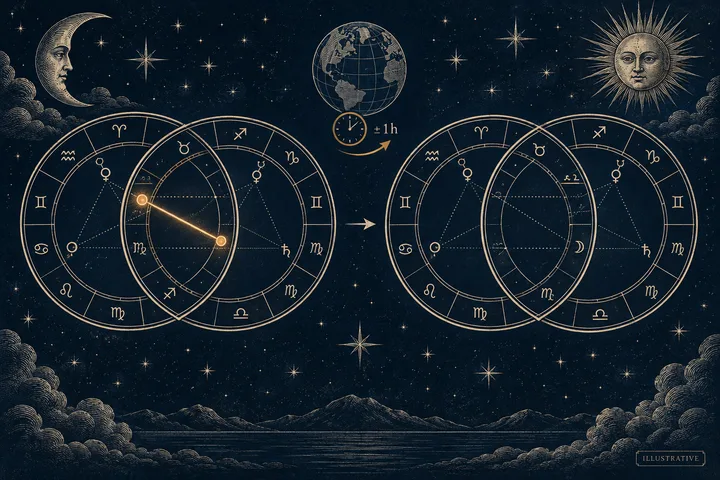
A birth record gives a local civil time. The chart needs the corresponding moment in a common time standard, usually Universal Time, along with the place that anchors the historical time-zone rule. A familiar abbreviation such as EST or CET may hide the wrong seasonal offset, and the wrong offset can move the represented moment by an hour or more.
IANA's time-zone database preserves histories of offsets and daylight-saving changes by location. That history is why a named place and birth date are more useful than a loose abbreviation. The rule in force at the time matters, not the rule used in that city today.
The Moon is the obvious pressure point because it moves quickly. A one-hour shift may leave it in the same sign while changing its degree enough to cross a close aspect boundary. Angles and house cusps respond even more sharply, though they require a full chart scope. Slower planets may barely move during the same correction.
The first question isn't which interpretation feels better. It's which moment each chart actually used. Write down the local date, clock time, place, time-zone identifier or offset, and resulting Universal Time for both people. If one entry is missing, mark the affected conclusion provisional.
Sources: Astrodienst FAQ: Time Zones and Daylight Saving Time; IANA: Time Zone and Daylight Saving Time Data
Rebuild the two moments before reading them
Keep the original chart inputs before you correct anything. Save the local times, places, displayed offsets, and the aspect list that first caused concern. You are comparing two versions of the data. You aren't trying to defend or blame the person who entered it.
Verify the civil-time history for each place and date. Check daylight saving, unusual historical rules, and whether the recorded time means the clock time shown at birth or a different registry convention. Then convert both moments using the verified offset. Don't subtract an hour by habit. Establish why the correction is an hour, half an hour, or something else.
Re-enter the corrected placements or recalculate them in the chart system used for the comparison. Compare degrees, not just sign labels. A planet can stay in the same sign while its degree moves across the edge of an aspect. A late local birth can also become the next date in Universal Time, which makes copying a date-only placement especially risky.
Finish with a compact record. For each person, list local time, place, zone, Universal Time, and the corrected placements you actually supplied. That record gives the later interpretation something solid to point back to.
Sources: Astrodienst FAQ: Time Zones and Daylight Saving Time; IANA: Time Zone and Daylight Saving Time Data
Let the degree and orb decide the contact
An aspect is an angular relationship between chart factors. Conjunctions approach 0 degrees, sextiles 60, squares 90, trines 120, and oppositions 180. The orb is the distance between the measured angle and the exact aspect. Degrees decide whether the contact belongs in the selected aspect list; signs add the surrounding symbolic language.
Consider an example. Maria's Venus is at 14 degrees 20 minutes Taurus. Her partner's Moon was first listed at 20 degrees 10 minutes Leo, placing the pair about 5 degrees 50 minutes from an exact square. After the corrected time-zone input, the Moon is listed at 21 degrees 05 minutes Leo. The separation is about 6 degrees 45 minutes, outside this guide's six-degree maximum. The Venus-Moon square is removed.
The Taurus and Leo placements still form a fixed-sign contrast. That can support a sign-based discussion of steadiness, pride, comfort, and the pace at which affection is shown. It can't be described as a confirmed Venus-Moon square under the stated method. The sign layer survives. The aspect claim doesn't.
Astrodienst notes that astrologers use smaller orbs for interaspects because synastry creates many possible contacts. Other traditions may choose another limit. Choose yours before the audit, state it, and apply it to every pair. A rule that changes only when a favorite aspect disappears isn't a method.
Sources: Astrodienst Astrowiki: Synastry; Astrodienst Astrowiki: Orb
Rank what survives instead of averaging it
Once the corrected degrees are in place, sort the evidence. Put the closest confirmed major contacts first, then wider confirmed contacts within the six-degree rule. Read sign themes after that. Keep out-of-sign contacts, minor aspects, outer-planet patterns, and lived observations in named layers rather than blending them into one dramatic conclusion.
A vanished Venus-Moon square might leave a Moon sign contrast, a different contact between the same planets, or a close Mars contact elsewhere in the comparison. Each possibility asks a different relationship question. Venus and Moon speak to affection and care. Mars speaks more to initiative, desire, and conflict pace. The planet pair should shape the wording.
If several surviving contacts repeat one theme, give that theme more attention. If the removed aspect was the only support for a claim, cut the claim. Don't let the old paragraph remain in charge because it was vivid. A quieter chart can still have a clear center.
The same ranking helps with a visual wheel. A missing line may reflect a display setting, while a line may represent a wide contact that the table ranks low. Read the degrees and orb first. Let the picture help you see the pattern, not decide what the pattern is.

Sources: Astrodienst Astrowiki: Synastry; Astrodienst Astrowiki: Orb
The exception is a change of layer, not a rescue
Sometimes the old contact disappears from one category but leaves a valid astrological layer behind. A square can fall outside the chosen orb while the signs still show a meaningful modal or elemental relationship. A contact can cross signs and become an out-of-sign or dissociate aspect, which some astrologers keep with reduced weight. A different declared orb can also explain why another report displays it.
Imagine a Moon at 28 degrees 50 minutes Gemini paired with Saturn at 4 degrees 40 minutes Virgo. The separation is about 65 degrees 50 minutes, a sextile with a 5-degree 50-minute orb. If the corrected Moon is 29 degrees 20 minutes Gemini, the separation becomes about 65 degrees 20 minutes. The sextile survives and becomes tighter. The correction changes its strength and wording, not its existence.
Now imagine the corrected degrees place the pair 7 degrees 12 minutes from the exact square. A wider-orb school may mention a broad, secondary square if that school was chosen in advance. This six-degree comparison doesn't rank it as a major aspect. Name the alternative. Don't smuggle it into the main result.
The Moon deserves its own care. If it stays in the same sign but loses the aspect, keep the sign reading and remove the aspect language. If it changes sign, rebuild the Moon interpretation from the corrected placement. If an Ascendant or house cusp changes, stop and use a full chart method with verified birth data. A placement-only report shouldn't add houses to fill an empty space.
Sources: Astrodienst Astrowiki: Synastry; Astrodienst Astrowiki: Orb
Turn the surviving chart into a useful question
Chart repair is only half the work. The surviving pattern should lead to a question you can observe, not a verdict about the relationship.
Start with the technical change in plain language: ‘The earlier report used a different offset. After correction, the Venus-Moon square is outside our six-degree rule. These other contacts remain.’ That gives both people the same starting point and keeps the correction from becoming a personal accusation.
Then choose one surviving theme. A Moon-Venus contact can open a conversation about how each person gives and receives care. A Mars contact can open one about initiative, pressure, and the time each person needs before repair. A sign contrast can help name different comfort styles. The chart suggests the question. The couple supplies the lived examples.
Consider an example. Imagine Maria once used the vanished square to explain why she asked for reassurance while her partner withdrew. After correction, a close Sun-Mars opposition remains. The better question is not whether the missing square secretly proves the pattern. It is how each person experiences pressure when one wants action and the other needs a pause, and what a fair pause would look like next time.
Write down one recent moment, what each person needed, what each assumed, and one change to try. If the conversation produces a new technical question, return to the corrected evidence. If it doesn't, let the chart do its useful work and stop there.
Make the final call and release the vanished aspect
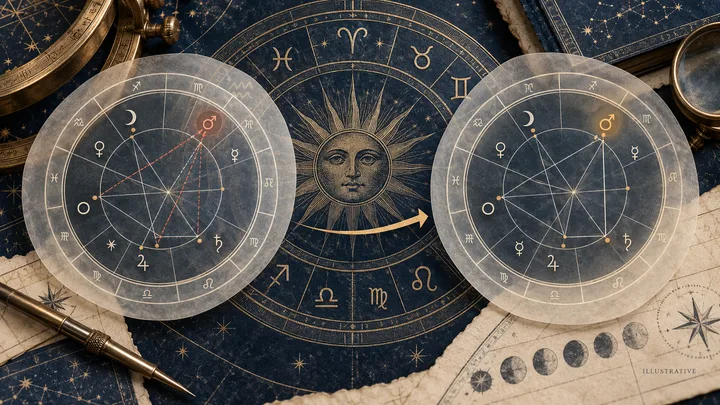
Use three labels in the finished comparison: confirmed, reclassified, and removed. Confirmed means the corrected degrees form the named aspect within the stated six-degree orb. Reclassified means another named layer remains, such as a sign relationship or an out-of-sign contact. Removed means the corrected data no longer supports the contact within the method. Removed is a complete result.
If two reports still disagree, compare them in order. Check place and coordinates, then the local clock time, then the historical offset and Universal Time. Only after those match should you compare zodiac reference, ephemeris, aspect list, rounding, and orb settings. This prevents a settings debate from hiding a basic input error.
Keep the old result in a short change note, not beside every interpretation. Record the corrected input, the surviving degrees, the aspect name and orb, and the layer that was removed or reclassified. Then take one surviving theme into the conversation described above.
The decision is simple. Keep the corrected evidence. Name any surviving layer honestly. Release the aspect that no longer meets the rule. If the data is uncertain, narrow the claim until it fits what you know. The relationship doesn't become less meaningful because one chart input was wrong. The reading becomes clearer about where its meaning comes from.
Sources: Astrodienst FAQ: Time Zones and Daylight Saving Time; IANA: Time Zone and Daylight Saving Time Data; Astrodienst Astrowiki: Synastry; Astrodienst Astrowiki: Orb
A little more clarity
Should I keep interpreting a synastry aspect that disappears after correcting daylight-saving time?
No. Remove it from the main interpretation when the corrected degrees place it outside your declared orb. Keep the old result only in a short change note. If a sign relationship, out-of-sign contact, or another valid aspect remains, name that layer separately and give it the weight its own evidence supports.
What if the corrected chart changes the Moon sign or an angle?
Rebuild that part of the reading from the corrected placement. The Moon can change degree or sign across a time correction, and angles can move quickly. A placement-only comparison can use supplied Moon, Venus, and Mars signs with optional degrees. Houses and angles need a separate full chart calculation with verified birth data.
Sources & further reading
- Astrodienst FAQ: Time Zones and Daylight Saving Time
Supports treating recorded local clock time through the historical time-zone and daylight-saving rule for the place and date.
- IANA: Time Zone and Daylight Saving Time Data
Supports using named historical time-zone data, documented UTC offsets, and location-specific daylight-saving changes.
- Astrodienst Astrowiki: Synastry
Supports defining synastry as comparison of horoscopes and interaspects between factors in one chart and another.
- Astrodienst Astrowiki: Orb
Supports defining the orb as distance from exactness and stating a consistent interpretive range for aspects.
Synastry Comparison Report
Enter known placements for two people. Get an input-by-input comparison, selected aspect calculations and a clear record of what remains uncertain.
Compare our placements