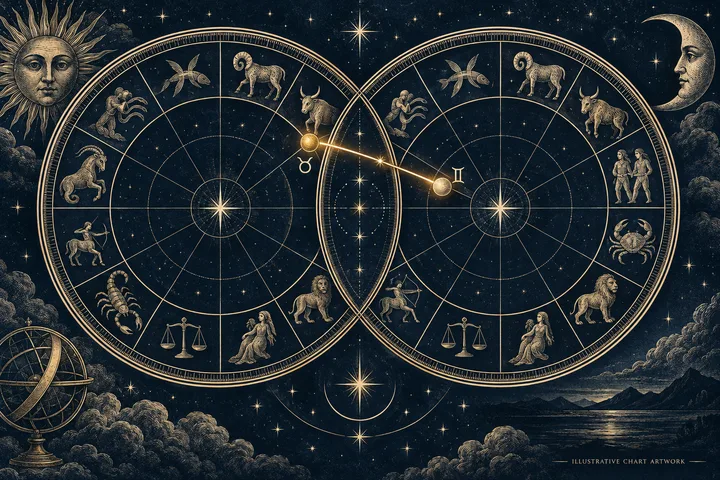
Imagine a Venus-Mars contact with two different stories
Imagine Maria’s Venus at 29° Aries and Alex’s Mars at 1° Cancer. Convert those placements to absolute zodiac degrees: 29° and 91°. Their shortest distance is 62°, which places them two degrees from an exact sextile. By degree, this is a close Venus-Mars sextile. By sign, Aries and Cancer form a square relationship. The same pair carries both descriptions.
That isn’t a chart mistake. It’s a crossed-sign, or dissociate, aspect. The degree contact links Venus and Mars. It can describe attraction, approach, pleasure, and the way two people energize one another. The signs add a different tone. Aries moves directly and quickly. Cancer protects feeling and looks for safety. The sextile offers a way in. The sign relationship asks them to learn each other’s timing.
Maria may reach out plainly and expect a lively response. Alex may feel the invitation, then pause until the moment feels safe. If he answers later with practical care, Maria could miss the affection inside the action. If she presses for an immediate answer, he could hear urgency where she meant warmth. The aspect is active. The signs explain why it needs translation.
This example is illustrative. It uses supplied placements to show the method, not a calculated personal chart. In a real comparison, keep the planet, sign, degree, and minutes visible. Then record the aspect and the sign relationship separately. That small habit keeps one label from doing too much work.
The useful question isn’t whether the sextile is real enough to keep. It is what the contact asks the pair to notice. When one person moves toward closeness quickly, what helps the other person respond without retreating?
Sources: The Classical Origin and Traditional Use of Aspects - Skyscript; Dissociate Aspect - Skyscript Glossary; Aspect - Skyscript Glossary
Degree distance and sign relationship measure different things
An aspect measures angular distance around the 360° zodiac. The major aspects are the conjunction at 0°, sextile at 60°, square at 90°, trine at 120°, and opposition at 180°. An orb is the difference between the actual distance and the exact angle. At 62°, the Venus-Mars pair has a 2° sextile orb.
A sign relationship works from the twelve sign divisions. Aries and Cancer are three signs apart, so they carry a square relationship by sign. Leo and Sagittarius are four signs apart, so they carry a trine relationship by sign. These sign patterns remain meaningful even when the exact planetary degrees point to another angle.
The distinction matters because the two layers answer different questions. Degree distance tells you how directly the planets meet. The signs tell you the language, element, modality, and style of that meeting. An orb lets a contact count without being exact, but closeness still matters: a 1° contact leads, a 5° contact supports, and a 6° contact sits at the edge of this comparison rule.
Yes. A synastry aspect can be close by degree and cross two different signs. Astrologers call this an out-of-sign or dissociate aspect. The angular distance shows that two planets are meeting strongly. The signs show the style of that meeting, and sometimes the friction around it. Read both layers in order: calculate the shortest distance, state the orb, name the aspect, then compare the sign relationship. For this comparison scope, use supplied Moon, Venus, and Mars placements and a six-degree maximum for selected major aspects. A close contact deserves attention, but it doesn’t erase the sign story or decide a relationship’s future. If you have the degrees, check the contact by hand. Then turn the result into one clear question about how the two of you handle closeness, timing, comfort, or desire.
Sources: The Classical Origin and Traditional Use of Aspects - Skyscript; Aspect - Skyscript Glossary; Skyscript Beginners Astrology Course, Lesson 10
How to check the aspect without guessing
Use absolute zodiac degrees. Aries begins at 0°, Taurus at 30°, Gemini at 60°, and so on. Add the sign’s starting point to the planet’s degree. Then subtract the two totals. If the result exceeds 180°, subtract it from 360° to find the shorter distance.
For the illustrative pair, Venus at 29° Aries is 29°. Mars at 1° Cancer is 91°. The difference is 62°. Compare 62° with the major aspect angles. It is 2° from 60°, so write: Venus-Mars sextile, 2° orb, out of sign, Aries-Cancer by sign.
Now test the example that exposes the strongest exception. Consider 28° Leo and 2° Scorpio. Leo begins at 120°, so the first placement is 148°. Scorpio begins at 210°, so the second is 212°. Their distance is 64°. That is a sextile with a 4° orb. Yet Leo and Scorpio form a square relationship by sign. The degree-first label is a sextile. The sign-first layer is a square.
This is why sign names alone can’t establish an exact aspect. They can show a broad relationship, but they can’t tell you whether two planets are 56°, 64°, or 74° apart. Rounded degrees have limits, too. A placement displayed as 29° may represent any point from 29°00′ to 29°59′. Record the source precision instead of inventing minutes.
If two reports disagree, compare their zodiac reference, degree display, aspect list, and orb settings before assuming one has made an error. Different rules can produce different labels from the same supplied placements.
Sources: The Classical Origin and Traditional Use of Aspects - Skyscript; Dissociate Aspect - Skyscript Glossary; Aspect - Skyscript Glossary
What out-of-sign or dissociate means in practice
Out-of-sign means the planets form an aspect by degree while their signs don’t hold the same aspectual relationship. Dissociate is the older technical term used for that split. Astrological reference material describes the contact as weakened, varied, or marked by a contradiction that must be worked through before the aspect expresses cleanly.
Treat that wording as a reading instruction, not a verdict. A dissociate aspect isn’t absent. It’s mixed. The planets connect, but the signs don’t hand them one shared method, so the expression may feel less automatic and more revealing at the sign boundary.
In Maria and Alex’s example, Venus and Mars have access through the sextile. Aries and Cancer add a square-like sign tension. Direct pursuit meets emotional caution. The result may be chemistry with a timing problem. That’s more precise than calling the pair harmonious or incompatible.
Some astrologers lead with the sign relationship and treat the degree contact as a modification. Others lead with the exact angle and read the sign mismatch as a complication. Name both, then say which layer leads your reading.
Sources: The Classical Origin and Traditional Use of Aspects - Skyscript; Dissociate Aspect - Skyscript Glossary
Let the aspect type describe the movement
The aspect still matters after you identify the sign mismatch. A conjunction brings the planets into one immediate field. A sextile offers an opening that usually needs participation. A square presses the two functions into friction and adjustment. A trine suggests flow. An opposition creates a strong line of awareness between two ends of an axis.
Then add the sign relationship. A close out-of-sign conjunction can feel immediate, yet the two signs may want separate things from the same moment. A close out-of-sign sextile can provide an easy opening while the signs disagree about speed. A close out-of-sign square may feel especially demanding because both the angle and the sign layer call for adjustment.
The 28° Leo to 2° Scorpio example makes the point. By sign, the planets form a square relationship. By degree, they form a 64° sextile. A reading that calls it only a square misses the opening in the contact. A reading that calls it only a sextile misses the fixed-sign friction. Keep both. Let the degree aspect describe the main movement, and let the sign relationship refine its tone.
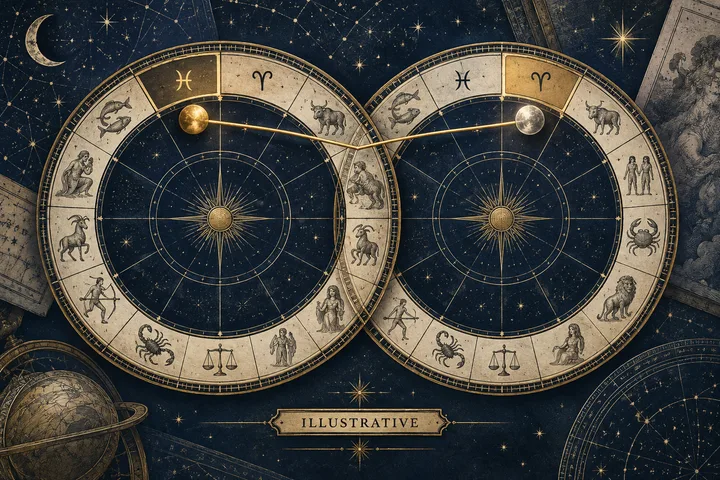
For Moon, Venus, and Mars, attach the interpretation to the planets. The Moon asks how the bond feels and settles. Venus asks what draws the people together and how they show preference. Mars asks how they pursue, desire, defend, and act. The same crossed-sign square means something different for Moon-Mars than for Venus-Mars because the planet pair changes the question.
Sources: The Classical Origin and Traditional Use of Aspects - Skyscript; Aspect - Skyscript Glossary; Skyscript Beginners Astrology Course, Lesson 10
Rank a close contact inside the whole comparison
Synastry can produce a long list of contacts. Ranking keeps the list from becoming the reading. Start with the tightest major aspects involving the Moon, Venus, and Mars. Then ask whether the same theme repeats elsewhere among the supplied placements. A close contact with a personal planet usually deserves more attention than a wide contact with no supporting pattern.
Use three questions. How close is the orb? Which planets are involved? Does another contact echo the same theme? A 1° Moon-Venus contact might lead a reading about comfort and affection. A 4° Venus-Mars square might explain pursuit and friction. A 6° contact may remain useful, but it shouldn’t outrank a tighter contact simply because its label sounds dramatic.
An out-of-sign aspect can rank high for exactness and lower for ease. That isn’t a contradiction. It tells you the contact is strong enough to notice but not simple enough to summarize with one flattering word. Write the strength and the complication together.
This article’s comparison scope uses supplied Moon, Venus, and Mars signs, optional degrees, and a stated six-degree maximum for selected major aspects. It doesn’t calculate natal positions from birth details or add houses and angles. If a birth time is missing, keep those layers out. A narrower reading is better than a precise-sounding one built from information you don’t have.
Sources: Aspect - Skyscript Glossary; Skyscript Beginners Astrology Course, Lesson 10
Translate the chart contact into a relationship question
Astrology becomes useful here when it gives the couple a better question. Don’t turn the aspect into a personality label. Name the symbolic contact, then test it against something observable.
For the illustrative Venus-Mars sextile across Aries and Cancer, ask: When one person initiates quickly, what response helps the other person stay open? For a Moon-Mars contact, ask: What lets action feel supportive rather than intrusive? For Venus-Venus, ask: How does each person show preference when the other person wants a different pace or kind of reassurance?
The question should fit the aspect. A square can point toward a recurring adjustment. A trine can reveal an ease the couple has begun to assume. A sextile can show an opportunity that needs a deliberate choice. An opposition can ask what balance each person is actually requesting.
Use the lived answer to refine the reading. If Maria and Alex already have a calm way to discuss timing, the crossed-sign tension may describe a difference they know how to handle. If every invitation becomes a chase-and-retreat cycle, the same contact deserves more attention. The chart supplies a pattern. The relationship shows its current expression.
That’s also the strongest protection against overreading. A close aspect can describe a real point of contact without predicting an outcome. Rank it, name its exception, and bring it back to a choice the two people can make.
The clean reading keeps both layers in view
So, can a synastry aspect be close by degree but cross two different signs? Yes. The geometry and the sign relationship are simply telling you different parts of the story.
Write the placements exactly as supplied. Convert them to absolute degrees, find the shortest distance, name the aspect and orb, then add the sign relationship. For 29° Aries Venus and 1° Cancer Mars, the complete note is: close Venus-Mars sextile by degree, 2° orb, with an Aries-Cancer square relationship by sign. For 28° Leo and 2° Scorpio, it is a 64° sextile by degree, 4° orb, with a Leo-Scorpio square relationship by sign.
Give the close angle the first place when it is tight and relevant, unless your chosen tradition gives sign relationships priority. Missing birth times mean no houses or angles in this placement-only comparison. If you have Moon, Venus, and Mars placements ready, use the method to find the strongest contact, the style that complicates it, and the conversation that helps both people meet it well.
Sources: The Classical Origin and Traditional Use of Aspects - Skyscript; Dissociate Aspect - Skyscript Glossary; Aspect - Skyscript Glossary
A little more clarity
Is an out-of-sign synastry aspect still valid?
It can be counted in a degree-based approach, especially when the orb is tight. Some astrologers give the sign relationship priority and call the degree contact dissociate or modified. Name both layers and state which method leads your reading.
Which matters more, the sign relationship or the exact degree?
They answer different questions. The exact degree shows how closely the planets meet by angle. The signs describe the style and friction around that meeting. In practice, rank the orb first, then use the sign relationship to explain how the contact works.
What orb should I use for a synastry aspect?
Use one stated rule consistently. This comparison scope uses up to a six-degree orb for selected major aspects, with closer contacts ranked higher. Other traditions use narrower or wider limits, so check the method behind the report you’re reading.
Sources & further reading
- The Classical Origin and Traditional Use of Aspects - Skyscript
Supports the distinction between degree-based and sign-based aspects, crossed-sign contacts, and the historical development of orb practice.
- Dissociate Aspect - Skyscript Glossary
Defines a dissociate aspect and explains why a crossed sign relationship can weaken or complicate the degree contact.
- Aspect - Skyscript Glossary
Supports the major aspect angles, including sextile at 60°, square at 90°, and trine at 120°, plus the use of orbs.
- Skyscript Beginners Astrology Course, Lesson 10
Supports the practical definition of aspect orbs, the distinction between applying and separating contacts, and the common six-degree sextile example.
Synastry Comparison Report
Enter known placements for two people. Get an input-by-input comparison, selected aspect calculations and a clear record of what remains uncertain.
Compare our placements