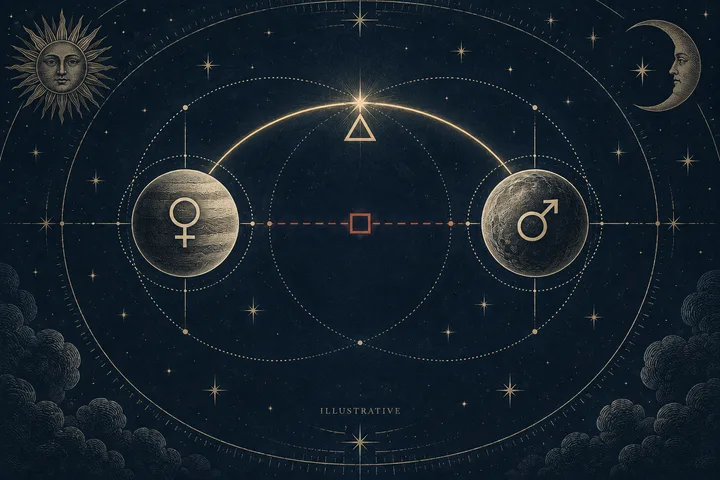
No, not for the same planet pair. Two planets have one angular distance on the zodiac circle, so within this six-degree major-aspect scope they cannot be both square and trine, or both tense and supportive, at once. A different planet pair can soften how the tension is lived. A Moon-Moon square may show different comfort rhythms, while a Moon-Venus trine can lend tenderness and emotional recognition. Read the exact tense contact first, then ask whether the other contact answers its question or merely improves the atmosphere. Compare supplied signs and degrees, rank the closest relevant aspect, and test the interpretation in an ordinary exchange. The hard contact names the pressure. The separate supportive contact may show the skill that helps you meet it.
The answer starts with the planet pair
You may see a tense contact and a flowing contact in the same synastry comparison and wonder which one wins. Perhaps your Moon squares your partner's Moon, while your Moon trines their Venus. Perhaps Mars opposes Mars, while Mercury forms a sextile to Saturn. The softer contact can feel like proof that the harder one should not matter. The harder contact can feel like proof that the softer one must be false. Neither conclusion is useful.
A supportive aspect can soften a tense aspect by giving the couple a familiar way to cooperate. It may help one person hear the feeling beneath a sharp tone, find warmth after an awkward conversation, or turn competing impulses toward a shared task. It doesn't remove the square's friction or the opposition's polarity.
The technical trap is treating one planet pair as if it can hold two major angles at once. Your Moon at 8 degrees of Taurus and another Moon at 12 degrees of Virgo are about 124 degrees apart. Under a degree-based method, that is a trine with a 4-degree orb. It isn't also a square. If a report shows both labels, check for a different planet pair, chart layer, or sign-based description.
Signs and degrees answer different questions. Signs show the style of the contact. Degrees show how close the planets come to its exact angle. Two placements in earth signs may share an elemental tone while falling outside this report's six-degree scope. Mention that background if it helps, but don't rank it beside a close degree aspect as though both had the same force.
Cafe Astrology describes sextiles and trines as flowing contacts that help blend planetary energies, while it describes squares as energies that need work and oppositions as a see-saw between two sides. Astrodienst defines the major aspects by their angles and describes the orb as the allowed deviation from exactness. That gives us a clean starting point. [Source 0, Source 1]
When you audit a report, write every supplied position as a zodiac longitude from 0 to 360 degrees. Aries begins at 0, Cancer at 90, Libra at 180, and Capricorn at 270. Add the sign's starting point to the planet's degree, then compare the two longitudes. If the difference is greater than 180 degrees, subtract it from 360. The smaller result is the pair's actual angular separation.
For example, 8 degrees of Taurus becomes 38 degrees, and 12 degrees of Virgo becomes 162 degrees. The separation is 124 degrees. The nearest major angle is 120 degrees, so the orb is 4 degrees and the contact is a trine under this method. The same two positions cannot also be 90 degrees apart. A square would require a different position or a different planet.
This check matters near sign boundaries. A planet at 29 degrees of one sign and another at 1 degree of the next sign may look far apart by sign language while sitting close to a conjunction. The reverse can happen too: two signs may suggest an elemental or modal affinity while their degrees sit outside the selected orb. Keep the sign meaning and the angular calculation in separate lines of your notes.
Then label the direction of the contact clearly. ‘Your Moon square his Moon’ and ‘your Moon trine his Venus’ are not interchangeable statements. The first compares the two Moons. The second compares your Moon with his Venus. That difference tells you whether the contact speaks first to emotional rhythm, affection, or the way one person's feeling meets the other's style of love. A report becomes easier to read as soon as every aspect carries its full planet-pair name.
For a comparison using known placements, write down the two planet pairs, the exact aspect type, and the orb for each contact. If you don't have degrees, you can discuss the sign relationship as a broad layer, but you can't honestly rank closeness. The sign tells you the style. The degree tells you how tightly the planets meet.
This is why the phrase ‘same planets’ must stay visible in the question. It changes the answer from relationship interpretation to chart mechanics first. Once the mechanics are clear, the astrological meaning has somewhere solid to stand.
Start with this working sentence: ‘The tense aspect names the recurring pressure; the supportive aspect names a resource that can meet it.’ That sentence keeps the reading direct. It also prevents the common mistake of turning one pleasant contact into a promise that everything will resolve itself.
Sources: Aspect - Astrodienst Astrowiki; Synastry: Love and Relationship Astrology - Cafe Astrology; Orb - Astrodienst Astrowiki
Read the tense aspect as the live question
Once you confirm both contacts, begin with the tense one. A square usually shows two planetary functions that don't combine without effort. An opposition places them across an axis, where each person can feel the other as a counterforce or mirror. Neither aspect is a sentence of failure. Both are questions the pair keeps meeting.
The planet pair tells you what kind of question it is. Moon-Moon asks how two people seek safety, process moods, and recover from hurt. Venus-Venus asks how they give affection, enjoy closeness, and decide what feels valuable. Mars-Mars asks how they pursue, assert, compete, and move from desire to action.
The sign pair describes the manner of the tension. A fixed-sign square may hold its ground long after the first disagreement. A mutable-sign square may scatter the issue into small corrections, changing plans, or restless talk. A cardinal-sign square may bring the conflict into the room quickly. These are tendencies, not scripts.
An opposition often feels more relationally visible than a square. One person takes the role of the initiator while the other becomes the responder, then the roles reverse. The attraction can be strong because each person carries something the other recognizes but doesn't express in the same way. The danger is making difference into accusation.
Ask what the tense contact repeatedly demands. Does the Moon square ask for different reassurance speeds? Does Venus opposition ask you to balance privacy with visible affection? Does Mars square ask you to separate shared momentum from winning? A precise question is more useful than calling an aspect difficult and moving on.
Cafe Astrology notes that squares can create frustration, but also enough tension to stimulate growth, while oppositions can bring attraction and complementarity alongside competition or insecurity. That combination is important. The contact has force. Your job is to name where the force goes. [Source 1]
Don't rank a tense aspect by how unpleasant one argument felt. Rank it by repetition, closeness, planet importance, and how many other contacts echo its theme. A close Moon square that appears every week may deserve more attention than a wide Mars opposition that shows up only in unusual circumstances.
Then write one observable sentence. ‘When one person needs immediate reassurance, the other needs time to settle.’ ‘When one person pursues, the other tests the pace.’ If the description can't be seen in a real exchange, it is still too vague.
Sources: Aspect - Astrodienst Astrowiki; Synastry: Love and Relationship Astrology - Cafe Astrology; Synastry Aspects Explained: How Two Charts Connect - AstroAk
Let the supportive aspect name the available skill
Now turn to the flowing contact. A trine usually shows an instinctive fit. A sextile shows an opening that becomes useful when someone takes initiative. Both can be supportive, but they don't work in exactly the same way. The trine may arrive without being requested. The sextile often asks to be chosen.
The supportive aspect should answer the tense aspect's question. If a Moon-Moon square creates different comfort rhythms, a Moon-Venus trine can show an available language of tenderness and care. You still need to negotiate timing. You may not need to explain why care matters to you in the first place, but you do need to decide how that care should arrive.
If Venus-Venus tension makes affection feel uneven, a trine can reveal shared pleasure beneath the mismatch. The couple may enjoy similar art, food, touch, or rituals even when they show love differently. A sextile may show that appreciation is available through deliberate acts, such as naming what the other person did well instead of waiting to feel perfectly understood.
If Mars-Mars conflict turns plans into contests, a trine can make physical work, travel, exercise, or problem-solving feel naturally collaborative. A sextile can offer a practical compromise: one person starts, the other improves the plan. The result isn't less Mars. It is Mars with somewhere useful to go.
The support may also be quieter than the tension. People notice the square during an argument. They often miss the trine during the ordinary afternoon that went smoothly. That doesn't make it weak. It means the supportive contact may be doing its work as background trust, shared rhythm, or an assumption of goodwill.
AstroAk's current synastry guide describes trines and sextiles as flowing contacts, with squares and oppositions creating workable friction. It also stresses that tighter contacts carry more weight than loose ones. That gives the supportive aspect a clear job: show the easier behavior, then test whether its degree and repetition make it strong enough to matter. [Source 3]
Don't turn the soft aspect into a personality compliment. ‘You understand each other’ is too broad. Say what they can do. ‘You can return to warmth after a disagreement.’ ‘You can make decisions through shared physical action.’ ‘You can give affection in a form the other person recognizes.’ Those are skills you can observe.
A supportive aspect is most valuable when the pair remembers it during tension. That is the bridge between symbolic ease and lived ease.
Sources: Synastry: Love and Relationship Astrology - Cafe Astrology; Synastry Aspects Explained: How Two Charts Connect - AstroAk
Closeness decides which contact leads
Aspect type matters. So does distance from exactness. The difference between a 0-degree-40-minute square and a 5-degree-50-minute trine is not a footnote. The square is usually louder because it is much closer. A wide supportive aspect may still describe a background tone, but it shouldn't overrule a close contact simply because its label sounds pleasant.
For this publication's comparison scope, use a six-degree orb for the selected major aspects. A contact at 6 degrees is a boundary contact, not equal to an exact aspect. A contact at 1 degree deserves more weight. The point isn't to pretend every astrologer uses one rule. The point is to choose the rule before you rank the chart.
Astrodienst explains an orb as the allowed deviation from an exact angular relationship and notes that astrologers use different rules for its size. Its orb guide also describes wider allowances for the luminaries and narrower ones for many other planets. Our fixed six-degree scope keeps the comparison clear when supplied placements are being reviewed. [Source 2]
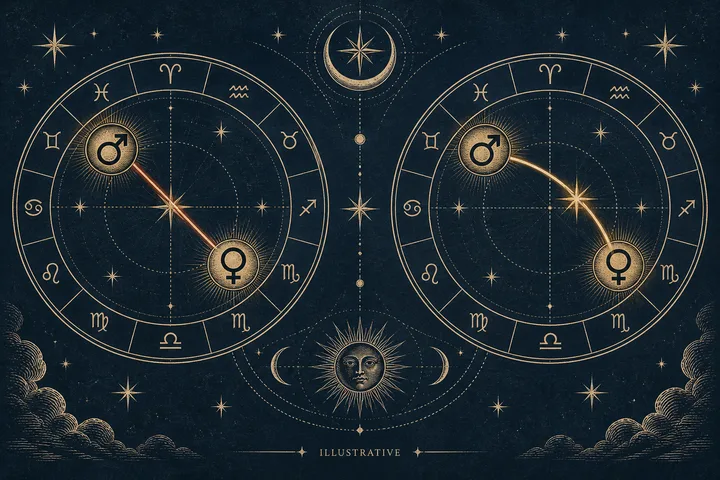
Imagine Maria has Moon at 14 degrees of Cancer and her partner's Moon at 20 degrees of Aries. Their Moon-Moon square has a 6-degree orb, right at this comparison's boundary. Maria's Moon also forms a trine to her partner's Venus at 17 degrees of Scorpio, with a 3-degree orb. The supportive contact is closer and speaks to tenderness. The square is wider but still inside the chosen scope, so it speaks to a live mismatch in emotional timing.
In that example, the trine leads the emotional reading, but it doesn't absorb the Venus square. Maria may feel that her partner understands her moods and still feel that the partner's way of showing love misses the moment. One contact says, ‘We know this inner weather.’ The other says, ‘We don't always know what to do with it.’
If the numbers reverse, the rank may reverse too. A 1-degree Moon-Moon square with a 5-degree Moon-Venus trine asks you to read the emotional friction as the dominant experience and the care contact as a usable resource. If the supportive contact falls outside six degrees, call it a sign-based or thematic background only, if your chosen method allows that language. Don't present it as an equally operative major aspect.
Exactness isn't the only ranking factor. Luminaries and personal planets often describe more immediate relationship experience. Saturn can make a contact weighty even when it is supportive. Outer-planet contacts can add intensity, idealization, or disruption. Read the planets before you announce a winner.
The practical rule is simple: closest first, personal relevance second, repeated themes third. The supportive contact earns influence by being close, meaningful, and available in the situation you are actually reading.
Sources: Aspect - Astrodienst Astrowiki; Orb - Astrodienst Astrowiki; Synastry Aspects Explained: How Two Charts Connect - AstroAk
The planet pair changes what softening looks like
The same aspect pattern doesn't soften in the same way for every pair. A Moon contact needs emotional timing. A Venus contact needs appreciation and value. A Mars contact needs a clean path for action. If you apply one generic meaning to all three, the interpretation will sound polished and tell you very little.
With Moon-Moon, a supportive trine can soften a square by preserving emotional belonging during difference. You might still need different amounts of quiet, touch, or verbal reassurance. But one person can sense that the other is not an enemy. The repair begins sooner because the bond remains present while the moods disagree.
A Moon-Moon sextile can work through small invitations. ‘Do you want company or space?’ ‘Should we talk now or after dinner?’ The questions may look ordinary. They are exactly how a sextile becomes active. It doesn't promise that both people will feel the same thing. It helps them make room for both experiences.
With Venus-Venus, the supportive contact can soften a tense aspect by creating a shared pleasure language. Two people may disagree about spending, social life, or the pace of romance and still delight in the same places, music, textures, or gestures. Let the shared pleasure become a meeting place, not a bribe that avoids the values conversation.
With Mars-Mars, support usually appears through movement. A trine can make joint effort energizing. A sextile can help each person respect the other's method enough to coordinate. The tense aspect may still surface when both want control of the same decision. The soft contact helps them remember that the goal matters more than the scoreboard.
Saturn changes the texture again. A supportive Saturn contact can lend patience, structure, and commitment to a tense personal-planet exchange. It can also feel heavy if the pair treats duty as the only proof of love. A pleasant contact to Venus does not automatically make Saturn warm. It gives the bond a container, and containers can hold or restrict.
Cafe Astrology describes Saturn contacts as capable of binding people while remaining tricky to manage, and it distinguishes steady support from restriction in the same planet pair. That is the strongest exception to a simple soft-versus-hard ranking: a supportive aspect can be helpful, but the planet's nature still sets the terms. [Source 1]
Read planet, aspect, sign, degree, and direction of experience together. The aspect supplies the relationship between the energies. The planets supply the subject. The signs supply the style. The orb supplies the emphasis.
Sources: Synastry: Love and Relationship Astrology - Cafe Astrology; Synastry Aspects Explained: How Two Charts Connect - AstroAk
A worked example: Moon-Moon friction beside Moon-Venus ease
Consider an example. Maria's Moon is at 14 degrees of Cancer. Her partner's Moon is at 20 degrees of Aries. At 6 degrees, the Moons form a boundary square. Maria's Moon is also 3 degrees from a trine to her partner's Venus at 17 degrees of Scorpio. These are different planet pairs touching the same emotional story, not competing labels for one angular distance.
The Moon-Moon square says Maria and her partner may seek safety at different speeds. Maria may want to stay with the feeling, while her partner moves quickly toward action. The contact doesn't make either need wrong. It puts emotional timing on the table, where the couple can work with it.
The Moon-Venus trine offers a different resource. Maria's partner may have a natural instinct for tenderness, comfort, and affectionate presence. They may share a soft bond around food, private care, or the small gestures that make home feel welcoming. The ease is real, and its closer orb gives it weight.
Here is the softening. Maria can say, ‘I know you care. I need you to stay with the feeling for five minutes before we make it nicer.’ Her partner can hear the request without assuming the relationship itself is under attack. The Moon-Venus trine doesn't solve the Moon-Moon square. It gives the couple warmth with which to meet it.
The tension may still repeat. Maria may become more upset when the same polished gesture arrives at the wrong time. Her partner may feel that nothing is enough if the gesture isn't received. The chart doesn't remove the need for a shared agreement. It shows why the agreement can work: emotional recognition already exists beneath the mismatch in expression.
Now reverse the lived evidence. Suppose the pair offers each other lovely comfort but repeatedly uses it to avoid hard subjects. Then the Moon-Venus trine may be operating as sweetness without courage, while the Moon-Moon square exposes the unspoken problem. A supportive contact can soften a tension and still help hide it. This is why observation must outrank wishful interpretation.
A useful reading would rank the pattern like this: first, the 3-degree Moon-Venus trine as a close resource for emotional safety; second, the 6-degree Moon-Moon square as the boundary contact that still asks for different timing to be understood; third, the couple's actual repair behavior as the deciding evidence of whether the resource is being used.
Notice what this example does not say. It doesn't invent a birth chart beyond the supplied illustration. It doesn't assign a score. It doesn't decide whether Maria should stay. It gives her a sentence, a pattern, and a conversation to test.
When the supportive contact cannot do enough
A soft aspect has limits. It cannot make a close tense aspect disappear, and it cannot carry a relationship by itself. The strongest exception appears when the tense contact is much closer, involves a highly sensitive personal planet, or repeats through several other contacts and chart layers. In that case, a supportive contact elsewhere may provide relief without changing the main work.
A close Mars-Saturn square, for example, can describe blocked action, frustration, criticism, or a painful difference in pace. A Venus trine elsewhere may restore affection after the clash. It won't necessarily make the decision process feel free. The couple may love each other and still need a firm way to divide authority, time, and responsibility.
A close Moon-Pluto opposition can pull emotional material into the room with great force. A Moon-Venus trine may bring tenderness, but tenderness alone doesn't settle questions of control, fear, or emotional exposure. The supportive contact helps the pair stay human with each other. It doesn't give either person permission to ignore the deeper pattern.
The same caution applies to Neptune. A flowing contact can feel romantic, compassionate, and spiritually beautiful. If a tense contact or the broader chart shows confusion, the sweetness may blur rather than solve the issue. Softness is not always clarity. Sometimes the relationship needs a plain question more than another kind gesture.
The conjunction is another exception to simple counting. Two planets in a conjunction blend and intensify one another. That can be supportive or tense depending on the planets and signs involved. Don't label every conjunction soft because it isn't a square. The planets are sharing a room. Whether they cooperate depends on what they bring into it.
Astro.com lists the conjunction and opposition among the major aspects and gives them different kinds of weight in a chart reading. Its guidance on orbs also makes clear that an aspect near the edge of its permitted range is weaker than a close one. Use those distinctions when a pleasant contact is tempted to outrank a more exact difficult one. [Source 0]
The practical test is severity plus recurrence. If the same rupture returns, the supportive aspect is not failing as a symbol. The pair may not be using its resource, or the resource may not address the real pressure. Read the chart again at the level of the actual planets and the actual behavior.
A good interpretation keeps both truths in view: there is help here, and there is work here.
Sources: Aspect - Astrodienst Astrowiki; Orb - Astrodienst Astrowiki; Synastry Aspects Explained: How Two Charts Connect - AstroAk
How to rank several contacts without counting positives
Readers often try to solve synastry by adding favorable aspects and subtracting difficult ones. That approach loses the shape of the relationship. One close contact can organize the story, while three wide contacts merely repeat a background mood. The better method ranks contacts by what they do, how tightly they operate, and whether another contact can answer their question.
First, verify the pair. Are you comparing Moon with Moon, or Moon with Venus? Are both contacts truly cross-chart? Are the degrees available? Remove duplicate labels and accidental sign-only aspects. A clean list is more valuable than a long list.
Second, rank exactness. Read the smallest orb first. A 1-degree opposition deserves the reader's attention before a 5-degree sextile. That doesn't make the sextile irrelevant. It tells you to treat it as a support around the central tension, not as the headline.
Third, rank planetary relevance. Moon, Venus, and Mars usually describe immediate emotional, affectionate, and assertive experience. Saturn can make a pattern binding or weighty. Jupiter may lend goodwill and generosity. Uranus, Neptune, and Pluto add their own texture. The planet's role may change how a nominally soft or hard aspect feels.
Fourth, ask whether the supportive contact answers the same problem. A Venus-Jupiter trine can add warmth to a Mars-Mars square, but it doesn't directly teach two people how to share initiative. A Mercury-Saturn sextile may help them structure a conversation, even if a Moon-Moon opposition still describes different emotional timing. Related support is useful. Direct support is stronger.
You can make that distinction clearer with a simple two-column note. In the first column, write the tense contact's subject: reassurance, affection, initiative, trust, or responsibility. In the second, write the supportive contact's actual offer: tenderness, pleasure, language, patience, or shared movement. If the two entries meet, the support is direct. If they sit beside each other without a clear bridge, call it atmosphere or goodwill instead. That wording keeps a Venus-Jupiter trine from being asked to solve a Mars-Mars argument, while still honoring the warmth it brings.
The same test helps with several contacts at once. Suppose Moon-Moon names emotional timing, Venus-Mars adds attraction, and Mercury-Saturn offers careful conversation. Don't blend all three into ‘strong chemistry with communication.’ Rank them by task. The Moon contact names the feeling problem. The Mercury-Saturn contact supplies a method for discussing it. Venus-Mars may keep desire and affection present while the discussion happens. Each contact earns its place by doing one clear job.
If two websites disagree, preserve the inputs before comparing their prose. Copy the sign, degree, zodiac reference, aspect name, and orb shown by each report. A changed zodiac reference can move a placement; a changed orb can include or exclude a contact; a rounded degree can alter a borderline result. Resolve the geometry first. Only then decide whether the interpretive difference comes from the planet pair, the aspect method, or the writer's emphasis.
Fifth, look for repetition. If the square appears in the signs, the personal planets, and the couple's shared habits, give it priority. If the trine appears once but the pair naturally uses its quality, keep it visible as a resource. Synastry is a pattern language, not a tally sheet.
Sixth, write a decision aid. ‘When the square activates, pause before assigning motive. Use the trine by naming the shared goal.’ Or, ‘When Venus feels unappreciated, choose a concrete love gesture, then ask whether it landed.’ A ranking that doesn't change what you do is unfinished.
Keep the layers separate when you write it down. Put the aspect and orb on one line, the planet pair's subject on the next, and the observed behavior below them. That simple layout stops a Moon-Moon tension from being mistaken for a Moon-Venus tension, while still letting you ask how the two contacts meet in daily life.
The final order should usually be: the closest relevant contact, the tense theme it creates, the strongest direct support, the useful related support, and the behavior that proves whether the pattern is integrated.
That order keeps interpretation tied to experience. It also leaves room for the chart to surprise you without making the conclusion vague.
Sources: Aspect - Astrodienst Astrowiki; Synastry: Love and Relationship Astrology - Cafe Astrology; Synastry Aspects Explained: How Two Charts Connect - AstroAk
Turn the soft aspect into a repair practice
The most respectful use of synastry is practical. Once you know the tense aspect and its supportive channel, build a small behavior around them. Keep it specific. A chart reading should help you notice a pattern sooner, name it more fairly, and choose a response that fits the relationship.
For Moon contacts, agree on a signal for emotional overload. One person can ask for ten quiet minutes without making it a withdrawal. The other can promise a return time. This uses the Moon's need for safety while respecting different rhythms. The soft aspect becomes a bridge, not a reason to pretend both people regulate in the same way.
For Venus contacts, name the form of affection that feels visible. Maybe one partner offers time, while the other needs words. Maybe one spends freely on shared pleasure, while the other values restraint. Use the supportive aspect to find what you already enjoy together, then use the tense aspect to make the values difference speakable.
For Mars contacts, divide the first move and the final call. Let one person initiate the plan while the other checks timing, risk, or resources. Then switch roles. This can turn a contest into a sequence. It won't suit every couple, but the principle is sound: give both Mars expressions a recognized job.
For Saturn contacts, put promises on the calendar. Affection becomes steadier when responsibility has a shape. But leave room for warmth and choice. A schedule that feels like punishment will intensify the tense side of Saturn. A shared structure that protects time together can let the supportive side breathe.
The practice should be small enough to repeat. Try one sentence, one pause, or one weekly ritual. Don't create a twelve-step relationship system because the chart has several contacts. More interpretation won't help if no behavior changes.
After two or three repetitions, review what happened. Did the tense pattern become easier to catch? Did the supportive contact appear naturally, or did one person have to carry all the repair? That question matters. A resource that only one person can access is not yet shared support.
Astrology can name the weather. The couple still decides whether to bring an umbrella.
Sources: Synastry: Love and Relationship Astrology - Cafe Astrology; Synastry Aspects Explained: How Two Charts Connect - AstroAk
The decision point: choose one behavior
A supportive aspect can soften a tense aspect when the pair gives its easier quality a job. Read the closest relevant contact first. Name the planetary need and sign style. Then ask what the separate supportive contact can lend. If the square is emotional timing, use tenderness to slow the exchange. If the opposition is affection versus autonomy, use shared pleasure to make room for both. If Mars is competing, put the shared goal back in the center.
Test that reading in one ordinary moment: a delayed text, a changed plan, or a tired evening. Note which planet pair seems active, what each person did, and whether the response changed the next exchange. You don't need a relationship spreadsheet. One clear observation is enough to keep the symbolism tied to life.
Watch the labor, too. If one person always remembers the supportive interpretation and carries the repair, the chart may describe shared potential without shared practice. Timing matters. A Moon resource may need to come first, before Venus can make the moment pleasant; a Mercury resource may need to translate the feeling before Mars can act.
The strongest exception still matters: a close, repeated tense contact can remain the main work even when another contact brings real warmth. If the supportive aspect falls outside six degrees, involves a different problem, or never appears in behavior, give it less weight. A clear limit is still a useful reading.
For a focused comparison, bring your supplied Moon, Venus, and Mars placements and add degrees where you know them. Keep selected major aspects within the six-degree scope. Then choose one action: ask for a return time after space, name the affection that lands, or divide the next task instead of fighting over control. Try it. Watch what happens.
Sources: Synastry: Love and Relationship Astrology - Cafe Astrology; Orb - Astrodienst Astrowiki; Synastry Aspects Explained: How Two Charts Connect - AstroAk
A little more clarity
Can a trine cancel out a square in synastry?
No. A trine can offer ease, recognition, or a repair route, but the square still describes a point of friction that needs conscious integration. Read the closer contact first and use the trine to name the skill that helps you meet the tension.
What matters more, aspect type or orb?
Both matter. Aspect type describes the kind of relationship between the planets, while the orb describes closeness. In a focused comparison using a six-degree orb, a close square usually leads over a wide trine, though the planets and repeated chart themes can change the emphasis.
Can I compare supportive and tense synastry aspects without birth times?
Yes, if you have the relevant supplied planetary placements and degrees. This scope can compare selected Moon, Venus, and Mars contacts without calculating houses. If a Moon degree is unknown, say so and keep the interpretation broad rather than guessing it.
Sources & further reading
- Aspect - Astrodienst Astrowiki
Supports the definitions of major aspects and the role of angular relationships in chart interpretation.
- Synastry: Love and Relationship Astrology - Cafe Astrology
Supports flowing, square, and opposition meanings across planetary contacts in synastry.
- Orb - Astrodienst Astrowiki
Supports the definition of orb, variation among astrologers, and greater weight for close aspects.
- Synastry Aspects Explained: How Two Charts Connect - AstroAk
Supports the comparison of flowing and tense contacts and the importance of tighter synastry aspects.
Synastry Comparison Report
Enter known placements for two people. Get an input-by-input comparison, selected aspect calculations and a clear record of what remains uncertain.
Compare our placements