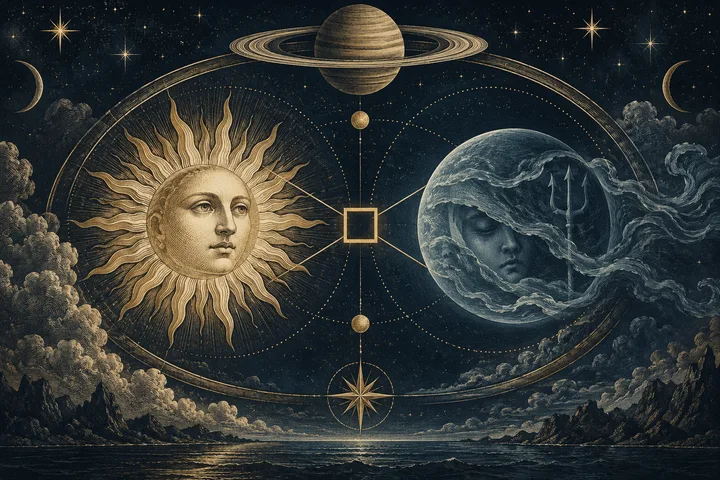
What exactly is being compared when you say Sun square Neptune?
In synastry, Sun square Neptune means that one person’s Sun and the other person’s Neptune form a 90-degree angular relationship across their charts. An aspect is the angle between two chart factors. The Astrodienst Astrowiki entry “Aspect” defines aspects in those geometric terms, and “Square” identifies the square as 90 degrees. This is an interchart aspect, sometimes called an interaspect: it links placements belonging to two different natal charts. A Sun square Neptune within one person’s own chart would instead be a natal aspect. The same aspect name describes the geometry in either case, while the chart context determines whether the contact is within one chart or between two people.
In modern Western astrology, the Sun is read as a symbol of identity and conscious self-expression; Neptune is associated with imagination, ideals, permeability, and longing. These are interpretive meanings, not properties established by the angle itself. The geometry tells you which two placements are being connected and how they relate by degree. It does not identify who is right, reveal what either person intended, or supply a verdict about the relationship. Astrodienst’s “Square” describes the aspect through tension, while also allowing that tension to call forth constructive effort. So the name points to a potentially demanding symbolic interaction, not automatically to harm or incompatibility. What that interaction might mean in Sun–Neptune symbolism requires a separate interpretive step.
The phrase “in cross-chart terms” matters because synastry compares how one chart factor meets another person’s chart factor; it does not merge the two charts into a single placement. The Sun remains the Sun in the first chart, and Neptune remains Neptune in the second. Reversing which person supplies each planet may change the interpretive emphasis, but it does not change the basic fact that the square is the angular link between them. Keeping that distinction clear prevents a shorthand label from sounding like a shared trait or a finding about either person’s character. The square names a relation between symbols that astrologers then interpret in context.
Sources: Square - Astrodienst Astrowiki; Aspect - Astrodienst Astrowiki
What does the Sun–Neptune symbolism suggest, and what does it leave undecided?
The Sun–Neptune square is often interpreted through the pull between a clear sense of self and Neptune’s imaginative, idealizing symbolism. In “Synastry: Sun – Neptune Aspects,” Cafe Astrology describes hard Sun–Neptune contacts as potentially idealizing and confusing, and distinguishes that reading from a conclusion of conscious deception. Within this tradition, the contact can describe fascination with what a connection might become, an urge to see the best in one another, or a shared vision that feels emotionally compelling before its terms have been made clear. Neptune can lend the Sun’s hopes color and possibility; the Sun’s directness can give those hopes a vivid center. The same imaginative force that inspires can also leave room for two people to understand an aspiration differently.
That ambiguity has more than one plausible reading. One person may be sincere but speaking from hope rather than from a settled promise. The other may hear certainty where the first person meant possibility. A person can also avoid clarifying a wish because keeping it open feels easier than testing it against practical limits. Those possibilities are not claims about how often couples behave this way; they are interpretive alternatives consistent with the symbolism. Deliberate deception is possible in human relationships, and the source does not rule it out. But the chart contact alone cannot establish it, and idealization should not be converted into an accusation. It cannot tell you whether a person knowingly misled someone, whether expectations were mutually understood, or whether conduct later matched an agreement. Those judgments depend on what was actually said, understood, and done.
Illustrative scenario: one person says, “I’d love for us to spend more time together this summer.” They may mean a wish they hope to explore; the listener may take it as a commitment to make a plan. The difference is not necessarily dishonesty. It may be a gap between intention, expectation, and agreement. Intention is what the speaker meant to express; expectation is what the listener thought would follow; agreement is what both people explicitly settled. The Sun–Neptune symbolism can make that gap worth examining, but it cannot fill in the conversation after the fact. To understand the actual exchange, ask what each person believed had been decided and what specific action, if any, they agreed to take.
The useful interpretive distinction is therefore between inspiration and definition. Inspiration gives an imagined future emotional force; definition makes its present meaning shared. A Sun–Neptune reading can invite attention to both without treating one as proof of the other. Cafe Astrology’s page recommends clarifying shared hopes, which fits the symbolic tension: preserve the vision, then give each person room to say what they mean by it. If a real agreement was broken, the relevant evidence is the agreement and the subsequent conduct, not the aspect as a substitute for either. If no agreement was reached, naming the difference between a wish and a commitment can make the next conversation more precise.
How do degrees and orb change what ‘clear contact’ can mean?
To check how close a reported square is, use the two placements and degrees from charts you already have. First record each planet’s zodiac position. Then find the smaller angular separation between them, moving either forward or backward around the 360-degree zodiac. Compare that separation with the square’s exact 90-degree angle. The absolute difference is the deviation: for example, a measured separation of 94 degrees differs from exact by 4 degrees. That arithmetic illustrates the method only; it is not a couple’s chart or a claim about anyone’s placements. In “Orb,” Astrodienst Astrowiki defines orb as the permitted deviation from an exact aspect and notes that astrologers use different rules. Here, orb is that distance from exactness, while the chosen allowance determines whether a contact is counted under a particular convention.
The Synastry Comparison Report uses a six-degree allowance for the selected major aspects it evaluates. That is the report’s consistent working rule, not a universal astrology standard. Astrodienst’s “Orb” describes differing rules and ranges; its discussion is a reason to state the convention being used, not to treat one example as binding on every school or chart reader. When comparing two reports, check whether they apply the same aspect list and orb allowance before treating their contact counts as contradictory. One reader may include a contact that another excludes because their stated boundaries differ. Naming the rule makes the comparison auditable: the reader can see both the measured separation and why a report includes or leaves out that aspect.
Degrees also separate sign-level recognition from an exactness check. If you know only the signs, you can note a possible symbolic relationship to investigate, but you lack the measured positions needed to calculate the angular separation and deviation. Label that reading provisional; do not supply an estimated orb. With degrees available, write down the planet pair, measured separation, exact target, absolute deviation, and allowance applied. A smaller deviation means closer to the exact angle under this ranking convention. It does not measure emotional force, importance, or the quality of a relationship. Those are different interpretive questions, and the geometry alone does not answer them. Keeping the calculation separate from interpretation lets someone verify the contact without mistaking numerical closeness for a verdict. If the degrees come from different chart displays, also confirm that both are expressed in the same zodiac framework before comparing them; otherwise the written numbers may not represent like-for-like inputs. Keep the source values beside your arithmetic so another reader can retrace the comparison.
Sources: Orb - Astrodienst Astrowiki
Why must each Saturn contact name both planet roles?
A list of “strong Saturn contacts” leaves out the information needed to read each contact: whose Saturn is involved, which planet it meets, and how the two are connected. Use a directional label such as “A’s Saturn square B’s Mercury.” If the people are reversed, the record becomes “B’s Saturn square A’s Mercury.” The planet pair and aspect name may look familiar, but the roles have changed: one person supplies Saturn in the comparison and the other supplies Mercury. Cafe Astrology’s “Aspects Between Two Charts” presents interchart interpretations by planet roles and recommends considering the signs and houses involved where known. That role-based framing keeps the notation tied to the two separate charts instead of turning the contact into a vague shared trait.
Read and record one contact at a time. A useful entry names the two people or neutral labels, the planet supplied by each, the aspect reported, and the degrees or orb if those are available. Add signs when verified; add houses only when the chart information supports them. Mark absent details as unknown rather than filling them in from the aspect label. For instance, the abstract template “Person A’s [planet] [aspect] Person B’s [planet]” makes direction visible before any symbolic meaning is proposed. Reversing the names should prompt a new reading of the roles, not an assumption that the two descriptions are interchangeable. This record also makes it easier to compare a claimed clear contact against its actual chart data instead of relying on a summary count. Keeping the fields in a fixed order also prevents a missing degree from being mistaken for a zero deviation or an exact contact.
A tally cannot do that work. Two entries involving Saturn could connect it to different planets, run in different directions, or have different measured distances from exactness. The count “two Saturn contacts” hides those distinctions, while a role-specific record preserves them for the later interpretation of what Saturn meets. Cafe Astrology’s interchart guide supports attending to planet roles and available chart context; it does not turn a role label into evidence of conduct. The notation is a reading aid within the astrological method. It cannot show whether either person is responsible, critical, dependable, or restrictive in daily life, and it cannot rank the relationship on its own. Its practical value is narrower: it identifies precisely which symbolic contact is being discussed so that interpretation does not slide between people or planets unnoticed.
In synastry, Sun square Neptune is a 90-degree cross-chart contact traditionally associated with imagination, idealization, and possible ambiguity. It does not establish deception. Saturn does not automatically clear that ambiguity: its symbolism may suggest structure or pressure depending on which planets it contacts, the aspect and orb, and how responsibility is shared. Name each contact and verify its degrees where available before interpreting it. Then compare the symbolism with explicit, revisable agreements and each person’s follow-through. The chart can frame questions about shared hopes and limits; it cannot determine either person’s intent or guarantee commitment.
What can Saturn symbolize across different receiving planets?
Saturn does not carry one relationship meaning wherever it appears. Its symbolism is associated with responsibility, limits, endurance, and the work of making something hold; the receiving planet identifies the part of life being organized or tested. Cafe Astrology’s “Saturn in Synastry” describes commitment and security as possible expressions, while also noting pressure, resistance, criticism, or restriction. Those are interpretive possibilities, not measured outcomes for couples. The useful question is therefore not simply whether Saturn is present, but what function it contacts and how the people experience that contact.
Read the contact by naming the receiving function and asking what Saturn might be doing there. Sun: identity and self-expression; ask whether feedback supports direction or makes recognition feel conditional. Mercury: communication and thought; ask whether plans gain care and follow-through or become cautious under correction. Moon: emotional security and needs; ask whether routines create steadiness or feel emotionally withholding. Venus: affection, values, and relating; ask whether shared values support durable care or turn affection into a test of worthiness. Mars: initiative and action; ask whether coordination gives effort a workable channel or makes action feel blocked or criticized.
The Sun, Moon, Venus, and Mars prompts above apply the tradition’s general Saturn symbolism to the distinct function of each planet. They are interpretive extensions, not claims that Cafe Astrology’s “Saturn in Synastry” tested or established an effect for every listed pairing. Mercury asks about exchange and understanding; the Moon concerns felt needs and security; Venus concerns what someone values and how they expresses affection; Mars concerns pursuit, effort, and assertion. Because the planets name different functions, “Saturn contact” alone cannot tell you whether a particular interaction concerns being heard, feeling safe, sharing affection, or acting freely. Name the receiving planet before describing the possible theme.
The same symbolic pressure can also take more than one form. Structure may mean a dependable routine, explicit expectations, careful advice, or a boundary that protects time and energy. Limitation may mean delay, a narrowed choice, or a rule that feels imposed. Criticism may be experienced as useful correction when it is specific and welcome, yet as discouragement when it repeatedly dismisses the other person’s judgment. These examples apply Saturn’s traditional range to ordinary interactions; they do not assign motives to either chart-holder. A contact can be experienced differently by the people involved, and a sign, aspect, degree, and wider chart context may refine the interpretation without settling it. The receiving planet narrows the subject of inquiry; it does not rank the contact’s strength or importance.
Use each row as a focused prompt, then compare it with what each person says actually happens. For a Mercury contact, for example, ask whether a difficult conversation ends with clearer commitments or with one person reluctant to speak. For a Venus contact, ask whether practical care feels mutual and valued, rather than assuming that a traditional association with commitment proves affection. The prompt becomes useful when it directs attention to a particular function and a checkable exchange. It remains a symbolic reading, not a deterministic translation from planet to behavior; neither a positive-sounding answer nor a difficult one can be inferred from the contact label alone.
Sources: Saturn in Synastry - Cafe Astrology
Does a Saturn contact to the Sun necessarily stabilize the square?
No. A Saturn-to-Sun contact can be read as support for direction and responsibility, or as pressure on identity and recognition; the aspect describes a particular relation between those symbols, not a guaranteed result. In “Synastry: Sun – Saturn Aspects Between Two Charts,” Cafe Astrology gives different possibilities for conjunction, square, opposition, trine, and sextile. The page’s supportive readings emphasize steadiness, commitment, patience, or practical cooperation. Its tense-contact readings include criticism, discouragement, restriction, and difficulty expressing oneself freely. These are competing traditional interpretations, not reported findings about couples or proof that either person behaves in one of these ways.
The geometry matters to that comparison. A trine or sextile is commonly treated as a more flowing connection, while a square or opposition is treated as more challenging; a conjunction brings the planets together, but its expression still depends on context. Cafe Astrology does not make the categories interchangeable: its Sun–Saturn discussion gives each geometry its own interpretive treatment. A supportive-looking aspect therefore does not certify respect, and a tense one does not rule out patience, maturity, or useful accountability. Keep the exact aspect label attached to the interpretation rather than translating it into a single good-or-bad rating. Check that the reported aspect really is the one being interpreted before comparing its traditional description.
For the Sun person, identity and conscious expression are at issue; for the Saturn person, the symbolic role is the one of limit, standard, or responsibility. The constructive reading is most plausible as a question when counsel is specific, the Sun person can respond without humiliation, and responsibility is shared rather than assigned from above. The restricting reading becomes worth examining when standards shift, recognition is withheld, or disagreement is treated as failure. These are practical distinctions derived from the symbolism, not behaviors the source says a chart proves. “Support” should describe the quality of an interaction, not excuse one person’s control by giving it an astrological name.
A useful decision rule is to look for reciprocal accountability: can both people state the expectation, explain its purpose, and revisit it when it no longer works? If yes, Saturn’s imagery of patience and durable effort may help describe the structure they are building. If only one person sets the terms and the other is penalized for questioning them, the same imagery may feel restrictive regardless of whether the aspect is conventionally called harmonious. This rule is the article’s practical inference, not a validated test and not a claim from Cafe Astrology. The chart can suggest which theme to explore; the actual exchange distinguishes dependable support from one-sided gatekeeping.
Sources: Synastry: Sun – Saturn Aspects Between Two Charts - Cafe Astrology
What can you responsibly add when birth time or house data is missing?
If birth time or location is uncertain, leave house overlays and the Ascendant open rather than assigning them by guesswork. “House” in Astrodienst Astrowiki’s “House” depends on place and time, and the page notes that houses and the Ascendant move through the zodiac. Cafe Astrology’s “Free Astrology Birth Chart Report” likewise omits Ascendant and house positions when its user does not know the birth time. These references support a specific boundary: do not describe a planet as falling in the other person’s house unless the chart data makes that placement dependable. They do not establish that all planetary signs or degrees require an exact birth time, nor that every other part of synastry must be discarded. Unknown house information is a blank field, not a reason to turn a partial comparison into an all-or-nothing exercise. Keep that boundary visible whenever you summarize what the chart can add.
Keep the data you do have distinct from the data you do not. If each person already has chart placements, compare those supplied signs; if the degrees are also known, use them to check the relevant angular contacts under the stated convention. Do not derive an Ascendant, house cusp, overlay, or missing degree from a vague recollection or from the Sun–Neptune interpretation. A useful record can show the known planet pair and signs, add verified degrees where available, and mark house placement “unknown” when the time or location is not reliable. That way the reading remains specific about what is being compared and equally specific about what has not been established. A bounded interpretation can still ask what the known contact symbolizes without pretending it supplies the absent house layer.
The Synastry Comparison Report uses placements supplied by the reader and optionally their degrees; it does not calculate a natal chart from birth details. So use it for the information already in hand, and do not treat its comparison as a source of missing birth-time data or house positions. If a later, better-supported chart supplies those fields, they can be considered as additional context. Until then, keep the interpretation at the level the available placements support. This approach preserves a meaningful partial reading while respecting the distinction between known planetary data and uncertain house data.
Sources: House - Astrodienst Astrowiki; Free Astrology Birth Chart Report - Cafe Astrology
When does Saturn give a hope structure, and when does it add pressure?
Read Saturn’s constructive and restrictive possibilities through three practical questions: Is the expectation defined by both people? Does each person have a meaningful part in carrying it? Can either person ask to revise it without being punished? This is an original interpretive framework drawn from the symbolic alternatives in Cafe Astrology’s “Saturn in Synastry” and “Synastry: Sun – Saturn Aspects Between Two Charts”; it is not a study result, score, or test of a relationship. The first source associates Saturn contacts with responsibility and security while also describing pressure, criticism, and restriction. The Sun–Saturn discussion offers supportive and difficult possibilities across different aspects. Together, they give a symbolic tension to explore, not a verdict about which possibility a particular pair lives. The questions organize attention; they do not produce a numerical result or substitute for either person’s account.
Consider an explicitly illustrative situation: two people agree to coordinate a recurring shared responsibility. In a mutual plan, they define what needs doing, decide who handles each part, and choose a date to check whether the arrangement still works. Either can explain a constraint or suggest a change; revision is part of maintaining the commitment. That pattern may fit a constructive Saturn reading because structure supports follow-through while leaving both people agency. The relevant evidence is not that the plan sounds formal, but that its obligations are understood, proportionate, and open to discussion. Even here, the chart does not establish the meaning: the people’s actual exchange is what lets them judge whether the structure feels dependable.
Now change the governance of that same plan. One person sets the schedule and duties alone, treats questions as disloyalty, and penalizes the other for asking to adjust an arrangement when circumstances change. The restrictive reading becomes more plausible as an interpretation of the interaction because responsibility has turned into one-sided authority and correction carries a cost. Yet one tense conversation would not prove a lasting pattern, and smooth coordination would not validate an astrological reading. Look at how the expectation is handled over time: who can define it, who carries its work, and what happens when either person asks to revisit it. These observations help distinguish structure from pressure without assigning motives from the chart.
The framework also clarifies why clear agreements do not require Saturn contacts. Two people can define a plan, share its work, and revise it through communication and choice; Saturn symbolism may offer one lens for reflecting on that structure, but it does not own the behavior or cause it. Conversely, a chart contact cannot make an unequal arrangement mutual merely by naming commitment. Use the three questions to examine the interaction first, then consider whether the known Saturn contact gives a useful symbolic description of it. If the people disagree about what was agreed, identify that disagreement directly; an aspect cannot settle their terms for them.
Sources: Synastry: Sun – Neptune Aspects - Cafe Astrology; Synastry: Sun – Saturn Aspects Between Two Charts - Cafe Astrology
What can the chart not decide about the relationship?
The strongest boundary is that a synastry contact cannot stand in for the whole relationship. The Centre for Psychological Astrology’s publisher description for “Relationships and How to Survive Them” states that “no relationship can be understood fully through synastry alone.” The page describes an astrological approach that also considers a composite chart in relation to each person’s individual chart. That is a statement about interpretive scope within the astrological tradition, not a measured finding about couples. Its practical point here is modest: even a carefully verified Sun–Neptune square and Saturn contact remain one layer of a wider reading.
The same boundary applies to conclusions about commitment. Saturn symbolism may give language to responsibility or pressure, while Neptune symbolism may help name idealization or uncertainty; neither symbol proves sincerity, deception, permanence, or success. The cited interpretive sources offer possible meanings for chart contacts, not evidence that a particular person holds an intention or will follow through. That distinction keeps the reading useful without asking it to answer a question its inputs cannot settle. Supplied placements and any verified degrees determine which contacts are being considered; missing chart details and the wider comparison leave parts of the interpretation open.
A narrow aspect comparison can still be meaningful on its own terms. It can frame a question worth discussing, such as what each person understands a shared hope or responsibility to require. The further step is a practical inference: when deciding what to do now, rely on the people’s stated agreements, choices, and follow-through. If those differ from an assumed meaning, clarify the agreement directly rather than treating the chart as proof of hidden intent. This helps distinguish a symbolic possibility from a term the two people have actually discussed and accepted.
Sources: Relationships and How to Survive Them - Centre for Psychological Astrology
What is the next useful comparison to make?
Write down the contacts you can verify, then choose one expectation that matters now. Ask what each person thinks that expectation means, who will do what, and when you will revisit the agreement. Name the time, task, or support at issue, then ask each person what a workable commitment would look like in practice. Keep the conversation to that concrete point; the purpose is to make a shared hope or responsibility clear enough that both people can respond to it. If you do not have every placement, degree, birth time, or house, leave those fields unknown and work with the information you do have; no missing value needs to be guessed to make that first conversation worthwhile.
If a structured comparison would help, the Synastry Comparison Report uses placements you supply and optional degrees. It evaluates selected major aspects using a six-degree orb convention; it does not calculate a natal chart from birth details. You can use it to organize known contacts, then bring one question from that comparison into the conversation. The report can support reflection on the symbolism, but the agreement itself belongs to both people: say what you can offer, ask what the other person means, and settle a next step and a time to check in.
A little more clarity
Does Sun square Neptune in synastry mean someone is lying?
No. Traditional interpretations include idealization, ambiguity, and hopes that exceed what either person can offer. The aspect does not establish intent. Clarify what each person meant and agreed to, then consider their words and follow-through.
Does Saturn cancel a Sun–Neptune square?
No. Saturn may symbolize structure around a shared hope, or pressure if responsibility and correction are one-sided. Its presence does not erase the square or guarantee commitment.
Why do the exact Saturn contacts matter?
Name both planets, whose chart each belongs to, the aspect, and the degree separation where known. Saturn contacting the Sun, Moon, Mercury, Venus, or Mars brings different symbolic themes; a count of Saturn contacts cannot show those distinctions.
Can sign placements alone tell me an aspect’s orb?
No. Signs can suggest an aspect, but degrees are needed to determine its precise orb. The Synastry Comparison Report uses supplied placements and optional degrees, with a six-degree orb convention for selected major aspects.
Sources & further reading
- Square - Astrodienst Astrowiki
Defines the square as a 90-degree relationship and offers a modern astrological interpretation of tension with constructive potential.
- Aspect - Astrodienst Astrowiki
Defines aspects as angular relationships and explains major aspect angles, including square at 90 degrees.
- Orb - Astrodienst Astrowiki
Defines orb as the permitted deviation from an exact aspect and explicitly says astrologers use different rules; it provides examples of varying ranges rather than one universal cutoff.
- House - Astrodienst Astrowiki
States house positions depend on place and time; the Ascendant and houses move through the zodiac, so unknown birth data limits reliable house interpretation.
- Synastry: Sun – Neptune Aspects - Cafe Astrology
Interprets hard Sun–Neptune contacts as potentially idealizing and confusing, while distinguishing this from conscious deception and recommending clear definition of shared hopes.
- Aspects Between Two Charts - Cafe Astrology
Recommends interpreting cross-chart contacts by planet roles and considering the signs and houses where available, rather than treating one aspect as the whole relationship.
- Saturn in Synastry - Cafe Astrology
Interprets Saturn interaspects through responsibility, commitment, and security, while describing possible resistance, criticism, pressure, or restriction in particular expressions.
- Synastry: Sun – Saturn Aspects Between Two Charts - Cafe Astrology
Distinguishes Sun–Saturn aspect expressions, including support and steadiness alongside criticism or restriction; it is an interpretive source, not a study of couples.
- Relationships and How to Survive Them - Centre for Psychological Astrology
The publisher description supports the limited interpretive boundary that synastry alone cannot fully explain a relationship.
- Free Astrology Birth Chart Report - Cafe Astrology
The provider says unknown birth time prevents accurate determination of Ascendant and house positions in its chart report.
Synastry Comparison Report
Enter known placements for two people. Get an input-by-input comparison, selected aspect calculations and a clear record of what remains uncertain.
Compare our placements