Start with the practice question
A synastry aspect can feel final because it has a clean name. Venus square Mars. Moon trine Venus. Mercury opposite Saturn. You see the geometry, read a familiar description, and think you have found the answer.
You haven't. The strongest next question is: What does this contact ask us to practice together? That question gives the symbolism a job. It turns a chart contact into something two people can notice, discuss, and try.
Ask what the contact asks of both people, not which person is the problem. A flowing aspect may ask you to use an easy gift deliberately. A tense aspect may ask for pacing, translation, repair, or a clear agreement. The contact shows a meeting between chart functions. It doesn't hand down a dating verdict.
Imagine Maria sees her Moon square her partner's Mars. She could stop at emotional friction. Or she could ask what happens when her need for comfort meets his urge to act. Do they need ten minutes before problem-solving? Does he need to ask whether help is wanted? Their chart question becomes a shared practice: How will we handle different speeds when something hurts?
The strongest useful question after reading a synastry aspect is: What does this contact ask us to practice together? It keeps the reading specific without trapping either person inside a label. Name the two chart factors, check the aspect and degree distance, then read the signs and the wider pattern. A Moon-Mars square, for example, can describe a meeting between emotional safety and direct action. The useful next step isn't deciding who is difficult. Ask, What helps us slow down before one person's need for comfort meets the other person's urge to act? Use the aspect to choose one conversation and one repeatable behavior. This guide uses supplied placements and optional degrees. It doesn't calculate a natal chart, houses, or a relationship outcome from birth details.
Sources: An Introduction to Aspects and Chart Shaping in Natal Astrology; Synastry chart - Astrodienst Chart Types; Skyscript: Beginners Astrology Course, Lesson 2
Why a verdict is the wrong job for one aspect
Questions such as Is this soulmate energy? Will we last? and Are we incompatible? feel urgent, but they ask one contact to carry an entire relationship. Synastry compares two natal charts by examining the aspects between their planetary positions and angles. One aspect is one part of that comparison.
The old split between easy and difficult aspects can mislead you when it becomes a scorecard. A square can create friction that forces attention. A trine can offer ease that nobody develops. An opposition can bring resistance, but it can also show two ends of an axis that widen the relationship's range. Even a conjunction, which blends two functions closely, may need separation and clear naming.
So rank the interpretation before you rank the contact. First ask what the planets are doing together. Then ask how the angle shapes that meeting. Only after that should you ask what the contact could look like in your daily life. A Venus sextile Mars may support a natural opening for affection and desire, but it doesn't schedule a date or make a direct invitation. A Venus square Mars may intensify attraction and annoyance at once, but it doesn't make either feeling false.
The better question protects the reading from borrowed drama. A guide may describe jealousy, urgency, or strong chemistry for a contact. Those are possible expressions, not proof of what your partner feels. Keep the astrological meaning. Test its expression against the relationship you can actually recognize.
Sources: An Introduction to Aspects and Chart Shaping in Natal Astrology; Synastry chart - Astrodienst Chart Types; Synastry - Skyscript Glossary
Name the two functions before the angle
Read the planets first. The aspect tells you how the contact behaves, but the planets tell you what is meeting. This small change in order cuts away a great deal of horoscope shorthand.
The Moon describes instinct, habit, emotional response, and the need for safety. Venus describes pleasure, affection, relatedness, values, and cooperation. Mars describes assertion, initiative, desire, courage, and action. Mercury describes thought and exchange. The Sun describes identity, vitality, and self-expression. These meanings give you the subject of the question without reducing either person to a type.
Put the functions side by side. Moon-Mars asks how need and action meet. Moon-Venus asks how feeling and affection meet. Venus-Mars asks how pleasure and desire meet. Mercury-Saturn asks how speech and structure meet. Sun-Moon asks how identity and feeling meet.
This also keeps one planet from becoming a caricature. Mars isn't only anger. It can protect, initiate, and act with courage. Venus isn't only romance. It can reveal values, pleasure, agreement, and self-worth. When you know the functions, your question can hold both the attractive and difficult expression of the contact.
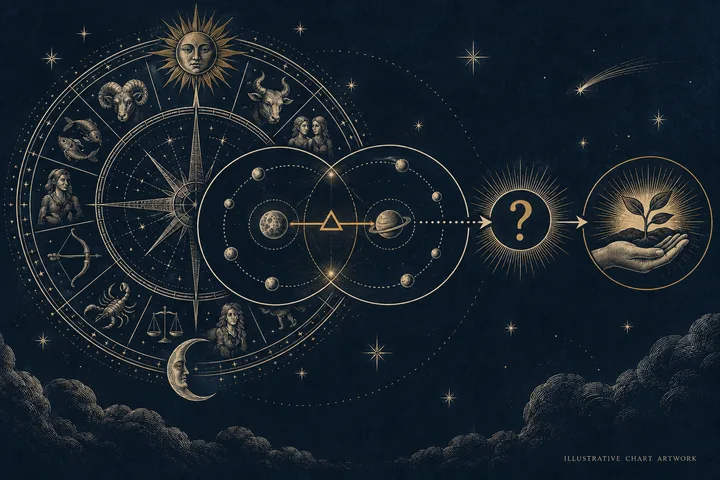
Let the aspect choose the conversation
Now read the geometry. Major aspects describe different ways that two functions meet, and each one suggests a different kind of conversation.
A conjunction blends. Ask, What are we combining so closely that we need to name the separate parts? Venus conjunct Mars may bring immediate attraction, but affection, desire, initiative, and conflict may not move at the same speed.
An opposition places two ends of an axis across from each other. Ask, What does each person see that the other tends to miss? Moon opposite Venus may bring emotional need face to face with harmony, pleasure, or social ease. The task isn't to choose a winner. It is to give comfort and connection room in the same exchange.
A square creates friction. Ask, What recurring moment shows the friction, and what response could change it? Mercury square Mars might heat a discussion before either person has understood the question. A pause or a clarifying question may matter more than another interpretation.
A trine flows. Ask, What comes naturally here, and where might we use it on purpose? A sextile opens a door. Ask, What opportunity appears when one of us reaches first? The short forms are useful because they keep the angle connected to a verb. Blend. Balance. Pause. Invite. Use.
Sources: An Introduction to Aspects and Chart Shaping in Natal Astrology; Skyscript: Aspect Meanings in Birth Charts - Aspects involving the Moon
Use degrees to decide what deserves attention
A synastry list can contain more contacts than a couple can use. Degree distance helps you decide which one deserves the first question. An orb is the distance a planet may sit from an exact aspect while the contact is still considered present. Astrologers use different orb traditions, so state your method instead of pretending one rule governs every chart.
For this publication's comparison report, selected major aspects use a six-degree orb when degrees are supplied. A one-degree contact usually deserves closer attention than a five-degree contact of the same kind, all else equal. That is a priority for reading, not a compatibility score.
If you know only Moon in Taurus and Mars in Leo, you can discuss the sign relationship and the broad meeting between feeling and action. You can't call it a tight square without degrees. If the supplied positions are Moon at 10 degrees Taurus and Mars at 12 degrees Leo, the 92-degree separation places them two degrees from an exact square. The contact falls within a six-degree method and deserves a focused reading.
If one contact is close and another merely repeats its theme at a wider distance, start with the close contact. Repetition can strengthen a theme, but it doesn't create three votes for one outcome. The goal is to choose the clearest question, not to count symbols until they become a percentage.
Sources: Orbs (or rays) - Skyscript Glossary; An Introduction to Aspects and Chart Shaping in Natal Astrology
Read the signs as the style of the meeting
The angle tells you the type of relationship between the planets. The signs tell you how those planets express themselves. That is why two squares can ask for very different practices.
Return to the imagined Moon at 10 degrees Taurus and Mars at 12 degrees Leo. Taurus may seek steadiness, proof, touch, and time. Leo may act with warmth, pride, boldness, or a need to lead from the heart. Their square isn't simply a clash. It may describe a moment when one person needs a calm container and the other wants to move decisively.
Their strongest useful question is precise: How can we protect the need for steadiness without shaming the need for direct action? That question can lead to a real agreement. The person who wants to help asks before acting. The person who needs time names when a pause will end. Neither sign has to disappear.
Sign elements can give you a first direction. Fire tends to initiate. Earth tends to give form and seek stability. Air works through thought and exchange. Water works through feeling, perception, and resonance. Treat those as broad lenses, then let the actual sign and planet refine them. A sign label alone cannot replace the aspect or the degree.
Sources: Skyscript: Beginners Astrology Course, Lesson 2; Skyscript: Beginners Astrology Course, Lesson 4; Synastry - Skyscript Glossary
Keep the strongest exception in view
Every aspect has more than one expression. The strongest exception is often the constructive function hidden inside the first impression. Keep it visible, or the reading will harden into a label.
Moon-Mars can feel like emotional heat. Mars can also protect the Moon. Quick action may feel intrusive in one moment and reassuring in another. The difference lies in timing, consent, and whether action serves the emotional need or overrides it.
Venus-Saturn can describe restraint or fear around affection. Saturn can also give Venus patience, loyalty, form, and endurance. Mercury-Neptune can blur practical details, yet it can also open a poetic and intuitive channel between two minds. The question should name the care and the risk: Which details need exact words, and where can we trust image, silence, or feeling?
This exception doesn't cancel the difficult expression. It ranks it properly. A contact is a field of potential, shaped by the condition of the planets, the signs, the rest of the chart, and the choices made inside the relationship. If the lived pattern never appears, check the data and the wider chart before forcing the symbol to fit.
Sources: An Introduction to Aspects and Chart Shaping in Natal Astrology; Skyscript: Beginners Astrology Course, Lesson 2; Skyscript: Aspect Meanings in Birth Charts - Aspects involving the Moon
End with one question and one decision
A reading becomes useful when it ends in a small decision. Choose one response that fits the contact and can be noticed the next time the pattern appears. Don't choose a promise such as communicate better. Choose a sequence.
For Moon-Mars, the sequence might be: name the feeling, ask whether help is wanted, then agree on a pause or a next action. For Mercury-Mars, each person might first say what they think the other is asking before answering. For Venus-Mars, one person can make a clear invitation and leave room for a real yes.
Write down the supplied contact, its degrees if known, the orb method, and the question it raises. Then ask your partner: When this contact is active, what should we each notice, and what will we try before the next reply? That is the conversation to initiate.
The comparison report can help you organize supplied Moon, Venus, and Mars placements, optional degrees, and selected major aspects within a stated six-degree orb. It doesn't calculate a natal chart from birth details, add houses, or predict whether a relationship will succeed. Those limits keep the question honest and the decision yours.
Sources: Orbs (or rays) - Skyscript Glossary; Synastry chart - Astrodienst Chart Types
A little more clarity
What should I ask after reading a synastry aspect if I only know the signs?
Ask what the two planetary functions need from each other in those signs, then name one situation where that need appears. Keep the reading at sign level unless supplied degrees establish the aspect and orb. For example, compare the Moon's need for safety with Mars's way of taking action, then ask what pace or response could respect both.
Sources & further reading
- An Introduction to Aspects and Chart Shaping in Natal Astrology
Supports the definitions and interpretive contrast of major aspects, exactness, orbs, and applying or separating contacts.
- Orbs (or rays) - Skyscript Glossary
Supports the explanation of orb as distance from exactness and the existence of different modern and traditional orb methods.
- Synastry chart - Astrodienst Chart Types
Supports the definition of a synastry chart as two partners' horoscopes shown together with their aspects and positions.
- Synastry - Skyscript Glossary
Supports synastry as chart comparison through planetary positions, angles, interlocking configurations, and planetary condition.
- Skyscript: Beginners Astrology Course, Lesson 2
Supports the working meanings of the Sun, Moon, Mercury, Venus, Mars, and the way signs modify planetary expression.
- Skyscript: Beginners Astrology Course, Lesson 4
Supports the broad elemental styles and the principle that sign rulers further modify planetary expression.
- Skyscript: Aspect Meanings in Birth Charts - Aspects involving the Moon
Supports the general reading of conjunctions, sextiles, squares, trines, and oppositions as different planetary relationships.
Synastry Comparison Report
Enter known placements for two people. Get an input-by-input comparison, selected aspect calculations and a clear record of what remains uncertain.
Compare our placements