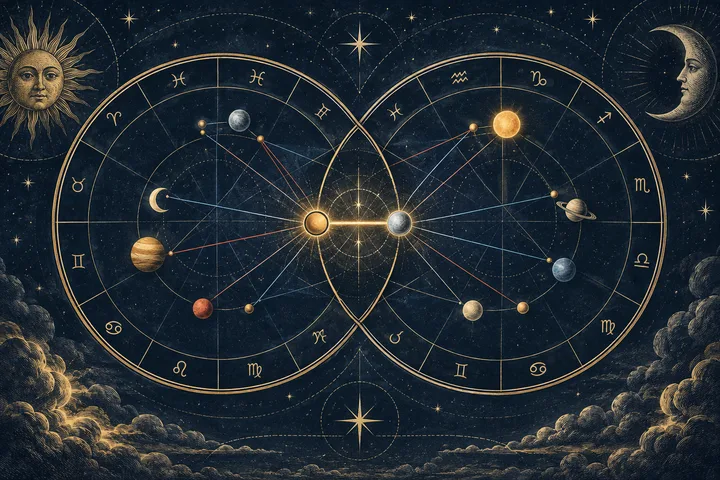
An equal orb measures closeness, not priority
Imagine Maria and Daniel comparing three synastry contacts, each listed with a 3° orb: Maria’s Venus square Daniel’s Mars, Maria’s Moon trine Daniel’s Saturn, and Maria’s Mercury sextile Daniel’s Jupiter. The software has shown that each contact sits three degrees from its exact angle. It hasn’t chosen the relationship’s main story.
An orb is the distance from exactness. It tells you how tightly two chart factors meet, and tighter contacts usually deserve more attention than looser ones. But when the displayed orbs match, exactness stops deciding the order. You have to read the contact itself.
That is where the common shortcut fails. Sort the list from smallest orb to largest, and the first line looks like a verdict. It isn’t. A conjunction blends two planetary principles. A square presses them into action. A trine allows an easier exchange. A sextile opens a door that still needs participation. Equal distance does not create equal movement.
Astrodienst defines an aspect as an angular relationship held within an accepted orb and identifies conjunction, opposition, square, trine, and sextile as the main aspects. Nicholas Campion’s aspect guide also treats exactness as a strength factor while giving each aspect its own nature. Read those ideas together. The orb tells you how close. The geometry tells you how the closeness behaves.
Begin your notes with the raw contact: ‘Venus square Mars, 3°.’ Add the signs and, if supplied, the exact degrees. Only then write an interpretation. This keeps a familiar phrase such as ‘strong chemistry’ from replacing the actual chart information. If the report rounds every orb to a whole degree, preserve the tie. Don’t invent minutes you weren’t given.
The first question is not ‘Which number is smallest?’ It’s ‘What question is this comparison meant to answer?’ Attraction, emotional safety, communication, commitment, and shared direction can each bring a different contact to the front. Relevance doesn’t erase astrological hierarchy. It tells you where to apply it.
Equal orbs create a tie in exactness, not a tie in meaning. Start with the aspect itself, then ask which planets it joins, how closely it touches the couple’s real question, and whether another contact repeats or modifies the same theme. A 3° Venus-Mars square may lead an attraction question, while a 3° Moon-Saturn trine may lead a question about steadiness. If the chart includes dependable degrees and motion data, applying or separating can break a final tie. If it doesn’t, leave that layer alone. The cleanest reading names one primary contact, one supporting contact, and the strongest exception. It gives the couple a symbolic center without pretending that every line in the aspect table carries the same weight.
Sources: Astrodienst Astrowiki: Aspect; Skyscript: An Introduction to Aspects and Chart Shaping
Use aspect type as the first tie-breaker
Once equal orbs leave you with a tie, compare the geometry. A conjunction concentrates two functions in one place. An opposition sets them across an axis, making difference visible through attraction, projection, or tension. A square creates friction that demands a response. A trine carries the planets together with ease. A sextile offers cooperation, but its promise usually becomes clearer when the couple chooses to use it.
For a question about immediate impact, a same-orb conjunction will often outrank a same-orb sextile between equally personal planets. The conjunction is harder to keep separate. The sextile is more like an available route. It may be valuable, but it doesn’t always announce itself.
Don’t turn that order into a good-versus-bad scale. Campion describes the opposition as powerful, the trine as the strongest harmonious aspect, the square as strong friction, and the sextile as a lighter harmonious contact. Astrodienst likewise presents a major-aspect hierarchy while noting that the planets involved can change the emphasis. A square can explain the pattern that keeps returning. A trine can describe ease the couple takes for granted.
Here is the strongest exception. Suppose the tied contacts include a Venus-Mars square and a Moon-Saturn trine, and the reader wants to understand emotional steadiness rather than initial attraction. The square may be louder. The trine may be more useful. If other supplied contacts repeat Saturn’s theme of care, patience, or responsibility, that trine can lead because it organizes the question the couple actually brought.
Use aspect type as a screen, not a scorecard. Keep major and minor contacts distinct when the report’s method does. A minor aspect may deserve a sentence when it answers the question unusually well, but it shouldn’t quietly outrank a major contact just because the interpretation sounds vivid. State what the aspect does, then let the planets decide what the exchange is about.
Sources: Astrodienst Astrowiki: Aspect; Skyscript: An Introduction to Aspects and Chart Shaping
Let the planets identify the subject
The aspect is the verb. The planets are the nouns. After you know whether a contact joins, opposes, presses, flows, or invites, ask what functions are meeting.
For attraction, Venus and Mars deserve close attention. For emotional response and care, include the Moon. The Sun brings identity and recognition. Mercury describes how thoughts, questions, and explanations move between two people. Jupiter can enlarge meaning and confidence. Saturn can give form, duty, limits, and staying power. Uranus, Neptune, and Pluto become more personal when they touch a personal planet or repeat a theme elsewhere in the comparison.
That is why a 3° Moon-Venus trine may lead a question about tenderness, even if a 3° Jupiter-Uranus conjunction sounds more dramatic. The outer-planet contact may describe a wider generational field. The Moon-Venus contact enters ordinary closeness more directly. Change the question to freedom, risk, or sudden change, and the ranking may change with it.
Cafe Astrology’s synastry guidance advises readers to consider the planet roles each person brings, the signs and houses involved, and inner-planet interaspects. That gives a useful sequence for known placements: name the two planet functions, name the aspect, then read the signs as the style of the exchange. In a placement-only report, stop there. Don’t claim a house emphasis that the supplied information cannot establish.
Keep the roles flexible. In Venus-Mars synastry, Venus does not belong to women and Mars does not belong to men. One person may bring the initiating function in one moment and the receptive function in another. The chart gives you a language for the exchange, not a fixed character label.
Return to Maria and Daniel. If their question is ‘Why is the attraction immediate but the pace uneven?’ Venus-Mars leads because it names desire and pursuit. If the question is ‘What helps us feel safe enough to build a routine?’ Moon-Saturn leads. The contacts stayed the same. The decision changed, so the useful emphasis changed with it.
Use signs to refine, not replace, the contact
Signs tell you how the planet pair speaks. They should refine a supported contact, not rescue a weak one. A Venus-Mars square remains a square whether it falls in fixed, mutable, cardinal, fire, earth, air, or water signs. The signs help you describe its pace, style, and point of friction.
A Venus contact in an earth sign may seek proof through reliability, touch, and practical follow-through. In an air sign, it may seek connection through talk, curiosity, and shared ideas. Mars in a fixed sign may hold a course once desire is engaged. Mars in a mutable sign may alter pace as circumstances change. These are interpretive lenses, not invented facts about Maria or Daniel.
Watch for a contact that is exact by degree but crosses sign expectations. Astrodienst and Skyscript discuss dissociate aspects, where the angular relationship is present but the signs don’t share the usual relationship. Such a contact may carry a more varied or contradictory tone. Keep the exact aspect in the record. Then give a comparable, non-dissociate contact priority unless the dissociate one clearly explains the concern in front of you.
This is also where missing information matters. The Synastry Comparison Report can compare supplied Moon, Venus, and Mars signs, with optional degrees and selected major aspects using a stated six-degree orb. It doesn’t calculate natal positions from birth details or houses. A sign-based refinement is useful only when you say which signs were actually supplied.
Sources: Astrodienst Astrowiki: Aspect; Cafe Astrology: Aspects Between Charts; Skyscript Glossary: Dissociate Aspect
Treat applying and separating as a late filter
Applying and separating can refine a close ranking, but they are not labels to add by instinct. Applying means the planets are moving toward exactness. Separating means they have passed exactness and are moving away. Some astrologers give applying aspects greater psychological force, while others use the distinction differently by technique.
Campion’s guide explains the basic distinction and gives applying aspects more psychological weight. Skyscript’s glossary adds that planetary motion must be checked, because retrograde motion can make an aspect that appears to be separating apply instead. This is a data question before it becomes an interpretive one.
If you have only signs, leave this filter out. If one planet’s degree is missing, leave it out. If the report provides degrees but no motion status, don’t infer it. The six-degree orb used by a report defines the selected field of contacts; it does not, on its own, tell you whether a contact is applying or separating.
Imagine two contacts that remain tied after aspect type, planets, signs, and relevance. One is applying and one is separating under a method that reliably includes motion. The applying contact may describe a theme becoming more immediate, while the separating contact may describe a pattern the pair already knows how to carry. Neither promises an event. The distinction adds a sense of movement to the interpretation.
Use this layer late. Exactness gets a contact into the reading. Aspect and planet functions tell you what is happening. Signs show the style. Motion can suggest whether the exchange is building or settling. When the input is missing, ‘motion status unavailable’ is a complete result.
Sources: Skyscript: An Introduction to Aspects and Chart Shaping; Skyscript Glossary: Separation
Group repeated themes without double-counting them
After you rank the individual contacts, look across the list. A repeated theme can make one contact more important, but repetition shouldn’t become three versions of the same promise.
Suppose Maria and Daniel have the three equal-orb contacts from the opening. Venus-Mars may describe charged attraction. Moon-Saturn may describe steadiness or restraint. Mercury-Jupiter may describe a conversation that opens perspective. The useful synthesis is not ‘three powerful indications.’ It is a small map: desire is vivid, steadiness can support it, and honest conversation helps the pair work with the difference.
Group phrases that genuinely overlap. ‘Chemistry,’ ‘magnetism,’ and ‘physical pull’ may all describe one Venus-Mars theme. ‘Care,’ ‘emotional ease,’ and ‘holding space’ may be one Moon-Venus or Moon-Saturn theme. Compressing those phrases makes the reading more accurate because it stops one pattern from taking up three places in the conclusion.
Then look for the strongest contradiction. A Venus-Mars contact may show quick pursuit while a Saturn contact slows trust. Don’t average that into ‘mixed energy.’ Name the sequence: desire moves quickly, but emotional confidence takes longer. That sentence gives the couple something observable to discuss.
Astrodienst describes several connected aspects as an aspect pattern. In synastry, the same habit of looking for relationships among contacts helps you see whether one line organizes the others. Keep the claim within the supplied chart layer. You can identify a repeated planetary or sign theme. You can’t claim a full natal pattern, house activation, or an aspect that was never calculated.
Sources: Astrodienst Astrowiki: Aspect; Cafe Astrology: Aspects Between Charts
Finish with one primary contact and one decision
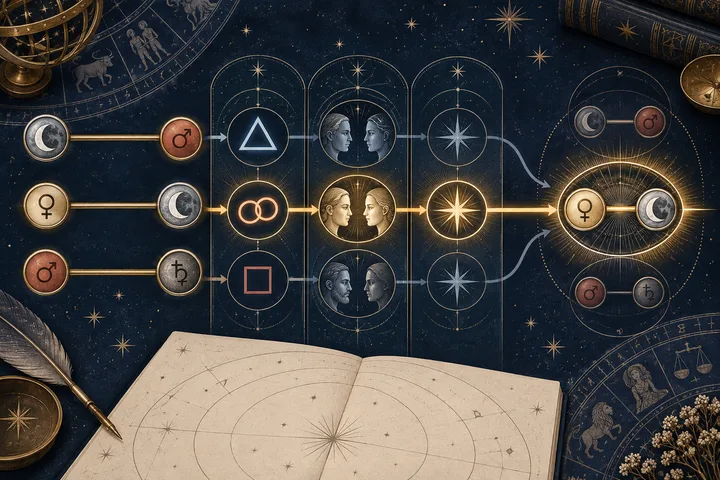
Use this short sequence when several synastry contacts share an orb. Record the exact data you have. Separate major from minor aspects. Read the aspect type. Identify the planet functions. Refine them with signs. Group repeated themes. Use applying or separating only when the degrees and motion method support it. Then choose the contact that best organizes the reader’s question.
Your final note should have four lines: primary contact, supporting contact, strongest exception, and one question to discuss. For Maria and Daniel, it might read: ‘Venus square Mars leads the attraction question. Moon trine Saturn supports steadiness. Mercury sextile Jupiter helps the conversation. Ask what happens when one person reaches for closeness and the other changes pace.’
That is not a compatibility score, and it isn’t a verdict about whether the couple should stay together. It is a clear reading of the supplied placements. The symbolic order points attention toward a real moment, where the couple can notice what the contact seems to describe and what it doesn’t.
The strongest contact is not always the closest-looking line. It is the contact with enough astrological weight, personal relevance, and thematic support to make the rest of the comparison easier to understand. A wider Moon-Saturn contact can matter more than an exact outer-planet trine when the question is emotional steadiness. A trine can outrank a conjunction when it explains how a difficult pattern becomes workable. Those are exceptions because they have reasons.
When the information is limited to signs, compare what the signs can support and stop there. When degrees are supplied, use them to compare exactness. When the data supports selected major-aspect calculations with a six-degree orb, stay inside that method. Put the method beside the interpretation, not after it.
Then make the decision small. Notice one ordinary interaction this week. Ask whether it feels exciting, pressuring, reassuring, or confusing. Compare that moment with the leading contact and its strongest exception. If the symbolism gives you better language for the conversation, it has earned its place.
Sources: Skyscript: An Introduction to Aspects and Chart Shaping; Cafe Astrology: Aspects Between Charts; Skyscript Glossary: Separation
A little more clarity
Does the smallest synastry orb always win?
No. A smaller orb shows greater exactness, but equal orbs require you to compare aspect type, planets, signs, the reader’s question, and repeated themes. Use exactness first, then rank the meaning it carries.
Which matters more, a conjunction or a trine with the same orb?
A conjunction usually has the more concentrated impact because it blends the planets directly. A trine can lead when it answers the couple’s question, repeats the central theme, or shows how a difficult contact becomes workable.
Can I rank applying and separating aspects without both degrees?
No. You need reliable degrees and a method that includes planetary motion. With sign placements alone, compare aspect type, planets, signs, relevance, and repeated themes, then leave application and separation unassigned.
Sources & further reading
- Astrodienst Astrowiki: Aspect
Defines aspects, accepted orbs, major aspect types, applying and separating contacts, and connected aspect patterns.
- Skyscript: An Introduction to Aspects and Chart Shaping
Explains exactness, the distinct qualities of major aspects, applying and separating, and dissociate signs.
- Cafe Astrology: Aspects Between Charts
Provides synastry guidance on planet roles, sign and house context, and inner-planet interaspects.
- Skyscript Glossary: Separation
Explains why planetary motion and retrograde conditions must be checked before calling an aspect separating.
- Skyscript Glossary: Dissociate Aspect
Defines dissociate aspects and supports treating their sign relationship as a refinement of angular evidence.
Synastry Comparison Report
Enter known placements for two people. Get an input-by-input comparison, selected aspect calculations and a clear record of what remains uncertain.
Compare our placements