A strong contact names a theme, not a level of desire
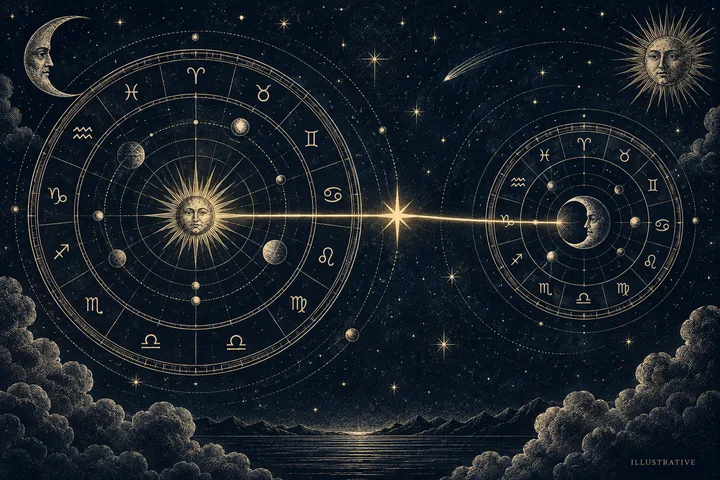
Synastry compares two natal charts. Aspects show how the planets meet, the planets show what is meeting, signs show the style, and houses show where the exchange becomes visible when birth times support that layer. The method describes interaction. It doesn't assign the same feeling to both people.
That distinction answers the question quickly. A strong contact can be shared because both people participate in one symbolic pattern. Investment can still differ because participation isn't intention. One person may feel the contact as longing or pressure. The other may experience it as ordinary action, guardedness, curiosity, or a passing spark. Both are in the contact. They aren't living the same inner weather.
Take a Venus-Mars conjunction. Venus may seek warmth, pleasure, beauty, and closeness. Mars may bring pursuit, heat, initiative, and the urge to act. The conjunction joins those functions. It doesn't decide whether the pair wants tenderness, sex, exclusivity, or a brief encounter. The chart gives you the subject. The people still have to name the agreement.
This is why strong needs a definition. It may mean a close aspect by degree, a conjunction, square, or opposition that keeps demanding attention, or a personal planet touching a natal pattern or dependable angle. Those are different reasons to rank a contact highly. Don't merge them into one dramatic label.
A better sentence is precise: this contact makes attraction, responsibility, safety, or conflict hard to ignore, and each person may carry a different part of it. That leaves room for intensity without turning intensity into proof of equal care.
Sources: Aspects Between Charts; Synastry: The Astrology of Relationships; Synastry - Skyscript Glossary
Planet roles explain the uneven feeling
In an interchart aspect, each person usually takes the role of the planet they bring. If one person's Saturn conjuncts the other's Sun, the Saturn person may set limits, standards, or a pace. The Sun person may feel recognized, contained, judged, supported, or slowed. The roles can move in a conversation, but the symbols give the exchange a direction.
The same applies to the personal planets. A Moon person may look for emotional response and safety. A Mars person may answer through movement, directness, defense, or pursuit. A Venus person may offer affection through pleasure, beauty, touch, or agreement. Mercury wants to name and understand. Saturn wants to define, test, and sustain. These are useful functions, not permanent labels for either person.
Imagine a Moon-Mars contact between two people who care for each other. The Moon person asks for reassurance after a difficult day. The Mars person starts solving the problem. The contact is active in both charts, but the care arrives in different forms. If the Moon person needs listening and the Mars person keeps giving instructions, the shared theme is real while the exchange misses its mark.
Write one sentence for each side before you interpret an outcome. Person A brings the Moon function, so safety and emotional response become central. Person B brings the Mars function, so action and directness become central. Then ask where those functions cooperate and where one person keeps doing the translating.
This role-based reading is stronger than asking which person feels the aspect more. A person can be the Venus person in one contact and the Saturn person in another. Synastry describes the meeting, not the whole character.
Sources: Aspects Between Charts; Synastry: Planet Overlays in Houses
Read each planet in its natal chart before judging the bond
The same synastry contact can open a resource for one person and touch a tender place for the other. To see why, read each involved planet in its own natal chart first. Check the sign, house, closest natal aspects, and relevant rulership. Synastry activates material that already belongs to the person; it doesn't replace that material.
A Venus in Taurus and a Venus in Gemini may both value affection, but they may seek it through different rhythms. Mars in Cancer doesn't pursue like Mars in Aries. Saturn may feel like trusted structure in one chart and a familiar burden in another. The interchart aspect brings a person into that existing pattern, so the two people can feel the same contact with different personal charge.
Suppose one person's Moon already forms a close natal square to Saturn. A partner's Saturn touching that Moon may feel profound, consequential, or frightening because it repeats an old inner meeting. The partner may still be acting from a Saturn pattern that feels normal to them. The difference is not evidence that one person cares and the other doesn't. It tells you where the contact lands in each biography.
Use a small worksheet. For every planet in the contact, record its sign, natal house, closest natal aspects, and the sentence, I already experience this planet as... Keep the sentence open. The person can confirm it, correct it, or reject it. Astrology should give language to the conversation, not speak over the person whose chart you are reading.
This layer also reveals projection. If one person calls a contact life-changing while the other describes it as enjoyable but undefined, the first chart may be carrying more activated longing or fear. Respect that feeling. Then check whether the second person's chart and conduct show a matching wish.
Sources: Aspects Between Charts; Synastry: The Astrology of Relationships; Synastry - Skyscript Glossary
Degrees and orbs tell you how much weight to give it
A sign match is not an exact aspect. Two planets in the same sign may share a style, but their degrees tell you whether they form a close conjunction. The same rule applies to trines, squares, oppositions, and sextiles. An orb is the distance between the exact aspect and the actual positions.
For this site's supplied comparison, selected major aspects use a six-degree orb when degrees are provided. That is a working boundary. It doesn't make every contact inside the boundary equally important. A one-degree Moon-Venus contact normally deserves a higher rank than a six-degree contact between the same planets, while a wider contact can rise when it repeats a major natal pattern or touches a dependable angle.
Aspect type changes the work. A conjunction blends functions and can feel immediate. A square creates friction that asks for a response. An opposition makes each person aware of the other as a counterweight. A trine may bring ease and recognition. A sextile offers an opening that still needs choice. None of these types measures who wants the relationship more.
A tense aspect can create more visible interaction than an easy one. A square may keep raising a subject that the couple must handle. A trine may work so quietly that nobody names it. Intensity, frequency, ease, and effort are separate questions. Keep them separate.
If you know only signs, call the pattern a sign-level theme and leave the aspect unconfirmed. If you know degrees, write them down before interpreting. Don't invent an exact conjunction because the signs look romantic. Precision protects the meaning of the reading.
A strong synastry contact describes a vivid exchange, not an equal promise. The planet person and the receiving person may enter the same theme through different needs, histories, and choices. A close Venus-Mars contact can make attraction obvious, yet it won't tell you whether both people want the same pace or commitment. Start with the planets, aspect, signs, degrees, and orb. Then read each planet in its own natal chart, add house overlays only when birth times are dependable, and rank the contacts by closeness and relevance. Finally, compare the symbolism with words and repeated conduct. Who initiates? Who follows through? Who makes the next conversation possible? Read the chart as a shared pattern with two entrances into it. Use it to name what needs attention. Use the lived exchange to decide whether that theme is becoming a mutual practice.
Sources: Synastry: The Astrology of Relationships; Synastry - Skyscript Glossary
House overlays show where the theme lands, and they aren't one-way
Once the aspect layer is clear, house overlays add location. A partner's planet falling in your sixth house may draw attention to routines, work, and practical care. A planet in your fifth may stir romance, play, pleasure, or creative expression. A planet in your eighth may make intimacy, trust, shared resources, or vulnerability harder to keep abstract.
The house person often experiences the partner through that house's concerns. The planet person brings the planetary function, while the house person supplies the field in which it becomes vivid. But the effect runs both ways. Your partner's Moon may awaken your fifth-house feelings, and your response to that Moon changes how the partner experiences their own emotional expression.
This is a useful place to notice uneven investment without declaring it. One person's Sun may fall in the other's eleventh house, creating a strong friendship or community theme for the house person. The planet person may want intimacy while the house person keeps returning to the social bond. The overlay describes the angle of perception. It doesn't guarantee that both people want the same relationship form.
Birth time matters here. If either Ascendant or house cusps are uncertain, treat overlays as provisional or leave them out. Don't announce a seventh-house placement from an unreliable time. A clear planet-to-planet aspect is more useful than a confident house claim built on missing data.
Read houses after aspects, not instead of them. The aspect tells you how the functions meet. The overlay tells you where that meeting keeps appearing. Together they can suggest the right question: is this attraction becoming a daily rhythm, a private bond, a shared plan, or only an intense room the two people visit?
Sources: Aspects Between Charts; Synastry: Planet Overlays in Houses
Rank mixed indications instead of calling the chart good or bad
Strong synastry rarely speaks with one voice. A Venus-Jupiter trine may describe generosity and pleasure. A Moon-Saturn square may describe the work of reassurance. Mercury contacts may show how the pair can explain what the other two contacts stir up. Don't average these into a score. Give each contact a job.
Rank by three questions. How close is the aspect? Which planets are involved? Does it answer the question the couple is actually asking? A close Venus-Mars contact ranks high for attraction. It may rank low for emotional safety. A slightly wider Moon-Saturn contact may deserve the lead when the concern is why one person feels responsible for holding the bond together.
Repetition matters only when contacts repeat one function. Several links to the Moon, Saturn, and fourth house may form a pattern around safety and responsibility. Five unrelated outer-planet lines don't automatically outweigh one exact personal-planet aspect. Start with the relevant layer, then add supporting contacts.
Consider an example with three indications: a close Venus-Mars contact, a tense Moon-Saturn contact, and a supportive Mercury-Venus contact. The first explains the pull. The second names the condition that may make closeness feel heavy. The third offers a tool for speaking about affection. The ranking is attraction, then safety, then communication as the repair path. That is a reading, not a compatibility grade.
The strongest exception is simple. Different expression isn't proof of unequal care. A private person may show Venus through steady help. A cautious person may show Saturn through reliability. Compare style with repeated follow-through before deciding that the contact is one-sided.
Sources: Aspects Between Charts; Synastry: The Astrology of Relationships; Synastry - Skyscript Glossary
Use missing information to narrow the claim, not lose the meaning
A placement-only reading can still be useful. With Moon, Venus, and Mars signs but no degrees, you can compare styles, elements, modalities, and possible themes. You can't confirm a major aspect or rank it by orb. With degrees but no dependable birth times, you can read many planet-to-planet contacts while leaving houses and angles open.
The Synastry Comparison Report on this site uses supplied placements and optional degrees. It compares Moon, Venus, and Mars signs and selected major aspects with a stated six-degree orb when degrees are provided. It doesn't calculate a natal chart from birth details, calculate houses, or issue a relationship score. That scope keeps the report tied to the information you actually bring.
Make a short data table before you read. List each person's planet, sign, degree if known, and source of the placement. Mark anything near a sign boundary. Then separate confirmed contacts from possible ones. Venus in Scorpio and Mars in Scorpio, degree unknown, is a real sign-level observation. Venus-Mars conjunction is a different claim and needs the degrees.
The Moon deserves extra care near a sign change. Angles and house overlays deserve extra care whenever birth time is uncertain. If better information arrives, revise the technical rank. Don't use the new detail to erase what the two people have already said and done. The chart refines the question. It doesn't replace the evidence of the relationship.
A narrow reading often opens the best conversation. Ask what each person notices before you lead with a dramatic interpretation. Does one feel pursued? Does the other feel pressured? Does affection survive ordinary scheduling? Those answers show which missing chart layer matters most.
Sources: Aspects Between Charts; Synastry: Planet Overlays in Houses; Synastry - Skyscript Glossary
Turn the shared theme into one clear decision
End with a question the chart has made clearer. If Venus-Mars is loud, ask what kind of closeness both people want. If Moon-Saturn is central, ask how reassurance and responsibility will be shared. If Mercury is the bridge, ask how the pair will handle a difficult subject before it becomes a pattern.
Use chart language as an invitation, not a charge sheet. Say, ‘This contact makes closeness and independence important for us. How do you want to handle that?’ Say, ‘I experience this connection as intense, and I need clarity about the pace.’ Don't say, ‘Your Saturn is blocking my Venus, so you must commit.’ One sentence creates a shared subject. The other uses astrology to apply pressure.
Then test the answer in two forms. Listen to the words. Watch the follow-through. A clear answer can still be no, but it tells you what the person is offering. A warm answer that never becomes a plan leaves the practical question open. Equal investment isn't identical style. It is a pattern of making room, naming terms, and returning to what matters.
Choose one observable action. Make a plan. Define the pace. Agree on how you'll revisit the conversation. Then watch what happens. If the action follows, the contact may become a shared resource. If repeated evasion follows warmth, step back from the story built around the aspect.
A strong synastry contact can be meaningful without becoming a mutual agreement. That isn't a failure of the chart. It is the distinction the chart helped you see. Name the theme, rank the evidence, ask the direct question, and choose only the form of participation the other person is actually offering.
Sources: Aspects Between Charts; Synastry: The Astrology of Relationships; Synastry: Planet Overlays in Houses
Sources & further reading
- Aspects Between Charts
Supports the distinction between planetary roles and the use of sign, house, inner-planet, and relationship-significator context in interchart aspects.
- Synastry: The Astrology of Relationships
Supports reading aspects before house overlays, giving tighter contacts more attention, and allowing tense aspects to describe active relationship work.
- Synastry: Planet Overlays in Houses
Supports the two-way house-overlay method and the different perceptions of the planet person and house person.
- Synastry - Skyscript Glossary
Supports the definition of synastry as comparison of natal charts through aspects between planetary positions and angles.
Synastry Comparison Report
Enter known placements for two people. Get an input-by-input comparison, selected aspect calculations and a clear record of what remains uncertain.
Compare our placements