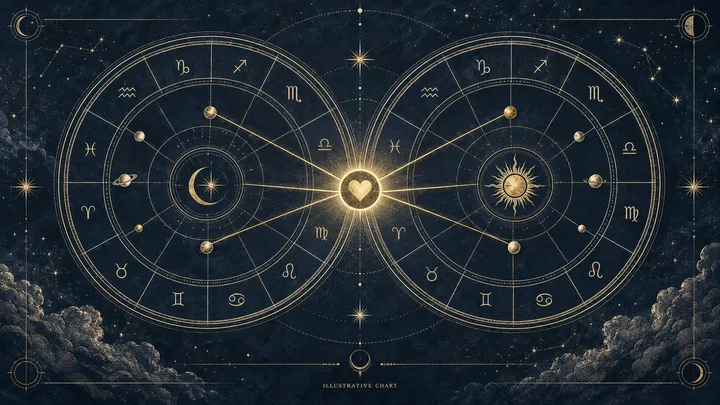
Several lines can describe one relationship problem
You see four tense lines in a synastry report and feel four problems gathering around the relationship. That first impression is often wrong. Several contacts can describe one subject from different angles, so the right question isn’t “How many difficult aspects do we have?” It’s “What keeps repeating between us?”
Astrodienst describes synastry through interaspects, the connections between factors in two charts. Cafe Astrology likewise treats a contact as a meeting between planet functions, not a score. A square can bring friction. A trine can ease exchange. Neither one tells the whole story by itself.
The strongest repeated theme is a convergence of three things: one relationship subject, several relevant contacts, and an exchange you can recognize in ordinary life. Maybe closeness turns into pressure. Maybe a request for reassurance turns into advice. Maybe desire meets caution every time the relationship tries to move forward. Start there. The lines come second.
You spot a repeated synastry theme when different contacts keep returning to the same planet pair, relationship role, or observable exchange. Three hard aspects do not automatically mean three separate problems. They may describe one pressure point from different angles. Start with the planets involved, then check the aspect types, their orbs, the supplied sign placements, and any available degrees. Give the tightest contact the most weight, but let the wider contacts confirm or qualify it rather than lead the reading. In a report that uses supplied placements and optional degrees, a six-degree orb can identify the contacts being considered, but the chart still needs interpretation. Ask what keeps happening between you, then see whether the same theme appears in the Moon, Venus, or Mars layer. A repeated theme is useful when it clarifies a conversation or choice. It isn’t a verdict about whether the relationship should continue.
Sources: Partner horoscopes: Synastry and aspect orbs; Synastry - Astrodienst Astrowiki; Synastry: Love and Relationship Astrology
Sort the contacts by planet role
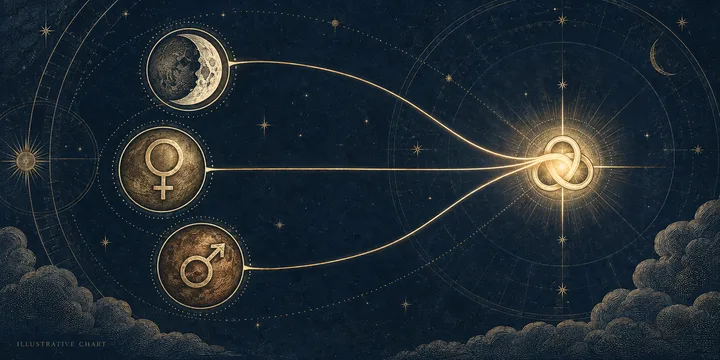
Repetition starts with the planets. Group contacts by the function they bring into the relationship, then ask whether the same subject survives the grouping. Moon contacts often bring feeling, safety, habit, and the need for care. Venus contacts bring affection, pleasure, values, and the style of relating. Mars contacts bring pursuit, assertion, desire, and conflict. Saturn adds rules, patience, responsibility, and pressure.
A repeated planet pair is the clearest case. Venus-Mars contacts can show attraction and friction together. Venus-Saturn can make affection feel serious, delayed, or tested. Moon-Mars can put feeling into motion and can also make domestic tension vivid. These contacts don’t mean the same thing. They can still converge on one question, such as how quickly closeness should become action.
A shared planet is not enough. Three Venus contacts might concern affection, money, taste, and self-worth rather than one single problem. Name the subject before you group the evidence. If you can’t say what the contacts have in common, keep them as separate threads.
Sources: Synastry - Astrodienst Astrowiki; Synastry: Love and Relationship Astrology
A worked example: attraction that needs a safe pace
Consider this example. One person’s Mars makes a close square to the other person’s Venus. That Mars also makes a flowing contact to the other person’s Moon, while Saturn contacts the Venus-Mars pair. These are illustrative placements, not a personal chart.
Read Mars first. Cafe Astrology describes Venus-Mars contacts as strong attraction signatures, with hard aspects adding friction. Mars moves toward what it wants. Venus decides what feels pleasing, valued, and welcome. The same approach can feel exciting one day and intrusive the next, especially when the contact is charged.
The Moon contact adds emotional heat and a possible route into tenderness. Saturn adds the need for steadiness, boundaries, and proof over time. The repeated theme is not three bad aspects. It is attraction meeting a different pace of trust. The practical question becomes clear: when one person moves closer, what helps the other feel invited rather than pushed?
That question is the synthesis. It keeps the Venus layer, the Mars layer, and the Saturn layer distinct while showing why they belong in one reading. It also gives the couple something to observe. A slower invitation, a stated boundary, or a clear plan can test the interpretation.
Sources: Synastry - Astrodienst Astrowiki; Synastry: Love and Relationship Astrology
Rank the contacts by relevance, aspect, and orb
Don’t let the report’s list order rank the story for you. Use three passes. First, choose the planet contact that most directly answers the reader’s question. Then read the aspect as the manner of exchange. Finally, use the orb to decide which contact leads and which ones confirm.
A conjunction joins two functions. An opposition creates a pull between them. A square asks for work and can create useful tension. A trine or sextile often supplies ease or an existing skill. Cafe Astrology makes these broad distinctions, while Astrodienst notes that synastry benefits from smaller orbs because two charts create many more contacts than one.
This comparison uses a six-degree orb for selected major aspects when degrees are supplied. That boundary tells you which contacts enter the reading. It doesn’t make a one-degree contact equal to a five-degree contact. Let the closer contact lead. Let the wider one support, modify, or remain background.
Tie the ranking to the question. For emotional reassurance, a close Moon contact may lead a wider Venus contact. For desire and pursuit, Venus-Mars may lead while Moon explains the after-effect. A beautiful aspect that answers another question can stay secondary. Relevance beats arithmetic.
Keep the calculation scope clean. If you have supplied signs and optional degrees, read those placements and selected major aspects. Don’t add houses, declination, minor aspects, applying language, or any other chart input that hasn’t been supplied and defined. The report is stronger when its evidence is visible.
Sources: Partner horoscopes: Synastry and aspect orbs; Synastry - Astrodienst Astrowiki; Synastry: Love and Relationship Astrology
Check whether the contacts describe one chain
Now test the proposed theme against three points: trigger, need, and consequence. This is where grouping either earns its place or falls apart.
A Moon contact may appear when someone feels ignored. Venus may enter when the offered affection doesn’t feel loving. Mars may take over when somebody demands an answer or pushes for action. If those moments form one chain, the contacts probably belong together. If a spending dispute appears only when values clash, keep it as a neighboring Venus theme.
Write the chain in plain language. “I ask for reassurance. You solve the problem. I feel unseen. You push harder. We both call it disrespect.” That sequence is more useful than “challenging emotional synastry.” It also shows where a different contact might belong. Similar vocabulary isn’t proof. A shared trigger and consequence are stronger evidence.
Don’t confuse a loose cluster with a formal aspect pattern. Cafe Astrology reserves names such as T-square for specific geometry, including an opposition joined by squares to a focal point. Several squares around a chart may repeat a subject without forming a T-square. Describe the structure you actually have.
Sources: Synastry: Love and Relationship Astrology; Aspect Patterns in an Astrology Chart
The exception: one theme can hold both strain and relief
A repeated theme doesn’t have to be a repeated problem. It can contain the pressure and the resource that helps the couple work with it. That’s the strongest exception to a purely negative reading.
Imagine Maria has a hard Venus-Saturn contact, a Mars contact to Venus, and a flowing Jupiter-Moon contact. The first may describe caution around affection. The second keeps desire active but can sharpen irritation. The third may offer warmth, generosity, and a way back into emotional connection. All three can belong to the subject of closeness without carrying the same meaning.
Cafe Astrology describes flowing contacts as supportive and difficult contacts as capable of friction or stimulation. Astrodienst also frames interaspects as channels that can be easier or harder to work through. So rank the pressure and the relief separately. Don’t let the supportive contact erase the difficulty. Don’t let the difficult contact hide the resource.
Look for the relief in behavior. “Jupiter helps” is a chart phrase. “After a hard talk, we can return without punishment” is an observable possibility. If you haven’t seen it yet, treat it as a practice to test. A resource matters when you can use it.
Sources: Partner horoscopes: Synastry and aspect orbs; Synastry - Astrodienst Astrowiki; Synastry: Love and Relationship Astrology
Turn the theme into one useful decision
Once you have a subject, stop collecting lines. Choose the next decision the theme can clarify. If the pattern is closeness meeting pressure, decide how an invitation should be made. If it is reassurance turning into advice, decide what kind of response actually lands. If it is affection meeting restraint, decide which promise needs consistency.
Match the action to the planet role. Moon needs emotional language. Venus needs a clear expression of affection and values. Mars needs a direct request or boundary. Saturn needs a plan that can be kept. Keep the behavior small enough to observe.
Imagine Maria writes down the same exchange three times: her partner moves quickly toward closeness, she asks for warmth first, and he hears criticism. Her next sentence can be simple: “When I ask for reassurance, I need warmth before advice.” That sentence tests the theme without turning either person into a fixed type.
When you compare your placements, record the lead contact, its orb if known, the repeated subject, and one real exchange that brought it to mind. Then ask the report one precise question: what would make this pattern safer to live? That is how several aspect lines become a reading.
Sources: Synastry - Astrodienst Astrowiki; Synastry: Love and Relationship Astrology
Sources & further reading
- Partner horoscopes: Synastry and aspect orbs
Supports the definition of synastry as chart comparison and the use of smaller aspect orbs in partner charts.
- Synastry - Astrodienst Astrowiki
Supports reading harmonious and difficult contacts as different channels of exchange, including Saturn and personal planets.
- Interaspect - Astrodienst Astrowiki
Supports using smaller orbs in synastry to keep the larger number of cross-chart contacts readable.
- Synastry: Love and Relationship Astrology
Supports the planet-pair interpretations for Moon, Venus, Mars, Saturn, Jupiter, and the difference between flowing and difficult aspects.
- Aspect Patterns in an Astrology Chart
Supports the formal definition of aspect patterns such as a T-square and the need to distinguish geometry from a loose cluster of aspects.
Synastry Comparison Report
Enter known placements for two people. Get an input-by-input comparison, selected aspect calculations and a clear record of what remains uncertain.
Compare our placements