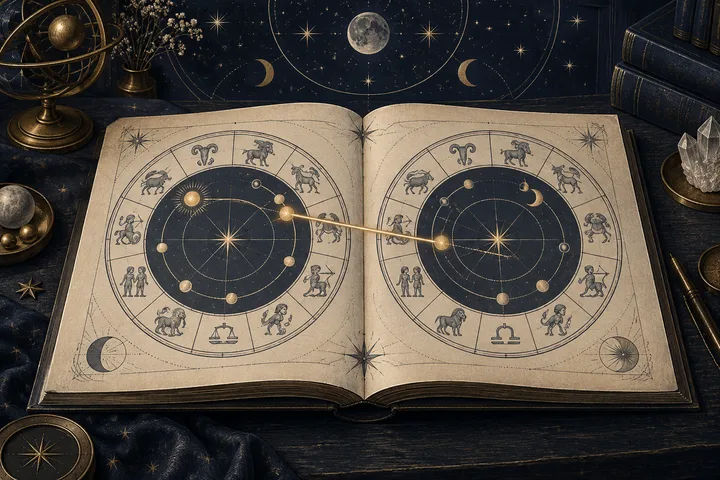
Specificity begins where the evidence begins
A vivid synastry reading can feel personal. That doesn’t mean it has earned every personal detail it claims. A few sign labels can become a whole backstory. Venus-Mars can become a promise of irresistible chemistry. Saturn can become proof that two people will stay. The symbols start carrying facts they never supplied.
Use a tighter rule. Make the interpretation as particular as the input allows, and no more. If you know that one person has Venus in Taurus and the other has Mars in Cancer, you can discuss two styles of affection and desire, their earth-water tone, and the question of how comfort meets initiative. If you also know the degrees and find a close sextile, you can add that geometry. You still can’t say where they met, what either person wants, or what will happen next.
Cafe Astrology describes synastry as the study of how people interact through chart factors, while its technique guide separates temperament comparison, interchart chemistry, house overlays, and composite work. That distinction gives the reading a useful floor. Synastry compares chart factors. It doesn’t hand you an unseen biography. [1] [2]
A simple audit keeps the prose honest. What chart input produced the sentence? What operation did you perform: compare signs, calculate an angle, or synthesize repeated contacts? What part is interpretation? Put those answers on the page through clear wording. ‘A close Moon-Venus trine can describe an easy exchange between comfort and affection’ names a chart pattern. ‘Notice whether reassurance arrives through touch, kind words, practical help, or being nearby’ turns it into a useful question. ‘You both feel safe with each other’ skips the evidence.
The strongest reading also gives the best alternative. Saturn can show commitment, but it can also show delay, fear, or a need for limits. Venus-Mars can show attraction, while a square may bring mismatched pace. Tell the reader what to observe so those possibilities can be separated. Evidence-led layering beats narrative confidence. It gives the symbols somewhere to go.
A useful synastry interpretation stays close to three things: the chart input, the astrological symbol, and the question you want the comparison to answer. Start with the two supplied placements. Name what each planet signifies, how each sign gives it a style, and what the aspect does to the exchange. If degrees are available, calculate only the selected major aspects within the stated six-degree orb. Then translate the pattern into an observable relationship question, such as how affection is shown, how desire is expressed, or how conflict gets handled. Don’t fill missing houses, birth times, or degrees with a personal story. The strongest reading is the one that shows its evidence, ranks its themes, gives the meaningful exception, and leaves the couple with something specific to discuss.
Sources: Synastry: Love and Relationship Astrology; Summary of Techniques in Synastry, Relationship Astrology
Why the invented story feels so tempting
Astrological symbols are rich. Venus can speak to attraction, pleasure, values, and the way affection is offered. Mars can speak to desire, pursuit, initiative, and conflict. Put those planets into two charts and the mind wants to complete the picture. Who pursues whom? Who feels exposed? What happens next?
That imaginative leap has a proper place. A list of definitions isn’t a reading. Interpretation needs synthesis. But synthesis must keep the same level of certainty as the chart factor. Venus-Mars can describe an attraction pattern. It can’t establish a date, a sexual history, or a hidden motive. Saturn can describe restraint, responsibility, endurance, or a difference in pace. It can’t certify permanence.
Use a three-step sentence. Name the contact. Describe the style. Ask the question. ‘This contact can make affection and action noticeable to each other. The signs show whether that exchange is patient, urgent, verbal, private, or practical. Do you both experience care as something to receive slowly, or as something to act on immediately?’ The reader gets a living interpretation without receiving a fabricated scene.
Cafe Astrology’s interchart guidance treats the planets as roles within an exchange and notes that sign placement changes how the same contact is expressed. That role language helps when it stays flexible. The Saturn person may bring caution in one interaction and responsibility in another. The Venus person may experience that caution as care or as distance. A planet role is a pattern, not a fixed personality. [1] [2]
The strongest exception is a pattern supported by several converging factors. Suppose the supplied data shows a close Moon-Venus trine and a close Venus-Mars square, both involving the same Venus. You can rank affection and attraction as major themes, then explain that ease and friction coexist. The convergence strengthens the theme. It doesn’t select a dramatic anecdote or prove mutual desire.
Sources: Synastry: Love and Relationship Astrology; Summary of Techniques in Synastry, Relationship Astrology
Read the chart in layers, then test the pattern
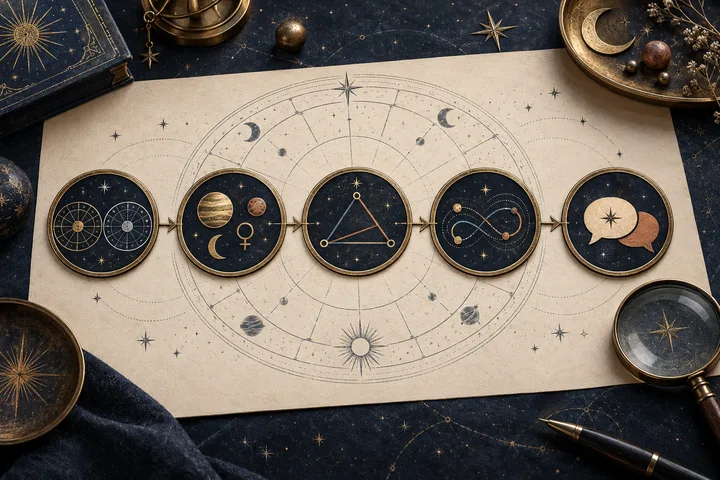
A specific reading has an order. Start with the planet. Add the sign. Identify the aspect only when the supplied degrees support it. Compare repeated themes. Then turn the symbolism into a relationship question. This sequence stops one attractive keyword from taking over the report.
The planet answers what part of relating is involved. The Moon points toward emotional response, comfort, memory, and daily needs. Venus speaks to affection, pleasure, values, and attraction. Mars speaks to desire, initiative, pursuit, and conflict energy. Mercury brings thought and exchange. Saturn adds boundaries, responsibility, time, and pressure. These are interpretive functions, not complete descriptions of a person.
The sign answers how that function moves. Fire can give a direct or initiating tone. Earth can seek steadiness and what can be relied on. Air can favor language, ideas, and comparison. Water can respond through feeling, instinct, memory, and atmosphere. Modality adds another turn: cardinal begins, fixed sustains, and mutable adapts. Use the qualities that serve the question. Don’t paste a full sign glossary into every paragraph.
The aspect answers how the two functions meet. The major aspects used here are conjunction at 0 degrees, sextile at 60, square at 90, trine at 120, and opposition at 180 degrees. Cafe Astrology’s interchart guide emphasizes that sign and house placements modify a contact, while its broader technique guide places interchart aspects among several distinct relationship layers. [1] [2]
Imagine Maria has Venus at 14 degrees Taurus and Alex has Mars at 17 degrees Cancer. Their shortest separation is 63 degrees, so this six-degree scope doesn’t select a major sextile. The sign relationship still gives an earth-water conversation: affection may seek steadiness while desire may move through protection and feeling. That’s a sign-based synthesis, not a degree-confirmed aspect.
Change Alex’s Mars to 14 degrees Cancer. The separation is now exactly 60 degrees, so the comparison can name a Venus-Mars sextile within the stated orb. The reading became more specific because the input became more specific. The story doesn’t need to become bigger. It needs to become better supported.
The useful conclusion is a question: who needs reassurance before moving closer, what counts as proof of care, and what pace lets both people feel wanted without pressure? The chart supplies the theme. The couple supplies its expression.
Sources: Synastry: Love and Relationship Astrology; Summary of Techniques in Synastry, Relationship Astrology
Degrees and orbs decide how much weight a contact deserves
Sign compatibility and aspect geometry answer different questions. Two planets can occupy signs that relate by element or modality without forming a close major aspect by degree. Two planets can also form a close aspect across a sign boundary. A report that treats every friendly sign relationship as an exact aspect loses the difference between style and geometry.
An orb is the distance between an exact aspect and the actual planetary positions. This report uses a six-degree scope for selected major aspects. A one-degree contact and a six-degree contact may both qualify, but they shouldn’t carry equal weight. Astrodienst’s synastry guidance notes that interaspects are often read with smaller orbs than natal aspects, because comparing two charts can quickly produce too many contacts to interpret clearly. [3]
Use the method in the language. Say ‘close’ when the contact is close. Say ‘within the six-degree scope’ when it is wider but included. Say ‘sign-based’ when there are no degrees to verify an aspect. The reader then understands why two reports may rank the same pair differently if they use different orbs or aspect lists. Cafe Astrology likewise advises giving close attention to inner-planet interaspects, the signs, and the houses involved. [1]
Consider a supplied Moon at 2 degrees Virgo and Venus at 20 degrees Pisces. Their shortest separation is 162 degrees, which is 18 degrees from an opposition. It doesn’t qualify within six degrees. The Virgo-Pisces polarity may still matter in a discussion of emotional habits and affection, but it must remain sign-based. The calculation tells you what kind of evidence is carrying the interpretation.
Aspect families deserve different verbs. A trine can describe a natural fit. A sextile may need an invitation or active opening. A square can create friction that asks for work. An opposition can draw two needs across a polarity. These are starting structures, not outcomes. A loose contact can gain weight when several separate, close factors repeat its theme, but repetition doesn’t turn a wide aspect into an exact one.
If one report lists a Venus-Mars sextile and another doesn’t, check the degrees, zodiac positions, orb, and aspect list before choosing a meaning. A short evidence table helps: record both positions, the angular distance, the named aspect, and the interpretation’s rank. If three paragraphs all rely on one Venus-Mars square, you have one theme with several applications, not three separate findings.
Sources: Synastry: Love and Relationship Astrology; Interaspect
Compare the same theme from both sides
A reading becomes personal in the right way when it shows how two people participate in the same pattern. Don’t write one partner as the cause and the other as the reaction. Synastry is an exchange. Each person may experience a different side of the contact, and the roles can shift as the interaction changes.
Take a close Venus-Mars square. The Venus person may experience the Mars person as thrillingly direct, too forceful, or too quick. The Mars person may experience Venus as inviting, elusive, or hard to satisfy. The square creates friction, but friction isn’t a verdict. It gives the couple a question about timing, initiative, and how each person recognizes a welcoming response.
Now take a Moon-Venus trine. The Moon person may feel soothed and accepted. The Venus person may find it natural to offer warmth. But ease can cover a difficult subject. If one person needs comfort and the other offers pleasant distraction, the contact may feel loving while leaving the need untouched. The exception matters because a supportive symbol can still require attention.
Cafe Astrology’s interchart guidance uses this two-sided role approach and stresses that signs change the expression of a planet pair. Apply it without assigning blame. With Taylor’s Saturn square Jordan’s Venus, Taylor may show care through caution and limits, while Jordan may want warmth without a test. The shared theme is whether restraint feels like reliability or rejection. When plans change, do they explain the reason, or does one person silently read the change as judgment? [1]
The same method works with Moon-Mars. The Moon person may seek recognition before action. The Mars person may try to solve the problem immediately. In an easier contact, action can reassure feeling. In a tense one, action can feel like interruption and feeling can feel like delay. Ask what each person wants first: comfort, space, a plan, or movement. The aspect suggests the pressure point. The conversation reveals its form.
Sources: Synastry: Love and Relationship Astrology; Summary of Techniques in Synastry, Relationship Astrology
Know which chart layers your data cannot support
Precision includes knowing what to leave out. A placement-only comparison can work with supplied Moon, Venus, and Mars signs. It can compare elements and modalities. It can interpret selected major aspects when both degrees are available and the report applies its six-degree scope. It can’t responsibly describe house overlays, Ascendant contacts, or an uncertain Moon degree as settled fact.
Houses answer where a planet’s symbolism lands in a person’s life. That makes a house overlay a separate layer from sign comparison and interchart aspects. A composite chart is separate again. Cafe Astrology describes it as a new relationship chart derived from mathematical midpoints between the two people’s planets and points. It isn’t another name for synastry. [1] [4]
Use this decision guide. With signs only, write a sign comparison and label it. With two planetary degrees, calculate the selected major aspects and report their orbs. If one degree is missing, don’t guess the aspect. If birth time is missing, don’t use houses or angles. If a complete aspect table or verified angle is supplied, you may use it, but state the input and scope.
Missing birth time can affect house cusps and, depending on the day and planet, the Moon’s exact sign or degree. Missing degrees create a similar boundary. You can compare two Venus signs. You can’t tell the reader whether they form a trine, square, or opposition from sign names alone. Also distinguish ‘not found in the supplied data’ from ‘not present in every possible method.’ Another orb, minor aspect, or corrected input could change the picture.
A bounded report won’t feel thin when it gives the known layer enough room. Moon, Venus, and Mars can support a clear discussion of comfort, affection, desire, pursuit, and repair. The report becomes thin when it impersonates a full natal reading. A narrow truth gives the reader more to work with than a broad paragraph built from missing inputs.
Sources: Summary of Techniques in Synastry, Relationship Astrology; The Composite Chart: Relationship Astrology
Turn interpretation into one useful conversation
The point of synastry isn’t to produce a sentence that sounds intimate. It’s to make a relationship pattern easier to see. Once the chart layers are ranked, translate the strongest theme into a conversation the couple can actually have.
Start with the clearest supported contact. Name the planet pair and aspect. State the sign expression. Then ask one practical question. For Moon-Venus, ask how each person gives comfort and what kind of comfort lands. For Venus-Mars, ask how each person signals interest, pace, and a welcome yes. For Saturn contacts, ask which promises can be made and kept without turning care into control.
Avoid the lazy ending, ‘You are compatible but need to communicate.’ Say what to communicate about. ‘When one of you needs quiet, how will the other know whether it means rest, distance, or a request for help?’ belongs to the Moon layer. ‘When attraction feels strong but your pacing differs, what action feels inviting rather than demanding?’ belongs to Venus and Mars.
Rank the interpretation in three moves. Lead with the closest supported personal-planet contact. Add the sign pattern to show its style. Then name the strongest exception, such as ease that avoids a difficult topic or attraction that creates timing friction. Stop there unless another factor changes the central question. This evidence ladder is the article’s original contribution: input, factor, geometry, convergence, exception, question.
Compare your placements when you want that ladder applied to supplied Moon, Venus, and Mars signs, with optional degrees and a stated six-degree orb. The Synastry Comparison Report organizes those selected contacts. It doesn’t need to invent a birth story to be useful.
End with one conversation: ‘Which chart theme feels most recognizable in how we care for, pursue, or protect each other, and what would we like to try differently this week?’ A short time frame keeps the question alive. Listen to the answer. That’s where interpretation becomes lived astrology.
Sources: Synastry: Love and Relationship Astrology; Summary of Techniques in Synastry, Relationship Astrology; Interaspect; The Composite Chart: Relationship Astrology
A little more clarity
Can a synastry reading be specific if I only know the signs?
Yes. Compare the planet functions, sign elements, and modalities, then keep the conclusion at the sign-based level. You can discuss how Moon, Venus, or Mars styles meet. You can’t claim a degree aspect, house overlay, or personal event without the needed inputs.
How do I describe a six-degree synastry orb without overstating it?
State that the report selects major aspects within a six-degree orb, then give the actual orb when available. Call a one-degree contact close and a six-degree contact wider. Both may qualify, but they shouldn’t receive identical emphasis.
What is the difference between a synastry theme and a relationship prediction?
A synastry theme describes how chart factors may interact, such as ease around affection or friction around timing. A prediction claims what will happen. Keep the reading with the theme, name its exception, and turn it into a question about behavior the couple can observe.
What should I do when a compelling interpretation isn’t supported by the data?
Keep the symbolic possibility as a question, not a fact. Record the supplied placements, identify the missing layer, and say what would be needed to examine it. Then interpret the evidence that is present. A bounded reading is stronger than an invented explanation.
Sources & further reading
- Synastry: Love and Relationship Astrology
Supports the distinction between sign comparisons, interchart aspects, aspect types, planetary roles, and applied synastry themes.
- Summary of Techniques in Synastry, Relationship Astrology
Supports separating temperament comparison, synastry chemistry, house overlays, composite charts, and individual relationship potential.
- Interaspect
Supports using smaller orbs in synastry because two-chart comparisons can create too many contacts to interpret clearly.
- The Composite Chart: Relationship Astrology
Supports distinguishing a midpoint composite chart of the relationship from a synastry comparison between two natal charts.
Synastry Comparison Report
Enter known placements for two people. Get an input-by-input comparison, selected aspect calculations and a clear record of what remains uncertain.
Compare our placements