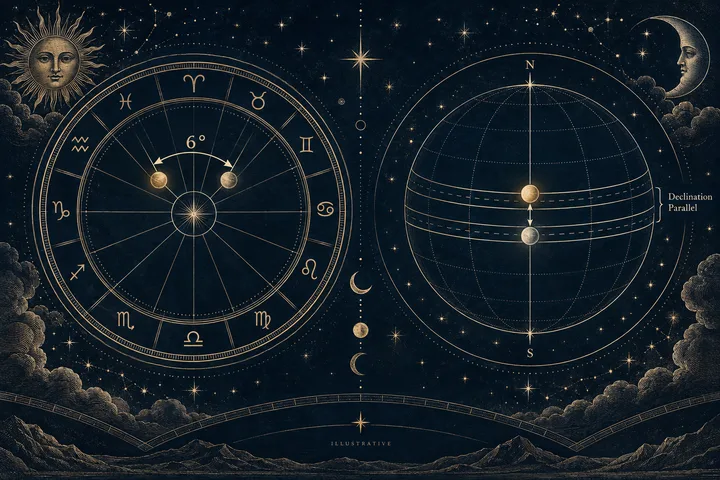
The assumption to test: one orb should work everywhere
A six-degree orb isn't a universal halo around every contact in a synastry chart. It belongs to a named longitude relationship. When Venus and Mars are six degrees from an exact square, you are measuring their positions along the zodiac. The same applies to a conjunction, trine, opposition, or another aspect calculated from ecliptic longitude.
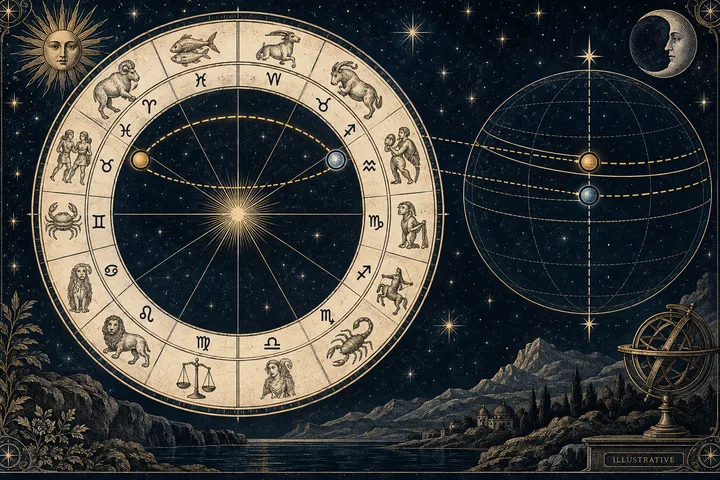
A parallel asks a different question. How far north or south is each body from the celestial equator? Two bodies at nearly the same declination on the same side form a parallel. Two bodies at nearly the same distance on opposite sides form a contraparallel. The ordinary chart wheel foregrounds longitude, so this second relationship may not appear in its aspect grid.
The supported position is simple: don't transfer the longitude orb to declination. Cafe Astrology demonstrates synastry parallels with a one-degree orb. Kerykeion gives a typical range of 1 degree to 1°15'. Choose a convention, write it beside the result, and apply it consistently. The number is a boundary for a particular measurement. It isn't a score for how important the relationship feels.
That distinction makes two reports easier to compare. If one includes a contact and the other doesn't, check the coordinate, the north or south direction, the exact difference, and the chosen orb. One report may be using the one-degree rule while another accepts the upper end of the narrower 1°15' range. The disagreement is methodological. It isn't proof that one report has discovered a stronger bond.
The six-degree synastry orb belongs to longitude aspects such as conjunctions, squares, and trines. A declination parallel is measured on another coordinate: how far north or south each body sits from the celestial equator. That is why astrologers usually use a much tighter orb, about 1 degree. Kerykeion describes a typical range of 1 degree to 1°15', while Cafe Astrology demonstrates the comparison with a one-degree orb. Treat those as separate conventions, not as competing versions of one universal rule. Compare the actual declinations, keep the north or south direction, and state the orb before interpreting. Then check whether the same planets also form a close longitude aspect. A parallel that reinforces a clear Venus-Mars or Moon-Saturn contact deserves more attention than an isolated, borderline result. Sign placements alone cannot establish a parallel. You need both bodies' declinations.
Sources: Determining Parallels/Contra-Parallels in Synastry - Cafe Astrology; Synastry in More Detail - Cafe Astrology; Parallels and Contra-Parallels in Astrology - Kerykeion
What declination adds to the chart
Declination measures a body's distance above or below the celestial equator. A planet at 18° North lies eighteen degrees north of that equator. A planet at 18° South lies eighteen degrees south. Both the number and the direction matter.
A parallel joins matching distances on the same side. Mars at 16° North and Venus at 16°40' North are parallel within a one-degree orb. A contraparallel joins matching distances on opposite sides. The Moon at 18° North and Pluto at 17°30' South are contraparallel within that same limit.
Astrologers often read a parallel like a conjunction because it blends the planetary functions. They often read a contraparallel like an opposition because it creates polarity, projection, and a need to balance two drives. Those comparisons are useful, but they don't erase the geometry. Venus parallel Mars is not Venus conjunct Mars. Venus contraparallel Mars is not Venus opposite Mars.
The declination layer can also link bodies whose zodiac positions don't make a close major aspect. That is its particular gift. It doesn't cancel sign symbolism or longitude. It adds another thread. If the signs describe how a planet behaves and longitude shows the visible relationship, declination can show a quieter bond operating across that picture.
Sources: Synastry in More Detail - Cafe Astrology; Parallels and Contra-Parallels in Astrology - Kerykeion; Declination and Out of Bounds - Lunarium
The calculation: what counts as a parallel
You need two declination values. Keep the minutes and the direction. A clean record might read: Person A's Venus, 19°12' North; Person B's Mars, 19°48' North. Subtract the smaller value from the larger one. The difference is 0°36'. Because both bodies are north and the difference is within one degree, the pair forms a Venus-Mars parallel under a one-degree rule.
For a contraparallel, compare the absolute distances while noting the opposite directions. Venus at 19°12' North and Mars at 19°48' South also differ by 0°36' in distance, but the contact is a contraparallel. Writing only '0°36'' hides the part of the calculation that changes the aspect name.
Cafe Astrology uses this same practical process: read the declination column, compare the numerical values, and check whether the bodies are on the same or opposite sides of the equator. Kerykeion describes the mathematical relationship as a separate equatorial coordinate, not a second way to measure zodiacal longitude.
The input boundary matters. A sign such as Leo or Scorpio does not tell you a planet's declination. Even a zodiac degree does not function as a declination value. If a report gives signs only, you can explain what a parallel would mean and what data would establish it. You can't announce that one exists.
Sources: Determining Parallels/Contra-Parallels in Synastry - Cafe Astrology; Synastry in More Detail - Cafe Astrology; Parallels and Contra-Parallels in Astrology - Kerykeion
A worked example: Venus and Mars across both layers
Consider an example. Person A's Venus is at 22° Leo. Person B's Mars is at 25° Scorpio. Their zodiacal longitudes are 142° and 235°. The shortest separation is 93°, which places the pair three degrees from an exact square. That is already a close longitude contact between attraction, preference, desire, and initiative.
Now add the declination table. Venus is 19°12' North. Mars is 19°48' North. The 0°36' difference qualifies as a parallel under a one-degree convention. It doesn't replace the square. It reinforces the same Venus-Mars pair through another coordinate, so the attraction and friction deserve one integrated interpretation rather than two unrelated paragraphs.
The reading might say that desire becomes immediate, but the way one person takes initiative can press on the other person's style of affection. The square supplies the tension. The parallel joins the two functions beneath it. Together they describe a charged exchange. They don't decide whether the couple communicates well or wants the same commitment.
Now change only the declinations. Suppose Venus remains at 19°12' North while Mars is 21°05' North. The difference is 1°53'. Under a one-degree rule, there is no parallel. Under Kerykeion's stated upper range of 1°15', there still isn't one. The Venus-Mars square remains. The declination claim does not.
The numbers here illustrate the method. They aren't a personal chart. In an actual comparison, replace them with supplied values and preserve the source of each value. If the report doesn't show declination, stop before the arithmetic. That small act of restraint protects the rest of the reading.
Sources: Determining Parallels/Contra-Parallels in Synastry - Cafe Astrology; Synastry in More Detail - Cafe Astrology; Parallels and Contra-Parallels in Astrology - Kerykeion
How to rank a declination contact beside longitude
A synastry report needs an order of attention. Otherwise every line in the aspect table receives the same weight, and the reader leaves with a pile of contacts instead of a clear pattern.
Start with exactness. A parallel at 0°05' is tighter than one at 0°58'. Both may qualify under a one-degree rule, but they don't deserve identical emphasis. Exactness is the first filter, not the whole interpretation.
Next, look at the planets. A Moon-Venus parallel can join emotional comfort with affection and receptivity. A Venus-Mars parallel can join attraction with initiative. A Saturn contact can bind closeness to time, duty, pacing, or responsibility. The aspect says how the functions meet. The planets say what is meeting.
Then check reinforcement. Cafe Astrology specifically notes that a parallel can reinforce a longitude aspect between the same planets. That is the clearest reason to give it more space. A Venus-Mars square with a Venus-Mars parallel is one layered story. Don't count it as two separate pieces of evidence and repeat the same interpretation twice.
Finally, compare the contact with the rest of the chart and the reader's question. A close Moon-Saturn contact may lead when the couple is asking about reassurance and responsibility. A Venus-Mars contact may lead when the question is attraction or initiative. The orb tells you whether the contact is close enough to enter the reading. It doesn't decide the emotional priority by itself.
Sources: Synastry in More Detail - Cafe Astrology; Parallels and Contra-Parallels in Astrology - Kerykeion; Declination and Out of Bounds - Lunarium
The strongest exception: a wider contact can stay secondary
The one-degree working rule is strong, but orb boundaries are conventions. Kerykeion describes a typical range reaching 1°15', so a practitioner using that method may include a 1°10' parallel. That wider contact should be labeled as a supporting layer. It shouldn't be presented as equal to a 0°12' parallel.
The best exception has a reason to exist beyond the wider number. Imagine Person A's Moon and Person B's Venus form a close longitude trine, while their declinations differ by 1°10'. Under the stated 1°15' convention, the parallel can echo the emotional and affectionate flow already visible in the trine. It confirms a theme. It doesn't rescue an otherwise empty interpretation.
The opposite case is cleaner. A 1°40' contact with no close longitude aspect, no personal-planet relevance, and no repeated theme should stay out of the main reading under either the one-degree rule or the 1°15' range. More contacts don't always make a chart clearer. Sometimes they bury the useful ones.
State the rule before you interpret. If you use one degree, use one degree for comparable contacts in that report. If you use 1°15', apply it consistently and mark the wider results as secondary when they need that treatment. Don't widen the boundary because one contact feels vivid. Method should lead meaning.
Sources: Synastry in More Detail - Cafe Astrology; Parallels and Contra-Parallels in Astrology - Kerykeion
Why contraparallels need careful wording
A contraparallel is not a parallel with a negative tone. It has a different north-south arrangement. The bodies sit at similar distances from the celestial equator, but one is north and the other is south. That reversal gives the contact its opposition-like quality.
A Moon-Mars contraparallel may describe feeling meeting direct action in a reactive way. A Venus-Saturn contraparallel may bring attraction into a conversation about time, limits, and responsibility. The planets set the subject. The contraparallel describes the polarity within it.
Use the analogy after the calculation, not instead of it. A useful sentence is: Mars contraparallel Moon, 0°24', creates an opposition-like pull between action and feeling. That wording gives the reader the input, the aspect, the closeness, and the interpretive bridge in one place.
Don't turn the contact into a forecast or a verdict. A contraparallel can describe friction, fascination, complementarity, or a recurring negotiation. Read the signs, the other aspects, and the question the couple is actually bringing. The chart shows a relationship between functions. The people decide how they work with it.
Sources: Synastry in More Detail - Cafe Astrology; Parallels and Contra-Parallels in Astrology - Kerykeion; Declinations: Parallel Aspect Interpretations - Cafe Astrology
What a placement-only comparison can and cannot say
A comparison based on supplied placements has three distinct layers. Signs support sign-based symbolism. Zodiac degrees support longitude aspects when the degrees are reliable. Declination values support parallels and contraparallels. Keep those layers separate in the report.
If you know only Moon, Venus, and Mars signs, you can discuss emotional needs, affection, desire, and sign affinity. If you also have degrees, you can check longitude aspects using the stated orb. If you have declinations, you can check the second coordinate. One kind of input doesn't quietly become another.
For each declination contact, preserve the body, value, direction, source, aspect name, and orb. Rounding 19°12' to 19° can change a borderline result. Mixing values from reports with unknown settings can create another problem. Before comparing, check that the reports use the same zodiac reference and a compatible calculation convention.
This is also where missing birth information matters. A placement-only report can compare supplied Moon, Venus, and Mars signs and optional degrees. It doesn't calculate a natal chart, houses, angles, or declinations that weren't supplied. If a reader wants the declination layer, the next useful input is the declination table itself.
Precision isn't a wall around interpretation. It tells you which part of the interpretation has earned its weight. Leave an unconfirmed parallel open. A clear limit is more useful than a beautiful claim built from the wrong coordinate.
Sources: Determining Parallels/Contra-Parallels in Synastry - Cafe Astrology; Parallels and Contra-Parallels in Astrology - Kerykeion; Declination and Out of Bounds - Lunarium
The decision: use the smaller orb, then read the whole pattern
The six-degree synastry orb doesn't apply equally to declination parallels because a parallel isn't a longitude aspect. It uses declination, an equatorial coordinate, and it belongs to a separate aspect family. The practical answer follows: use a tight declination convention, usually 1 degree, with 1°15' as the upper range described by Kerykeion.
For your comparison, record the two declinations and their north or south directions. Calculate the difference. Name the contact as a parallel or contraparallel. Write the orb you chose. Then check the closest longitude relationship between the same planets.
If the declination contact is exact and reinforces a clear personal-planet theme, let it strengthen the reading. If it is wider but falls within your announced convention, keep it secondary. If it is outside the boundary or rests on missing data, leave it out. A clean absence is better than a loose presence.
Then bring the chart back to life. A Venus-Mars link can prompt a conversation about initiative, welcome, and mutual desire. A Moon-Saturn link can prompt a conversation about reassurance, limits, and practical care. Astrology gives you the pattern. The couple decides how to meet it.
That is the method worth keeping: smaller orb, visible inputs, ranked layers, and a human question at the end.
Sources: Determining Parallels/Contra-Parallels in Synastry - Cafe Astrology; Synastry in More Detail - Cafe Astrology; Parallels and Contra-Parallels in Astrology - Kerykeion
A little more clarity
Can I use a 6° orb for a parallel when the planets are personal planets in synastry?
No. Six degrees belongs to a longitude aspect, while a parallel compares declinations. Use a stated declination convention, usually about 1 degree. A result up to 1°15' can be treated as a secondary contact when your chosen method allows it and another clear synastry theme supports it. Record both declinations, their directions, and the orb so the judgment can be followed.
Sources & further reading
- Determining Parallels/Contra-Parallels in Synastry - Cafe Astrology
Demonstrates comparing synastry declinations, distinguishing same-side parallels from opposite-side contraparallels, and using a one-degree orb.
- Synastry in More Detail - Cafe Astrology
Explains that parallels resemble conjunctions, contraparallels resemble oppositions, and a parallel can reinforce a longitude aspect between the same planets.
- Parallels and Contra-Parallels in Astrology - Kerykeion
Defines declination as an equatorial coordinate, separates it from longitude, and gives typical parallel and contraparallel orbs of 1° to 1°15'.
- Declination and Out of Bounds - Lunarium
Explains that longitude and declination come from different celestial coordinate systems and discusses practical declination-orb choices.
- Declinations: Parallel Aspect Interpretations - Cafe Astrology
Defines contraparallels by equal declination distance on opposite sides of the celestial equator and places interpretation within the wider chart.
Synastry Comparison Report
Enter known placements for two people. Get an input-by-input comparison, selected aspect calculations and a clear record of what remains uncertain.
Compare our placements