Start with the contact, then ask who runs it
A difficult Venus-Mars aspect does not tell the whole story. It tells you where two relationship functions meet with heat. Venus seeks pleasure, agreement, attraction, and a way to value the other person. Mars moves toward what it wants. It pursues, cuts through hesitation, claims space, and acts. When these planets meet by square or opposition in synastry, the attraction can be real and the rhythm can still be awkward. One person reaches while the other is still deciding. One wants tenderness while the other wants a direct answer. The contact creates movement, but movement is not the same as ease.
That is why sign rulership adds something important. It shows the conditions under which Venus or Mars has to operate. In traditional astrology, a planet placed in its own sign has command of its territory. A planet in another planet’s sign has a dispositor, a manager that receives and directs its affairs. Venus in Aries answers to Mars. Mars in Taurus answers to Venus. Venus in Virgo answers to Mercury. Mars in Cancer answers to the Moon. The aspect remains the main event, but the ruler tells you how the event gets handled.
Think of the aspect as the conversation and the dispositor as the person who sets the house rules. A square between Venus and Mars may produce desire and argument. If Venus is in Libra, Venus can speak from her own home. She knows what she wants from exchange, fairness, and attraction. If Mars is in Libra, Mars works through Venus’s rules instead. Action has to pass through negotiation, taste, and response. Neither placement erases the square. Each changes its accent.
This prevents a common mistake. Readers often label every hard Venus-Mars contact as hot but difficult, then stop. That description may fit the first glance. It does not rank the evidence. A close square between a Venus with strong sign dignity and a Mars with a stable dispositor is not read the same way as a close square involving planets that both depend on afflicted or conflicted rulers. Nor should you reverse the judgment simply because one planet is exalted. Dignity describes capacity. The aspect describes the meeting. You need both.
Use the traditional sign rulers consistently for this layer. Mars rules Aries and Scorpio, Venus rules Taurus and Libra, Mercury rules Gemini and Virgo, the Moon rules Cancer, the Sun rules Leo, Jupiter rules Sagittarius and Pisces, and Saturn rules Capricorn and Aquarius. Modern astrologers may add outer-planet rulers for some signs, but a report that uses sign rulership should state which scheme it follows. This guide uses the traditional rulers when it follows a dispositor chain. That keeps the method reproducible.
The first useful judgment is therefore narrow. Ask, “What kind of pressure does this aspect create, and which planet has the better means to answer it?” Do not ask whether the aspect proves devotion or failure. Synastry describes interaction. It does not replace the choices two people make. A hard aspect can become a shared craft when both people learn its timing. It can also expose a pattern that stays costly. Sign rulership helps you tell those paths apart.
Sources: Exaltation (and Fall) - Skyscript Glossary; Synastry: Venus-Mars Aspects Between Two Charts - Cafe Astrology; Synastry - Cafe Astrology; Dispositor - Skyscript Glossary
What information do you need before judging rulership?
You need less information than a full natal-chart reading, but you do need the right information. Record the two planets, the person who owns each planet, each sign placement, and the exact degree if it is available. For example, write “Person A Venus 18° Aries square Person B Mars 20° Cancer,” not only “Venus square Mars.” The signs reveal the rulers. The degrees tell you whether the aspect is close. They do not, by themselves, establish whether it is applying or separating. That judgment also needs planetary motion and a stated method.
Start with the aspect type. A square links signs that share a mode but not an element, so it often produces pressure through different ways of acting. An opposition places the planets across the zodiac. It can create attraction through polarity, but it can also turn into a see-saw in which one person’s expression calls out the other’s counter-expression. The interpretation of a conjunction, sextile, or trine changes again. The same rulers may matter, yet the contact has a different path into the relationship.
Next, check the orb. This article’s report scope uses a six-degree orb for selected major aspects when optional degrees are supplied. A two-degree Venus-Mars square deserves more weight than a six-degree square that sits alone in the comparison. A wider contact can still describe a theme, especially when other placements repeat it, but it should not outrank a tighter and more supported contact. The practical lesson is simple: exactness ranks the contact within this report’s stated method.
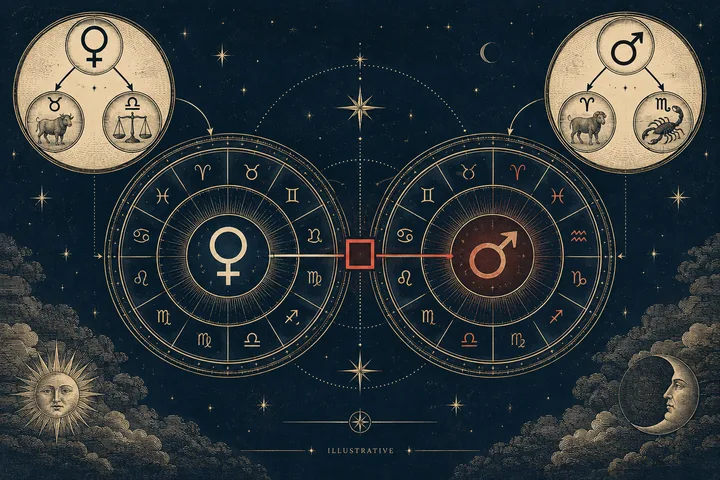
Then identify the sign ruler of each planet. If Person A’s Venus is in Aries, Mars is the dispositor. If Person B’s Mars is in Cancer, the Moon is the dispositor. You now have a second-level connection: Venus is managed by Mars, while Mars is managed by the Moon. This does not mean Person A is secretly a Mars person or Person B is secretly a Moon person. It means their Venus or Mars function answers to that planet’s symbolism and condition.
If the birth information is incomplete, stay within the supplied placements. You can read Venus and Mars by sign and degree without inventing houses, angles, or a calculated Moon. If you have no degrees, describe the sign relationship and leave exact orb, application, and degree-based reception open. A precise report names what it has and what it does not have. That is not a retreat from interpretation. It is how you keep the reading honest and useful.
Finally, write down the traditional dignity status of each planet. Venus is in domicile in Taurus and Libra, exalted in Pisces, in detriment in Aries and Scorpio, and in fall in Virgo. Mars is in domicile in Aries and Scorpio, exalted in Capricorn, in detriment in Taurus and Libra, and in fall in Cancer. These labels are not moral grades. They describe ease, authority, and strain in the planet’s sign expression. Skyscript’s dignity reference also notes that the whole sign carries the dignity, while the exact exaltation degree can receive special emphasis.
Sources: Essential Dignities - Astrodienst Astrowiki; Exaltation (and Fall) - Skyscript Glossary; Synastry: Venus-Mars Aspects Between Two Charts - Cafe Astrology; Dispositor - Skyscript Glossary
Read Venus and Mars by sign before you read the rulers
Rulership works best when it grows out of a plain sign reading. Venus in Aries wants attraction to feel alive, immediate, and brave. Mars in Cancer wants action to protect, secure, and respond to feeling, but it may act indirectly when exposed. Put these together in a square and you can see the problem before naming any reception. Venus wants a clean yes or no. Mars may want proof of safety first. The desire is not absent. The timing is different.
Now add rulership. Venus in Aries is disposed by Mars, so the Venus person’s way of wanting and relating is handed to Mars. Mars in Cancer is disposed by the Moon, so the Mars person’s pursuit answers to mood, memory, and emotional protection. The square is no longer just “Venus clashes with Mars.” Venus is carrying Mars’s directness, while Mars is carrying the Moon’s sensitivity. Attraction may arrive through pursuit, then stumble when pursuit feels unsafe or when affection feels too demanding.
Consider an example. Imagine Maria has Venus at 18° Aries and Daniel has Mars at 20° Cancer. This is an illustrative placement comparison, not a calculated personal chart. The two-degree square is close enough to lead the reading. Maria’s Venus is in Mars’s domicile. Her affection may come with initiative, heat, and a quick response to chemistry. Daniel’s Mars is in fall in Cancer by traditional dignity, so his action may have a harder route into clean assertion. He may protect, retreat, test, or react before he says what he wants. None of that makes him weak or Maria selfish. It gives the square a recognizable shape.
The next question is whether the rulers support the planets they manage. If Daniel’s Moon is in Taurus, the Moon is exalted, and the emotional manager has steadier ground. Maria’s Venus-Mars link can still feel forceful, but Daniel’s Mars has a lunar dispositor with more capacity to regulate feeling and turn it into care. If Daniel’s Moon is in Scorpio, the Moon is in its fall, and the same Mars may struggle to name a need before acting from it. The square has not changed. The management system has.
This is why the planet’s own dignity should not become a verdict. Mars in Capricorn may be exalted, but an exalted Mars can still press too hard in a Venus square. Venus in Virgo may be in fall, but that does not mean the Venus person cannot love well. It can mean that affection gets routed through discernment, correction, usefulness, or anxiety about getting the details right. A difficult aspect asks how the planets meet. Dignity asks how each planet can carry its own task.
A good interpretation keeps the layers separate until they have earned integration. First describe Venus. Then describe Mars. Then describe the square or opposition. Then follow each dispositor. If you collapse those steps into one sentence, you lose the reason behind the reading. If you keep them distinct, the final interpretation becomes more specific: desire is strong, timing is uneven, and the emotional manager determines whether the pressure becomes pursuit, protection, criticism, or repair.
Sources: Essential Dignities - Astrodienst Astrowiki; Exaltation (and Fall) - Skyscript Glossary; Synastry: Venus-Mars Aspects Between Two Charts - Cafe Astrology; Synastry - Cafe Astrology; Dispositor - Skyscript Glossary
Follow the dispositor chain to find the relationship’s pressure point
The dispositor is the planet that rules the sign another planet occupies. In practical reading, it acts like the manager of that planet’s affairs. Venus in Aries reports to Mars. Mars in Cancer reports to the Moon. If the Moon sits in Virgo, the Moon reports to Mercury. You can follow this chain until it reaches a planet in its own sign, a loop, or a planet whose condition gives you the clearest stopping point. You do not need to trace every planet in the chart to use the technique well.
For a Venus-Mars synastry contact, follow both sides. The Venus person’s dispositor tells you how affection and values get organized. The Mars person’s dispositor tells you how desire and action get organized. Then compare the two managers. If Venus answers to Mars and Mars answers to Venus, you have mutual reception by domicile when the placements are in each other’s signs. For example, Venus in Aries and Mars in Libra each occupy the other’s traditional sign. That can bind the two planets together, even while the signs create a hard opposition.
Mutual reception is not a magic eraser. Venus in Aries and Mars in Libra exchange domiciles, yet both are in detriment. That exception matters. The planets are tied to each other, but neither is especially comfortable in the other’s territory. The result can be compelling and repetitive: each person knows where the other presses, yet neither finds the exchange easy.
A different pattern appears when one planet is dignified and the other depends on a strained dispositor. Imagine Venus in Pisces square Mars in Gemini. Venus is exalted in Pisces, while Mars in Gemini answers to Mercury. Venus may carry feeling, receptivity, and imagination with real richness. Mars may act through words, questions, jokes, or changing plans. If Mercury is in Taurus and Venus is in Pisces, the chart has a route toward softness and sensory steadiness. If Mercury is in Sagittarius and caught in other hard contacts, Mars may keep converting desire into debate.
The chain also helps you spot a hidden third planet. A Venus-Mars square may look like the whole story until you see that both dispositors are Mercury. Then the relationship’s pressure point may be language, timing, interpretation, or the need to explain every feeling before anyone can respond. If both dispositor chains end at Saturn, the conflict may collect around duty, delay, boundaries, or fear of losing control. If they end at Jupiter, the issue may be scale, faith, excess, or competing visions of what a relationship should become.
Use this as a ranking tool, not an endless web. The direct Venus-Mars aspect leads. Close contacts to the dispositors come next, followed by the dignity and condition of those rulers. A distant chain shouldn’t overrule a close planet-to-planet aspect. A repeated chain deserves attention because it shows where the couple might interrupt the pattern.
Sign rulership tells you what happens to a difficult Venus-Mars aspect after the first spark. The square or opposition shows the contact itself: desire, friction, mismatched timing, or a push-pull between affection and pursuit. Venus and Mars by sign show the style of that friction. Their rulers, called dispositors, show who manages it and what resources the planets can draw on. A Venus-Mars square can be tense while still having a workable route if Venus is in a sign ruled by a planet that supports Mars, or if the two planets receive each other through domicile or exaltation. The reverse is also true. A close aspect can keep repeating the same fight when both planets answer to rulers that cannot cooperate. To read it, record each planet’s sign and degree, judge the aspect and its orb, identify each dispositor, then look for reception and supporting or aggravating contacts. The report uses supplied placements and optional degrees. It does not calculate a natal chart, houses, or a relationship verdict.
Sources: Exaltation (and Fall) - Skyscript Glossary; Synastry - Cafe Astrology; Dispositor - Skyscript Glossary; A brief comparison of the use of reception by historical authors
Reception can soften a hard aspect, but it cannot do the work for you
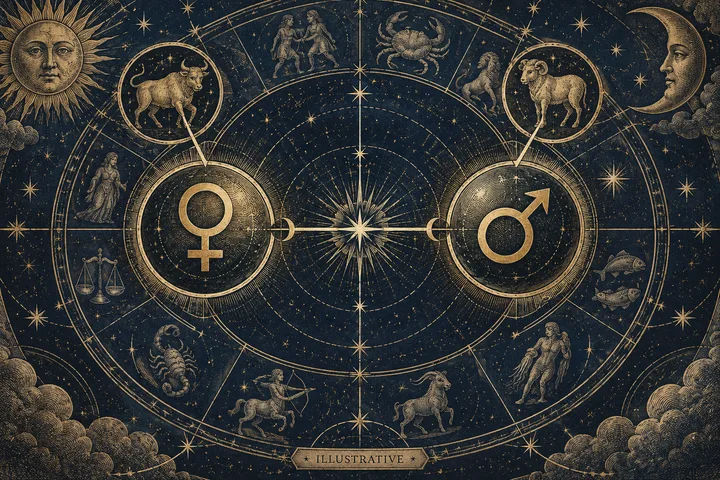
Reception asks whether one planet is placed in a sign or dignity belonging to the other. In the simplest case, Venus in Aries is in Mars’s domicile. If Venus and Mars are also in aspect, Mars receives Venus. The old language of hospitality is useful here. Venus is a guest in Mars’s house, and Mars has an obligation to deal with what Venus brings. The aspect may still be a square or opposition, but the planets are not strangers to one another. They have a channel.
This matters in synastry because reception can describe a form of recognition inside friction. Person A’s Venus in Aries may activate Person B’s Mars in a way that feels direct and personal. Person B’s Mars may understand the Venus person’s desire because Venus is speaking in Mars’s own sign. That understanding can be exciting. It can also make the contact harder to ignore. Reception adds connection, not automatic kindness.
Traditional reception has levels. Domicile and exaltation reception carry more weight than a single minor dignity such as term, face, or triplicity. Deborah Houlding’s historical comparison explains that reception through sign is stronger than the weaker forms, and that combined minor dignities can increase the effect. For this report, keep the working method simple. Lead with domicile and exaltation. Mention minor dignities only when exact degrees and the chosen dignity table make them reliable enough to matter.
Return to the illustrative Maria and Daniel example. Maria’s Venus at 18° Aries is in Mars’s domicile. Daniel’s Mars at 20° Cancer is in the Moon’s domicile, not Venus’s. Their square has one clear reception pathway: Daniel’s Mars receives Maria’s Venus by sign because Venus is in Aries. Maria’s Venus enters Daniel’s Mars territory. That can make Daniel’s pursuit feel immediately relevant to Maria’s desire. It can also let Mars dominate the tone. Maria may feel that attraction sets the pace, even when her Venus wants consideration.
Now change one detail. Suppose Daniel’s Mars were at 20° Libra instead. Venus in Aries and Mars in Libra oppose each other by sign, and each planet occupies the other’s domicile. The opposition becomes a mutual reception. The relationship has a strong exchange between desire and attraction, but both planets are in detriment. In lived terms, the pair may keep circling the same bargain. Each person wants the other to speak the language of love, yet each person’s own planet feels displaced while doing so.
The strongest exception is a hard aspect backed by several supportive layers. Reception, strong dispositors, a close Moon contact, and a shared language aspect may give a square a route toward repair. But exact reception doesn’t excuse coercion, contempt, or ignored boundaries. Astrology can show pressure and response. People still decide what conduct they’ll accept.
Sources: Exaltation (and Fall) - Skyscript Glossary; Synastry - Cafe Astrology; Dispositor - Skyscript Glossary; A brief comparison of the use of reception by historical authors
Compare the direct aspect with the rulers instead of letting one label win
Once you have the aspect and the rulership layer, compare them. Do they tell the same story, or do they pull in different directions? A close Venus-Mars square says the contact is active and tense. Venus in Libra and Mars in Capricorn may add a preference for social balance on one side and controlled, goal-driven action on the other. Their rulers, Venus and Saturn, may show whether that difference becomes a workable division of labor or a contest over who sets the terms.
Ask which planet can express its sign nature most clearly, which dispositor has more room to manage pressure, and whether the rulers support, repeat, or interrupt the direct aspect. That order keeps a dramatic sign label from taking over the reading.
Imagine a second example. Consider this comparison: Person A Venus at 12° Virgo opposes Person B Mars at 14° Pisces. Venus is in fall in Virgo, while Mars has no major traditional essential dignity in Pisces and answers to Jupiter by domicile rulership. Both planets must express their relationship function through their dispositors. Venus answers to Mercury. Mars answers to Jupiter. The opposition can feel intimate because each planet sits across from the other, yet both people may experience the other as asking for a style they cannot naturally sustain.
Now suppose Mercury is in Libra and Jupiter is in Cancer. The rulers are both placed in signs where relationship, care, and emotional meaning can be developed. The original Venus-Mars opposition still needs work, but the managers offer resources. Venus can learn to value without correcting every detail. Mars can act from feeling without turning every feeling into a test. If Mercury were in Sagittarius and Jupiter in Gemini, the managers would sit in each other’s detriment and the argument could move into promises, interpretations, and changing explanations. Same direct aspect. Different management.
Don’t turn this into a scorecard. Adding one point for dignity and subtracting one for detriment would flatten the reading into arithmetic. Dignity tells you what authority a planet has. Reception tells you how planets acknowledge one another. The aspect tells you how their functions meet.
Cafe Astrology’s current Venus-Mars synastry material describes conjunction, opposition, square, trine, and sextile as different expressions of romantic and physical attraction, with the square bringing strong attraction and untuned feeling. That is a useful first layer. Sign rulership adds the next question: what helps these untuned feelings find a rhythm? It may be direct speech, patience with timing, a clearer boundary, a shared ritual, or the decision to stop treating friction as proof of passion. The chart points to the practice.
Sources: Exaltation (and Fall) - Skyscript Glossary; Synastry: Venus-Mars Aspects Between Two Charts - Cafe Astrology; Synastry - Cafe Astrology; Dispositor - Skyscript Glossary; A brief comparison of the use of reception by historical authors
Turn the interpretation into a usable reading sequence
End with three facts: the contact, the leading modifier, and the response you can observe. For the illustrative comparison: Venus at 18° Aries squares Mars at 20° Cancer by two degrees; Venus is received by Mars, while Mars answers to the Moon; direct pursuit needs emotional naming and a slower pace.
If degrees or a dispositor’s placement are missing, leave exact orb or the rest of the chain open. Don’t complete it by guesswork. The Synastry Comparison Report compares supplied Moon, Venus, and Mars placements, with optional degrees and selected major aspects using a six-degree orb. It doesn’t calculate houses or natal positions from birth details.
Then test the reading in one recurring moment. Does a clear invitation work better than a hint? Does naming the feeling before acting change the exchange? If a mutual reception or strong dispositor promises a route toward cooperation, look for cooperation. If the same pressure returns without repair, lower the modifier’s rank. A chart interpretation should sharpen what you notice, not protect its own label.
Keep one exception in view. Dignity and reception can give a difficult aspect capacity, but they don’t excuse pressure, contempt, or ignored boundaries. A flowing Venus-Mars aspect can be handled badly. A tense one can be handled with care. The chart shows the pressure and the available tools. The people decide what they’ll do with them.
So make the next step small. Name the aspect without turning it into a verdict. Ask for one change in pace, language, or repair. Watch whether both people can practice it. If they can, sign rulership has given the difficult contact a workable route. If they can’t, the lived pattern outranks the promise of the chart.
Sources: Exaltation (and Fall) - Skyscript Glossary; Synastry: Venus-Mars Aspects Between Two Charts - Cafe Astrology; Synastry - Cafe Astrology; Dispositor - Skyscript Glossary; A brief comparison of the use of reception by historical authors
A little more clarity
Does mutual reception cancel a difficult Venus-Mars square or opposition?
No. Mutual reception links the planets and can give them a channel for exchange, but it does not cancel the square or opposition. Check the type of reception, the dignity of both planets, the exact orb, and the condition of the dispositors. Venus in Aries and Mars in Libra exchange domiciles, yet both are in detriment. That can create a strong bond with a repeated struggle over pace, pursuit, and whose style sets the terms. Read reception as a modifier and possible resource, not as a promise that conflict will disappear.
Can you read Venus or Mars rulership without birth times?
Yes, if the Venus and Mars signs or degrees are already supplied. You can identify sign rulers, dignity, dispositor chains, and major sign-based aspects within the information you have. Birth times become important for houses, angles, and a full natal-chart calculation. If degrees are missing, you should not claim a precise orb or degree-based reception. A placement comparison can still explain how a difficult Venus-Mars contact may operate, but it should name its calculation scope clearly and stop where the data stops.
Sources & further reading
- Essential Dignities - Astrodienst Astrowiki
Supports the distinction between essential dignity, accidental dignity, domicile, detriment, exaltation, fall, and the traditional dignity hierarchy.
- Exaltation (and Fall) - Skyscript Glossary
Supports the traditional exaltation and fall signs for Venus and Mars and the special attention given to exact exaltation degrees.
- Synastry: Venus-Mars Aspects Between Two Charts - Cafe Astrology
Supports the direct synastry reading of Venus-Mars conjunction, opposition, square, trine, and sextile as attraction with different forms of ease or friction.
- Synastry - Cafe Astrology
Supports the interpretation of major synastry aspects, including opposition as polarity, square as work and tension, and Venus-Mars hard aspects as attraction with conflict.
- Dispositor - Skyscript Glossary
Supports the definition of a dispositor and the interpretive idea that its condition helps manage and modify a planet placed in its sign.
- A brief comparison of the use of reception by historical authors
Supports reception as a relationship through dignity, the stronger role of domicile and exaltation, and the distinction between strong and weak reception.
Synastry Comparison Report
Enter known placements for two people. Get an input-by-input comparison, selected aspect calculations and a clear record of what remains uncertain.
Compare our placements