
Which rulers belong to each Venus sign in the chosen tradition?
Choose a rulership framework before tracing a connection, and keep its assignments consistent. This comparison uses traditional domicile rulership: a domicile ruler is the planet assigned rulership of a sign in that scheme. A planet occupying a sign is then described as being in the sign of its ruler. That ruler is the planet’s dispositor. The word names a relationship within an astrological framework; it does not mean that the ruler replaces the planet or that a cross-chart contact has already been established.
For a strictly hypothetical teaching illustration, let chart holder A have Venus in Gemini and chart holder B have Venus in Scorpio. In the traditional domicile scheme, Mercury rules Gemini and Mars rules Scorpio. William Lilly’s Christian Astrology, Book I, gives these assignments in its table of essential dignities; they yield Mercury A as the ruler associated with Venus A, and Mars B as the ruler associated with Venus B. These labels preserve chart ownership: the letter follows the person whose chart contains the planet. The example supplies signs only and describes no actual person or calculated chart.
The same scheme assigns Taurus and Libra to Venus, as Deborah Houlding’s “The Astrological Attributes and Rulerships of Venus (adapted from William Lilly, Christian Astrology)” explains. Those domiciles provide context for the traditional system being applied: Venus is its own domicile ruler in those signs, while Gemini and Scorpio are assigned to Mercury and Mars respectively. The point of establishing the framework is practical. If one mapping is traditional and another is imported from a different scheme, later comparisons become difficult to interpret because the rules have shifted midway through the reading.
Modern astrologers may also use co-rulers or additional dignity schemes, and terminology can vary. That variation does not make the traditional mapping unusable; it means the reader should name the scheme rather than present one set of assignments as every astrologer’s practice. Here the illustration holds to traditional domicile rulers throughout. At this stage, identify the sign and its ruler for each Venus placement, then retain the A or B label. The meaning of a possible contact between those planets belongs to the later comparison, not to the sign-to-ruler lookup itself. Keeping that choice visible also makes the example portable: someone using another stated rulership scheme can substitute its ruler assignments and follow the same labeled process, while recognizing that the interpretation now rests on a different premise. A mapping is the starting convention, not a conclusion about how either person expresses affection.
When two Venus placements lack a direct major aspect under a stated method, their sign rulers offer three separate comparisons: Venus A with ruler B, Venus B with ruler A, and ruler A with ruler B. In the traditional Gemini–Scorpio example, those pairs are Venus A–Mars B, Venus B–Mercury A, and Mercury A–Mars B. Check each independently; supplied degrees are needed to confirm an aspect under this article’s five-aspect set and six-degree working orb. Sign rulers create possible interpretive routes, not a Venus-to-Venus aspect. Record reception and shared rulership as separate context under a named method.
Sources: Christian Astrology, Book I (1647), William Lilly; The Astrological Attributes and Rulerships of Venus (adapted from William Lilly, Christian Astrology)
What does ‘no direct major aspect’ mean under a stated method?
Under this article’s stated convention, “no direct major aspect” means that Venus A and Venus B do not make a conjunction, sextile, square, trine, or opposition that qualifies under the chosen degree-and-orb rule. The phrase depends on the aspect set being counted. It is not a claim that the placements have no possible symbolic relationship, nor does it settle whether another aspect vocabulary would describe them differently. It reports one specific comparison: Venus to Venus, within five named aspects and the working limit defined here.
An aspect describes an angular relationship between two chart points. In “An Introduction to Aspects and Chart Shaping in Natal Astrology,” Nicholas Campion presents the five familiar major aspects alongside minor aspects and explains orb as the permitted distance from exactness. The list matters because an astrologer counting only the five major aspects can accurately report no direct major aspect while a practitioner who includes additional minor aspects may ask a different question. The careful wording keeps the conclusion tied to the stated set instead of allowing “no aspect” to sound broader than the method supports.
For a reproducible comparison in this article, the five major aspects are conjunction, sextile, square, trine, and opposition, with a six-degree working orb when exact degrees are available. Six degrees is a chosen consistent threshold for this analysis, not a universal law of astrology and not a claim that every aspect or planet has the same customary orb in every tradition. Campion’s discussion illustrates that published frameworks can assign different allowances; the article adopts one limit so a reader can apply the same rule to each pair under review.
Two levels of description should therefore stay distinct. Signs can indicate a possible sign-level relationship within a given aspect framework, but signs alone do not reveal the exact separation between two planets. A degree-confirmed contact requires supplied degrees whose angular distance falls within the selected aspect and its six-degree allowance. If the degrees are absent, the reader can describe a sign-level candidate where the chosen geometry permits one, but cannot confirm that the pair meets this working orb. “Unresolved from sign-only information” is more accurate than either asserting a contact or declaring that no degree-based contact exists.
Historical sign-based practice and later degree-and-orb approaches do not always frame aspect judgments in the same way. Deborah Houlding’s “The Classical Origin and Traditional Use of Aspects” traces sign relationships and the development of orb practice, including distinctions between sign-level and degree-level judgment. That history is a reason to state the method, not to erase historical approaches or claim that one modern convention supersedes them. For this article, the phrase has a narrow, testable meaning: none of the five listed Venus-to-Venus aspects qualifies within six degrees under the chosen rule. A list that includes minor aspects, or a framework with different orb allowances, may produce a different classification and should be named as such. Stating that boundary makes the result clear to another reader.
Sources: The Classical Origin and Traditional Use of Aspects; An Introduction to Aspects and Chart Shaping in Natal Astrology
How can a dispositor explain the Venus placement before synastry routes are tested?
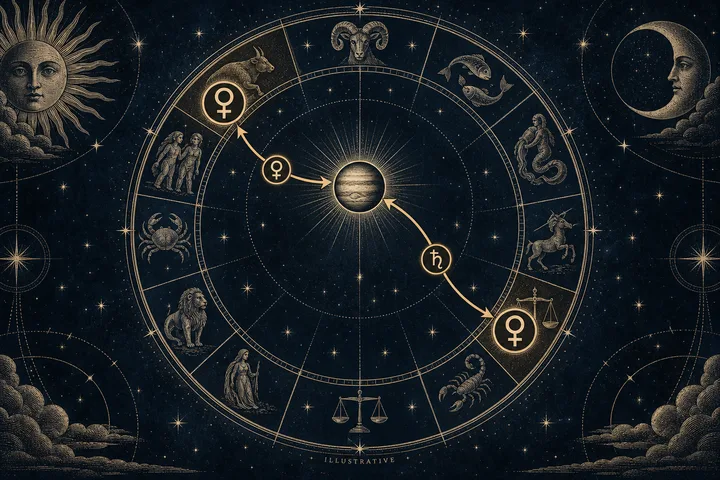
A dispositor adds context to Venus inside the chart where Venus sits. In the traditional dignity practice described in “Understanding Planetary Dignity and Debility – Part 6: Reception,” a planet is disposed by the ruler of the sign it occupies. The astrologer therefore reads two connected factors: Venus’s own placement, and the condition of the planet governing Venus’s sign. The second factor can qualify how the first is interpreted. It does not displace Venus as the subject, and it does not yet describe a connection to another chart.
Consider a generic hypothetical in the already defined example: chart holder A has Venus in Gemini, while chart holder B has Venus in Scorpio. Within A’s chart, the astrologer identifies Mercury as the dispositor of Venus and examines Mercury’s condition according to the dignity framework being used. Within B’s chart, the astrologer separately identifies Mars as the dispositor of Venus and examines Mars in B’s chart. Each reading asks how the sign ruler is situated in its own chart and what that adds to the interpretation of that chart’s Venus. No degrees, life events, or personal behaviors follow from the sign labels alone.
“Condition” should be treated as a question to investigate, not as a ready-made verdict. The astrologer records which planet rules the sign, then examines that ruler within its own chart and within the selected dignity practice. The point is to make the chain of interpretation explicit: Venus is read in its sign, and the ruler’s own situation informs how that sign-based context is understood. A dispositor’s placement does not erase Venus’s placement, and a favorable or difficult judgment about the ruler cannot by itself establish how two people relate. The source’s discussion places planetary condition within a broader chart reading; it does not supply a universal formula for translating one ruler’s condition into a relationship conclusion. That leaves room for the astrologer to explain which factor carries the interpretation and why, rather than treating “Venus has a dispositor” as a complete reading.
This is an intra-chart sequence, not a synastry aspect. First, Venus occupies a sign; second, that sign has a ruler in the chosen scheme; third, the astrologer considers the ruler’s condition and its relation to Venus within the same chart. Repeating those steps for A and B yields two contextual observations. It does not place a planet in A’s chart at an angular distance from a planet in B’s chart. The fact that A’s Venus is governed by one planet and B’s Venus by another is a useful map of chart structure, but a map of two structures is not itself a contact between them.
That distinction matters because the word “connection” can refer to more than one kind of astrological relation. Dispositorship describes rulership within a chart; an aspect describes angular contact between chart points; and a cross-chart comparison asks whether selected points from separate charts form such a contact. The dispositor can help an astrologer interpret the Venus placement before asking the cross-chart question, particularly when the chosen traditional method gives planetary condition weight. A reader who prioritizes Venus itself, or follows a different dignity framework, may give this layer less emphasis. Either way, it remains an interpretive layer, not evidence of a relationship outcome or proof that the two charts aspect one another. To test that separate question, the ruler must now be paired across chart boundaries with the other person’s Venus or its ruler.
Sources: Understanding Planetary Dignity and Debility – Part 6: Reception
Which ruler routes actually cross from one chart to the other?
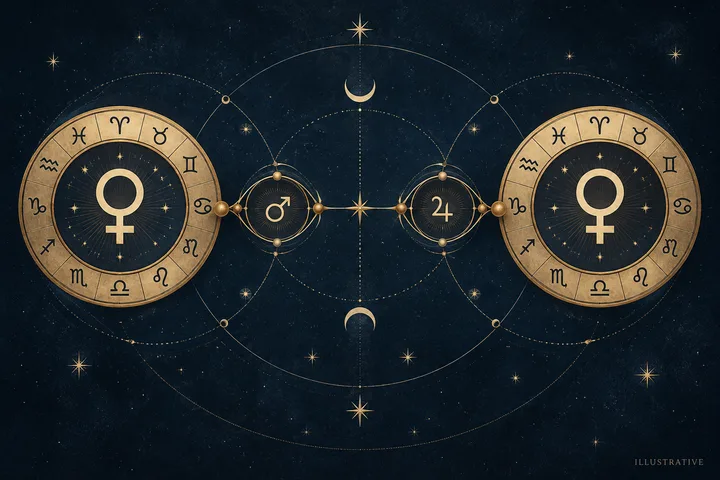
With the two Venus placements defined and their in-chart rulers identified, the cross-chart map has three distinct routes: Venus A to ruler B; Venus B to ruler A; and ruler A to ruler B. In the hypothetical Gemini Venus A and Scorpio Venus B example, the traditional rulership table in William Lilly’s “Christian Astrology, Book I (1647)” assigns Mercury to Gemini and Mars to Scorpio. The labels therefore resolve to Venus A–Mars B, Venus B–Mercury A, and Mercury A–Mars B. Keeping the chart letters attached to each planet prevents the common swap that would mistakenly pair Venus A with Mercury B or Venus B with Mars A.
Route one is directional from A’s Venus to B’s sign ruler: Venus A–Mars B. It asks whether Venus in A’s chart forms a qualifying contact with Mars in B’s chart. If confirmed under the article’s stated aspect method, the result is a cross-chart Venus-to-Mars contact. It may contribute an interpretive link between A’s Venus placement and a planet associated with B’s Venus sign, but it does not mean Venus A aspects Venus B. The endpoints remain Venus A and Mars B, so the interpretation must retain those identities rather than quietly substituting the two Venus placements.
Route two reverses the direction: Venus B–Mercury A. Here the question is whether B’s Venus forms a qualifying contact with the ruler associated with A’s Venus sign. This is a separate candidate from route one. A contact on this route would be Venus B to Mercury A, not proof that Venus A and Venus B aspect each other, and it need not have the same status as the first route. One can qualify while the other does not; the route labels simply specify which endpoints to compare. This symmetry of method allows each person’s Venus placement to be read in relation to the other person’s sign ruler without confusing the charts’ ownership.
Route three compares the two rulers themselves: Mercury A–Mars B. Unlike the first two routes, neither endpoint is Venus. The pair asks whether the ruler of A’s Venus sign contacts the ruler of B’s Venus sign across charts. If it does, that is a ruler-to-ruler contact that can connect the two Venus sign contexts in the chosen interpretive scheme. It still does not create a Venus A–Venus B aspect by proxy. A named route can support an indirect reading while preserving the exact planets that make the contact; the distinction is what keeps an interpretive bridge from being reported as different geometry.
Treat the three comparisons as independent tests, not as links that automatically transmit a result along a chain. If Venus A–Mars B is later found to qualify, that finding says something about those two endpoints under the stated method; it does not establish that Venus B–Mercury A or Mercury A–Mars B also qualifies. Likewise, the sign ruler assignment tells the reader which planet to place in a candidate pair, but it cannot supply the angular relationship between planets in separate charts. This separation is an interpretive inference from the route map: rulership selects the comparison, while the comparison itself must be checked on its own terms. It also prevents a long chain of symbolic association from being mistaken for several confirmed contacts.
The complete labeled map is therefore: Venus A → Mars B; Venus B → Mercury A; Mercury A → Mars B. Each arrow means “compare these two chart points,” not “assume an aspect.” The example supplies signs and rulership assignments only. Without exact degrees, none of the three candidate contacts is confirmed under the article’s degree-and-orb rule. Nor does the absence of a direct Venus-to-Venus major aspect disappear: that remains the finding about the Venus pair, while these are three other pairs to test. Lilly’s table supports the traditional sign-ruler assignments used to label the example; the route map is the article’s transparent application of those assignments to cross-chart comparisons, not a claim that Lilly prescribed this exact modern synastry procedure.
This is why a missing direct Venus aspect need not end the inquiry, but also why ruler links should not be promoted to equivalent evidence automatically. An astrologer may reasonably prioritize direct Venus contacts and treat the three indirect routes as secondary context. Another may explore the routes because rulership provides a meaningful symbolic bridge. Either approach can preserve the geometry: first name the actual endpoints, then determine whether those endpoints form a contact under the selected rule, and only then interpret its place in the larger comparison. The route map extends the question beyond Venus-to-Venus; it does not answer that question in advance or predict how either person will behave.
Can reception connect placements when the planets do not aspect?
Reception can describe a dignity relationship between two planets, but it does not change their angular distance. In “A brief comparison of the use of reception by historical authors,” Deborah Houlding shows that historical writers did not apply one uniform rule about whether reception operates only with configuration or may matter without it. The useful answer, then, is conditional: reception may be considered as a separate relation under a named technique, even when a proposed pair has no qualifying aspect, but it should not be reported as an aspect or as a universal substitute for one in synastry. This keeps two different questions visible: whether the planets form the geometry required by the selected aspect rule, and whether the chosen reception method recognizes a dignity relation between them.
For a reception entry, record three things: the occupying planet, the planet whose dignity is occupied, and the dignity basis used. For example, the form is “planet X occupies a sign or other dignity of planet Y; reception is judged by [named dignity level].” Domicile is one basis, but traditional dignity systems also distinguish other levels, such as exaltation and lesser dignities. Naming the basis matters because a statement about domicile reception is narrower than a statement that one planet receives another through any dignity. “Understanding Planetary Dignity and Debility – Part 6: Reception” discusses these varying dignity levels and mutual reception. This is a method record, not a conclusion about what either chart holder feels.
Mutual reception reverses the relation: each planet occupies a dignity assigned to the other. The record should therefore show both directions and the basis for each, rather than using “mutual” as a general label for two planets that happen to be linked. If only one planet occupies a dignity of the other, the reception is one-way under that stated technique. If the astrologer counts different dignity levels in each direction, those should be recorded separately. This precision makes the interpretation traceable: a reader can see which planet is the occupant, which planet owns the relevant dignity, and whether the claim rests on domicile, exaltation, or another selected level. It does not answer the geometry question by itself.
The comparison in “A brief comparison of the use of reception by historical authors” is especially useful here because it treats reception as a historical question with source-specific answers, rather than a single definition detached from practice. One author’s use of configuration, another’s emphasis on dignity, and later summaries may not line up exactly. A careful reader should therefore avoid combining pieces of different systems into an unannounced hybrid. State whether the chosen account requires an aspect, what dignity levels it recognizes, and how it handles one-way versus mutual reception. If those details are not specified, the report can name the proposed dignity relation without claiming a completed reception judgment. That distinction makes disagreement legible while allowing the astrologer to preserve a useful traditional concept.
William Lilly’s “Christian Astrology, Book I (1647)” supplies a primary historical example, but its reception discussion belongs to horary astrology. Lilly considers reception through planetary dignities within that practice; the passage is useful for seeing a historical technique in its own setting. It is not a modern synastry manual, and its horary treatment cannot establish a rule for two natal Venus placements. Houlding’s comparative account helps explain why importing a single passage as a general law would flatten genuine differences among historical approaches. Read together, these sources support a careful distinction: historical authors provide techniques worth naming and examining, while the astrologer must identify which technique is being applied to the present comparison.
Applied to a ruler route, the report can therefore keep separate fields: aspect status under the selected geometry, then reception status under the explicitly named dignity method. If no aspect qualifies but a reception judgment does under that method, report “reception without a qualifying aspect under this rule,” and explain the dignity basis. If the technique requires configuration, the absent aspect may mean the reception condition is not met in that technique. Neither result means the planets have secretly formed an aspect, and neither licenses a universal claim about how reception works in every synastry tradition. This is the narrow conclusion warranted by the historical variation: preserve reception as a distinct interpretive relation, name the method and its assumptions, and leave the geometric finding unchanged. The interpretation remains about symbolic chart relations, not a disclosure of either person’s inner state.
Sources: A brief comparison of the use of reception by historical authors; Christian Astrology, Book I (1647), William Lilly
How can degrees confirm a route without changing its meaning?
Check each proposed pair on its own. The three routes already identified are separate comparisons, so a result for one pair cannot be carried over to either of the others. With exact degrees supplied, convert each planet’s position to a place on the zodiac circle, find the smaller angular separation between the two positions, and compare that distance with the target angle for conjunction, sextile, square, trine, or opposition. Then ask whether the difference from that exact target is no more than the article’s six-degree working orb. Nicholas Campion’s “An Introduction to Aspects and Chart Shaping in Natal Astrology” describes aspects as angular relationships and orb as the allowed distance from exactness; this article applies its own consistent six-degree threshold to each tested pair.
A practical worksheet needs only the pair label, the two supplied positions, the measured separation, the nearest selected aspect angle, and the difference from exactness. Mark the outcome “confirmed under this rule” when the separation lies within the declared orb of one of the five targets. Mark it “outside this rule” when it does not qualify for any selected target. If either degree is missing, mark it “unresolved from supplied information,” even when the signs make a sign-level candidate worth noting. This record lets another reader follow the same calculation without confusing a suggested sign relationship with a degree-confirmed contact. Campion’s discussion also notes varied orb conventions; the chosen threshold is an explicit working rule, not a claim that all astrologers use one allowance.
The circle wraps at 0° Aries, so direct subtraction can give the wrong distance when positions sit on opposite sides of that point. One can treat the zodiac as a 360-degree circle: compare the raw difference with its complement around the circle, then use the smaller separation. For instance, two positions close to the end and start of the zodiac are close across the boundary, even though their written degree numbers appear far apart. No invented chart values are needed to apply this rule. Once the shortest separation is found, compare it with each relevant target angle and its permitted deviation. The same procedure applies to every route, regardless of which planet is Venus and which is a ruler.
Signs alone do not provide that exact measurement. They can identify a possible sign-level relationship according to the chosen aspect framework, but each sign spans a range of degrees; two planets in those signs may sit at very different distances from one another. A sign-only candidate can therefore remain unresolved: it may qualify once exact degrees are known, or it may fall outside the working orb. The correct report preserves that uncertainty rather than converting a plausible sign geometry into a confirmed aspect. Equally, if one route is confirmed, that says nothing about the remaining route pairs until each is checked independently. The degree test confirms only the geometry of its named endpoints under the declared rule; it does not alter their chart ownership or turn a ruler contact into a Venus-to-Venus aspect.
A reader can use the Synastry Comparison Report to organize supplied Moon, Venus, and Mars signs and optionally supplied degrees. It does not calculate natal positions from birth details, so the degree check depends on having those positions available from the reader’s own chart information. The report can present a sign-level candidate where appropriate, show which pair was checked, and distinguish a confirmed result from one outside the working rule or unresolved for missing degrees. This boundary keeps the conclusion reproducible: supplied degrees allow the stated calculation; signs alone support a more limited description. A different declared orb system may classify a borderline pair differently, as Campion’s account of differing conventions illustrates, but that does not make the present result ambiguous once its rule and inputs are stated.
Sources: An Introduction to Aspects and Chart Shaping in Natal Astrology
How should contact and ruler condition be weighed without a score?
Give emphasis by stating what each layer establishes, then showing how those layers meet in the named route. First ask whether the two endpoints form one of the selected major aspects and how far their measured separation lies from exactness under the declared six-degree working orb. “An Introduction to Aspects and Chart Shaping in Natal Astrology” describes closer aspects as stronger within its own interpretive framework, while also showing that astrologers use differing orb conventions. The article’s orb remains a consistent comparison rule, not a universal scale of relationship importance. A close qualifying contact is therefore more exact by this measure than a marginal one; that observation does not turn either into a quantity of affection or compatibility.
Next consider the contacted ruler in the chart where it belongs. “Understanding Planetary Dignity and Debility – Part 6: Reception” describes planetary condition and the chart as a whole as relevant to interpretation. In practice, an astrologer can say why a ruler appears more or less supported within that chart according to the stated dignity approach, then explain how that context shades the route’s symbolism. This is a judgment about interpretive emphasis, not a second measurement of the cross-chart angle. A well-supported ruler may deserve attention in a particular traditional reading even when its qualifying contact is marginal; another astrologer may put more weight on the contact’s directness or closeness. The reasoning should name its basis so a reader can distinguish geometry from the reading of condition.
Reception, when the chosen method recognizes it, adds a separately named dignity relation. “A brief comparison of the use of reception by historical authors” shows why the astrologer should specify the technique rather than assume one rule about reception and configuration. Record the dignity relation and its method beside the aspect finding. It may shape how the astrologer describes an exchange between the planets, but it does not move them closer together or make a nonqualifying pair qualify. These layers answer different questions: degree geometry asks whether the endpoints aspect under the selected rule; planetary condition asks how a ruler is situated in its own chart; reception asks whether the named dignity method recognizes a relation between the planets.
Shared rulership or a longer dispositor chain can remain useful background: it shows further symbolic context around the Venus placements. It should not outweigh a tested cross-chart contact by merely adding more links to the story. For example, imagine one candidate route falls close to exactness within the working orb and another barely falls inside it. The first has the closer geometry; if the second involves a ruler judged well-supported under the selected tradition, an astrologer may still explain why that condition draws attention. Neither fact cancels the other, and neither yields a universal ranking without stating the chosen interpretive priorities. This hypothetical supplies no degrees or chart facts; it illustrates how to report distinct considerations without inventing a score.
The practical report can therefore lead with the actual pair and its geometric status, describe the ruler’s condition with the dignity framework named, and then add reception or shared rulership only if that method contributes something distinct. “A close qualifying route with a ruler judged challenged” and “a marginal qualifying route with a ruler judged supported” are different descriptions, not opposite verdicts. Which one receives more discussion depends on the astrologer’s stated method and the question being explored. The strongest alternative emphasis is legitimate: some readings privilege closeness, others the ruler’s condition, and traditions can set different orb or dignity rules. Make the choice visible. The comparison remains an interpretation of symbolic contacts, not a numerical measure of how two people fit.
Sources: An Introduction to Aspects and Chart Shaping in Natal Astrology; Understanding Planetary Dignity and Debility – Part 6: Reception; What's Your Sign? An Intro to Synastry Charts and Astrological Compatibility
What is one useful question to take from the comparison?
Choose the clearest route in the comparison and use it to frame one open question about an actual exchange of affection. If the route highlights one person’s Venus in contact with the other person’s ruler, ask about a specific moment: “When I show affection by doing something practical, what helps that feel caring to you?” Or name a different observed exchange that fits the conversation. The chart can suggest a topic to reflect on; it cannot tell you what the other person intended. Their words and choices answer the practical question.
Keep the question small enough to discuss without turning it into a test. Listen for what each of you means by the gesture, then say what would feel welcome or reassuring to you. The useful result is a clearer understanding of one interaction, not a verdict about the relationship. If you want help organizing known placements, the Synastry Comparison Report compares supplied Moon, Venus and Mars signs with optional degrees. It does not calculate natal positions from birth details. Compare our placements when that format would help you keep the chart information together, then bring the conversation back to the two people involved: “What kind of affection feels meaningful to each of us in this situation?”
Sources & further reading
- The Astrological Attributes and Rulerships of Venus (adapted from William Lilly, Christian Astrology)
In the traditional domicile scheme used for the illustration, Venus rules Taurus and Libra; this establishes the scheme's traditional basis, while the rulers of Gemini and Scorpio are verified from Lilly's traditional rulership table in source 6.
- The Classical Origin and Traditional Use of Aspects
Houlding's historical account explains sign-based aspect geometry, the historical status of the inconjunct, and the development of orb practice; it shows why a five-major-aspect modern working set should be declared rather than treated as the sole historical vocabulary.
- An Introduction to Aspects and Chart Shaping in Natal Astrology
Campion defines aspects as precise angular distances, gives the common five major aspects and additional minor aspects, defines orb as allowable deviation from exactness, and describes differing orb approaches and closer aspects as stronger within his framework.
- Understanding Planetary Dignity and Debility – Part 6: Reception
The article defines a dispositor through sign rulership and describes reception through dignity, including mutual reception at different dignity levels; it treats the whole chart and planetary condition as relevant to interpretation.
- A brief comparison of the use of reception by historical authors
Houlding's comparison traces reception and rulership through historical sources and shows that authors differ in how contact, configuration and reception operate; the reader must name the chosen reception technique instead of claiming universal agreement.
- Christian Astrology, Book I (1647), William Lilly
Lilly's traditional table of essential dignities assigns Mercury rulership to Gemini and Mars rulership to Scorpio; his Book I reception discussion addresses planets receiving one another by dignities in a horary framework. The sign-ruler mapping supports the corrected illustrative route labels, while the reception passage cannot be generalized into a synastry law.
- What's Your Sign? An Intro to Synastry Charts and Astrological Compatibility
The publisher's synastry explainer treats degree distance and orb as part of judging contact and favors tighter orbs in its stated approach, illustrating contemporary variation in practical synastry conventions.
Synastry Comparison Report
Enter known placements for two people. Get an input-by-input comparison, selected aspect calculations and a clear record of what remains uncertain.
Compare our placements