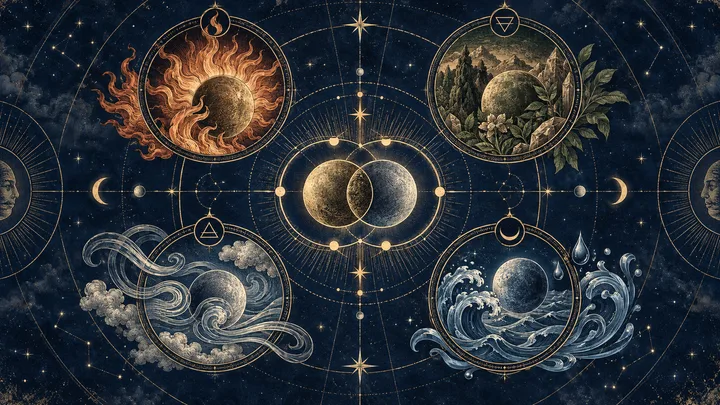
The aspect gives the structure. The element gives it a voice.
Two couples can share the same synastry aspect and live it very differently. That isn’t a contradiction. It’s the difference between geometry and expression.
An aspect describes the relationship between two chart factors. A conjunction joins them. A square creates pressure. An opposition sets up a polarity. A trine lets energy flow. A sextile offers an opening that grows through choice. The signs and their elements show how that contact speaks in ordinary life. Fire acts. Earth steadies. Air connects through thought and language. Water bonds through feeling, memory, and protection.
Take a Moon-Venus trine. The Moon brings emotional needs and habits of comfort. Venus brings affection, pleasure, and values. The trine offers ease between those functions. Moon in Aries trine Venus in Leo may show warmth through action, praise, and shared excitement. Moon in Taurus trine Venus in Virgo may show the same ease through food, consistency, useful help, and a well-kept routine. Same aspect. Different dialect.
Synastry guides commonly separate the specific interchart aspect from the broader comparison of signs and elements. That distinction keeps an element from becoming a compatibility grade. Start with what the planets are doing together, then ask what kind of fire, earth, air, or water carries the exchange.
Sign elements change the style and task of a synastry aspect, but they don't erase the aspect itself. A Moon-Venus trine still describes ease between feeling and affection. Fire signs may express that ease through enthusiasm and direct warmth. Earth signs may show it through steady care and practical reliability. Air may keep affection moving through talk, humor, and shared ideas. Water may make the bond private, intuitive, and emotionally absorbing. Read the aspect first, then the elements, then the sign pair and exact degrees. This order keeps you from calling a square bad or a trine effortless. A supplied-placement report can compare your Moon, Venus and Mars signs and use a six-degree orb for selected major aspects. It won't calculate a natal chart, houses, or a relationship outcome from birth details.
Sources: A Brief Introduction to Astrology: The four Elements; What Is a Synastry Chart? Birth Chart Compatibility; Synastry: Love and Relationship Astrology; The Meaning of the Aspects in Astrology
What each element changes in a synastry contact
The elements aren’t four scores. They’re four modes of participation. Fire brings initiative and candor. Earth brings patience, form, and follow-through. Air brings words, curiosity, and movement between viewpoints. Water brings sensitivity, emotional continuity, and the wish to protect what feels private.
The planet still decides what the element is carrying. A fire Moon may need room to respond honestly. A fire Mars may need a direct outlet for desire. An earth Venus may show love through reliability. An air Venus may keep affection alive through talk and play. A water Moon may look for safety before it reveals the full feeling. Don’t let a general element description erase the planet under examination.
Broad pairings can help as a first sketch. Fire and air often energize one another. Earth and water often offer mutual support. But a mismatch is more useful when you call it a translation problem. One person may offer speed, while the other needs time. One offers explanation, while the other needs emotional presence. The aspect tells you whether that difference flows, pulls, or creates pressure.
Sources: A Brief Introduction to Astrology: The four Elements; What Is a Synastry Chart? Birth Chart Compatibility; Synastry: Love and Relationship Astrology
One Moon-Venus trine, four different lived expressions
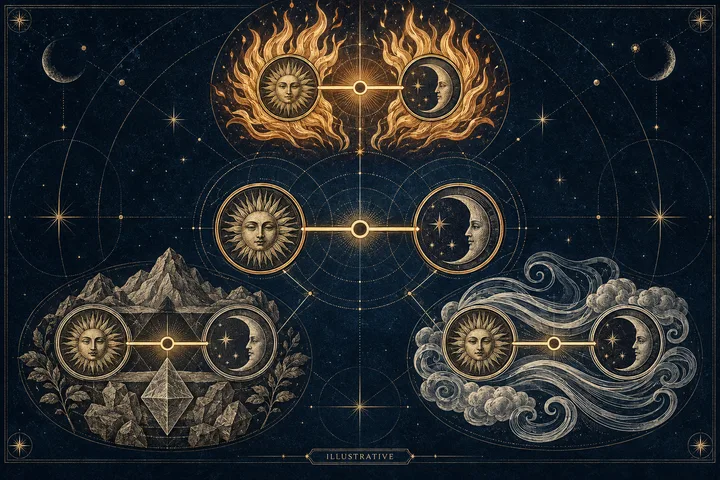
Keep the aspect fixed: one person’s Moon trines the other person’s Venus. These are illustrative sign combinations, not personal charts or invented degrees. They show how to move from symbol to exchange.
Fire with fire, Moon in Aries trine Venus in Leo, can make affection visible. The Moon person may respond quickly and openly. The Venus person may offer praise, loyalty, and a desire to celebrate the bond. Shared momentum comes easily, so the useful question is what happens after the exciting beginning, when enthusiasm needs a plan.
Earth with earth, Moon in Taurus trine Venus in Virgo, can make care dependable. The Moon person may seek calm and sensory steadiness. The Venus person may notice details and solve small problems. That rhythm builds trust through repetition, but it can also leave warmth unspoken. Useful service still needs words of appreciation.
Air with air, Moon in Gemini trine Venus in Libra, can make feeling conversational. Questions, humor, fairness, and mental companionship keep the bond moving. The strength is perspective. The risk is staying in the explanation. Can you name the feeling before you explain the relationship? Water with water, Moon in Cancer trine Venus in Scorpio, can make affection private and deeply recognizant. That can feel like emotional shelter, but intimacy still needs direct speech. Did your partner say that, or did you infer it from the mood?
All four versions describe a Moon-Venus bridge with a trine’s natural flow. Fire makes it active. Earth makes it dependable. Air makes it discussable. Water makes it intimate. The element changes the practice, not the existence of the aspect.
Sources: A Brief Introduction to Astrology: The four Elements; Synastry: Love and Relationship Astrology; The Meaning of the Aspects in Astrology; Romantic Compatibility Synastry Analysis in Astrology
The same method works for squares, oppositions, and sextiles
A square still creates pressure, but the element changes the pressure’s shape. Fire and water may disagree about timing, with one person acting while the other needs to absorb. Earth and air may disagree about proof, with one asking for a workable plan and the other asking to keep the question open. Cardinal signs can make the conflict direct, fixed signs can hold it, and mutable signs can keep revising it.
An opposition sets up a live polarity. Fire and air may pull action toward explanation. Earth and water may pull stability toward emotional release. Attraction can grow from that difference, but only if both people visit the other side. If one person always pursues and the other always yields, the polarity has become a role.
A sextile links energies that can cooperate without doing so automatically. Fire and air can turn an idea into movement. Earth and water can turn care into something tangible. Someone has to use the opening. A trine may feel easier at first, while a sextile can become valuable through deliberate repetition.
Keep the reading order steady: planets and aspect, degree closeness, elements and modalities, then repeated chart themes. This prevents a broad element pairing from outranking a close personal-planet contact.
Sources: What Is a Synastry Chart? Birth Chart Compatibility; Synastry: Love and Relationship Astrology; The Meaning of the Aspects in Astrology; Romantic Compatibility Synastry Analysis in Astrology
The strongest exception: easy symbolism can still miss the need
An easy aspect and supportive elements describe potential. They don’t guarantee that either person knows how to use it.
Consider an example: Moon in water trine Venus in earth. The Moon person may ask for emotional presence. The Venus person may offer practical solutions. Both are caring, but they’re answering different questions. The trine is real. So is the missed need. The repair begins when the Venus person listens before fixing and the Moon person names the feeling plainly.
The reverse can happen with a tense contact. Imagine Mars in Gemini square Moon in Pisces. One person may pursue through questions or debate. The other may need time before responding. The square names friction, but it also points to a practice: ask one clear question, state the feeling, and pause before pushing for resolution.
Degree strength and the rest of the chart still matter. If you know only signs, discuss elemental style and possible sign relationships. If degrees are supplied, check the major aspect and its closeness. If several contacts repeat one theme, give that pattern more weight than a single element pairing. Don’t count fire, earth, air, or water as votes.
Sources: Synastry: Love and Relationship Astrology; The Meaning of the Aspects in Astrology; Romantic Compatibility Synastry Analysis in Astrology
A precise way to read your own comparison
Start with one real question: how do we show care, handle pressure, or make room for desire? Write down the two planets and the person each planet belongs to. Your Moon to a partner’s Venus isn’t identical to your Venus to a partner’s Moon. Direction matters.
Name the aspect. Then check the degrees if you have them. This report uses a six-degree orb for selected major aspects and works from supplied placements. It doesn’t calculate natal positions, houses, or a relationship outcome from birth details. Once the contact is clear, add the elemental verbs: fire begins, earth steadies, air translates, water attunes.
Finish with one observable practice. A fire square may need a slower response. An earth opposition may need flexibility. An air conjunction may need emotional follow-through. A water trine may need direct speech. Match the action to the planet: emotional language for the Moon, affection and values for Venus, desire and boundaries for Mars.
That gives you a reading you can test in daily life. Not a verdict. A better question. Compare the known Moon, Venus, and Mars placements, identify the closest major contacts, and ask what each elemental difference needs from both people.
Sources: A Brief Introduction to Astrology: The four Elements; What Is a Synastry Chart? Birth Chart Compatibility; Synastry: Love and Relationship Astrology; The Meaning of the Aspects in Astrology
A little more clarity
Can the elements change a square into a positive synastry aspect?
No. The square remains a dynamic aspect that asks the planets to work across tension. Compatible elements may make the problem easier to translate, while a difficult elemental pairing may make the friction more obvious. Read the planets and the square first, then describe the elemental task. A square can become a practiced strength, but it doesn’t become a trine.
Which sign elements work best together in synastry?
Fire and air often energize one another, while earth and water often support one another. Signs of the same element can also recognize each other quickly. These are broad tendencies, not a compatibility ranking. The planets, aspect, degree distance, modality, and repeated chart themes matter more than a simple element pair.
Can I read sign elements without a full birth chart?
Yes, if you already know the placements you want to compare. You can discuss the Moon, Venus, and Mars signs and, when available, check selected major aspects by degree. That kind of reading won’t calculate missing natal positions, houses, or a complete chart from birth details. State what you know, keep the scope clear, and interpret the supplied contacts directly.
Sources & further reading
- A Brief Introduction to Astrology: The four Elements
Supports the four element categories, their sign groups, and their basic temperamental meanings.
- What Is a Synastry Chart? Birth Chart Compatibility
Supports reading synastry through layered charts, signs, elements, planets, houses, and aspects.
- Synastry: Love and Relationship Astrology
Supports the relationship meanings of Moon, Venus, Mars, conjunctions, oppositions, flowing aspects, and squares.
- The Meaning of the Aspects in Astrology
Supports the distinction between conjunction, square, trine, opposition, and sextile as planetary contact types.
- Romantic Compatibility Synastry Analysis in Astrology
Supports ranking chart factors carefully and avoiding absolute conclusions from element tallies or score sheets.
Synastry Comparison Report
Enter known placements for two people. Get an input-by-input comparison, selected aspect calculations and a clear record of what remains uncertain.
Compare our placements