
Choose one question before you open the report
A shared report works best when the couple arrives with one question, not a stack of conclusions. 'Why do we misread each other's pauses?' gives the reading a job. 'What does this prove about us?' gives it too much power and invites every dramatic phrase to sound final.
Write the question at the top of the page. Under it, write what a useful answer would change. Perhaps you want a better way to start difficult conversations. Perhaps you want to understand why affection lands differently. The point is to choose a decision the reading can inform, rather than asking it to pronounce on the whole relationship.
Synastry compares two horoscopes and follows the interaspects between them. The subject is the meeting of the charts. Cafe Astrology's interchart guide asks the reader to consider the role each person may play through the planet involved. That makes synastry especially suited to a paired worksheet: every interpretation needs an A side, a B side, and a shared question.
Start with three lines. 'I notice this in myself.' 'I notice this from you.' 'We want to understand what happens between us.' Those lines keep a placement from becoming a label. A Venus contact can show a way affection moves. A Mars contact can show how desire or initiative enters the exchange. Neither one assigns a permanent personality to either partner.
Agree on the reading rules before you interpret anything. Either partner can ask for plainer language, pause the conversation, or reject a phrase that doesn't fit. The reader who knows more astrology doesn't get the final word. The report is a shared text, not a ruling.
Give each partner a private first pass. Write down the line that feels accurate, the line that feels unfair, and the question the report leaves open. Compare those notes only after both people have met the symbol directly. This stops the most confident voice from deciding what the chart means before the other person has spoken.
Keep the first meeting narrow. Read one question, two or three chart facts, and one pattern. If the room gets defensive or tired, stop. A pause protects the reading's usefulness; it isn't a failure to finish the report.
Imagine Maria and Daniel opening a report after a tense week. Maria wants to understand why Daniel goes quiet when she asks for reassurance. Daniel wants to understand why the same question becomes an argument. They write that question first, then each marks what they notice before discussing the meaning. Their goal isn't to solve the whole relationship in one sitting. It is to leave with a clearer picture of one exchange and a fair test for the next one.
Sources: Aspects Between Charts, Cafe Astrology; Synastry: The Astrology of Relationships; Synastry: The Astrology of Relationships
Build a shared worksheet from the inputs you actually have
A report can only speak from the information it contains. Start there. Write down the exact placements supplied for each person. If you know them, record the Moon, Venus, and Mars signs. Add degrees when available. Note whether an aspect is listed, which planets form it, and the stated orb. If you don't have degrees, don't pretend a contact is exact.
This article's Synastry Comparison Report uses supplied placements and optionally supplied degrees. It can compare Moon, Venus, and Mars signs and select major aspects with a stated six-degree orb. It does not calculate natal positions from birth dates. It does not calculate houses, Ascendants, or a complete natal chart from birth details. Those limits are part of an honest reading, not an obstacle to it.
The distinction is worth making because couples often bring different kinds of information to the same page. One partner may have a full birth chart from an astrologer. The other may know only a Sun sign from a birthday. Those are not equal inputs. You can still discuss a sign pairing, but you should label it as a sign-level comparison. You cannot responsibly turn a missing birth time into a house overlay or an Ascendant contact.
If you want to continue with the technical layer, the guide [What a Synastry Report Can Say When a Moon Degree Is Unknown](/journal/synastry-report-moon-degree-unknown) takes up that exact limit. And if several emotional, affectionate, and desire themes compete, [How to Read Synastry When Moon, Venus and Mars Disagree](/journal/summarize-synastry-when-emotional-affection-desire-layers-disagree) offers a related comparison. Read those questions after you have named the issue in your own relationship, not as a substitute for naming it.
In astrology, an aspect is an angular relationship between two chart points. A conjunction brings them together. An opposition places them across the zodiac and creates polarity. A square creates friction that asks for work. A trine and sextile usually show easier flow, though ease can become passive or unnoticed. The orb is the distance from exactness that an astrologer allows when counting the aspect. A tighter orb usually deserves more attention within a selected set of contacts, while a wider contact should not crowd out a closer one.
Synastry creates many possible contacts between two charts, so different astrologers set working rules for which ones deserve attention. That is why you should read the report's method instead of treating every listed aspect as equally loud. Here, the useful boundary is a six-degree orb for selected major aspects. The number gives the reading a repeatable scope. It does not turn the interpretation into a score.
Make a small evidence table before you read. Put Person A's planet and sign in one column. Put Person B's planet and sign in the next. In a third column, add the aspect and orb if known. In a fourth, write the lived question you want to explore. For example: A Moon in Taurus, B Mars in Leo, square, two degrees, 'What happens when one person needs calm and the other pushes for action?' That last column protects the reading from becoming a label hunt.
Separate fact, interpretation, and observation. The fact column might say, 'Moon in Taurus, Mars in Leo, square, two degrees.' The interpretation might say, 'Feeling and action meet through fixed-sign tension.' The observation might say, 'We argue when one person asks to slow down.' Only the first is a chart statement. The other two must remain open to correction.
The same discipline helps when only signs are known. Suppose you know one partner's Venus in Libra and the other's Mars in Capricorn, but you don't know their degrees. You can discuss the contrast between relational grace and practical pursuit at the sign level. You cannot announce a Venus-Mars square. There may be no major aspect at all. Precision doesn't make the reading colder. It protects the meaning from carrying more weight than the information can hold.
Don't confuse a missing input with a missing relationship. A birth time can matter for houses and angles, yet known Moon, Venus, and Mars signs can still give a couple a focused conversation. Label the reading by scope. 'Sign-level comparison' and 'degree-based aspect' tell you what kind of statement you're hearing.
If one partner knows astrology well and the other doesn't, explain each term before using it. 'An orb is the distance from exactness' is enough for a first pass. You don't need a lecture on every technique. The goal is shared understanding. When both people know what an aspect and a sign are doing in the sentence, neither partner has to surrender authority to the reader holding the vocabulary.
Don't fill an empty cell with a guess. If the Moon degree is unknown, say so. If the birth time is approximate, leave houses and angles aside. A careful reading can name what a fuller chart would add later without pretending those layers are already present.
Sources: Aspects Between Charts, Cafe Astrology; Synastry: The Astrology of Relationships
Start with the chart layer that matches the question
When a couple says, 'We keep having the same fight,' the real subject is often not the sentence that started it. It may be rest, reassurance, privacy, touch, pace, or the fear of being dismissed. Begin with the Moon when the report is meant to illuminate those needs. The Moon describes emotional habit, instinctive response, and the conditions in which a person can soften.
Read the two Moon signs on their own before reading the contact between them. A Moon in an earth sign may seek steadiness through routine and tangible care. A Moon in an air sign may need words, perspective, and room to think. A Moon in a water sign may register tone and atmosphere before the facts are clear. A Moon in a fire sign may recover through movement, candor, and a sense that life can keep moving. These are broad sign meanings, not fixed personalities. The point is to ask what each person reaches for under pressure.
Then examine the contact. A harmonious Moon contact can make comfort feel natural. A tense contact can make one person's attempt to settle the room feel intrusive to the other. Read the exchange in both directions: what does each person need, and what does each person do when that need appears? Support must remain mutual. No chart contact appoints a permanent regulator of the other's feelings.
Consider an example. Maria's Moon is in Taurus, and Daniel's Mars in Leo forms a square to it at two degrees. Maria may want a slower, quieter route through conflict. Daniel may try to break the stalemate by speaking plainly, acting quickly, or making the issue visible. At its best, his courage helps her move. At its worst, his urgency feels like pressure, and her pause feels like refusal. The aspect doesn't prove either story. It gives the couple a vivid question about pace.
Read the question aloud without blame: 'When I need time to settle, what action from you feels supportive rather than forceful? When you need a response, what can I offer so you don't feel shut out?' The answer may be a ten-minute pause with a promised return, a hand on the shoulder, a written message, or a clear request for one decision. Astrology names the tension. The couple still chooses the ritual.
Moon contacts deserve care because they can feel personal before either partner knows why. A square isn't a sign that tenderness is absent. It can show that tenderness takes translation. A trine isn't a guarantee that both people will always feel understood. It can show a comfort so familiar that you stop tending it. The strongest reading holds both possibilities.
Keep the report's language near the interaction. Say, 'Your Mars may activate my Moon's need for calm.' Then ask, 'Does that fit this exchange?' Avoid global language such as 'You make me emotional' or 'I have to manage your feelings.' Those sentences turn a moving contact into an identity. The Moon needs a safer container than that.
Test the Moon interpretation with three questions: What helps this person return to themselves? What makes that harder? What request could make the need visible before it becomes a complaint? The answers may be ordinary: lower your voice, ask before touching, or name when you'll come back. That is where lunar symbolism becomes a shared practice.
A Moon can be activated without giving anyone permission to lash out. Feeling flooded is real; insulting a partner is still a choice. Let the chart name the weather, then let both people choose their conduct in it.
Sources: Aspects Between Charts, Cafe Astrology; Synastry: The Astrology of Relationships
Rank Moon, Venus, and Mars by the job they do here
Once you understand the emotional layer, move to Venus and Mars. Couples often collapse these planets into one word, chemistry. That word is too small. Venus speaks to attraction, taste, pleasure, values, and the ways a person receives and offers affection. Mars speaks to desire, initiative, assertion, heat, and the way a person moves toward what they want. They can cooperate. They can also tell different stories.
Read Venus by sign first. Ask what feels beautiful, considerate, or worth choosing. Venus in a fixed sign may value loyalty and continuity. Venus in a mutable sign may need freshness and conversation. Venus in a cardinal sign may enjoy visible movement and initiative. Then ask what values are actually shared. Two people can have a soft Venus contact and still disagree about money, time, exclusivity, or the shape of daily devotion. Affection is not the same thing as agreement.
Read Mars by sign next. Ask how each person starts, pursues, protects, competes, and handles a direct no. Mars can show sexual style, but it also describes ordinary initiative. Who proposes the plan? Who pushes through the awkward first minute? Who needs a clean answer? Who needs space to regain desire after conflict? These questions make Mars practical. They also stop the report from turning attraction into a promise.
A Venus-Mars contact can bring attraction and a lively exchange of giving and receiving. Cafe Astrology describes these contacts as romantic and sexual, while also placing friction and competitiveness among their possible expressions. Hold the whole picture. The same contact may feel playful one day and like a chase the next, especially when one partner wants closeness and the other wants to control the pace.
Imagine Maria has Venus in Cancer and Daniel has Mars in Aries, with a close square. Maria may show love through protection, memory, and creating a private nest. Daniel may show desire through direct pursuit and immediate action. He may think he is making his interest unmistakable. She may experience the approach as too fast. She may retreat to feel safe. He may read the retreat as a challenge and press harder. The pattern is not a verdict. It is a loop.
Break the loop by giving each planet a fair job. Venus can state the conditions that help affection land: 'I want warmth, but I need you to ask before you solve the problem.' Mars can state the conditions that help desire stay alive: 'I want a clear answer, but I can give you time if I know when we'll return to this.' Now the report has moved from description to consent, timing, and choice.
Don't let a sweet Venus aspect excuse a harsh Mars habit. Don't let a tense Mars aspect erase genuine care. Rank the evidence within the reading. First ask whether the contact is close and clearly described. Then ask what the planets do in the sign pairing. Finally ask whether the couple's repeated behavior confirms, modifies, or contradicts the symbolism. A report is most valuable when it makes those three layers easier to see.
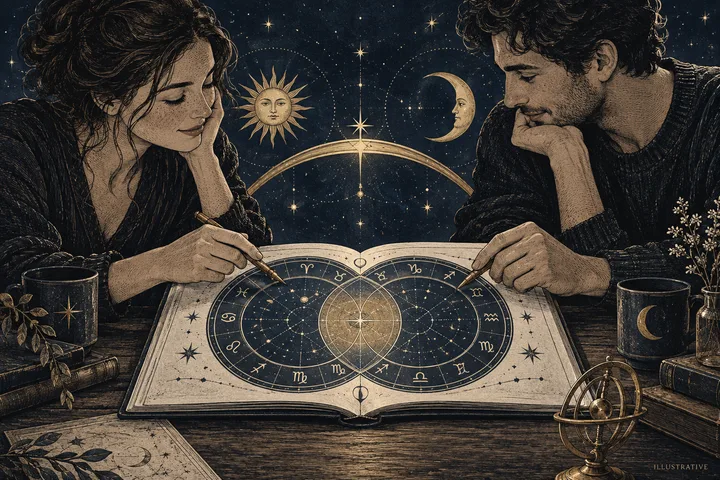
Share a synastry report as a joint reading, not a private verdict handed to the other person. Before you begin, choose one real question, list only the supplied placements and known degrees, and agree that both partners may challenge an interpretation. Then use four columns: chart fact, astrological meaning, lived example, and next experiment. Start with the layer that matches the question. Moon speaks to emotional habits, Venus to affection and values, and Mars to desire, initiative, and friction. Rank close, relevant contacts before broad or dramatic ones. A difficult aspect may describe a task. An easy one may describe a gift you have stopped noticing. Finish by choosing one small action you can test together. The report should change the quality of the conversation, not settle who is right.
Sources: Synastry: Venus-Mars Aspects Between Two Charts; Synastry: The Astrology of Relationships
Read the contact from both sides of the exchange
Now read the aspect as the verb in the sentence. The planets are the subjects. The aspect tells you whether they join, oppose, press, or support one another. This grammar gives the couple something precise to discuss: not 'who is difficult,' but 'how does this function meet that function when the question is alive?'
A conjunction concentrates two functions. It can feel immediate, familiar, or impossible to ignore. A Venus-Mars conjunction might join affection and desire so closely that attraction becomes a central language of the relationship. A Moon-Venus conjunction might make comfort and affection easy to recognize. The same closeness that creates ease can become a habit the couple stops tending.
An opposition sets up a polarity. The planets face each other across the zodiac, so each person may recognize the other's function as both compelling and inconvenient. Oppositions can create balance when the couple learns to move between the poles. They can also produce a ping-pong pattern, where one person expresses and the other counters. The answer is not to choose one side. It is to give each side a legitimate place.
A square creates friction between functions that don't blend automatically. The friction can irritate, but it can also force skill. A Moon-Mars square may ask for a better way to combine feeling and action. A Venus-Mars square may ask how attraction can stay lively without turning pursuit into pressure. Cafe Astrology describes squares as frustrating and demanding work, but also capable of producing excitement and growth when people learn to integrate the energies. That is the right tone for a shared reading: serious, specific, and still open to development.
Trines and sextiles usually make the exchange easier. A trine can show an instinctive fit, while a sextile may describe a resource the couple notices and appreciates when they use it. Ease is not the same as completion. A couple with an easy Moon-Venus contact may comfort each other without ever naming one difficult need. A couple with a hard Moon-Mars contact may argue often yet learn to say what they mean. Never rank a relationship by the aspect label alone.
Use a four-part note for every major contact. Record the chart fact. Translate the planet jobs. Write the strongest useful possibility. Then write the clearest pressure. For example: 'Your Mars squares my Moon. Action meets feeling. Your initiative can help us move. It can also make my pause feel unsafe.' The next line belongs to both partners: 'Which part belongs to our question, and what would we observe if it were active?'
This worksheet also gives both partners a clean way to disagree. One may mark the possibility as strong and the pressure as absent. The other may do the reverse. Keep both marks. The disagreement is information about the reading's range, and it tells you which part needs an ordinary example before you move on.
Be careful with the words good and bad. Flowing and difficult are more precise, but even those words need context. A trine may let two people avoid a subject because they recover quickly. A square may keep a needed subject visible until they learn to handle it. A conjunction may intensify a gift or a problem. The aspect describes the meeting. The sign, planet condition, maturity, and choices shape its expression.
If you need to rank several contacts, start with the contact closest to exact, then the contact most tied to your stated question, then the contact repeated by more than one layer. For example, a close Moon-Mars square that matches your recurring conflict deserves attention before a loose Venus-Mars contact that only sounds romantic. This isn't a mathematical score. It is a reading order that keeps drama from outranking relevance.
When two contacts compete, ask what kind of answer each one can give. A Moon-Mars contact may describe the moment a disagreement heats up. A Venus-Venus contact may describe why the same couple still enjoys making a home or sharing pleasures. Neither cancels the other. They belong to different questions. The first helps you choose a conflict ritual; the second helps you protect a source of goodwill while you do the harder work.
Also check whether the same planet appears in several contacts. If one person's Moon receives contacts from the other's Venus and Mars, don't treat those as three independent verdicts. Begin with the Moon's question, then ask how Venus colors care and how Mars colors pressure or movement. The repeated Moon is the shared doorway. It tells you where the reading is concentrated.
The sign tells you the style of the exchange, while the aspect tells you how the two functions meet. This report works with supplied Moon, Venus, and Mars signs and any supplied major aspects within its stated scope. It doesn't calculate houses or angles. If a separate full-chart reading later adds those layers, treat them as additional context, not a reason to rewrite the known placements as useless.
The reading is ready to move on when both people can finish the sentence from both sides. 'When my Venus wants reassurance, your Mars...' and 'When your Mars wants a clear response, my Venus...' If only one side can speak, the interpretation is still too blunt. Synastry is relational. The grammar has two subjects.
Sources: Synastry: The Astrology of Relationships; Synastry: The Astrology of Relationships
Test the symbolism against one ordinary scene
A first interpretation is a proposal. Give it one ordinary scene to answer to. Don't search the whole history of the relationship for confirmation. Choose a Tuesday night when one person asked for help, a Saturday when a plan changed, or the morning after an argument. Describe what happened in order, including the moment the exchange changed direction. Keep motives out at first.
Then compare the scene with the chart layer. If the report describes a Moon-Mars tension, did emotion and initiative actually collide? If it describes Venus steadiness, does affection appear through reliable action, or does one person experience the style as too indirect? If the report suggests an easy Moon-Venus flow, where does comfort come naturally? Where has that ease become invisible? The chart should sharpen the question, not replace the account.
Use three findings. A match means the symbol names the scene cleanly. A translation means it fits after you change the wording. A Venus contact may show a preferred way of giving affection rather than simple harmony. A mismatch means this contact isn't illuminating the question now. Keep it in the chart, but set that interpretation aside. Relevance outranks drama.
Cafe Astrology's synastry guidance treats difficult aspects as capable of creating tension and development, while harmonious aspects can support ease without guaranteeing movement. That gives you a strong way to handle evidence inside the astrological tradition. Ask what the contact makes possible, then ask how the two people have used or neglected that possibility. Don't turn a potential into an event that never happened.
Consider an example. A report calls Daniel's Venus-Mars square tense. Their lived pattern says something more exact. Daniel remembers what Maria likes and reaches for closeness quickly. Maria feels desired, but she also feels crowded whenever she needs a slower pace. The first interpretation was too blunt. The better reading is, 'Attraction is strong, but timing needs consent and room for preference.' That sentence can guide a change. 'You are too much' cannot.
Ask each partner to write three lines: 'This fits because...' 'This misses because...' and 'A better question would be...' Read them without interrupting. Then ask what the pattern gives and costs. A tense contact may demand patience while also giving candor or momentum. A flowing contact may offer warmth while becoming easy to neglect. Both sides belong in the reading.
Review the agreement once after a week, but don't turn the review into surveillance. Note one moment when it worked and one when it failed. Did the pause last too long? Did the request arrive too late? Those details improve the practice more than another search for a darker aspect.
The strongest exception belongs here. A difficult contact may be accurate and still not be the main issue. A close Moon-Mars aspect can describe a real pressure point, yet the couple may already handle it well. A wider Moon-Venus contact may look gentle, yet a current question about trust may matter more. Rank the chart against the question and the scene. Exactness helps. Relevance decides.
Sources: Synastry: The Astrology of Relationships; Aspects Between Charts, Cafe Astrology; Synastry: Venus-Mars Aspects Between Two Charts
Leave the reading with one decision to try
A shared reading should end somewhere concrete. Not with a label or a pile of highlighted paragraphs. End with one conversation that changes what you do next time the pattern appears.
Pick the contact that is relevant to the question, supported by the supplied information, and visible in a recent scene. Leave the rest for later. Seven half-read aspects create more heat than insight.
Use this sequence. First, describe the planet functions in plain language. 'My Moon needs time to settle. Your Mars wants movement.' Second, name the generous version of the contact. 'Your movement can help me leave a loop. My pause can help us avoid a rushed fight.' Third, name the strain without accusation. 'When you push before I settle, I hear pressure. When I disappear without a return time, you hear rejection.' Fourth, choose a small agreement.
The agreement should be visible. 'We will pause for twenty minutes and return at eight.' 'We will ask whether the other person wants comfort, action, or space.' 'We will not quote the report during an argument.' 'We will discuss money when neither of us is already defending a hurt.' A chart reading earns its place in a relationship when it helps two people do something they could not name before.
Choose an owner for the follow-through, too. Not a person to blame, but a shared cue: whoever notices the pattern names the agreement and both people return to it. A ritual works because it can be remembered in the heated moment, not because it sounds wise on paper.
Write the final note so either partner could read it later without feeling prosecuted. A useful record might say, 'Moon-Mars tension showed up around delayed replies. Maria needs a stated return time; Daniel needs confirmation that the conversation will continue. We will pause for twenty minutes, send the return time, and review the result Sunday.' Notice what the note does not say. It doesn't call Maria needy, Daniel aggressive, or the aspect bad. It preserves the pattern and the choice.
That record also protects the report from selective memory. If the experiment works, you can see which part helped. If it fails, you can change the agreement instead of announcing that the chart was wrong or that one partner is the problem. Astrology gives the pattern a symbolic language. The written experiment gives the couple a way to learn from its expression.
If the report contains a powerful Venus-Mars contact, ask how you want to care for attraction while respecting pace and consent. If it contains a Moon contact, ask what helps each person feel safe enough to stay present. If Venus is central, ask which acts of affection actually land. Use the planet's meaning to create a better question.
The Synastry Comparison Report works from known Moon, Venus, and Mars placements, with optional degrees, and reviews selected major contacts within a six-degree orb. It doesn't calculate a complete chart from birth details, so houses, angles, and a full natal synthesis remain outside this comparison. Mark those as future work rather than reading them into supplied data.
Ask: 'When this contact gets loud, what would help us express both planets with more choice?' You aren't trying to win against the chart. You're trying to recognize the pattern early enough to meet it differently.
If the conversation becomes circular, reduce it to one event and one request. 'Yesterday, when I asked for ten minutes, you followed me from the room.' That is clearer than, 'Your Mars always overwhelms my Moon.' Then add the request: 'Next time, please agree on a return time and let me take the ten minutes.' The chart may explain why the event has heat, but the request tells you what to do with that heat.
If one partner wants a symbolic answer and the other wants a practical answer, give them both. 'This contact links your need for action with my need for emotional settling.' Then translate it: 'We need a pause with a clear end.' The translation is the bridge.
Some couples will discover that the report isn't the right tool for the conversation they need. If the issue is a broken promise, discuss the promise. If the issue is consent, discuss consent. If the issue is fear, coercion, or a repeated refusal to respect a boundary, don't ask a chart to soften the fact. Astrology can reveal meaning and pattern. It should never be used to argue someone out of what they know happened.
The same rule applies to favorable language. If a report calls a contact supportive, ask what support looks like on an ordinary day. Does someone follow through, make room, tell the truth, or repair a missed moment? Warm symbolism becomes useful when it points to behavior you can recognize. Otherwise, praise can become another way to avoid the question the couple came to ask.
Start with Maria and Daniel's question, not their conclusion: 'When one of us needs calm and the other needs movement, how can we protect both?' Choose one answer to practice this week. That is enough.
Sources: Aspects Between Charts, Cafe Astrology; Synastry: The Astrology of Relationships
A little more clarity
What should we do if one partner feels blamed by the synastry report?
Pause the interpretation and return to the exact exchange. Remove character words such as cold, selfish, or controlling. Name the planet functions, ask what part fits, and let the affected partner say what misses. Then choose one practical question or agreement. A report can describe tension, but it shouldn't overrule lived experience or become evidence in an argument.
Should we read the whole synastry report in one sitting?
Usually, no. Choose one question and one or two contacts that speak to it. Read the Moon for emotional safety, Venus for affection and values, or Mars for initiative and desire. Compare the interpretation with one recent scene, then stop with a small agreement. A focused reading gives each symbol room to become useful.
Can a difficult synastry aspect be helpful?
Yes. A square or opposition can show friction, but friction can teach a couple how to translate different needs. The useful reading names both the possibility and the pressure. A Moon-Mars square, for example, may ask how one partner can take action without rushing the other's feelings. The aspect describes a task. It doesn't decide the outcome.
Sources & further reading
- Aspects Between Charts, Cafe Astrology
Supports the definition of interchart aspects, planet roles in an interaction, and the need to consider signs when reading a contact.
- Synastry: The Astrology of Relationships
Supports synastry as comparison of two horoscopes and the interpretive distinction between flowing contacts, friction, and potential development.
- Synastry: The Astrology of Relationships
Supports the working meanings of conjunctions, oppositions, trines, sextiles, squares, signs, and the need to interpret contacts in context.
- Aspects Between Charts, Cafe Astrology
Supports reading each planet as a role in the interaction and considering the sign style alongside the aspect.
- Synastry: Venus-Mars Aspects Between Two Charts
Supports Venus-Mars attraction, timing friction, and the practical need to handle conflict as part of the contact's expression.
Synastry Comparison Report
Enter known placements for two people. Get an input-by-input comparison, selected aspect calculations and a clear record of what remains uncertain.
Compare our placements