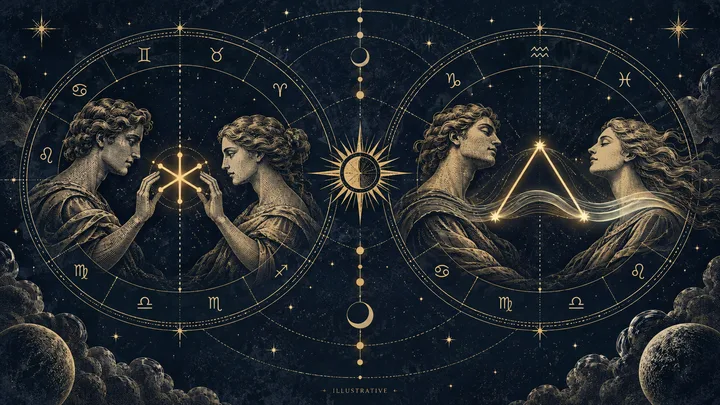
A sextile can require more conscious action than a trine because the two planets cooperate without speaking the same elemental language. A trine joins the same element, so its support often feels immediate and instinctive. A sextile joins compatible but different elements, such as earth and water or fire and air. The opening is there, but the people must recognize how to use it. In synastry, read the planet pair first, then the sign relationship, exact degree distance, and orb. A Venus sextile Mars may connect welcome with pursuit, but someone still has to make the invitation clear. A trine may let desire move more naturally. Neither aspect guarantees equal effort or a particular outcome. The useful distinction is simple: the trine describes a channel that may run on its own, while the sextile asks you to open it deliberately.
The real difference is potential versus instinctive flow
A sextile isn’t a weaker trine. That shortcut loses the interesting part. Both are harmonious aspects, and both can help two planetary functions cooperate in synastry. The difference is the kind of cooperation they offer, not a simple scale of good and bad.
A trine joins signs of the same element. Fire meets fire. Water meets water. The planets share a basic language, so the contact can feel familiar before either person has explained it. A sextile joins signs two places apart. Its signs can support each other, but they bring different materials. Earth and water can nourish one another. Fire and air can feed one another. Still, the exchange needs recognition.
That is why a sextile can ask for more conscious action. Its promise is there, but the two people may not reach it at the same moment or in the same style. The aspect needs a human verb: ask, invite, explain, or build.
This doesn’t mean every sextile feels effortful or every trine is obvious. A close sextile between personal planets can be lively. A wide trine can be quiet. Read the geometry, then let the planets and the wider chart decide how much weight it deserves.
Keep the shorthand, then move on to the chart: a trine tends to flow, while a sextile tends to invite.
Sources: The Meaning of the Aspects in Astrology; Aspect - Astrodienst Astrowiki; Synastry: Love and Relationship Astrology
Read the angle before you read the mood
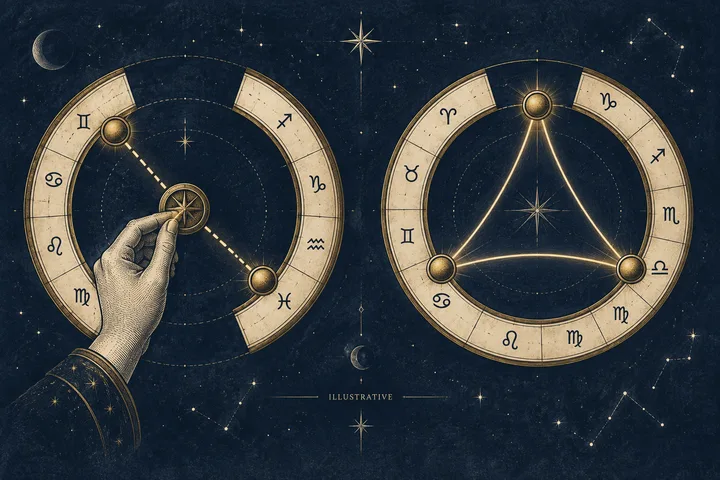
In synastry, an aspect is the angular relationship between a planet in one chart and a planet in the other. The sextile is 60 degrees. The trine is 120 degrees. Those numbers tell you what kind of relationship the two chart factors form before you attach a romantic story to it.
The trine divides the zodiac into three same-element groups. Aries, Leo, and Sagittarius belong to fire. Taurus, Virgo, and Capricorn belong to earth. Gemini, Libra, and Aquarius belong to air. Cancer, Scorpio, and Pisces belong to water. When two relationship planets meet through a trine, they often recognize a shared mode of expression.
The sextile connects signs such as Aries and Gemini, Taurus and Cancer, or Libra and Sagittarius. These pairs can cooperate, but they don’t mirror each other. One may bring initiative while the other brings ideas. One may offer steadiness while the other offers feeling. The aspect gives them a route between those functions. It doesn’t erase the distance.
That distance is useful. If Venus and Mars are sextile, affection and desire can meet without the pressure of a hard aspect. Yet the Venus person may show interest through welcome while the Mars person shows it through movement. The practical question is who will make the first signal legible.
Name a sign-based sextile honestly. Signs can describe a meaningful relationship, but they don’t tell you the exact angular distance. If degrees are available, measure the contact. If they aren’t, read the sign relationship as a broad layer and stop there.
Sources: Aspect - Astrodienst Astrowiki; Synastry: Love and Relationship Astrology; Aspects Between Charts
Conscious action means directing the two planetary functions
Astrologers often say that a sextile needs activation. That doesn’t mean constant work. It means the energies become useful when the people notice the connection and give it a form.
The form has to belong to the planets. Mercury sextile Moon may become a habit of asking whether the other person wants comfort, facts, or quiet. Venus sextile Mars may become a clear expression of attraction followed by a welcome response. Mars sextile Saturn may put desire inside a plan that can survive limits and patience.
The receiving person matters as much as the planet person. In a synastry contact, the person whose planet is involved often expresses that planet’s role in the interaction. But the roles can move, and both people still carry a full chart. Venus doesn’t make one partner passive. Mars doesn’t make the other partner responsible for initiating everything.
A sextile becomes readable when you can name the missing verb. Is it ask, invite, explain, schedule, encourage, or build? ‘Good compatibility’ is too blunt. ‘Translate affection into a clear invitation’ gives Venus-Mars a direction. ‘Turn an emotional impression into a question’ gives Moon-Mercury one.
Then look for reciprocity. A sextile describes capacity between chart factors. It doesn’t prove that both people will use it. If one person keeps creating every opening and the other never answers, the chart has shown an available channel, not a shared practice.
Sources: The Meaning of the Aspects in Astrology; Aspects Between Charts
The planet pair decides what the opening is for
The aspect tells you how the planets meet. The planets tell you what is meeting. That is where a geometry lesson becomes a synastry reading.
With Moon and Venus, the sextile may connect emotional safety with affection in different but compatible styles. One person notices atmosphere and timing. The other notices pleasure, beauty, or a graceful way to show care. The contact can be tender, but it may need a shared rhythm before both people recognize the same gesture as loving.
With Mercury and Mars, the opening is verbal and active. One person brings thought and language; the other brings speed, assertion, and heat. A sextile can help the conversation move when the pair gives disagreement a clear subject. A trine may make banter and response feel more automatic. The rest of the chart decides whether ease becomes clarity or merely fast talk.
With Venus and Mars, attraction is the obvious layer. Flowing aspects can make desire pleasant rather than combative, but the sextile may still require a visible bridge between receiving and pursuing. The Venus person may want a sign of welcome. The Mars person may need a direct opening. The contact supports attraction; it doesn’t set the pace or replace consent.
With Saturn involved, conscious action takes a different shade. Venus sextile Saturn may support steady affection, yet reserve can shape how warmth is shown. Mars sextile Saturn may help action become disciplined, but it can also make initiative slower. The same 60-degree angle cannot carry the same advice for every planet pair.
Rank the planetary function before you rank the aspect. A close contact that answers the couple’s question deserves attention before a looser contact that merely sounds flattering.

Sources: Synastry: Love and Relationship Astrology; Aspects Between Charts
Degrees and orb show how much priority the contact deserves
A sextile or trine is measured by degree distance, not by sign names alone. The exact sextile is 60 degrees. The exact trine is 120 degrees. An orb is the permitted distance from exactness. It gives you a consistent way to decide whether a reported contact belongs in the main reading.
For this placement comparison, use a six-degree working orb for selected major aspects. A contact at 61 degrees is one degree from exact. A contact at 65 degrees is five degrees from exact. Both fall within the rule, but the closer contact normally gets earlier attention when the planet pair and wider pattern are otherwise comparable.
Here is a clean worksheet. Suppose one supplied Venus is at 14 degrees Taurus and the other supplied Mars is at 16 degrees Cancer. The distance is 62 degrees, so the planets form a sextile with a two-degree orb. That is a measured contact. Taurus and Cancer describe its style, while Venus and Mars describe the functions involved.
Now change Mars to 25 degrees Cancer. Venus at 14 degrees Taurus is 44 degrees of zodiacal longitude, and Mars at 25 degrees Cancer is 115 degrees. Subtracting gives 71 degrees, so the contact is 11 degrees away from an exact sextile and falls outside the six-degree rule. Don’t call it a Venus-Mars sextile. The sign story may remain a broad layer, but it cannot outrank actual geometry.
The same caution applies to a trine. If the signs share an element but the supplied degrees are too far from 120 degrees for the working orb, describe the sign affinity without presenting it as a measured trine. A rounded placement can hide that difference.
This protects the ranking. A close sextile may deserve more attention than a wide trine, while a close trine may describe the chart’s most immediate resource. Use the aspect name to start. Let orb, planet pair, and repetition decide its place.
Sources: Aspect - Astrodienst Astrowiki; A Brief Introduction to Astrology: Aspects
The strongest exception is a sextile that never becomes mutual
The phrase ‘a sextile needs action’ can become too neat. A tight trine may be highly visible, especially when it involves a personal planet, an angle, or a repeated theme. A sextile can be exact and still remain quiet if the wider synastry offers no way for the people to recognize or return it.
Imagine a close Venus sextile Mars. The contact can describe a smooth route between affection and desire. But suppose the same comparison includes a difficult Moon-Mars contact that makes timing feel intrusive, or a Saturn pattern that brings fear and restraint to expression. The sextile hasn’t disappeared. Its use has become conditional. Attraction may need emotional pacing or a safer structure before it can be felt as ease.
The reverse is possible. A close trine can look effortless because the two people share a mode of expression, but that ease may become assumed. They may understand each other so quickly that they stop checking whether the old response still fits. A trine can need renewal, while a sextile can need a beginning. That is a difference in task, not a value ranking.
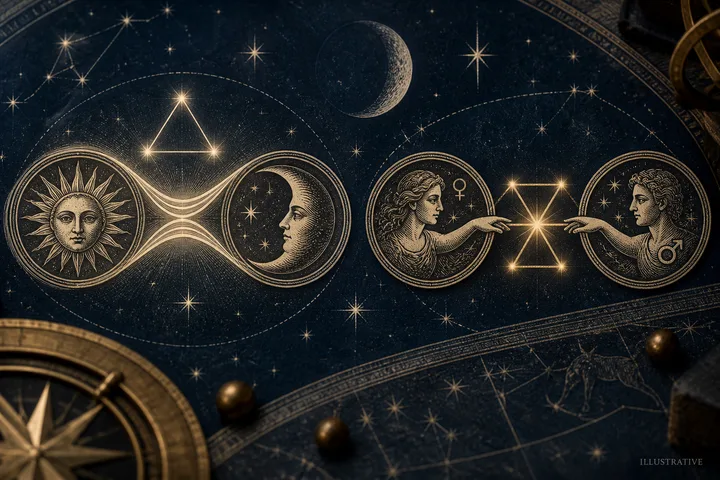
A sextile may also be easier to use when another contact supplies the missing translation. A Venus-Mars sextile can become more legible when Mercury contacts one of the planets. A Moon sextile Venus may find form through Saturn giving care a reliable container. The supporting aspect doesn’t cancel the sextile. It explains why the opening is easier to reach.
So don’t read the isolated aspect as a verdict. Read it as one channel in a network. Give priority to the contact that best answers the question, fits the degrees, and survives comparison with the wider pattern.
Sources: The Meaning of the Aspects in Astrology; Synastry: Love and Relationship Astrology; Aspects Between Charts
A seven-step method for reading the difference
When you have a reported sextile and trine in synastry, use this order. It keeps the interpretation specific and stops the word ‘easy’ from doing all the work.
First, write the two planets and the direction of the contact. Note whose planet is involved, but don’t turn that role into a permanent personality label. Second, verify the geometry. Is the distance close to 60 degrees or 120 degrees? Third, record the orb and apply the same six-degree working rule to the selected contacts.
Fourth, describe the signs. Ask what each sign contributes and where the two styles differ. Fifth, name the shared function in plain language: comfort, affection, desire, speech, planning, or encouragement. Sixth, identify the action that would direct the sextile or protect the trine from becoming invisible. Make it specific to the planets.
Seventh, test the pattern against the rest of the supplied comparison. Does another personal-planet contact change the timing? Does the same theme repeat? Are houses or angles actually available? If birth times or house cusps weren’t supplied, leave those layers out. A precise reading says what it can see.
For a placement comparison, record the planets, signs, degrees, and orb. Then choose one action that lets both functions participate. Watch whether the exchange becomes easier and more mutual. If it doesn’t, return to the wider pattern before asking one soft aspect to explain the whole bond.
Sources: Aspect - Astrodienst Astrowiki; Synastry: Love and Relationship Astrology; Aspects Between Charts
A little more clarity
Is a sextile better than a trine in synastry?
Neither is automatically better. A trine usually describes more instinctive flow, while a sextile describes harmonious potential that may need recognition and direction. Rank both by the planet pair, exact degree distance, orb, sign expression, and the wider synastry pattern. A close sextile can deserve more attention than a wide trine when it answers the couple’s actual question.
Can I read a sextile if I only know the signs?
You can read the sign relationship as a broad layer, but you can’t confirm the exact aspect or its orb without degrees. Call it sign-based rather than measured. Don’t claim that the contact is close, applying, or separating. Add exact degrees before ranking the sextile against other chart contacts.
What does it mean if a sextile feels inactive?
Look for the missing action and the missing response. The planets may describe a usable channel, but the couple still has to recognize it and meet it mutually. Then check the wider pattern. A difficult Moon, Mars, or Saturn contact may change timing or expression without erasing the sextile.
Sources & further reading
- The Meaning of the Aspects in Astrology
Supports the interpretive distinction between trines as natural and automatic and sextiles as conscious, directed potential.
- Aspect - Astrodienst Astrowiki
Supports aspect geometry, the 60-degree sextile, the 120-degree trine, and orb as deviation from exactness.
- Synastry: Love and Relationship Astrology
Supports interpreting flowing interchart contacts through specific planet pairs, including Venus-Mars, Venus-Moon, and Venus-Saturn.
- Aspects Between Charts
Supports assigning planetary roles in interchart contacts and considering each planet’s sign and house placement when available.
- A Brief Introduction to Astrology: Aspects
Supports harmonious sextile and trine meanings, angular definitions, and the need to state an orb consistently.
Synastry Comparison Report
Enter known placements for two people. Get an input-by-input comparison, selected aspect calculations and a clear record of what remains uncertain.
Compare our placements