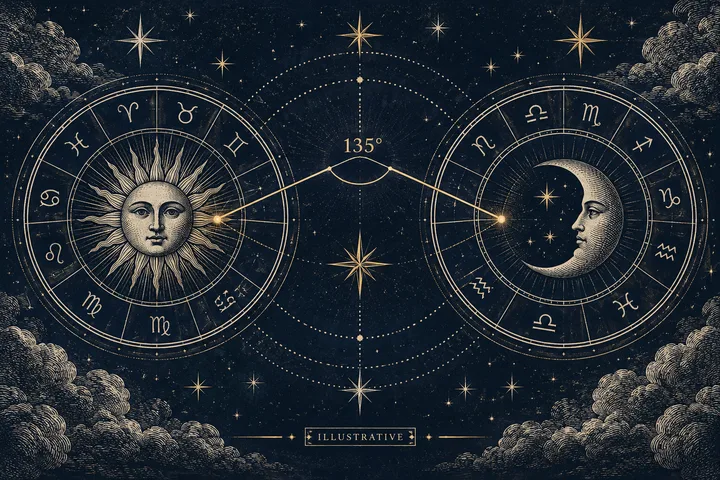
A sesquiquadrate can add a quieter, recurring adjustment theme between two planetary functions. Read it after the conjunction, opposition, square, trine, and sextile establish the main cross-chart picture. Keep it as a secondary note only when degrees verify the 135° contact, it fits a stated orb policy, and its planetary pair adds a distinct nuance. A close angle alone doesn’t make it central.
What does a sesquiquadrate add after the five major aspects?
A sesquiquadrate can add a quieter, recurring adjustment theme between two planetary functions. It belongs after the conjunction, opposition, square, trine, and sextile have established the main cross-chart picture. AstroGraph’s TimePassages guide calls the 135° contact a minor dynamic alignment marked by subtle tension, while Kerykeion’s guide describes a more persistent drive for refinement. Those are different shades of interpretation, not a report on what a particular couple will do. Read together, they suggest a useful secondary question: where might these two planetary functions call for repeated adjustment?
That question earns a place only when the contact is verified from degrees, its orb is judged under a stated rule, and its meaning adds something distinct. A close angle alone doesn’t make an aspect central. Nor does a vivid description prove that it fits your relationship. The test is threefold: does the contact meet the chosen orb, does the planetary pair point to a specific theme, and does that theme add information the major aspects haven’t already supplied? If the answer to any part is no, leave it out of the central reading.
The order matters. Horoscope Logic advises reading the major aspects for the chart’s main story, then the minor aspects for finer detail. Applied to synastry, that means summarizing the major contacts between the two charts before asking what a sesquiquadrate contributes. It may describe a subtler point of friction, or an ongoing adjustment that helps refine how two functions meet. But if a major contact already carries the same theme, adding another label can make the reading busier without making it clearer.
So treat the sesquiquadrate as a possible qualifier, not a verdict about either person or the relationship. First establish the main pattern. Then check the 135° contact and its distance from exact, and name the particular functions it joins. Keep it when it offers a close, distinct, useful nuance. Otherwise, the major aspects already have the floor.
Sources: Sesquiquadrate – 135°; The Sesquiquadrate Aspect (135°) - Learn Astrology; The Minor Aspects
What is the 135° contact, and how do you verify it?
A sesquiquadrate is a 135° angular relationship between two planets in different birth charts. In synastry, you compare one person’s planetary position with the other person’s, then measure the separation along the zodiac. The aspect is exact when that shorter separation is exactly 135°. If it is close but not exact, the difference is its orb. For example, a separation 1° away from 135° has a 1° orb. The name also appears as sesquisquare or sesquiquadrature. These are names for the same angle, not separate contacts.
Use the planets’ ecliptic longitudes, which are positions measured around the zodiac in degrees. The technical guide “Aspects: Geometry, Orbs, and Exact Timing” defines an aspect through this longitude difference and gives the sesquiquadrature as 135°. Its formula uses the shortest arc between the two positions. That detail matters because a raw subtraction can point the long way around the circle. When the absolute difference between the longitudes is 180° or less, that difference is the shorter arc. When it exceeds 180°, subtract it from 360° to get the shorter arc. Then compare the result with 135° and take the absolute difference to find the orb.
Here’s a math illustration, not a couple’s chart: if two hypothetical longitudes have a raw difference of 225°, the shorter separation is 360° minus 225°, or 135°. That makes the aspect exact, with a 0° orb. If the shorter separation were 134°, the contact would be 1° from exact. This example only shows the arithmetic; it assigns no real person a placement. The guide also notes that standard aspect geometry measures ecliptic longitude, rather than the planets’ full three-dimensional distance in the sky. For this reading method, longitude is the quantity being compared.
To verify the contact, you therefore need degree positions for both planets, not just their sign names. Each zodiac sign spans 30°, so a sign label gives a range rather than one precise longitude. Two planets in particular signs may be near the required angle, or far from it; the labels alone cannot settle the question. Philip Graves’s synastry text recommends recording each factor’s sign and degree, comparing the positions across the two charts, and keeping clear which planet belongs to which person. That gives you both the geometry and the attribution needed for a cross-chart aspect.
A chart or report that lists only signs leaves a proposed sesquiquadrate unconfirmed. Ask for the planetary degrees or a named cross-chart aspect with its orb, then check how the calculation handles the zodiac’s 0°/360° boundary. The angle itself is three 45° units, or 135°; its relationship to the semisquare’s 45° is useful context for the next interpretive step. First establish that the contact is there. Only then decide what, if anything, its symbolism contributes.
Sources: Aspects: Geometry, Orbs, and Exact Timing; Introduction to Relationship Astrology: Synastry
What can the 45° family add symbolically?
Astrologers often read a sesquiquadrate as a quieter kind of tension: less direct than a square, yet persistent enough to invite repeated adjustment. In synastry, it can suggest a point where two planetary functions need recalibration, but it cannot establish conflict between two people or tell you what either intends. The useful question is narrower: what might these functions ask each other to refine?
The geometry offers a clue to the symbolism. A sesquiquadrate spans 135 degrees, which can be understood as a square of 90 degrees joined to a semisquare of 45 degrees. Kerykeion’s technical guide places the sesquiquadrate and semisquare among aspects built from 45-degree divisions of the circle. In that family, the square is the more direct meeting with pressure; the semisquare adds friction, and the 135-degree relation carries both measures together. This framework doesn't dictate how a pair will experience the contact.
Astrological sources give the combined symbolism different emphases. AstroGraph’s “Sesquiquadrate – 135°” calls it a minor dynamic alignment marked by subtle tension. Kerykeion’s “The Sesquiquadrate Aspect (135°)” stresses a persistent drive for refinement, describing the square as more direct and the sesquiquadrate as a quieter call to adjust. Horoscope Logic’s “The Minor Aspects” places it among hard minor aspects and describes a low background irritation that prompts action. These accounts share ongoing pressure, but they don't give it one inevitable meaning.
That difference matters. “Friction” can fit when the planetary functions seem to pull against each other; “refinement” can fit when the same tension is treated as a prompt to adjust. Neither word reports what has happened in a particular relationship. They are symbolic possibilities to test against the planet pair, its degrees, and the larger synastry. A minor aspect stays minor even when its language feels vivid.
Consider Venus and Mars as an illustrative pair, not a calculated chart. Venus can represent relating, attraction, and what feels pleasing; Mars can represent assertion, desire, and how energy moves toward what one wants. A sesquiquadrate between them might suggest a recurring adjustment between affection and initiative: a question about how each function makes room for the other. That is a symbolic prompt, not a claim that one partner pursues and the other resists, or that either must change. Without the rest of the chart and the people’s own account, the image remains open.
A reader who sees this contact chiefly as friction need not adopt constructive refinement. That reading can stay on the table as a secondary hypothesis, not a verdict. The check is whether the rest of the chart gives the symbolism a distinct place. If major contacts already describe the same tension, the sesquiquadrate may add no useful detail. If it points to a different planetary pair, it may offer a more focused question to explore. The angle names a possible quality of exchange, not a guaranteed event.
Read the 45-degree family as a vocabulary for dynamic tension, not as a label for a troubled bond. The sesquiquadrate can shade a synastry reading with persistence, friction, or a call to refine how two functions meet. Let the planet pair and major pattern decide which interpretation earns attention, and leave both open when the chart doesn't make the distinction clear.
Sources: Sesquiquadrate – 135°; The Sesquiquadrate Aspect (135°) - Learn Astrology; Aspects: Geometry, Orbs, and Exact Timing; The Minor Aspects
How should it rank beside the five major aspects?
A useful synastry reading gives the five major aspects first say over the chart's main pattern. Then the sesquiquadrate can add a finer note. This order is a reading priority, not a claim that every major contact is stronger in every sense or that minor aspects never matter. It keeps the 135° contact in its proper role: a possible qualifier whose value depends on the planetary pair and on what the rest of the chart already says. The five major angles offer a broad first map. A conjunction at 0° brings two planetary functions together, though the planets determine whether that blend feels easy, charged, or demanding. An opposition at 180° sets functions across an axis, where attraction, contrast, or tension may become visible. A square at 90° marks friction and activation; it can call for adjustment without declaring incompatibility. A trine at 120° points to ease or natural flow, while a sextile at 60° suggests cooperative potential that may need attention to develop. These are conventional starting meanings, not fixed relationship outcomes. In “Synastry Aspects: Meanings & Compatibility,” SynastryCalc lists the five angles and stresses that conjunctions depend on the planets involved, squares can activate rather than condemn, and even easy flow does not remove the need to tend a connection. That range matters. If a reader sorts the major aspects into a simple good list and bad list, the smaller contact has no sound framework to refine. A square may describe a lively point of engagement; a trine can describe something that comes easily but needs no special effort to notice. The question is not whether 135° is secretly better or worse. It is whether this contact gives a precise second angle on a pattern already visible between the charts. Horoscope Logic’s “The Minor Aspects” recommends reading the majors for the main story and the minors for fine detail, warning that a pile of minor lines can bury the larger pattern. First summarize the close major contacts between the two charts in plain terms. Then name the two planets linked by the sesquiquadrate and ask what additional shade their functions could bring. Last, check whether that shade is genuinely new. If the major contacts already describe the same tension, the minor aspect may repeat the point rather than deepen it. The geometry supports this distinction in rank. “Aspects: Geometry, Orbs, and Exact Timing” by Kerykeion classifies conjunction, opposition, trine, square, and sextile as major, and lists the 135° sesquiquadrature among minor aspects. That technical classification tells you how the reference organizes aspects; it does not measure how a particular couple experiences them. So treat the sesquiquadrate as texture, not a verdict. It can remain in the reading when a close, verified contact adds a distinct recurring adjustment to the major pattern. If it only supplies another label for a theme already explained, leave it in the margins.
Sources: Synastry Aspects: Meanings & Compatibility; Aspects: Geometry, Orbs, and Exact Timing; The Minor Aspects
Which orb rule is fair to use?
There isn't one shared cutoff in the accessible sources. AstroGraph/TimePassages gives the sesquiquadrate an orb of 135° ±2°. Philip Graves's synastry text recommends a tighter 1.8° allowance for both the semisquare and sesquiquadrate. Horoscope Logic describes minor aspects generally as counting within a degree or two, while Kerykeion's technical guide explains fixed orbs by aspect and planet-based methods, and says software should let readers configure the model. For a deliberately selective reading, prioritize contacts within 1°, allow 1°–2° as secondary context, and identify that as your chosen policy. It is a practical editorial threshold, not a law of astrology. The sources differ partly because they answer different questions. AstroGraph/TimePassages presents an aspect-specific allowance for its sesquiquadrate listing. Graves sets out a synastry method: record each person's planetary sign and degree, measure cross-chart separations, and apply his own recommended allowances. His 1.8° limit is close to Horoscope Logic's general one-to-two-degree range. Kerykeion describes the broader technical choices behind orb assignment, including a fixed maximum for each aspect type or a pair-specific allowance based on the planets. That variation matters when you compare chart reports. One report may list a contact because it uses a two-degree sesquiquadrate allowance; another may omit it under a stricter setting. Kerykeion's account makes the source of another difference clear: a fixed aspect limit and an orb calculated from the two planets need not produce the same threshold. Check whether it names the aspect angle, gives the measured separation or orb, and explains its settings. Without those details, verify the listing. Consider three hypothetical orb values: 0.6°, 1.4°, and 2.2°. These are examples of distance from exactness, not positions from a real chart. Under the selective policy used here, 0.6° earns first attention because it lies within 1°. A 1.4° contact may be retained as secondary context, with the chosen wider allowance stated plainly. A 2.2° contact falls outside this article's central rule, though it falls within AstroGraph/TimePassages' stated ±2° only if the value is at most 2°; 2.2° exceeds that limit too. Apply the boundary as written; another astrologer may choose a different method. A narrower orb gives you a manageable first pass, but closeness doesn't settle importance. Graves explicitly warns that too many minor factors can obscure the larger picture and advises leaving out small influences unlikely to matter. Keep two judgments separate: how close is the contact to 135°, and does its planetary pair add a distinct point to the reading? A tight sesquiquadrate can repeat a major theme. A wider contact within your stated method remains secondary. Neither number tells you what either person intends or what the relationship will become. For consistency, choose the orb policy before interpreting the contact and use it across the charts you compare. Record the exact angle, measured orb, and whether your cutoff is fixed or varies by planet. That record makes later comparisons easier to follow. Then read the five major contacts and decide whether this minor aspect adds a useful, specific adjustment theme. If you use the selective rule here, treat under 1° as the priority band and 1°–2° as optional context. Leave wider contacts out of the central reading. The fair rule is the one you state, apply consistently, and keep in proportion to the rest of the chart.
Sources: Sesquiquadrate – 135°; Introduction to Relationship Astrology: Synastry; The Minor Aspects; Aspects: Geometry, Orbs, and Exact Timing
When does the sesquiquadrate add a pattern instead of repeating one?
Keep a sesquiquadrate when it gives a close planetary pair a useful adjustment theme that the major contacts have not already made clear. Set it aside when it only repeats an existing square or opposition, falls outside the orb rule you chose, or has no clear connection to the two planets involved. Exactness helps. Distinctness gives it a job. A simple test can keep the reading selective. First, name the two planetary functions. Then summarize what the major cross-chart contacts already emphasize. Next, state in one plain sentence what this 135° contact might add. Finally, ask whether that idea is genuinely new, and whether it clarifies the picture enough to keep as a secondary note. If you can describe the contact only as “more tension,” it may be adding a label rather than insight. Try naming the adjustment more narrowly: which planetary functions are being asked to adapt, and what part of the existing reading leaves that question open? If no clear answer emerges, the contact has not earned extra weight. The guide “The Minor Aspects” recommends reading major aspects first and using minor ones for finer detail; it also warns that too many minor contacts can bury the main pattern. Consider an illustration, not a calculated couple’s chart. Suppose a prominent cross-chart square already links two planetary functions, and the reader has described its tension. A sesquiquadrate involving that same pair might also be read as friction or adjustment. “The Sesquiquadrate Aspect (135°) - Learn Astrology” describes the contact as a persistent call to adjust, while “The Minor Aspects” calls it a low background irritation. Now imagine the verified sesquiquadrate links a different pair of planetary functions. It may prompt a narrower question, even if the chart already has a strong major pattern elsewhere. A reader could ask what kind of adjustment this second pair suggests, rather than treating it as another version of the first contact. Keep the two planets in view while testing that thread. The sesquiquadrate’s general symbolism cannot do all the interpretive work by itself. Kerykeion’s guide describes refinement and persistent adjustment, but those words need the planetary pair to become specific. Also ask whether the interpretation has room for more than one expression. A useful symbolic note should invite a question, not assign a behavior or motive to either person. Philip Graves’s “Introduction to Relationship Astrology: Synastry” stresses that linked chart factors may be experienced differently by each person. This supports naming whose planet is involved instead of claiming both feel it the same way. Use a final keep-or-drop check: Is the 135° contact verified? Is it close under the stated method? Can you name the planetary functions? Does the proposed adjustment add something beyond the major pattern? If yes, retain it provisionally and describe it as a secondary possibility. If not, leave it out. A shorter, clearer reading often serves the chart better than a longer list of minor aspects.
Sources: The Sesquiquadrate Aspect (135°) - Learn Astrology; The Minor Aspects; Introduction to Relationship Astrology: Synastry
How do the two planets and two people shape the reading?
The angle tells you how two planetary functions meet. The planets tell you what kind of themes are meeting. In synastry, that means you should name both chart owners before interpreting the contact: one person’s Venus with the other person’s Mars is not a single, blended “relationship planet.” The sesquiquadrate’s tension or refinement describes the style of the link. It doesn’t replace the meaning of the planets involved. Start with the pair. Venus is commonly read through affection, relating, and attraction; Mars through assertion, initiative, and pursuit. A Venus–Mars contact can therefore raise a question about how one person’s way of relating meets the other’s way of acting. If the cross-chart angle is a sesquiquadrate, you might explore whether that meeting calls for small adjustments. That is a symbolic prompt, not a claim that either person behaves in a particular way. The same angle between the Moon and Mercury would point to a different set of themes: emotional response and communication. The aspect’s geometry stays the same, but its interpretive subject changes with the planets. This order matters. If you begin with “hard aspect,” you can make the contact sound like a problem before you know what it connects. First identify each planet and its owner. Then name the functions in ordinary language. Only then consider whether the 135° relationship suggests friction, adjustment, or no useful additional theme. The five major aspects also connect specific planets, so this method keeps the minor contact in the same readable frame without giving it equal weight. Philip Graves’s synastry text offers a useful interpretive caution: the two people may experience an interaction differently, and the astrologer should distinguish the planet person from the person receiving that planet’s influence. That is one author’s method, not a rule that predicts how every pair will feel. Still, it gives you a sound question to ask of the symbolism: whose planet is being described, and from whose chart? Keep those roles visible in your notes. Don’t turn “Venus meets Mars” into “you both want the same thing,” or assign blame to one person from the aspect alone. Signs can add another layer after you have confirmed the degree-based contact. They describe the signs through which the two planetary functions express themselves, while the angle establishes the aspect. A sign-pair resemblance by itself cannot verify a sesquiquadrate. Nor do you need house overlays or birth times to confirm the 135° separation between supplied planetary degrees. Those details belong to other layers of a chart reading; they aren’t part of the placement comparison described here. So write the contact in a way that preserves its parts: “Person A’s Venus forms a sesquiquadrate to Person B’s Mars.” Then interpret the planetary pair, add the aspect’s secondary tone, and leave room for each person’s perspective. If that wording leads to a clear, relevant question, the contact may enrich the reading. If it forces a story about motives or behavior, leave that story out.
Sources: Introduction to Relationship Astrology: Synastry; Synastry Aspects: Meanings & Compatibility; The Sesquiquadrate Aspect (135°) - Learn Astrology
What would a restrained Venus–Mars reading look like?
Imagine a couple comparing known placements. Their chart notes show a close Venus–Mars sesquiquadrate, but this is an illustration, not a calculated chart or a claim about any real pair. Start with the symbols: Venus describes relating, attraction, and what feels pleasing; Mars describes assertion, pursuit, and how desire moves into action. A sesquiquadrate links those functions through a minor, dynamic angle. AstroGraph’s “The Sesquiquadrate Aspect” describes subtle tension, while Kerykeion’s “The Sesquiquadrate Aspect (135°)” also gives the contact a refinement or adjustment quality. Those are interpretive possibilities, not instructions to expect conflict. Now compare it with a major Venus–Mars contact, if one is present. The major aspect belongs in the first reading because it gives the clearest initial frame for how relating and initiative meet across the two charts. A conjunction, square, trine, opposition, or sextile would each shape that frame differently; none, by itself, guarantees a particular behavior or outcome. The sesquiquadrate can then ask a smaller question: is there a recurring point where affection and initiative need adjustment, beyond what the major contact already describes? That adjustment could concern timing. One person may prefer a slower approach to closeness while the other values a direct expression of interest. Or it could concern style: warmth may be offered through tenderness while desire is shown through decisive action. These are possible translations of the Venus and Mars symbols, not predictions about how either person acts. In the method described by Philip Graves’s synastry text, each person’s chart factors can be experienced differently, so keep track of whose Venus and whose Mars you are discussing. Don’t turn the contact into a single fused statement about “the couple.” The useful test is whether the question clarifies something. The couple might ask, “What helps each of us feel wanted, and how do we prefer to show it?” That invites both people to describe their experience. It doesn’t assign blame or tell either person to change. If their answers reveal a practical difference they want to understand, the symbol has offered a thoughtful prompt. Their conversation supplies the lived detail. The aspect offers a lens for inquiry; the people remain the authority on their experience. There’s also a sound reason to leave the contact out. If a major Venus–Mars aspect already captures the relevant theme, calling the sesquiquadrate another form of tension may only repeat the same point. If neither person recognizes a useful adjustment question, an elegant symbolic interpretation adds little. Keep the minor contact as a secondary note only when it is verified, close under the orb policy being used, and distinct enough to help the reading. Otherwise, let the major pattern stand on its own.
Sources: Sesquiquadrate – 135°; The Sesquiquadrate Aspect (135°) - Learn Astrology; Introduction to Relationship Astrology: Synastry
What should you do with the contact now?
Check the two planetary degrees, or use a report that names the cross-chart aspect. Record the separation and its distance from 135°: that distance is the orb. Apply one orb rule consistently. AstroGraph/TimePassages allows ±2° for a sesquiquadrate; Philip Graves's synastry method uses 1.8°. These are distinct approaches, so name your choice. With signs but no degrees, mark the contact unconfirmed and don't assign it meaning.
Read the conjunctions, oppositions, squares, trines, and sextiles before deciding what the minor contact adds. Keep the sesquiquadrate as a secondary note if it's verified, close under your rule, and points to a specific adjustment the major pattern doesn't already describe. State that contribution, then check whether a major contact covers the same point. If it's unconfirmed, too wide, or redundant, leave it out.
Ask whether the contact changes your interpretation. If removing it leaves the reading clear, it may be accurate but unnecessary. Keep it only if it names a distinct adjustment, with the orb and planet pair attached. The Synastry Comparison Report organizes supplied Moon, Venus, and Mars signs and optional degrees, and checks selected contacts within its stated scope. It doesn't calculate natal positions from birth details or predict relationship success. Compare the placements you have under one method. The chart can suggest a question; the people decide whether it fits.
Sources: Introduction to Relationship Astrology: Synastry; Sesquiquadrate – 135°
Sources & further reading
- Sesquiquadrate – 135°
Supports the 135° sesquiquadrate’s minor dynamic classification, its stated ±2° orb, and the source’s interpretation of subtle tension.
- The Sesquiquadrate Aspect (135°) - Learn Astrology
Supports the interpretation of the sesquiquadrate as persistent adjustment or refinement, while distinguishing it from the more direct square.
- The Minor Aspects
Supports reading major aspects first, using minor aspects for finer detail, and keeping minor contacts from obscuring the main pattern.
- Aspects: Geometry, Orbs, and Exact Timing
Supports the 135° sesquiquadrature classification, longitude-based aspect geometry, shortest-arc calculation, and configurable orb approaches.
- Synastry Aspects: Meanings & Compatibility
Supports the definition of cross-chart synastry aspects and the conventional five-major-aspect comparison framework.
- Introduction to Relationship Astrology: Synastry
Supports recording each chart’s planetary signs and degrees, applying a stated 1.8° sesquiquadrate allowance, and distinguishing each person’s perspective.
Synastry Comparison Report
Enter known placements for two people. Get an input-by-input comparison, selected aspect calculations and a clear record of what remains uncertain.
Compare our placements