A separating contact adds a history layer to synastry. Technically, the planets are moving away from exactness. In an established couple, that makes the contact useful for asking what the relationship has already learned, repeated, or left unresolved. The phase does not mean the bond is weaker, the attraction is over, or a breakup is coming. Start with the planet pair and orb, then check the aspect, signs, and repeated behavior. A close Moon, Venus, or Mars contact deserves more attention than the word separating alone. If degrees are missing, don't assign a phase. Use the contact as a practical prompt: what happens between you when this symbolism is activated, and what one agreement would make the old pattern kinder or clearer?
Separating describes direction, not a relationship ending
A separating aspect is moving away from exactness. An applying aspect is moving toward it. In traditional technique, the faster planet has already perfected the aspect and is leaving it. That is the technical distinction. It isn't a verdict about affection, durability, or emotional availability.
The distinction becomes less literal in synastry. A natal chart comparison places two birth charts together; it isn't one event chart unfolding through a single shared sky. Some reports still label an inter-chart contact applying or separating by using the planets' motion and the available chart data. Treat that label as an added interpretive layer, not as a dated account of what happened between two people.
For a couple with history, the useful question is simple: what has this contact already become in daily life? It may describe a familiar attraction, a practiced way to soothe one another, or a disagreement that starts before either person notices. Separating points you toward what has been carried forward. It doesn't tell you to stop caring about it.
Sources: An Introduction to Aspects and Chart Shaping in Natal Astrology; Application - Skyscript Glossary; Applying and Separating Aspects: Why Astrological Timing Has Direction
Rank the contact before you interpret its phase
The word separating cannot carry the reading by itself. Rank the evidence in this order: planet pair, exact aspect, orb, sign relationship, repeated themes, then phase. This order keeps a close personal-planet contact ahead of a wide aspect whose main feature is a technical label.
Orb is the distance from exactness. A conjunction is exact at zero degrees, a square at ninety, and a trine at one hundred twenty. For this publication's comparison report, selected major contacts use a six-degree orb. A one-degree separating contact is tighter than a five-degree contact, but neither number tells you what the planets mean without the rest of the comparison.
If the degrees are supplied, record the exact distance and the reported phase. If they aren't, stop at sign meaning. Sign affinity can suggest a style of exchange, but it cannot prove an aspect, its orb, or its direction. Precision is not a decoration. It tells you how far the interpretation is allowed to go.
Sources: An Introduction to Aspects and Chart Shaping in Natal Astrology; Application - Skyscript Glossary; Partner horoscopes - Astrodienst FAQ
Let the planets name the part of life with history
Planetary meaning comes before phase. The Moon describes emotional rhythm, familiarity, home life, and the needs that surface through routine. Venus describes attraction, pleasure, affection, and values. Mars describes desire, pursuit, physical energy, initiative, and conflict. These are interpretive starting points, not personality verdicts.
The direction of the contact matters too. Your Moon contacting your partner's Mars is not the same sentence as your Mars contacting your partner's Moon. The Moon person may feel the other's action in an immediate, bodily way. The Mars person may experience the Moon as a signal that calls for movement, protection, or response. Both people belong in the reading.
Then add the aspect. A trine may make the exchange easy to repeat. A square may keep asking for adjustment. An opposition can create a strong pull between two needs. A conjunction can fuse the functions so closely that the couple has trouble separating attraction from irritation, or comfort from action. Separating tells you to ask what this exchange has already taught the couple to do.
Sources: Synastry - Astrodienst Astrowiki; The Planets - Celestial Organs and Their Functions; The Moon; Astrology and Sex: What the Horoscope Reveals About Our Actual Needs
A close Moon-Mars contact can become a practiced reflex
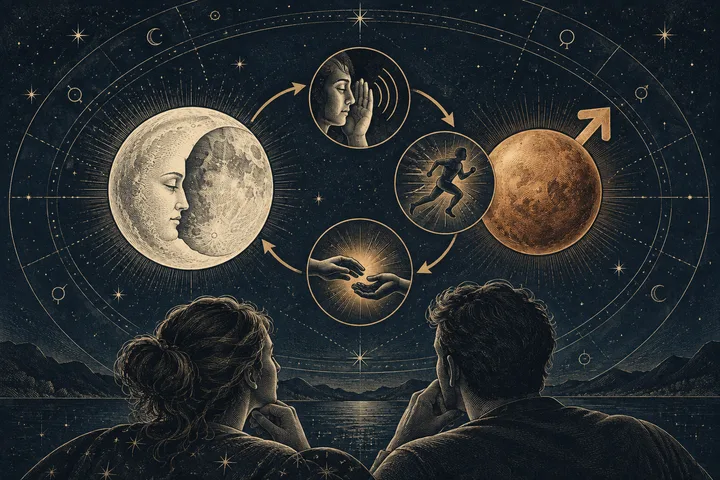
Consider an example. Maria has the Moon and Leon has Mars in a close separating conjunction in their comparison. Maria's feelings may trigger Leon's instinct to act. Leon's quick action may make Maria feel protected, rushed, or both. Early in the relationship, the contact might have felt thrilling because emotion and movement arrived together.
After years together, the same contact can become a reflex. Maria begins to speak about a hard day. Leon starts solving the problem before she finishes. She hears pressure where he intends care. He hears rejection where she is asking for room. The separating phase doesn't create this exchange, but it helps frame it as an established track rather than a brand-new discovery.
The useful reading is observable: when one person expresses the Moon, what does the other person do with Mars? Does action follow listening? Does a pause protect the bond, or does it become withdrawal? The contact is doing its work when it helps the couple catch the first move and choose what comes next.
Sources: Synastry - Astrodienst Astrowiki; The Moon; Astrology and Sex: What the Horoscope Reveals About Our Actual Needs
Use the history layer to find the gift and the cost
A long-standing contact usually has two sides. It has helped the couple get through something, and it may now be costing them something. A separating Moon-Venus contact can show care that feels instinctive: remembering a small preference, creating a calm home, or offering affection in a form the other person recognizes. The cost appears when familiar care becomes an assumption and nobody asks whether the old gesture still lands.
A separating Venus-Mars contact can keep attraction vivid, but it can also make the same directness show up as pressure during conflict. A Venus-Saturn contact may turn affection into reliability, though it can feel spare if duty replaces warmth. Read the planet pair as a field of possible experience, then check what the couple actually repeats.
Ask two questions. What has this contact made easier between you? What has it made automatic? The first question protects the gift. The second keeps history from becoming an excuse.
Sources: Synastry - Astrodienst Astrowiki; The Planets - Celestial Organs and Their Functions; Astrology and Sex: What the Horoscope Reveals About Our Actual Needs
Read the signs as the style of the old pattern
The aspect gives the geometry. The signs describe how the planets carry it. Fire may reach for movement and direct expression. Earth may ask for proof, steadiness, and a workable form. Air may seek words, space, and perspective. Water may need trust, feeling, and emotional presence. These are broad sign functions, so use them to sharpen a pattern you can observe, not to replace the degrees.
Modality adds pace. Cardinal placements may start the exchange. Fixed placements may hold it in place. Mutable placements may adapt, redirect, or keep changing the terms. A separating square between fixed placements may describe a disagreement that survives because neither person wants to move first. A mutable contact may describe a couple that keeps adjusting without naming the original problem.
Keep the layers separate. Don't let a harmonious sign relationship erase a tense aspect, and don't let a separating label erase a close degree. The strongest sentence names all three: the angle, the style, and the history the couple can recognize.
Sources: An Introduction to Aspects and Chart Shaping in Natal Astrology; Synastry - Astrodienst Astrowiki
The strongest exception is a contact that stays immediate
Separating does not always feel settled. A very close contact involving a personal planet can stay vivid, especially when another contact repeats the same theme or current circumstances keep activating it. Phase is a ranking clue. It is not a volume control.
A separating Mars-Venus conjunction may remain unmistakably magnetic. A Moon-Mars square may keep producing quick reactions during a stressful season. A Venus-Saturn contact may feel urgent when money, commitment, or responsibility is under review. In each case, the present situation gives an old contact new pressure.
This is where a careful reader checks the whole comparison. Look for the closest major personal-planet contact. Look for another aspect that supports or repeats its subject. Then ask whether the current behavior matches. If the chart says established pattern but life says immediate crisis, don't choose one sentence and discard the other. The old pattern may be exactly what the crisis has stirred.
Sources: An Introduction to Aspects and Chart Shaping in Natal Astrology; Partner horoscopes - Astrodienst FAQ; Synastry - Astrodienst Astrowiki
Turn one established reflex into a clear agreement
A separating contact becomes useful when it leads to a specific choice. Write down the planet pair, aspect, orb, sign relationship, and reported phase. Then describe three recent moments without astrological language. What happened first? What did each person do next? How did the exchange end?
Return to the Moon-Mars example. Maria can say, “I need listening or help.” Leon can ask before offering a solution. If either person needs a pause, they can name when they will return to the conversation. That agreement doesn't remove the conjunction. It gives its instinctive energy a better route.
Use the same method for Venus or Mars. If the issue is affection, name the gesture that counts. If it is desire, name the pace and the boundary. If it is conflict, name the first move that stops escalation. “Be more understanding” is too vague. “Ask before fixing” can be practiced and reviewed.
Know what a placement-only comparison can support
This report uses placements you supply. With Moon, Venus, and Mars signs plus optional degrees, it can compare those functions and identify selected major contacts within a stated six-degree orb. It can discuss a reported applying or separating label when the source report supplies one. It cannot calculate a natal chart from birth details, calculate houses, or turn an aspect into a relationship score.
When a birth time or degree is missing, narrow the claim. You can discuss the known sign relationship. You cannot invent a close aspect, a house overlay, or a phase. If a chart wheel and aspect table disagree, check the numerical table and the calculator's orb settings before interpreting the picture.
That limit improves the reading. It tells you which sentence rests on supplied geometry and which sentence is an interpretive question for the couple. A separating contact matters when the data is clear enough to rank and the lived pattern is clear enough to recognize.
Sources: Partner horoscopes - Astrodienst FAQ; Applying and Separating Aspects: Why Astrological Timing Has Direction; Synastry - Astrodienst Astrowiki
Make the next step smaller than the interpretation
Don't leave an established couple with a pile of symbols. Choose the closest supported contact. Name its gift. Name its cost. Then choose one practice for the next two weeks. The practice might be a question asked before advice, a return time after a pause, a weekly check on affection, or a clear limit around conflict.
At the review point, ask whether the first move changed. Did the couple notice the pattern sooner? Did the repair arrive faster? Did one person feel more heard, wanted, or free? If yes, keep the practice. If not, revise it. The separating contact has shown the groove. Daily life tells you whether the new route works.
That is what a separating contact adds after shared history. It doesn't declare the relationship finished. It gives a name to what the couple has already carried, so the two people can decide what deserves renewal, what needs a boundary, and what should finally be left behind.
A little more clarity
Is a separating synastry aspect weaker than an applying aspect?
Traditional astrology gives an applying aspect forward motion, while a separating aspect describes a contact moving away from exactness. In synastry, that doesn't mean important versus unimportant. Rank the phase with the planet pair, aspect, orb, signs, repeated themes, and lived behavior. A close separating Moon, Venus, or Mars contact may describe the strongest established pattern in the relationship.
Can a separating synastry aspect tell you when something happened?
Not by itself. A separating label can add a history emphasis, but it doesn't supply a dated event. In a two-chart comparison, applying and separating are already less straightforward than in a single chart with moving planets. Use the contact to ask what the couple encountered early or has repeated since. A dated timing question needs an appropriate chart and actual planetary data.
What should I check first when degrees are available?
Check the planet pair, exact angle, orb, and reported phase. Then read the signs and look for another contact that repeats the same subject. This comparison report uses a six-degree orb for selected major contacts. A closer contact usually ranks earlier, but the couple's repeated behavior decides whether the symbol is alive, settled, or no longer central.
Sources & further reading
- An Introduction to Aspects and Chart Shaping in Natal Astrology
Supports aspect geometry, major aspect types, orb, exactness, applying and separating motion, and dissociate signs.
- Application - Skyscript Glossary
Supports the faster planet's role in application and the need to account for retrograde motion.
- Partner horoscopes - Astrodienst FAQ
Supports the distinction between a synastry comparison, an aspect table, and the narrower orb used in chart drawings.
- Applying and Separating Aspects: Why Astrological Timing Has Direction
Supports the interpretive caution that applying and separating labels are less direct across two natal charts.
- Synastry - Astrodienst Astrowiki
Supports synastry as a comparison of horoscopes and the role of personal-planet contacts in relationship interpretation.
- The Planets - Celestial Organs and Their Functions
Supports the planetary symbolism of the Moon as forming and nourishing experience and Mars as action and mobilization.
- The Moon
Supports the Moon's relationship meanings around emotional habit, home life, familiarity, and daily compatibility.
- Astrology and Sex: What the Horoscope Reveals About Our Actual Needs
Supports Venus as attraction, bonding, values, and pleasure and Mars as libido, pursuit, and physical action.
Synastry Comparison Report
Enter known placements for two people. Get an input-by-input comparison, selected aspect calculations and a clear record of what remains uncertain.
Compare our placements